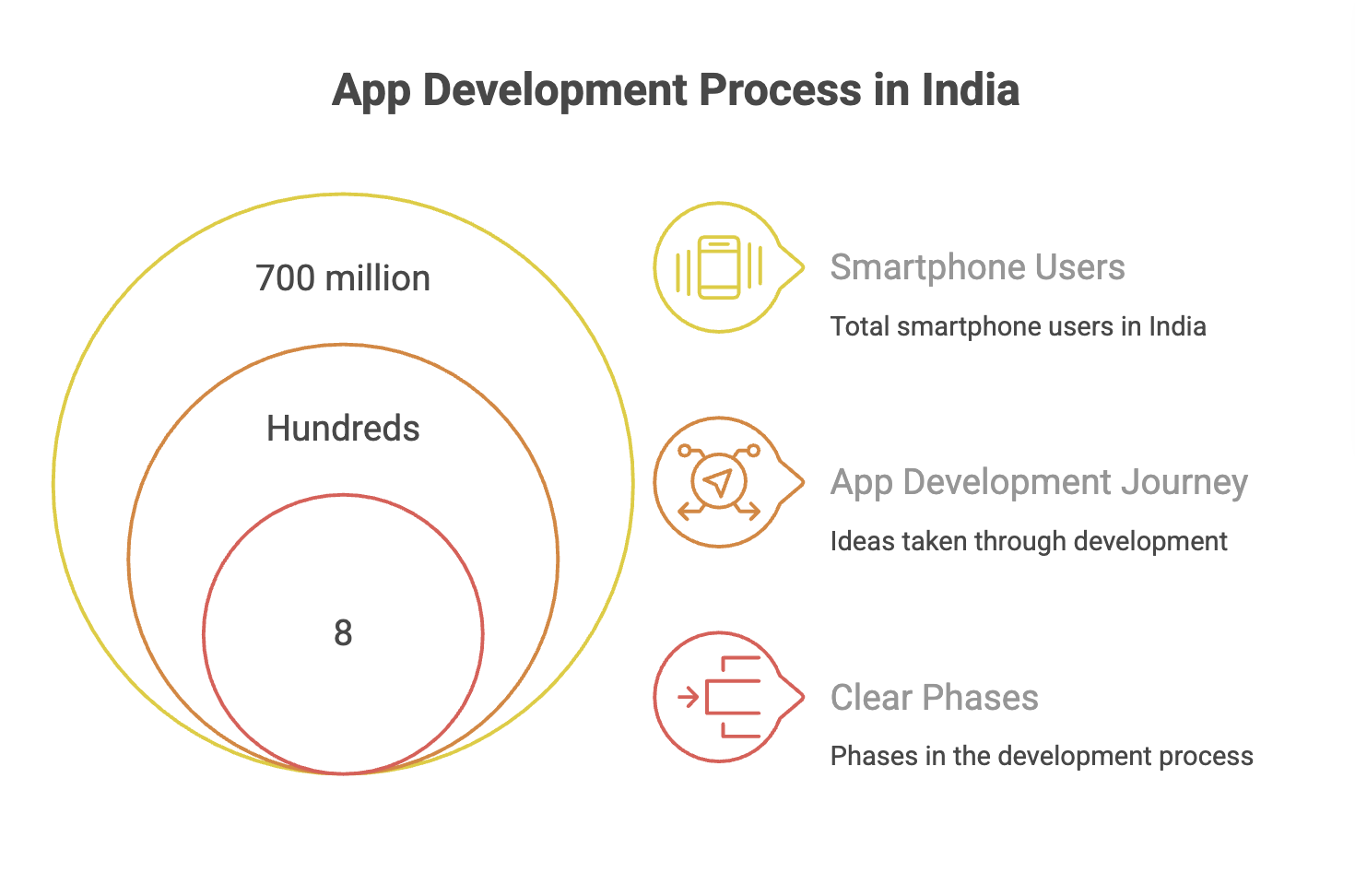
The app development process India has transformed the way businesses go digital. With over 700 million smartphone users and a startup ecosystem that rivals Silicon Valley, understanding the app development process step by step is no longer optional — it’s essential for every founder, product manager, and business owner ready to compete in the digital economy.
At Noukha Technologies, we’ve taken hundreds of ideas through the complete app development journey — from a founder’s first sketch on a napkin to a live product on the App Store and Google Play. This guide is everything we know, laid out in 8 clear phases. Whether you’re searching for how to develop a mobile app step by step, or you want to understand the full app development process in India before hiring a team, this is your reference guide.
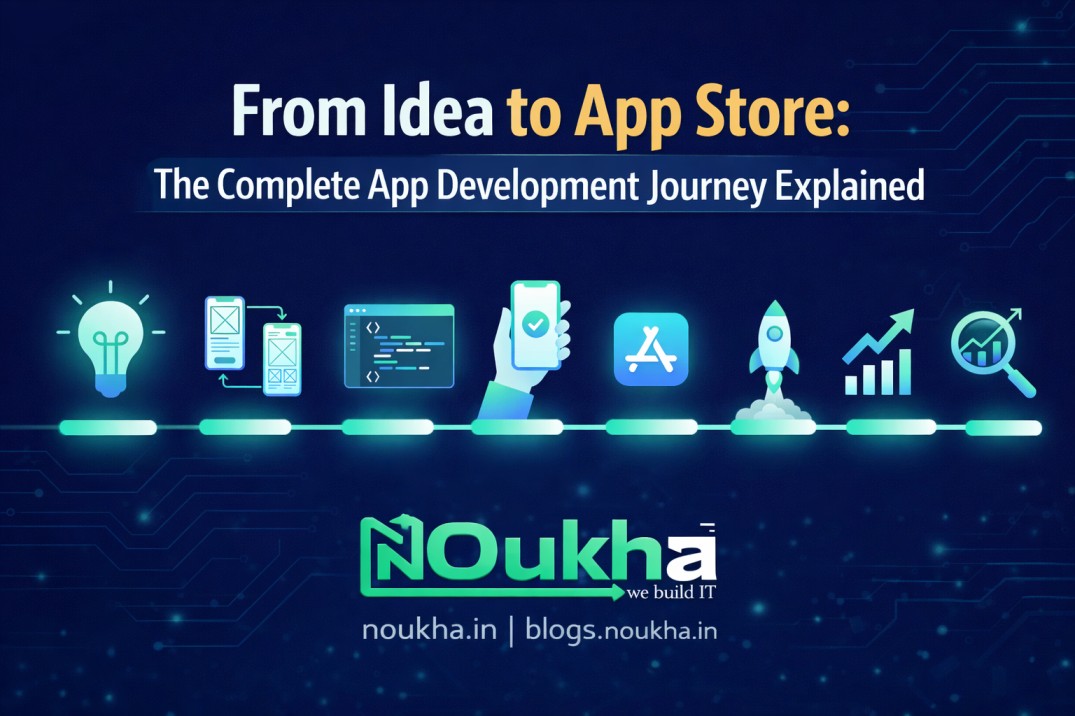
The 8-Phase App Development Journey at a Glance
| Phase | Name | Timeline | Cost % |
|---|---|---|---|
| 01 | Discovery | 1–2 weeks | 5–8% |
| 02 | Strategy | 1–2 weeks | 5–7% |
| 03 | Design | 3–5 weeks | 15–20% |
| 04 | Development | 8–16 weeks | 40–50% |
| 05 | Quality Assurance | 2–4 weeks | 10–15% |
| 06 | App Store Submission | 1–2 weeks | 3–5% |
| 07 | Launch | 2–4 weeks | 8–12% |
| 08 | Growth | Ongoing | Ongoing |
Phase 1: Discovery — Validating Your Idea Before Writing a Line of Code
Timeline: 1–2 weeks | Cost Contribution: 5–8% of total budget
The most expensive mistake in app development is building the wrong thing. Discovery is the antidote.
What Happens in Discovery:
- Idea Validation: We stress-test your concept. Is there genuine demand? Who are your competitors? What is your unfair advantage?
- Market Research: We study app store data, user forums, competitor reviews, and industry reports to map the landscape.
- User Persona Development: We define exactly who will use your app — their demographics, frustrations, and goals.
- Business Requirements Document (BRD): Every stakeholder’s expectation gets documented in a single source of truth.
- Feasibility Analysis: Technical, financial, and timeline feasibility are evaluated honestly.
What Can Go Wrong:
Skipping discovery is the number-one reason apps fail post-launch. Teams get excited about the solution before they’ve confirmed the problem exists. The result? A technically sound app that no one downloads.
Noukha’s Approach:
We conduct facilitated discovery workshops with your team, combining structured interviews with competitive intelligence tools. Every engagement begins with a written discovery report — no vague verbal agreements. If the idea needs pivoting, we say so early, saving you months of wasted budget.
Phase 2: Strategy — Building the Blueprint
Timeline: 1–2 weeks | Cost Contribution: 5–7% of total budget
With your idea validated, it’s time to make critical decisions that will shape every subsequent phase. Strategy is about making choices early so you don’t pay for them later.
Key Strategic Decisions:
- Platform Choice: iOS first, Android first, or cross-platform (React Native / Flutter)? This decision affects timeline, cost, and your target audience’s demographics.
- Tech Stack Selection: Backend (Node.js, Python, Ruby on Rails), database (PostgreSQL, MongoDB, Firebase), cloud provider (AWS, GCP, Azure).
- MVP Scope Definition: What is the minimum feature set that delivers real value? What gets deferred to version 2?
- Budget Planning: Realistic cost modeling broken into design, development, QA, launch, and post-launch phases.
- Timeline & Milestone Setting: Agile sprint structure, release milestones, and stakeholder review checkpoints.
- Monetization Strategy: Freemium, subscription, one-time purchase, in-app purchases, or ads?
What Can Go Wrong:
The most common strategy mistake is over-scoping the MVP. Founders want every feature in version 1. The result is a bloated first release that’s late, over-budget, and confusing to users. The second most common mistake: choosing a tech stack based on what the team knows rather than what the product needs.
Noukha’s Approach:
We present a technology recommendation with clear rationale — not just “what we prefer.” Our strategy deliverable is a Product Requirements Document (PRD) that serves as the contract between your business vision and our engineering team. We use React Native for most cross-platform builds, and have deep expertise in Flutter for performance-critical applications.
Phase 3: Design — From Concept to Clickable Prototype
Timeline: 3–5 weeks | Cost Contribution: 15–20% of total budget
Design is where your app becomes real for the first time — without a single line of code. Great design reduces development cost because developers spend less time re-building screens that didn’t test well.
The Design Process in 4 Steps:
- UX Research & User Flows: We map every user journey — registration, core actions, edge cases, and error states. Nothing is assumed.
- Wireframing: Low-fidelity grey-box layouts for every screen. This is where structural decisions (navigation patterns, information hierarchy) are made quickly and cheaply.
- UI Design: High-fidelity screens with your brand language — colors, typography, iconography, animations. We follow Apple Human Interface Guidelines and Google Material Design principles.
- Interactive Prototype: A clickable prototype built in Figma lets you experience the app before development begins. We use this for stakeholder reviews and early user testing.
What Can Go Wrong:
“Design by committee” kills great products. When every stakeholder has equal veto power over design decisions, apps become cluttered and inconsistent. Another pitfall: skipping the wireframe stage and jumping straight to visual design — it looks faster but generates expensive rework cycles when the structure doesn’t work.
Noukha’s Approach:
Our design process is collaborative but structured. You get two rounds of revisions at each stage — wireframes and UI. We conduct accessibility audits on all designs, ensuring WCAG 2.1 compliance from the start. Every screen is delivered with developer-ready design specs and assets. Handoff happens through Figma with auto-generated measurements, making development faster and more accurate.
Phase 4: Development — Building the Machine
Timeline: 8–16 weeks | Cost Contribution: 40–50% of total budget
Development is the longest, most complex phase — and where most projects go off-track. A structured agile process is the difference between a successful launch and a death-march project.
The Development Sequence:
- Sprint Planning: Work is organized into 2-week sprints. Each sprint has a defined goal, user stories, and acceptance criteria. Stakeholders see working software every fortnight.
- Backend Development: APIs, databases, authentication systems, and third-party integrations (payment gateways, SMS, push notifications) are built first.
- Frontend Development: Mobile screens are built to match the approved designs. Pixel-perfect implementation matters — poor frontend quality is the first thing users notice.
- Integration: Frontend and backend are connected. APIs are tested in a staging environment before moving forward.
- Continuous Testing: Developers write unit tests throughout. QA begins parallel testing from Sprint 3 onwards — not at the end.
- Code Reviews: Every pull request is reviewed by a senior developer. This is non-negotiable at Noukha.
What Can Go Wrong:
Scope creep is the silent budget-killer. Mid-project feature additions can add weeks and tens of thousands of rupees if not managed through a formal change control process. Technical debt is another danger — teams that prioritize speed over code quality create systems that become exponentially expensive to maintain after launch.
Noukha’s Approach:
We use Jira for project tracking with full client visibility. Every sprint ends with a demo call where you see working features. Our developers follow a Clean Architecture approach — the code you own after delivery is maintainable, documented, and ready for any developer to pick up. Change requests are scoped, estimated, and approved before development begins.
Phase 5: Quality Assurance — Testing Everything That Can Break
Timeline: 2–4 weeks | Cost Contribution: 10–15% of total budget
A bad review on the App Store is nearly impossible to overcome. Users are merciless about crashes, slow load times, and security failures. QA is the insurance policy that protects your launch.
The 4 Layers of QA Testing:
- Functional Testing: Every feature is tested against its acceptance criteria. Does it do what it’s supposed to do?
- Performance Testing: Load tests simulate real-world traffic. We test how the app behaves with 100 concurrent users, 1,000, and 10,000.
- Security Testing: We check for OWASP Top 10 mobile vulnerabilities — SQL injection, insecure data storage, authentication bypass, and more.
- Device & OS Testing: Real device testing across the most popular iPhone and Android models in the Indian market. Emulators alone are not sufficient.
What Can Go Wrong:
Treating QA as a final-phase checkbox rather than a continuous process. When testing happens only at the end, bugs found late cost 6x more to fix than bugs caught in development. Inadequate device coverage is another common failure — an app that looks perfect on a Samsung Galaxy S24 may be broken on a Redmi Note popular in Tier 2 Indian cities.
Noukha’s Approach:
We begin QA testing from Sprint 3 and run a dedicated regression cycle before submission. Our QA reports are shared with clients in real-time via a shared bug tracker. We use both manual testing and automated test suites (Appium, Detox) for regression. Security testing is conducted by a dedicated security engineer — not the same team that built the feature.
Phase 6: App Store Submission — Getting Past the Gatekeepers
Timeline: 1–2 weeks | Cost Contribution: 3–5% of total budget
App store rejection at launch is a nightmare scenario — especially if marketing campaigns are already running. This phase requires meticulous attention to platform-specific guidelines.
App Store Checklist:
- Apple App Store: App Review Guidelines compliance, App Privacy nutrition label, screenshots for all required device sizes (iPhone, iPad if applicable), app preview video.
- Google Play Store: Content rating questionnaire, data safety section, target API level requirements, signed release APK/AAB.
- ASO (App Store Optimization): Keyword-optimized title, subtitle, and description. Research-backed keyword selection for Indian market search behavior.
- Visual Assets: App icon (multiple resolutions), feature graphic for Play Store, localized screenshots with compelling captions.
- Privacy Policy & Terms: Required by both stores. Must accurately reflect your data practices.
What Can Go Wrong:
Apple rejects approximately 40% of first submissions for guideline violations. Common reasons include: privacy policy missing or incorrect, in-app purchase flows violating guidelines, content that violates regional regulations, or using private APIs. Google rejections are often related to the data safety section inaccuracies or policy violations around user-generated content.
Noukha’s Approach:
We maintain an internal submission checklist updated with every guideline change from Apple and Google. We complete ASO research using tools like AppFollow and Sensor Tower to identify high-volume, low-competition keywords. Our average first-submission approval rate is over 90% on both platforms.
Phase 7: Launch — Making Your App’s Debut Count
Timeline: 2–4 weeks | Cost Contribution: 8–12% of total budget
A great app with a poor launch is a tree falling in an empty forest. Launch strategy is not an afterthought — it should be planned from Phase 2 onwards and executed with precision.
Launch Strategy Components:
- Beta Testing Program: Recruit 50–200 real users 3–4 weeks before launch via TestFlight (iOS) or Google Play Internal Testing. Their feedback surfaces last-mile issues that QA misses.
- Press & PR: Prepare a press kit — app overview, founder story, screenshots, and unique value proposition. Reach out to Indian tech media (YourStory, TechCrunch India, Inc42) 2 weeks pre-launch.
- Social Media Warm-Up: Build anticipation across LinkedIn, Instagram, and Twitter/X with teaser content, countdown posts, and behind-the-scenes stories.
- Launch Day Blitz: Coordinate a Product Hunt launch, Reddit posts in relevant communities, email campaigns to waitlists, and influencer outreach simultaneously.
- Paid Acquisition: Launch a small performance marketing campaign (Meta Ads or Google App Campaigns) with a defined Cost Per Install target.
- App Store Rating Strategy: Prompt happy users for a review at the right moment in their user journey — never immediately after download.
What Can Go Wrong:
Server infrastructure not scaled for launch-day traffic spikes. Launching during a major competing event (big cricket match, national holiday) that steals attention. Having a marketing-ready launch plan but forgetting to enable your support channels — app users who encounter bugs and can’t reach anyone become the most vocal negative reviewers.
Noukha’s Approach:
We build a Launch Readiness Checklist 4 weeks before go-live: infrastructure stress-tested, monitoring dashboards live, support channels configured, rollback plan documented. We run a 24-hour launch day war room where engineering and product are on standby.
Phase 8: Growth — The Journey Doesn’t End at Launch
Timeline: Ongoing | Cost Contribution: Ongoing (typically 15–25% of original build cost per year)
The app is live. Users are downloading. Now the real work begins. The most successful apps in India — Zepto, CRED, Meesho — didn’t become successes at launch. They iterated their way there.
The Growth Engine:
- Analytics & KPI Tracking: Integrate Firebase Analytics, Mixpanel, or Amplitude. Track DAU/MAU, session length, feature adoption, funnel completion rates, and churn.
- User Feedback Loops: In-app feedback widgets, app store review monitoring, and periodic user interviews keep you connected to what’s actually frustrating your users.
- Regular Update Cadence: The best apps release meaningful updates every 4–6 weeks. Each update is an opportunity to improve store ratings and re-engage lapsed users.
- Performance Monitoring: Tools like Sentry and Firebase Crashlytics catch production crashes in real-time. Issues are fixed before they compound.
- A/B Testing: Test onboarding flows, pricing pages, push notification copy, and feature layouts. Data beats opinion every time.
- Scaling Infrastructure: As your user base grows, architecture must scale. This includes database optimization, CDN implementation, and server auto-scaling.
What Can Go Wrong:
Post-launch neglect. Many founders treat the app launch as the finish line. Without a structured post-launch roadmap, apps stagnate, users churn, and competitors overtake. The second trap is optimizing for the wrong metrics — downloads look great in reports, but retention and revenue are what matter.
Noukha’s Approach:
We offer Maintenance & Growth retainers starting from the day of launch. Every retainer includes a monthly product review, analytics reporting, and a prioritized feature backlog. We treat your app as a living product, not a delivered project.
Realistic Cost Ranges for App Development in India
The most searched question in the Indian app development space is: “How much does it cost to develop an app?” Here’s an honest answer:
| App Type | Timeline | Budget (INR) | Budget (USD) |
|---|---|---|---|
| Simple MVP | 10–14 weeks | ₹8–20 Lakhs | $10K–25K |
| Mid-complexity App | 14–24 weeks | ₹20–60 Lakhs | $25K–75K |
| Complex / Enterprise App | 24–40 weeks | ₹60–200+ Lakhs | $75K–250K+ |
Note: Costs vary based on feature complexity, third-party integrations, and team composition. The above ranges reflect quality development with proper QA, design, and post-launch support — not the cheapest option on the market.
Ready to Begin Your App Development Journey?
From the first discovery call to post-launch growth — Noukha Technologies is your end-to-end partner.
| Get Your Free App Consultation
Book a 45-minute strategy session with our Product team. We’ll review your idea, estimate scope, and give you a realistic roadmap — no strings attached. Visit: www.noukha.in |