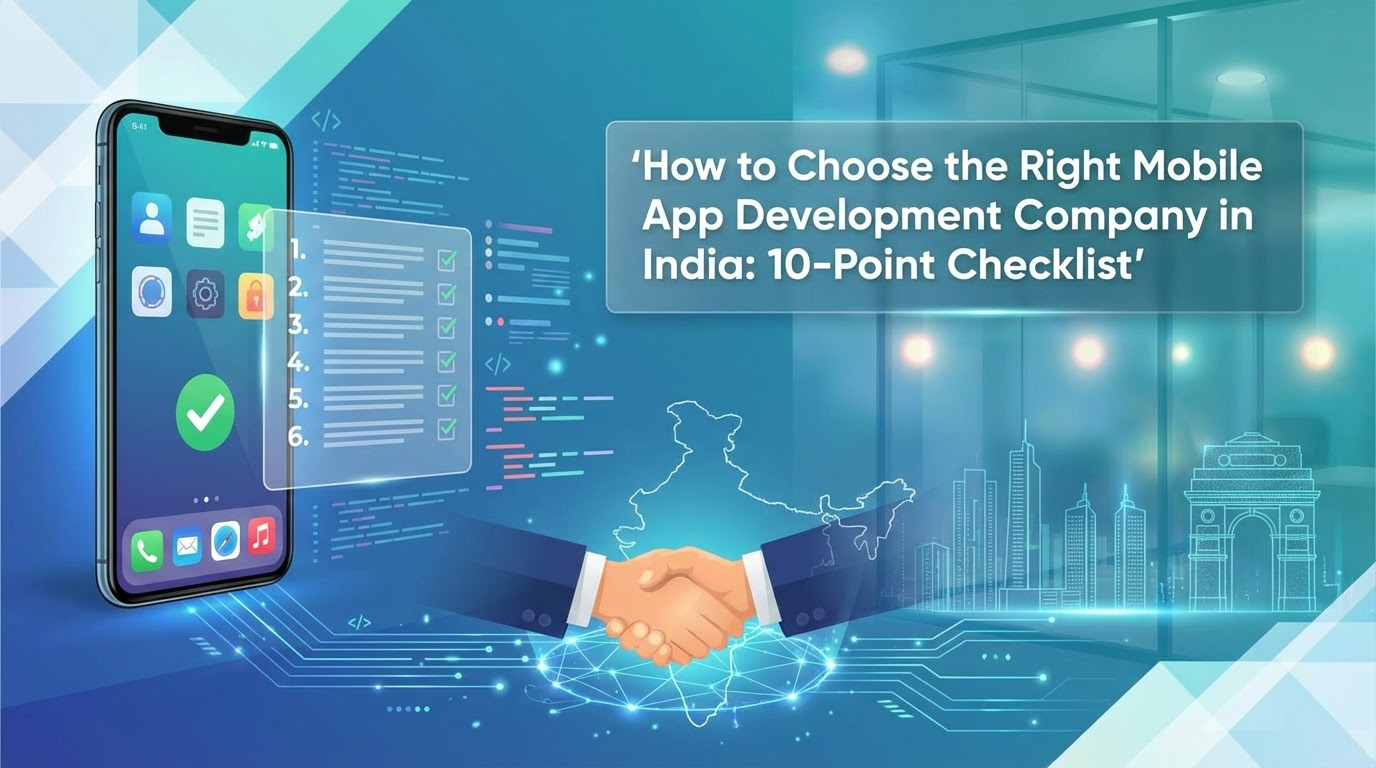
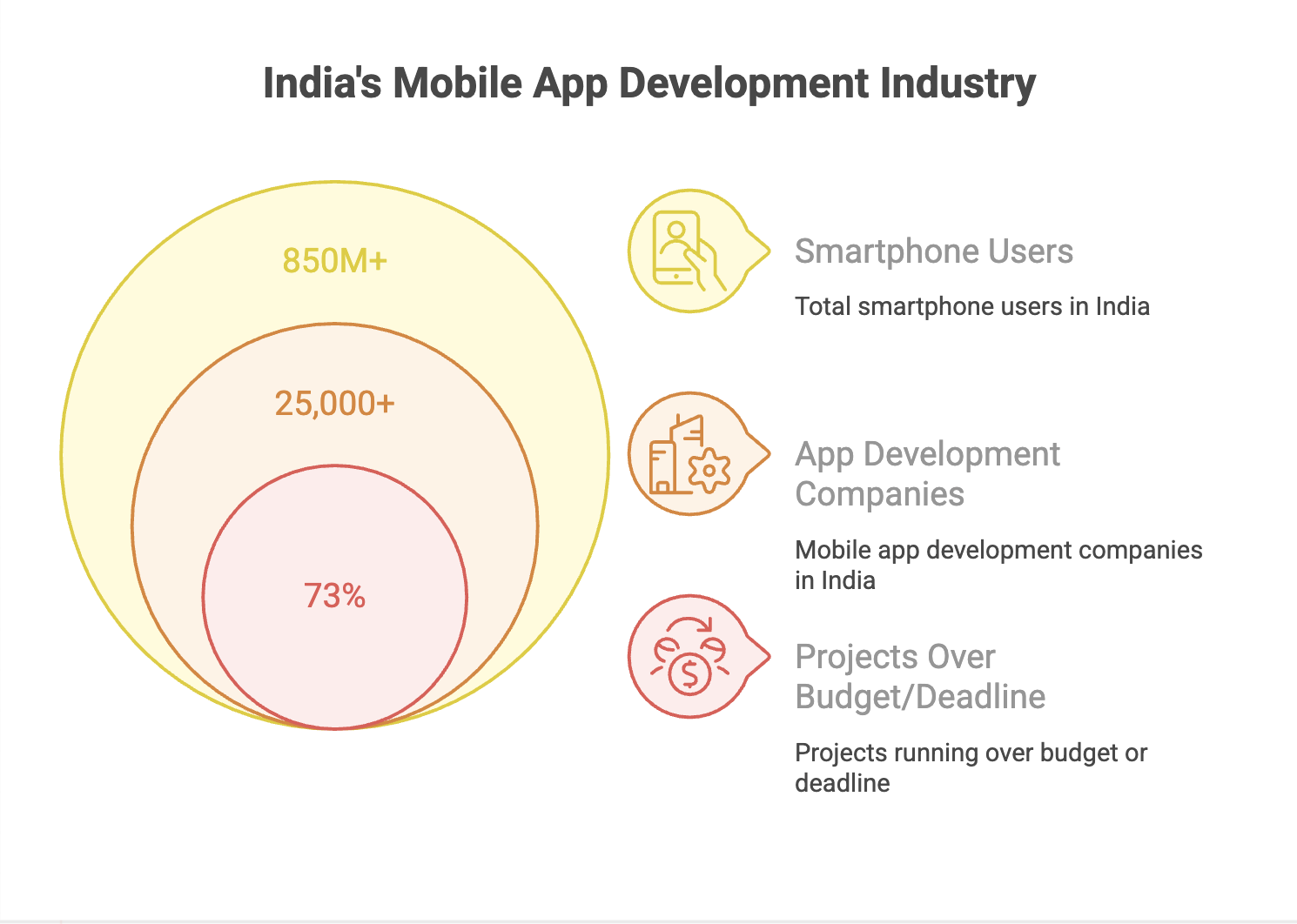
India has over 25,000+ mobile app development companies. The barrier to calling yourself a “leading app development company” is essentially zero.
A Google search returns hundreds of confident-sounding agencies, each promising world-class quality at unbeatable prices. So how do you find the one that won’t burn your budget, blow your deadline, or deliver an app that barely works?
This checklist was built from years of real project experience and honest post-mortems of businesses that hired the wrong partner first. Whether you’re a Coimbatore MSME going digital, a funded startup looking for a tech co-builder, or a global company outsourcing app development to India, these 10 checkpoints separate genuinely capable companies from ones that only appear capable.
Key Industry Statistics
-
73% of app development projects run over budget or deadline when the wrong partner is chosen.
-
₹30B+ India’s mobile app development industry value in 2025, growing at 18% annually.
-
850M+ smartphone users in India. The world’s 2nd largest mobile market.
Use this checklist before your first call, during vendor evaluation, and before signing any agreement. The few hours you spend on this will save months of rework — and potentially lakhs in wasted investment.
CHECKPOINT 01 : Verify Their Technology Stack — Native vs Cross-Platform Expertise
Technology choice determines your app’s performance ceiling. A company that only knows one framework will push you toward it regardless of whether it fits your needs. The best partners can explain why they’re recommending a specific stack for your project — and show you prior work built with it.
The key stacks to ask about: Flutter and React Native for cross-platform (iOS + Android from a single codebase), Swift and Kotlin for native iOS and Android, and Python/Node.js for the backend. For AI-powered apps, ask about their TensorFlow, PyTorch, or LangChain experience specifically.
Also ask whether they own their stack decisions or simply follow client instructions. Experienced teams push back when a choice is technically wrong — that’s a feature, not a problem.
Red Flags — Watch Out For
→ Same-day large fixed quote without a thorough discovery session
→ Only one pricing model, zero flexibility offered
→ Design, QA, and App Store deployment not in base quote
→ Payment terms require 100% upfront
What Good Looks Like
→ Recommends stack based on your specific use case
→ Can show live Play Store / App Store listings
→ Team has certified developers in recommended stacks
→ Proactively discusses AI/ML integration capability
CHECKPOINT 02 : Check Domain-Specific Portfolio — Your Industry Matters
A company that’s built 20 restaurant apps has domain intuition that a generalist simply can’t replicate. They know the edge cases, the compliance requirements, the user journeys, the API integrations, and the business model nuances before the first meeting. That expertise saves you weeks of back-and-forth and reduces product risk significantly.
Relevant industries in India to ask about: Healthcare (ABDM compliance), FinTech (RBI/SEBI regulations), E-commerce (Razorpay/Paytm integrations, COD flows), Logistics (real-time tracking, driver apps), and Manufacturing/MSME (ERP integrations, field apps). If your app touches any regulated industry, domain experience isn’t optional.
Red Flags
→ Portfolio covers only generic apps with no industry depth
→ Hesitant to share client names or live app links
→ No case studies with measurable outcomes
What Good Looks Like
→ 2–3 completed apps in your specific industry
→ Case studies mentioning real business metrics (downloads, conversion, retention)
→ Happy to connect you with a reference client from that industry
CHECKPOINT 03 : Assess Communication Transparency — Dedicated PM, Regular Updates
Communication breakdown is the #1 cause of failed app projects. Not technical incompetence — communication. A brilliant developer who doesn’t communicate leaves you guessing about progress, changes, and risks until it’s too late.
Ask specifically: Who is my single point of contact? How often will we have formal updates? What project management tool do you use? Quality agencies use tools like Jira, Linear, or Trello for task tracking, share live dashboards, and hold weekly sprint reviews. They also proactively flag scope risks before they become cost overruns — not after.
For international clients or companies based outside Coimbatore, ask about time zone availability and response SLAs. A company that only responds during Indian business hours (9am–6pm IST) may leave UAE or US clients waiting a full day for answers.
Red Flags
→ Communication only through sales rep, not technical team
→ No formal project management tool
→ Promises ‘daily updates’ but can’t show a sample
→ Vague answers about who runs the project day-to-day
What Good Looks Like
→ Named project manager assigned before project start
→ Weekly sprint review cadence included in contract
→ Demo of their PM tool with client access walkthrough
→ Clear escalation path if PM is unavailable
CHECKPOINT 04: Understand Their Development Methodology — Agile vs Waterfall
Development methodology isn’t just buzzword compliance — it directly determines how quickly you can course-correct when requirements change. And they always change.
Waterfall (plan everything upfront, build everything, deliver at end) works for highly stable, government-specification type projects. Agile — building in 2-week sprints, demoing working software every cycle — is right for almost every modern mobile app.
Agile gives you something critical: the ability to see working software every fortnight, validate assumptions with real users early, and redirect without destroying the entire project budget. Ask to see a sprint plan for your type of project. A company that truly works in Agile will show you one immediately.
Red Flags
→ Says ‘Agile’ but can’t describe what a sprint review looks like
→ First demo only at project completion
→ No change management process in the contract
What Good Looks Like
→ Bi-weekly sprint demos included as standard
→ Working build accessible to client after each sprint
→ Clear documented process for handling scope changes mid-project
CHECKPOINT 05 : Look for AI-Readiness — Can They Integrate AI Into Your App?
In 2025, AI-readiness isn’t a bonus feature — it’s table stakes. Even if your initial app doesn’t need AI, your second version almost certainly will. Personalisation engines, smart search, chatbot support, recommendation systems, predictive analytics — these are now expected in category-leading apps across every vertical.
Choosing a company without AI experience means you’ll need to rebuild or find a second partner when that moment arrives. Ask specifically: Have you integrated OpenAI, Gemini, or any LLM API? Can you build on-device ML using TensorFlow Lite or Core ML? Have you built RAG-based systems or AI chatbots? Ask to see working examples, not marketing claims.
→ AI mentioned in pitch deck but no actual AI projects in portfolio
→ Can’t name the AI tools, APIs, or models they’ve used
→ No dedicated ML/AI engineer on team — outsources it
What Good Looks Like
→ Live demos of AI-integrated apps they’ve shipped
→ Specific experience with LLM APIs, on-device ML, or computer vision
→ In-house AI/ML engineers, not subcontracted
CHECKPOINT 06 : Check Post-Launch Support Terms
Most apps fail not because of how they were built, but because of what happened — or didn’t happen — after launch.
OS updates break apps. Store policy changes require rapid compliance. User feedback demands quick iteration. New device form factors cause layout issues. A development company that disappears after delivery leaves you stranded — and the cost of finding a new team to take over unfamiliar code is almost always more expensive than staying with the original team.
Ask for specifics: What is your standard warranty period after go-live? What’s covered — bug fixes only, or feature updates? Do you offer a retainer model for ongoing support? What’s the response SLA for critical bugs? A well-defined support contract protects you as much as the development contract itself.
Red Flags
→ No support terms mentioned until you specifically ask
→ Only a 30-day bug warranty with nothing offered after
→ Support only via email with no defined response time
→ ‘We don’t do retainers’ — project-only mentality
What Good Looks Like
→ 60–90 day warranty with clear bug classification tiers
→ Documented monthly / annual retainer packages available
→ Critical bug SLA under 24 hours; standard under 72 hours
→ Long-term account manager relationship offered
CHECKPOINT 07 : Evaluate Scalability Capacity — Can They Handle Your Growth?
The app you launch is almost never the app you’ll run a year later. User volumes, feature complexity, new platform requirements, geographic expansion — growth changes every technical assumption you started with. Your development partner needs to have built at scale before, not just promised they can.
Ask for concrete examples: What’s the highest daily active user count of any app you currently maintain? How did you handle a traffic spike? Ask about their infrastructure approach — do they design for auto-scaling on AWS or GCP from day one, or bolt it on later? Ask about their database sharding experience, caching strategies, and performance testing process.
Also ask about team scalability. Can they add two more developers quickly if your project needs to accelerate? What’s their bench strength and hiring pipeline?
Red Flags
→ No examples of apps with 10,000+ daily users in portfolio
→ No experience with cloud auto-scaling or CDN setup
→ Small team (under 10) with no clear growth plan
→ Infrastructure is an afterthought, not part of architecture
What Good Looks Like
→ Examples of apps scaled from hundreds to hundreds of thousands of users
→ Cloud-native architecture as default, not an upsell
→ Load testing included in standard QA process
→ Named DevOps or infrastructure engineer on team
CHECKPOINT 08 : Ask About IP Ownership and NDAs — Your Code, Your Business
This point can save — or cost — your entire business. When a development company builds your app, the default ownership of the source code depends entirely on what’s in your contract. Without explicit language stating otherwise, an Indian development company may retain rights to code they’ve written. This is a real legal risk, particularly for startups building proprietary products.
Before sharing any business details, request a mutual NDA (Non-Disclosure Agreement). Before development begins, ensure the contract explicitly states: all source code, design assets, API integrations, documentation, and intellectual property created during the engagement transfers entirely to you upon final payment. There should be zero residual rights for the development company.
Red Flags
→ Refuses to sign NDA before preliminary discussions
→ IP transfer not explicitly covered in the contract
→ Mentions ‘we retain rights to reuse components’ without specifics
→ Only verbal assurance — nothing in writing
What Good Looks Like
→ Signs NDA promptly before any technical discussion
→ Full IP transfer included in standard contract template
→ Provides complete source code + documentation at delivery
→ Code is escrowed or delivered at each milestone
CHECKPOINT 09 : Compare Pricing Models — Fixed Price vs Time-and-Material
The right pricing model depends on how well-defined your requirements are. Fixed price works when scope is crystal clear — you know exactly what you want, the spec is detailed, and changes will be minimal. It gives budget certainty but punishes requirement changes with expensive change orders. Time-and-material (T&M) means you pay per hour or sprint — you get flexibility but carry budget risk if the project expands.
Most Indian app projects work best as a hybrid: fixed price for a well-defined MVP, then T&M for post-launch improvements based on real user data. Be very wary of companies that give a large fixed price quote within 24 hours of your first conversation — they’ve padded the estimate significantly to cover unknown risks, and you’ll overpay.
Also compare what’s actually included: design iterations, QA cycles, App Store submission, third-party API costs, infrastructure setup, and basic post-launch support. Many low quotes exclude these entirely and add them as surprises later.
To know more about developer hiring, please click here : https://noukha.in/more/developers-for-hire/
Red Flags
→ Same-day large fixed quote without a thorough discovery session
→ Only one pricing model, zero flexibility offered
→ Design, QA, and App Store deployment not in base quote
→ Payment terms require 100% upfront
What Good Looks Like
→ Discovery session before final quote (ideally a paid session)
→ Milestone-based payment terms (e.g. 20/30/30/20 model)
→ Fully itemised quote — what’s included and what isn’t
→ Both fixed and T&M options available for different phases
CHECKPOINT 10 : Look at Client Reviews on Clutch, GoodFirms & Google
Any company can write glowing testimonials on its own website. What they can’t easily fake are verified reviews on independent third-party platforms. Clutch.co (the gold standard for B2B service reviews — reviewers are verified and phone-interviewed), GoodFirms, and Google Reviews are the three you should check without exception.
On Clutch, pay attention to the reviewer’s industry and company size, the project budget range, and specific feedback about communication and post-launch support — not just the star rating. Read 1-and 2-star reviews carefully if they exist. On Google, look at the volume of reviews (10 vs 200 matters) and whether the company responds to negative feedback professionally.
If a company has no external reviews at all, ask for 3 direct references you can call or video-call. Any legitimate company with repeat clients should be able to provide them without hesitation.
Red Flags
→ Zero reviews on Clutch, GoodFirms, or Google
→ Only testimonials on their own website — unverifiable
→ Refuses to provide direct client references
→ Clutch profile with suspicious patterns (all 5-star, same posting date)
What Good Looks Like
→ 10+ verified Clutch reviews across multiple industries
→ Google Reviews with detailed written feedback (not just stars)
→ Company responds professionally to any negative reviews
→ Willingly provides 2–3 live client references on request
Noukha Technologies Checks All 10 Boxes
| ✓ Multi-Stack Expertise
Flutter, React Native, Swift, Kotlin — we recommend the right tool for your specific project and show you why in our discovery session. |
✓ Industry Portfolio
100+ apps delivered across healthcare, manufacturing, fintech, e-commerce, logistics, and EdTech in India and globally. |
| ✓ Dedicated PM from Day 1
Every project has a named PM, bi-weekly sprint demos, and a live Jira board accessible to clients 24/7. |
✓ True Agile Development
2-week sprints, working builds every cycle, and a documented change management process so you’re never surprised by scope or cost. |
| ✓ In-House AI Team
Our AI/ML engineers have shipped LLM-powered apps, computer vision systems, and predictive analytics tools — not subcontracted, built in-house in Coimbatore. |
✓ Structured Post-Launch Support
90-day warranty, tiered SLAs (critical bugs within 8 hours), and flexible monthly retainer packages for ongoing product growth. |
| ✓ Built-for-Scale Architecture
Cloud-native, auto-scaling infrastructure as default. We’ve taken apps from 500 to 500,000 users without architectural rebuilds. |
✓ Clean IP Transfer + NDA
Your code is yours from day one. We sign NDAs before any technical discussion and transfer full IP with every final delivery. |
| ✓ Transparent Milestone Pricing
Discovery session included. Fixed and T&M models available. Fully itemised quotes — zero hidden costs or surprise change orders. |
✓ Verified External Reviews
Listed on TechBehemoths. Client references available on request. 95%+ client retention rate across all delivered projects. |
Frequently Asked Questions
| Q1: How do I verify if a mobile app development company is reliable? |
| A: Check their portfolio for domain-specific work in your industry, verify client reviews on Clutch and GoodFirms, ask for technical references you can call, and review their case studies for code quality and project complexity. |
| Q2: What is the difference between fixed price and time-and-material pricing? |
| A: Fixed price means you pay an agreed total for a defined scope — good for well-specified MVPs. Time-and-material means you pay per hour/sprint for evolving requirements — better for complex, iterative projects. Most Indian app companies offer both. |
| Q3: What should I ask about IP ownership when hiring an Indian app company? |
| A: Ensure your contract states that all source code, design assets, APIs, and intellectual property transfer to you fully upon final payment. The development company should retain zero rights. Also request a mutual NDA before sharing business ideas. |
| Q4: How important is AI-readiness when choosing an app development company? |
| A: Extremely important in 2025. Even if you don’t need AI features today, your app will likely need them within 12–18 months. Choose a company with proven AI/ML integration experience so you don’t need to rebuild later. |
| Q5: How much does it cost to develop a mobile app in India? |
| A: Mobile app development costs in India range from ₹1.5 lakh for a simple app to ₹50 lakh+ for a complex AI-powered platform. A typical medium-complexity business app costs ₹4–12 lakh. Key factors: platform (iOS/Android/both), features, backend complexity, and AI requirements. |
Ready to Build Your App with the Right Partner?
Get a free 45-minute strategy session with Noukha Technologies. We’ll review your idea, scope it honestly, and give you a clear action plan — no sales pressure, no obligation.