You asked two developers to quote your app. One came back with ₹3 lakh. The other said ₹35 lakh. Both claim to build exactly what you described.
Mobile app development cost in India 2026 is one of the most searched — and most misunderstood — numbers in the tech industry. You asked two developers to quote your app. One came back with ₹3 lakh. The other said ₹35 lakh. Both claim to build exactly what you described.
This isn’t a trick. Both quotes could be legitimate — or both could be wrong. The mobile app development cost in India varies wildly based on factors most people never think to ask about, and the cheapest quote almost never represents the true cost of getting an app to market.
This guide breaks down the mobile app development cost in India 2026 completely: by app type, development model, geography, and the hidden costs that turn a ₹4 lakh budget into a ₹12 lakh project. By the end, you’ll have a realistic budget framework — and you’ll know exactly what to ask any development company before signing.
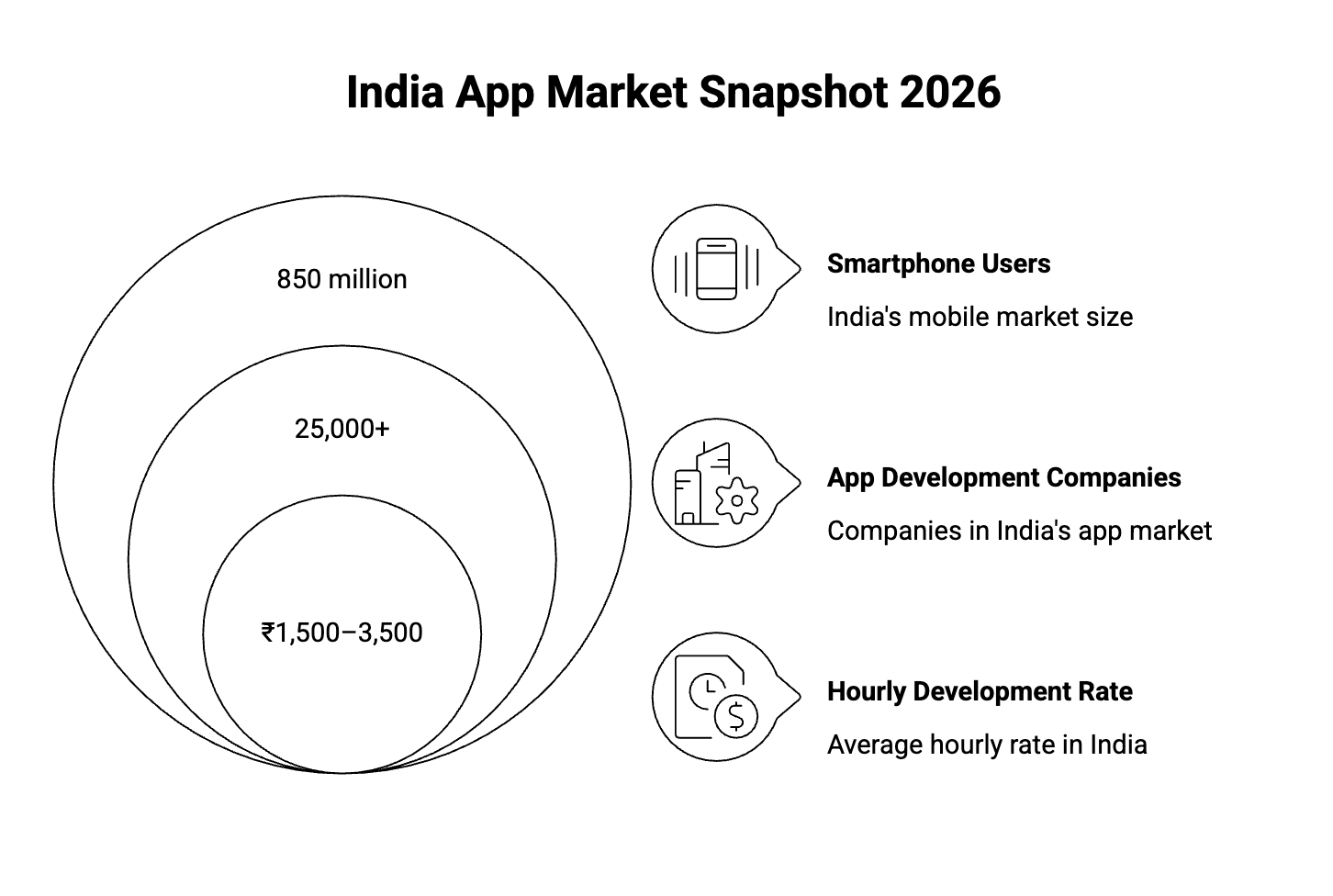
India App Market Snapshot 2026
→ India’s mobile app development industry is valued at ₹30,000 crore+ and growing at 18% annually
→ 850 million smartphone users make India the world’s 2nd largest mobile market
→ Average hourly development rate in India: ₹1,500–3,500/hour vs ₹8,500–17,000/hour in the USA
→ Over 25,000 app development companies operate in India — quality varies enormously
SECTION 1: What Drives Mobile App Development Cost in India 2026
7 key factors that determine your final price
“Before looking at any numbers, understand this: the mobile app development cost in India 2026 has no single answer. The cost is entirely a function of what you’re asking the app to do, how you’re asking it to do it, and who you’re asking to build it.” The cost is entirely a function of what you’re asking the app to do, how you’re asking it to do it, and who you’re asking to build it. Here are the seven factors that matter most:
1. App Complexity
The single biggest cost driver. A simple 3-screen informational app costs a fraction of a marketplace with real-time matching, payment escrow, and a dual-sided user base. Complexity is measured by: number of screens, number of user roles, backend data logic, real-time features, and integrations required.
2. Platform Choice — iOS, Android, or Both
Building for both platforms adds 30–50% to development cost if using native code (Swift for iOS, Kotlin for Android). Cross-platform frameworks like Flutter or React Native allow you to share ~80% of the codebase, significantly reducing this overhead. For most Indian startups, launching on Android first (80%+ market share in India) and adding iOS later is the smarter budget move.
3. UI/UX Design
Design is often the first cost that gets cut — and the one that most directly determines user retention. A fully custom design with UX research, wireframing, interactive prototyping, and pixel-perfect implementation costs ₹1–5 lakh depending on complexity. A template-based design costs significantly less but risks looking generic. Many quotes exclude design entirely.
4. Backend & Infrastructure
Every app with user accounts, data storage, or API connections needs a backend. A simple Firebase backend costs less than a custom Node.js or Python API with a PostgreSQL database, caching layer, and cloud infrastructure. For apps with real-time features (live chat, tracking, notifications), backend complexity — and cost — increases substantially.
5. Third-Party Integrations
Each integration adds time and cost: payment gateways (Razorpay, Stripe), maps (Google Maps API), SMS/OTP services, push notifications (Firebase/OneSignal), analytics (Mixpanel, Amplitude), social logins, ERP/CRM syncing. A complex app may have 8–12 integrations, each taking 4–16 hours of development.
6. AI & Advanced Features
Adding AI features — recommendation engines, NLP chatbots, computer vision, predictive analytics, LLM integration — can increase project cost by 30–100% depending on complexity. On-device ML (TensorFlow Lite, Core ML) adds further complexity. However, using hosted AI APIs (OpenAI, Google Vision, AWS Rekognition) is now cost-effective enough for startups to include.
7. Team Location & Experience Level
A senior developer in Mumbai or Bangalore charges more than an equivalent in Coimbatore or Indore. An agency with 10 years of track record and structured processes will cost more than a 3-person startup team — but will typically deliver in less time, with less rework, and with proper documentation. Hourly rates in India: ₹800–1,500/hr (junior), ₹1,500–3,000/hr (mid), ₹3,000–5,000/hr (senior).
SECTION 2: Mobile App Development Cost in India 2026: By App Type
INR and USD ranges for 4 tiers — with features, timelines, and team size
Use these ranges as your starting framework for understanding mobile app development cost in India 2026. Your actual cost will depend on the factors above.
| Tier 1 — Simple App
₹1.5 Lakh – ₹4 Lakh | $1,800 – $4,800 ⏱ Timeline: 6–10 weeks 👥 Team: 1 developer + 1 designer |
| Typical Features Included:
✓ 3–5 screens / user flows ✓ Basic UI from template or UI kit ✓ Single platform (Android or iOS) ✓ Firebase backend (authentication + database) ✓ 1–2 third-party integrations (e.g. push notifications, basic analytics) ✓ Play Store or App Store submission ✓ 30-day post-launch bug warranty Examples: → Business card apps, event apps, simple service booking, informational apps, basic restaurant menu apps |
| Tier 2 — Medium Complexity App
₹4 Lakh – ₹12 Lakh | $4,800 – $14,500 ⏱ Timeline: 12–20 weeks 👥 Team: 2–3 developers + 1 designer + QA |
| Typical Features Included:
✓ 10–20 screens with custom UI/UX design ✓ Cross-platform (iOS + Android) using Flutter or React Native ✓ Custom backend API (Node.js or Python) + database ✓ User authentication, profiles, roles ✓ Payment gateway integration (Razorpay/Stripe) ✓ 3–6 third-party integrations ✓ Admin dashboard / CMS panel ✓ Basic analytics integration ✓ 90-day post-launch support Examples: → E-commerce apps, appointment booking apps, food delivery (single restaurant), B2B field sales apps, healthcare appointment apps, EdTech apps |
| Tier 3 — Complex App
₹12 Lakh – ₹50 Lakh | $14,500 – $60,000 ⏱ Timeline: 20–40 weeks 👥 Team: 4–6 developers + designer + PM + QA “At the higher end of mobile app development cost in India, complex platforms require dedicated teams and longer timelines:” |
| Typical Features Included:
✓ 20–50+ screens, multiple user roles ✓ Full custom UI/UX with research and prototyping ✓ Both iOS and Android (native or Flutter) ✓ Complex backend with microservices architecture ✓ Real-time features (live tracking, chat, notifications) ✓ AI-powered features (recommendations, chatbot, prediction) ✓ 6–12+ third-party integrations ✓ Multi-vendor or marketplace functionality ✓ Advanced admin panel + analytics dashboard ✓ Security audit + performance load testing Examples: → Multi-vendor marketplace, fintech apps, AI-powered health apps, on-demand platforms (Uber-style), logistics management, complex B2B SaaS mobile apps |
| Tier 4 — Enterprise App
₹30 Lakh – ₹1 Crore+ | $36,000 – $120,000+ ⏱ Timeline: 6–18 months 👥 Team: 6–15 member dedicated team |
| Typical Features Included:
✓ 50+ screens across multiple modules ✓ Enterprise-grade security (SSO, MFA, end-to-end encryption) ✓ Complex ERP/SAP/CRM integrations ✓ Multi-tenant architecture or white-label capability ✓ AI/ML modules (predictive analytics, computer vision, NLP) ✓ Offline-first architecture for field use ✓ Custom API layer for legacy system integration ✓ Compliance requirements (HIPAA, GDPR, RBI, IRDAI) ✓ Dedicated infrastructure + DevOps pipeline ✓ SLA-backed support with dedicated team Examples: → Bank or NBFC apps, hospital management mobile apps, large e-commerce platforms, government apps, ERP mobile frontends for manufacturing companies |
SECTION 3: Cost by Development Model In-house vs Freelancer vs Indian Agency vs US/UK Agency
The same app can cost wildly different amounts depending on who builds it. Here’s an honest comparison of your four main options:
| In-House Team | Freelancer | Agency (India) | Agency (US/UK) | |
| Cost / month | ₹8L–20L+ | ₹80K–2.5L | ₹2L–10L | ₹18L–50L+ |
| Setup time | 3–6 months | 1–2 weeks | 1–2 weeks | 2–4 weeks |
| Quality control | Full control | Variable | Structured | Structured |
| IP ownership | 100% yours | Risk: unclear | Contractual | Contractual |
| Scalability | Slow to scale | Hard to scale | Flexible | Flexible |
| Post-launch support | Built-in | Uncertain | SLA-backed | SLA-backed |
| Best for | Large orgs with ongoing dev | Tight budget MVPs | Most businesses | Enterprise global cos |
Which Model is Right for You?
- In-House Team: Best for large organisations that need constant, ongoing app development and have the HR infrastructure to hire and retain developers. Upfront cost is high and time-consuming. Not suitable for first-time app builds.
- Freelancer: Best for very tight budgets and simple, well-defined apps. High risk on quality, communication, timeline, and IP protection. Suitable for internal tools and prototypes, not for production apps with real users.
- Indian Agency (Recommended for most): Best balance of cost, quality, and risk management. You get a structured team, Agile delivery, post-launch support, and contractual IP ownership. This is the right choice for 80%+ of businesses building their first or second app.
- US/UK Agency: Best for very large enterprises with compliance requirements that demand local presence, or for companies where a US/UK time zone overlap is genuinely mission-critical. Cost premium is 4–8x India pricing.
SECTION 4: Mobile App Development Cost in India 2026 vs Global Rates
Why global companies outsource app development to India
India’s cost advantage in mobile app development is well-documented — but what makes Tier-2 Indian cities like Coimbatore even more competitive is that the talent quality matches metro cities at a 20–30% lower rate, because operating costs, attrition, and overhead are all lower.
| Region | Avg Hourly Rate | Simple App | Medium App | Complex App |
| USA / Canada | $100–$200/hr | $50K–100K | $100K–250K | $250K–1M+ |
| UK / Western Europe | $80–$150/hr | $40K–80K | $80K–200K | $200K–800K |
| Eastern Europe | $40–$80/hr | $20K–40K | $40K–100K | $100K–300K |
| India (Metro cities) | $20–$45/hr | $8K–18K | $18K–50K | $50K–150K |
| India (Tier-2, incl. Coimbatore) | $15–$35/hr | $5K–12K | $12K–40K | $40K–120K |
The Coimbatore Advantage
Coimbatore developers command 20–30% lower rates than Bangalore or Mumbai counterparts — without any compromise in technical skill.
Why? Lower cost of living, lower attrition (developers stay in stable jobs longer), strong engineering college pipeline (PSG Tech, Amrita, CIT, KCT), and no metro-city salary inflation.
For a global client, this means you get the quality of Bangalore at the cost of a Tier-2 city. For Indian businesses, it means better value from a partner who understands local markets deeply.
SECTION 5: Hidden Costs Nobody Mentions in the Quote
9 costs that surprise first-time app builders
This is the section most app development blogs skip — and it’s the one that matters most for your real budget. The biggest shock in mobile app development cost in India 2026 is what the quote doesn’t include. A ₹6 lakh development quote can easily become a ₹10 lakh first-year costonce these items are properly accounted for. Go in with eyes open.
| Hidden Cost Item | Typical Range | Why It Catches People Out |
| App Store & Play Store Fees | ₹6,500 (Apple – one time)₹1,700 (Google – one time) | Often forgotten. Needed to publish your app. |
| QA & Testing | ₹50K–3L depending on complexity | Automated + manual testing. Usually 15–20% of dev cost. |
| App Store Optimisation (ASO) | ₹15K–50K for initial setup + ₹10K–20K/month ongoing | Without ASO, your app won’t be found organically. |
| Third-Party APIs & SDKs | ₹10K–2L+/year | Maps, payments, SMS OTP, analytics, push notifications — each has a cost. |
| Server / Cloud Infrastructure | ₹5K–50K+/month on AWS/GCP | Scales with users. Often underestimated at launch. |
| Ongoing Maintenance & Updates | 15–20% of development cost per year | OS updates, security patches, new device compatibility. |
| UI/UX Design Iterations | ₹50K–2L+ if not included in dev scope | Many agencies quote dev-only. Design is extra. |
| App Marketing & UA | ₹50K–5L+/month | User acquisition, ASO, social ads. Separate from dev entirely. |
| Legal & Compliance | ₹20K–1.5L+ | Privacy policy, T&Cs, GDPR/PDPB compliance for data-handling apps. |
SECTION 6: Budgeting for an MVP vs a Full Product
The smartest way to spend your first ₹10 lakh
The single most expensive mistake in app development is trying to build everything on day one. An MVP (Minimum Viable Product) is not a compromise — it’s a strategy. It’s the smallest version of your app that solves the core problem for your core user. Everything else is a hypothesis that should be validated with real user data before spending on it.
What to Include in an MVP
- The one core user flow that delivers your primary value proposition
- Basic authentication (sign up, login, profile)
- The minimum set of features needed for a user to complete that core flow
- A way to collect user feedback (in-app feedback, analytics)
- App Store presence (so users can find and download it)
What to Cut from an MVP
- Social sharing features, referral programmes, loyalty points
- Advanced search and filter systems (use basic version first)
- AI-powered personalisation (collect data first, then personalise)
- Multi-language support (validate in one language first)
- Admin dashboard bells and whistles (basic reporting is enough)
SECTION 7: Why Cheap Isn’t Always Cheap — The Real Cost of a Failed App
The hidden price of choosing the wrong partner
This is the section that every business owner needs to read before choosing the cheapest quote. The reality is that a failed app project costs far more than what you paid for it.
The True Cost of a Failed App Project
- Rebuild cost: 70% of apps built by under-qualified teams need to be partially or fully rebuilt within 12–18 months. Rebuilding is more expensive than building right the first time, because you’re paying to understand and unpick someone else’s architecture.
- Lost time: A 6-month delay to market in a competitive app category can mean losing first-mover advantage entirely. Time cannot be recovered.
- User trust damage: A buggy, slow, or crash-prone app launch creates negative reviews that take 12–18 months to recover from on the App Store.
- Opportunity cost: Every month your app is broken or delayed is revenue not earned, users not acquired, and investor confidence not built.
- Data migration risk: When you switch developers after a bad project, migrating data from poorly structured databases can take weeks and is high-risk for data integrity.
| Watch Out For
→ Quote 50% cheaper than all competitors with no explanation → No discovery session — instant quote on first call → Offshore sub-contracting to cheaper developers without disclosure → No post-launch support in contract — disappears after delivery → Template-based apps sold as ‘custom development’ |
What Good Looks Like
→ Quote is detailed, itemised, and explained clearly → Discovery session before final pricing → Fixed team, no subcontracting without your knowledge → Post-launch support and SLAs included in contract → Custom code with source code handed over at delivery |
SECTION 8: How Noukha Technologies Approaches Pricing
Transparent. Itemised. No surprises.
We’ve seen too many clients arrive at Noukha after a bad experience with a cheaper agency that disappeared after delivery, handed over code that didn’t compile, or quoted ₹3 lakh and billed ₹9 lakh. So here’s exactly how we approach pricing — transparently, because you deserve to know before we start.
Step 1 — Free Scoping Session (45 Minutes)
Before any number is mentioned, we spend 45 minutes understanding your business, your users, your goals, and your constraints. This isn’t a sales call — it’s a technical conversation. We bring our Head of Technology, not a sales executive.
Our Porfoilio : noukha.in/portfolio
Step 2 — Requirements Documentation
We document your requirements in plain English and technical terms. This becomes the basis of your quote — not a vague description. You get to review and approve it before we price anything.
Step 3 — Fully Itemised Quote
Our quote breaks down every line: design phases, development sprints, QA cycles, third-party integration time, App Store submission, and post-launch support. You see exactly what you’re paying for. Design and QA are always included — not separate surprises.
Step 4 — Milestone-Based Payment
We work on a milestone model: 20% at project start, 30% at design sign-off, 30% at development completion, 20% at App Store launch. You never pay for work that hasn’t been delivered. No 100% upfront, ever.
Step 5 — MVP-First Recommendation
For most new apps, we recommend starting with an MVP. We’ll tell you honestly what can wait — and why. Our interest is in a long-term relationship, not a one-time invoice.
Step 6 — Transparent Post-Launch Support
Every project includes a 90-day warranty covering bug fixes. We offer monthly retainer packages for ongoing development, starting from ₹50,000/month. You’ll know the cost before you sign, not after.
The Bottom Line on Mobile App Development Cost in India
Here’s the honest summary of everything in this guide:
- Simple apps cost ₹1.5–4 lakh. Medium-complexity apps cost ₹4–12 lakh. Complex apps start at ₹12 lakh. Enterprise platforms start at ₹30 lakh.
- The cheapest quote is rarely the cheapest outcome. Factor in rebuild costs, delays, and hidden costs before comparing.
- Add 20–30% to any development quote for a realistic first-year total budget (hidden costs, QA, ASO, infrastructure).
- An Indian agency in a Tier-2 city like Coimbatore gives you metro-quality development at 20–30% lower rates.
- Always start with an MVP. Validate first. Build the full product second.
- The right partner gives you an itemised quote, a discovery session, milestone billing, and post-launch support in the contract.
If you’re budgeting a mobile app project, the most valuable thing you can do right now is have a direct, honest conversation with a technical team — not a sales team. That’s what Noukha Technologies offers.
Frequently Asked Questions
| Q1: How much does it cost to develop a mobile app in India in 2026? |
| A: Mobile app development costs in India range from ₹1.5 lakh for a simple 3–5 screen app to ₹50 lakh+ for a complex AI-powered or marketplace platform. A typical medium-complexity business app (e-commerce, booking, field sales) costs between ₹4–12 lakh. Enterprise platforms start at ₹30 lakh and scale upward. |
| Q2: Is it cheaper to build an app in India vs the USA? |
| A: Significantly cheaper. US app development agencies charge $100–$200 per hour, meaning even a medium app costs $100K–250K. Indian agencies in Tier-2 cities like Coimbatore charge $15–$35/hour, delivering the same quality for 60–75% less cost. The saving is on labour cost, not quality. |
| Q3: What is the biggest hidden cost in mobile app development? |
| A: Ongoing maintenance and cloud infrastructure are consistently the most underestimated costs. Expect 15–20% of your original development cost annually for maintenance (OS updates, security patches, device compatibility). Cloud costs on AWS or GCP can range from ₹5,000 to ₹50,000+ per month depending on your user base. |
| Q4: Should I build an MVP or a full product first? |
| A: Always start with an MVP. An MVP costs 30–50% of a full product but lets you validate your core assumption with real users before committing the full budget. Most successful apps today (Swiggy, Razorpay, Zepto) launched with a fraction of their current features. Once you have user data and investor interest, build the full product. |
| Q5: How does Noukha Technologies price its projects? |
| A: Noukha uses a transparent, milestone-based pricing model. We start with a free scoping session to understand your requirements, then provide a fully itemised quote (design, development, QA, App Store submission — all included). For well-defined MVPs we offer fixed-price contracts. For evolving, data-driven projects we use time-and-material. No hidden costs. |