To hire an Android app developer in India and get it right, you need more than a shortlist of agencies and a budget. You need a clear framework for separating teams that can deliver from teams that will disappoint. In 2026, India has thousands of Android developers — freelancers, boutique agencies, and large IT companies all competing for the same projects. This guide gives you the exact criteria to evaluate them, the questions to ask before signing anything, and the red flags that signal a bad engagement before it starts.
The Indian Android app development market in 2026 is large, competitive, and uneven. Exceptional developers work alongside developers who oversell their capabilities. Transparent agencies work alongside agencies that subcontract your project without telling you. The surface signals — portfolios, client logos, award badges — are increasingly unreliable as differentiators.
This guide walks you through the complete hiring process: who to consider, what questions to ask, what engagement models work best for different business needs, and what red flags to walk away from regardless of how attractive the proposal looks.
The decision to hire an Android app developer in India looks simple on the surface —
post a requirement, receive proposals, pick one. In practice, the gap between the best
and worst outcomes from that process is enormous, and it is almost entirely determined
by what happens before you sign a contract.
Step 1 — Define the Problem Before You Define the Role
The most common mistake businesses make when hiring an Android app developer is starting with the solution instead of the problem. They decide they need an app, write a rough feature list, and start looking for someone to build it. The result is a misaligned brief, a proposal that costs more than expected, and a development engagement that spends the first four weeks reworking requirements that were never properly defined.
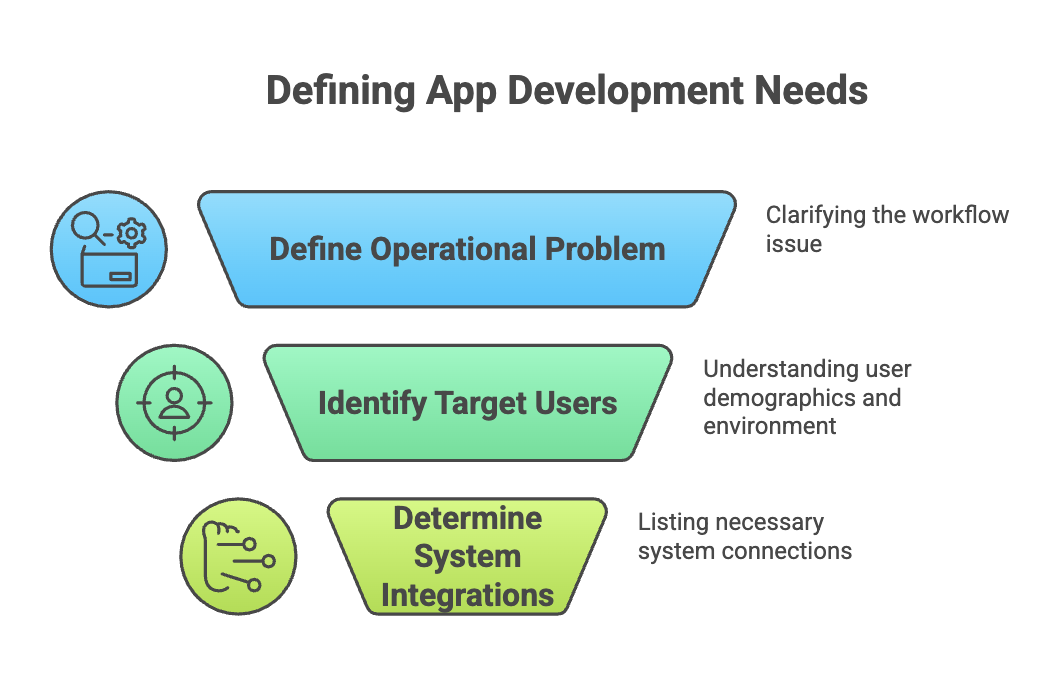
Before reaching out to any developer or agency, document three things clearly. First, the specific operational problem you want the app to solve — not features, but the workflow that is currently broken or missing. Second, who will use the app, what devices they carry, and in what environment they will use it. Third, what systems the app needs to connect with — existing software, databases, hardware, or third-party services.
That document — even if it is just two pages — changes every conversation you have with a prospective developer. It shifts the dynamic from a sales pitch to a problem-solving discussion, and it immediately reveals which developers have the experience to engage with your actual requirements.
Step 2 — Understand Your Three Hiring Options
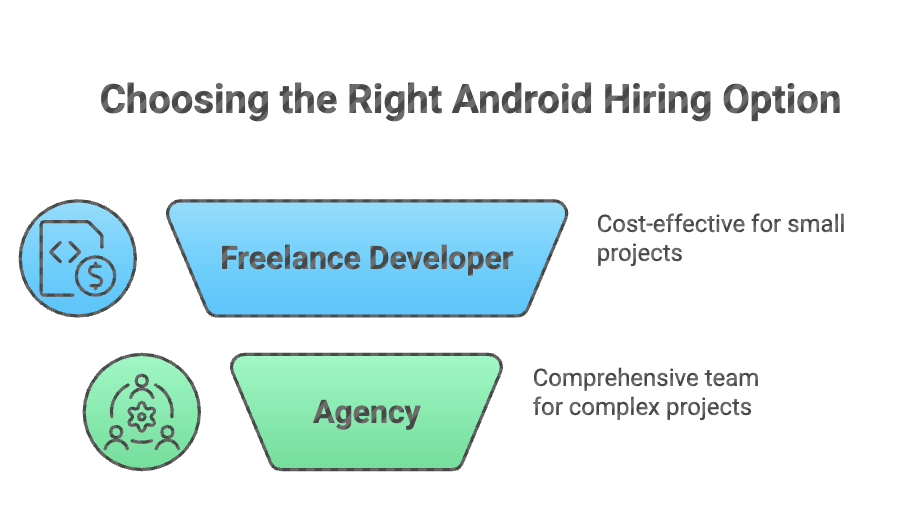
In India, there are three primary ways to hire Android app development capability. Each suits a different business context and budget.
Option 1: Freelance Android Developer
A freelance Android developer is a single individual — typically found on platforms like Upwork or through direct referrals. Rates in India range from ₹500 to ₹3,000 per hour depending on experience. The advantage is cost and direct communication. The disadvantage is capacity risk: a single developer cannot cover design, backend development, testing, and project management simultaneously. Suitable for small, well-defined projects with limited integrations.
Option 2: Android App Development Agency
An agency brings a full team — Android developer, backend developer, UI/UX designer, QA tester, and project manager — under one engagement. Fixed-price or milestone-based contracts are common. Quality and process maturity vary widely between agencies. The best agencies in India operate with structured requirement documentation, sprint-based development, and transparent communication. Suitable for business applications with multiple user roles, integrations, or offline requirements.
Option 3: Dedicated Developer Engagement
Some agencies offer a dedicated developer model where a specific developer is assigned full-time or part-time to your project. This gives you the cost advantage of an agency’s recruitment infrastructure with the control of direct management. Suitable for businesses with ongoing development needs and an internal technical lead who can manage day-to-day work.
| Option | Best For | Advantage | Risk |
| Freelancer | Small, simple projects | Low cost, direct communication | No team backup, limited capacity |
| Agency | Business & enterprise apps | Full team, structured process | Quality varies widely |
| Dedicated Developer | Ongoing development needs | Control with cost efficiency | Needs internal tech oversight |
Step 3 — Where to Find Android App Developers in India
The platform you use to find candidates shapes the quality of the pool you are evaluating. Each channel has different characteristics worth understanding before you invest time in outreach.
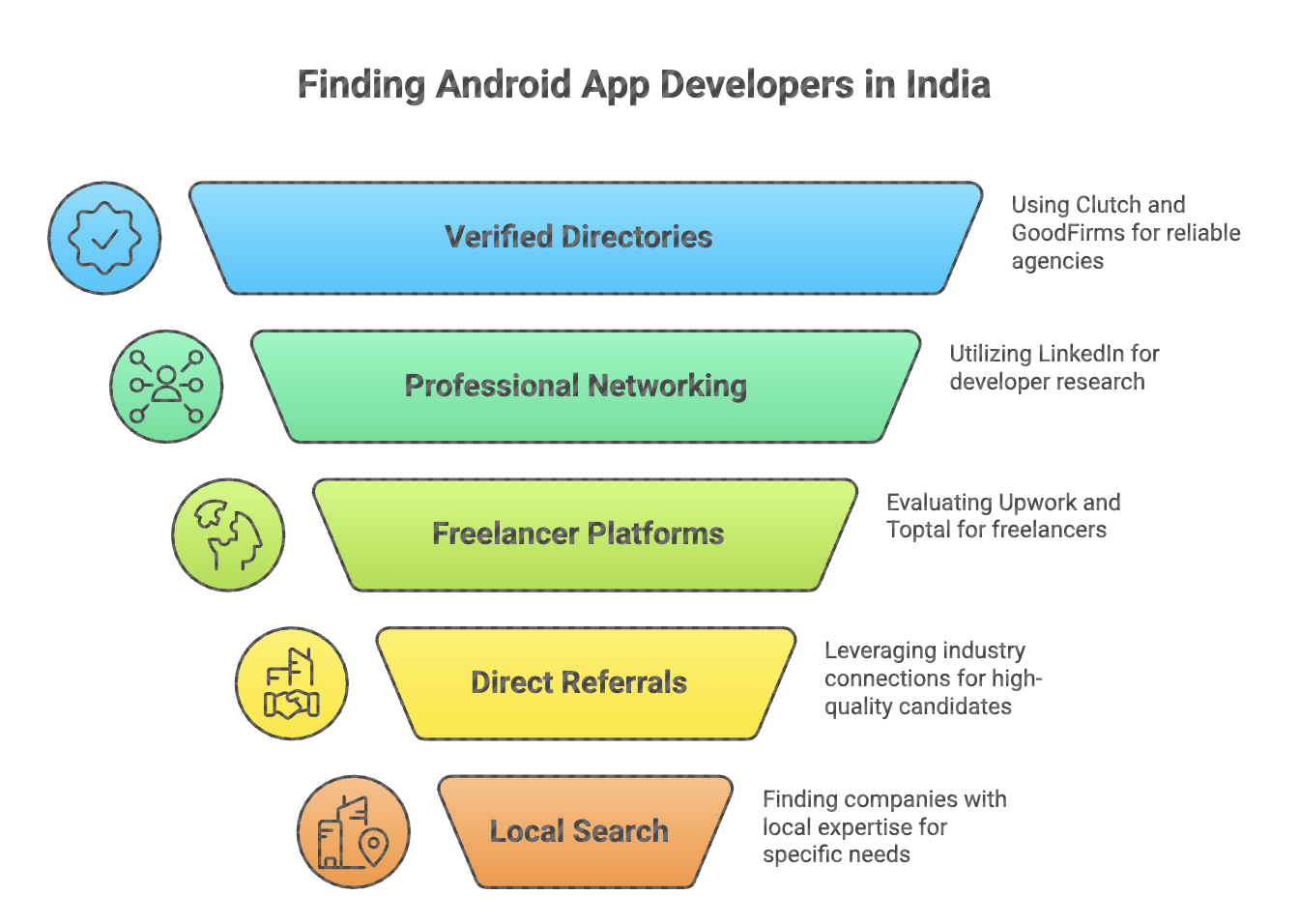
- Clutch and GoodFirms — verified agency directories with client reviews, filterable by industry, location, and budget. The most reliable starting point for finding agencies with a real track record
- LinkedIn — useful for researching specific developers and agencies and reading founder backgrounds. Less useful for comparing multiple options quickly
- Upwork and Toptal — freelancer platforms with varying quality levels. Both require careful evaluation of profiles and test work before committing
- Direct referrals from businesses in your industry — the highest-quality channel and the one most businesses underuse
- Local search for city-specific needs — if your project involves factory floor deployment or regional operational context, a local Android app development company offers proximity and local knowledge advantages that remote teams cannot replicate.
- Most businesses that hire an Android app developer in India for the first time make the
same mistake — they evaluate on price and portfolio without verifying whether the team
has ever worked in a similar operational environment. A beautiful portfolio of consumer
apps tells you very little about whether a team can build a factory floor inspection
app or a logistics COD reconciliation tool.
Step 4 — The Interview Questions That Actually Reveal Capability
A portfolio review and a sales call tell you very little about a development team’s actual capability. The questions that reveal genuine competence require specific, experience-based answers — not general descriptions of a process.
Ask these questions in every evaluation conversation:
- Describe a project where requirements changed significantly mid-development. How did you handle it and what was the outcome?
- What Android devices do you physically test on, and how do you decide which devices to include in your test set?
- Walk me through how you would handle offline data synchronisation for an app used in an environment with inconsistent connectivity
- What happens if we need to change something six months after the app is launched — what does your support process look like in practice?
- Can I speak with two previous clients whose projects are similar to mine in complexity or industry?
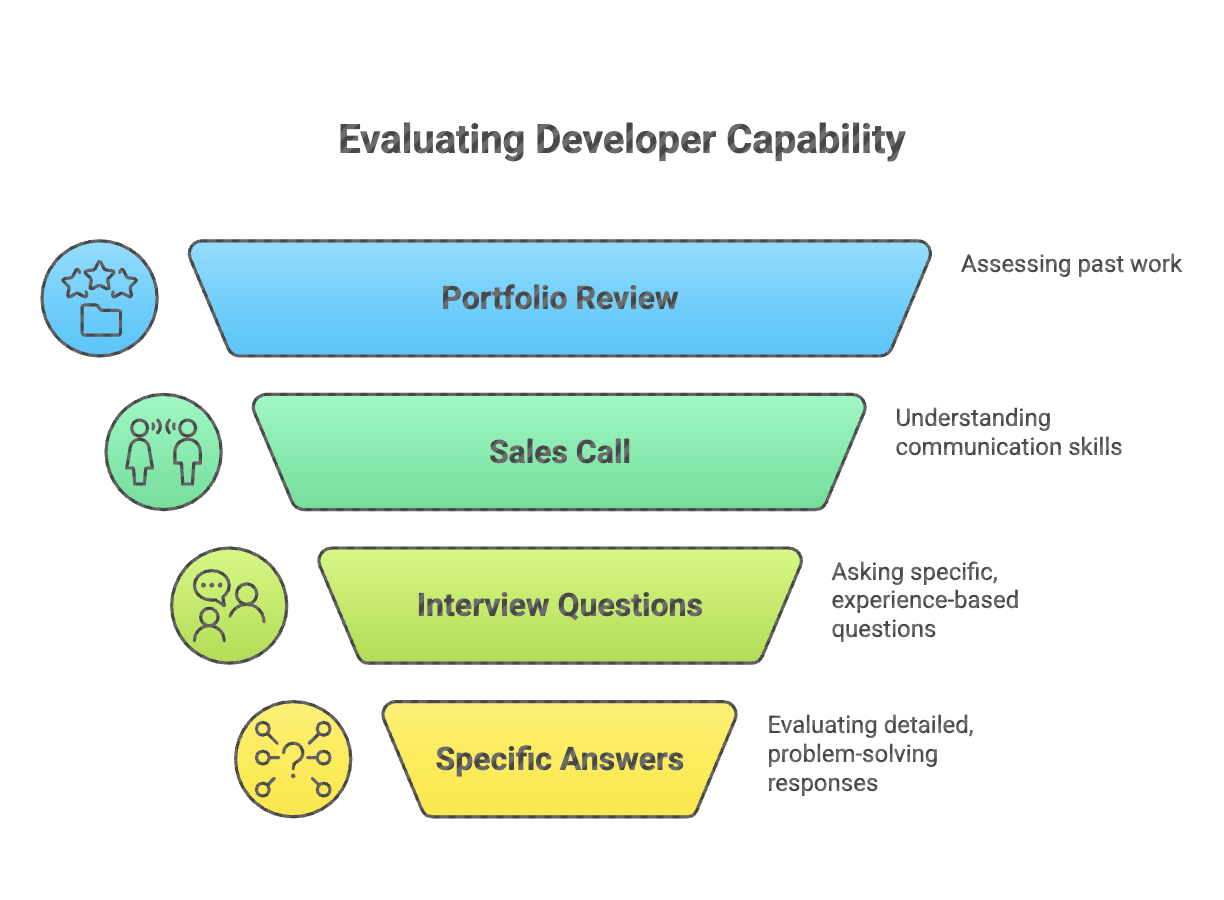
A developer with genuine experience will answer every one of these with specifics — including problems they encountered and how they resolved them. Vague, general answers are a reliable signal of limited real-world experience regardless of how impressive the portfolio appears.
Step 5 — Three Contract Clauses That Protect Your Investment
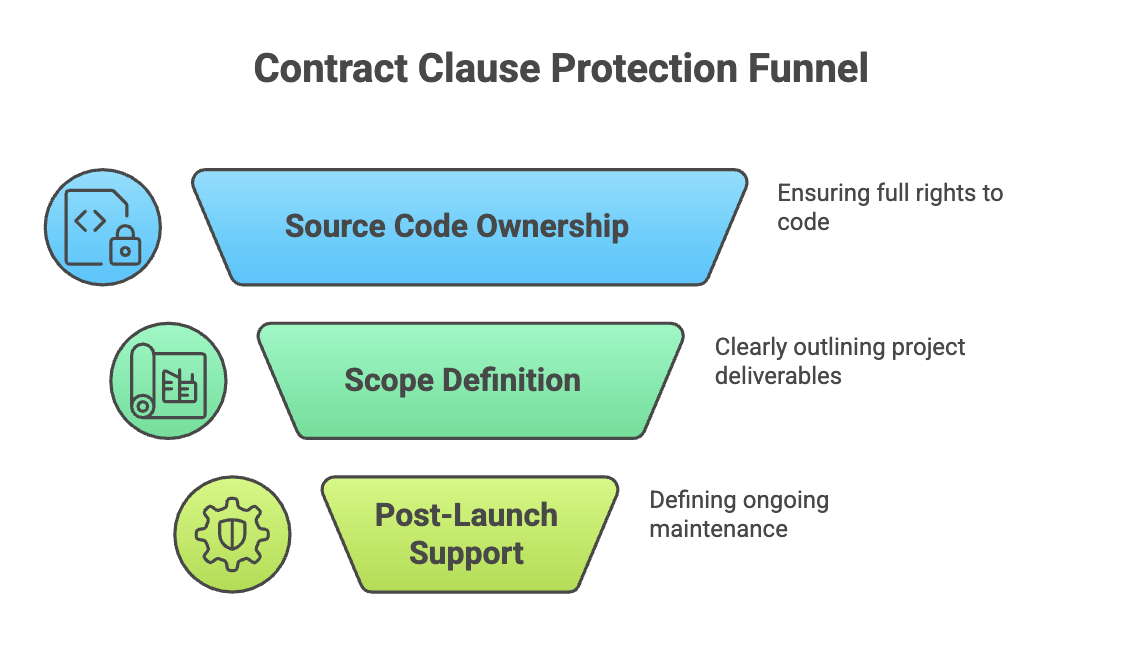
The contract is where the relationship is defined in writing. Three clauses determine most post-project outcomes and deserve careful attention before signing.
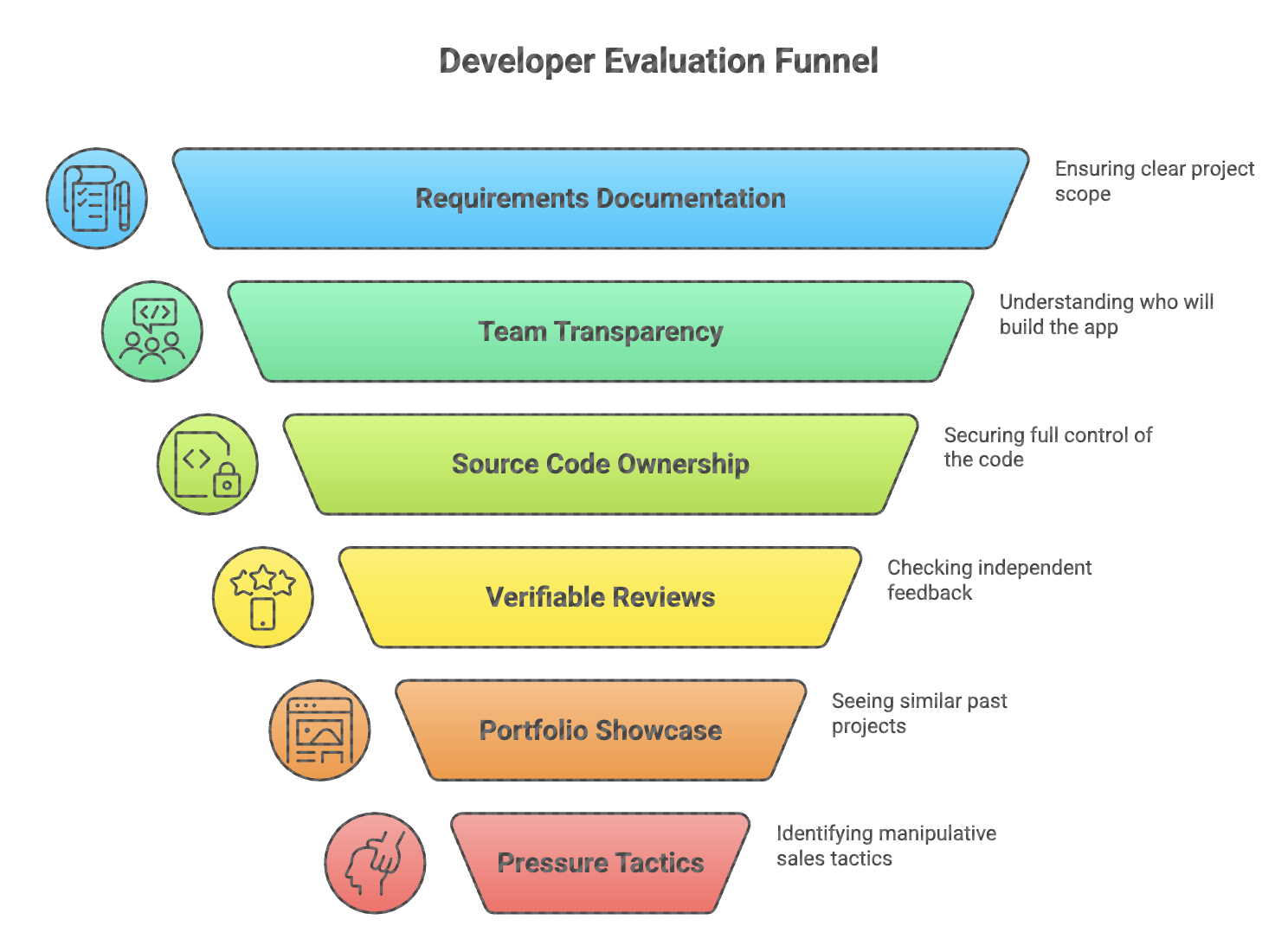
Source code ownership: the contract must explicitly state that full source code ownership transfers to you on project completion, with no conditions, licensing fees, or restrictions on what you can do with the code afterwards. This is the single most important clause in any software development contract.
Scope definition: the contract should reference a specific, written requirements document — not general feature descriptions — as the basis for what is being built. Every scope dispute between a business and a developer ultimately traces back to a contract that was too vague about deliverables.
Post-launch support terms: understand exactly what is covered after the app goes live. Bug fixing window, OS compatibility update coverage, response time for critical issues. Getting these in writing before launch is significantly easier than negotiating them when something breaks.
This point alone eliminates a significant number of vendors. When you hire an Android
app developer in India and do not confirm source code ownership upfront, you risk
building your entire operation on software you do not legally control. Get this
confirmed in writing before any work begins — no exceptions.
Step 6 — Red Flags to Walk Away From
Regardless of how competitive the price or how polished the presentation, end the conversation with any developer or agency that shows these signs:
- Gives a cost estimate before producing any requirements documentation — this number will change upward
- Cannot tell you specifically who will build your application and where they are based
- Resists or adds conditions to full source code ownership on project completion
- Has no verifiable reviews on independent platforms like Clutch or GoodFirms
- Cannot show working software from a previous project similar to yours in operational complexity
- Applies pressure to sign quickly with time-limited discounts or artificial urgency
Hiring in Tamil Nadu and Coimbatore Specifically
For businesses in Tamil Nadu — particularly manufacturers in Coimbatore, logistics companies managing routes across the state, and healthcare providers in mid-sized cities — there is a specific case for hiring a local Android development partner over a remote team in a different city.
Local developers understand the device landscape in Tamil Nadu’s workforce, the connectivity constraints of industrial and semi-urban environments, the integration requirements of locally common business software like Tally, and the language preferences of end users. These are not soft benefits — they directly reduce requirement-gathering time, design revision cycles, and post-launch fix burden that remote teams unfamiliar with local context typically generate.
The businesses that get the best results when they hire an Android app developer in
India are not the ones with the biggest budgets. They are the ones who asked the right
questions, verified the answers, and chose a partner based on demonstrated capability
in their specific industry context — not on a polished website or a low quote.
For businesses in Coimbatore and Tamil Nadu evaluating Android development partners, Noukha is an Android app development company in Coimbatore that works with manufacturers, logistics businesses, and healthcare providers across the region. In-house development team, sprint-based delivery, full source code ownership on completion, and a free discovery conversation before any price is quoted.