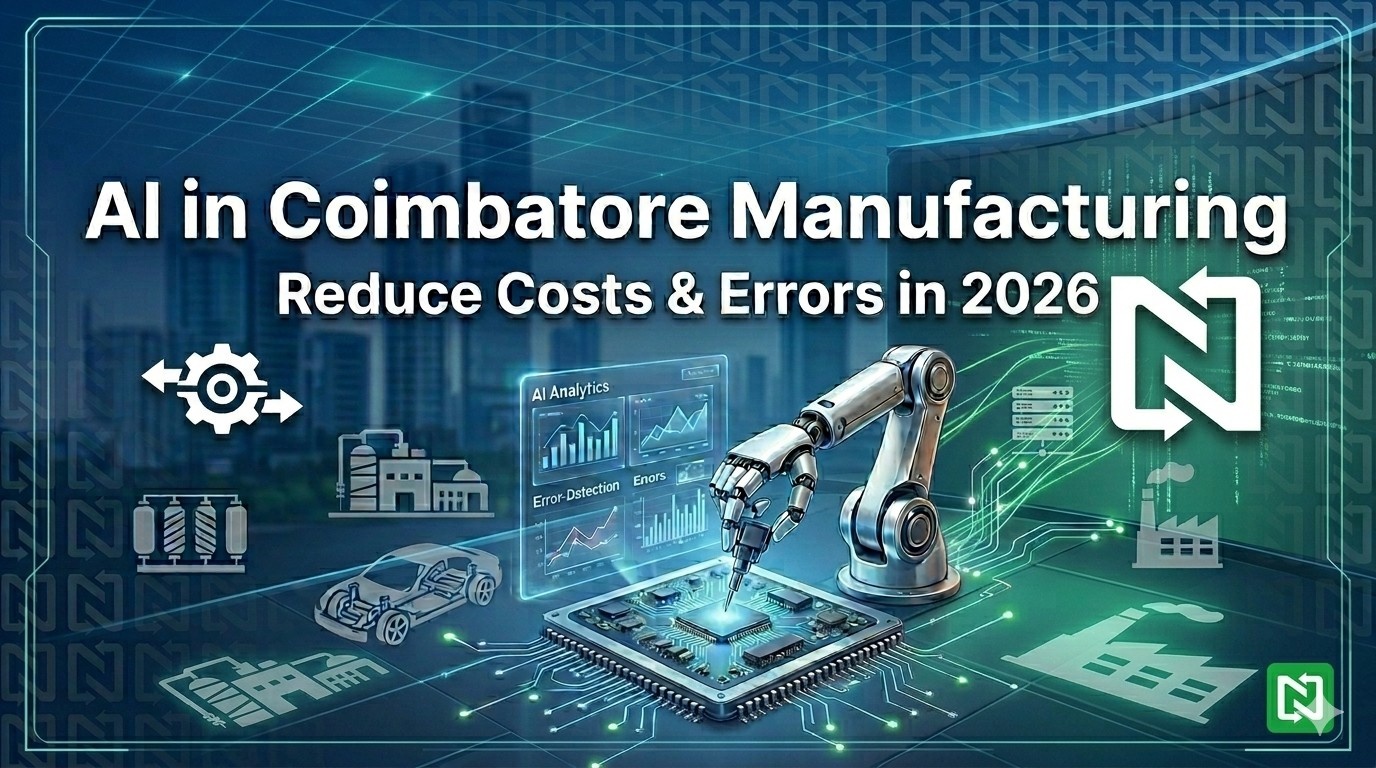
AI in Coimbatore manufacturing is helping factories reduce downtime, defects, and operating costs without disrupting production.
A practical guide to how pump makers, textile mills, and engineering units in Coimbatore are cutting downtime, defects, and overheads with AI – without disrupting their shop floors. Across industries, AI in Coimbatore manufacturing is shifting how factories manage costs, quality, and production efficiency
Table of Contents
- Why Manufacturing Companies in Coimbatore Are Turning to AI
- Predictive Maintenance: Reducing Downtime in Pump & Motor Manufacturing
- AI-Powered Quality Control with Computer Vision
- AI Demand Forecasting for Smarter Production Planning
- Automating Invoices and Documents with AI
- Case Study: How a Coimbatore Manufacturer Reduced Costs Using AI
- Cost of Implementing AI in Manufacturing (India Context)
- Challenges and Limitations of AI in Manufacturing
- Frequently Asked Questions
- Conclusion & CTA
1. Why AI in Coimbatore Manufacturing Is Gaining Adoption
Coimbatore’s industrial identity is built on grit. The city runs on pump factories in Ganapathy, spinning mills across Peelamedu, precision castings in Singanallur, and hundreds of small engineering units spread across SIDCO estates and private industrial zones. For decades, these manufacturers have competed on price, craftsmanship, and supplier relationships. That competitive formula still works – but it is under increasing pressure.
Raw material costs are volatile. Skilled labor is expensive and harder to retain. Buyers – from large OEMs in Chennai and Bangalore to export customers in the Middle East and Europe – are demanding tighter lead times, better traceability, and lower defect rates. Meanwhile, power costs in Tamil Nadu continue to climb, and working capital cycles in the SME segment remain tight.
The result: margins are shrinking exactly when operational precision matters most.
This is where AI is beginning to make a genuine, measurable difference. Not as a technology experiment reserved for large multinationals, but as a practical toolkit being deployed in Coimbatore’s mid-sized factories right now. From predictive maintenance on pump test rigs to computer vision cameras on weaving machines, AI development services in Coimbatore are helping manufacturers identify problems before they cause damage, reduce waste before it accumulates, and automate paperwork that consumes hours of supervisory time.
This article is not a technology overview. It is a ground-level examination of four specific AI applications – predictive maintenance, computer vision quality control, demand forecasting, and document automation – with a focus on how they apply to the industries that define Coimbatore: pump manufacturing, textiles, and precision engineering. We will also walk through a realistic case study, cost benchmarks for AI deployment in India’s SME context, and an honest assessment of where AI still falls short on the factory floor.
If you are evaluating whether AI is right for your facility, this is the starting point.
| ₹1.2L Cr+
Coimbatore Industrial Output Annual contribution to Tamil Nadu GDP |
~30,000
Manufacturing Units MSMEs in Coimbatore district |
15–40%
Typical AI ROI Window Cost reduction potential in Year 1 |
6–18 Months
Average Payback Period For AI in Indian SME manufacturing |
2. AI in Coimbatore Manufacturing: Predictive Maintenance for Pump & Motor Downtime
Coimbatore is one of India’s foremost pump manufacturing hubs. The city produces an estimated 40% of India’s agricultural and industrial pump output. Names like Texmo, Suguna, CRI, and hundreds of smaller OEMs and job-work units rely on continuous machine uptime to meet production schedules. A single CNC lathe or vertical machining centre going down unexpectedly can delay a batch of impeller castings by two to three days, ripple through downstream assembly, and result in penalties from industrial buyers with firm delivery windows.
Traditional maintenance in most Coimbatore factories still runs on one of two models: breakdown maintenance (fix it when it fails) or calendar-based preventive maintenance (shut it down every 500 hours regardless of actual condition). Both are expensive in different ways. Breakdown maintenance causes unplanned downtime; calendar maintenance causes unnecessary downtime and consumable waste.
How Predictive Maintenance AI Works
Predictive maintenance AI uses sensor data to understand the current health of a machine and forecast when it is likely to fail – before it actually does. In a typical deployment in a Coimbatore pump manufacturing unit, this involves:
- Vibration sensors mounted on motor bearings, spindle housings, or pump test-bench motors
- Temperature sensors on gearboxes, coolant circuits, and hydraulic systems
- Current clamp sensors on motor control panels to detect load anomalies
- An edge computing gateway that collects sensor data locally (often every 100–500 milliseconds)
- An AI model – typically a combination of anomaly detection and time-series forecasting – that learns what normal vibration and temperature signatures look like for each machine, and raises alerts when readings deviate in ways that historically precede failure
The critical insight is this: most bearing failures, coolant pump failures, and spindle degradation events leave a detectable signature in vibration and current data anywhere from 48 hours to three weeks before catastrophic failure. AI systems can learn to detect these early signatures. A trained maintenance technician on the shop floor may notice something unusual; an AI system running 24/7 on 8–12 sensors per machine will catch it reliably, every time.
Real-World Outcomes in Pump & Motor Manufacturing
In deployments across comparable Indian manufacturing facilities – primarily in Rajkot, Coimbatore, and Pune – predictive maintenance AI has produced the following outcome ranges:
| Metric | Before AI | After AI |
| Unplanned downtime | 8–12% of production hours | 2–4% of production hours |
| Mean time between failures | Baseline | Improved by 35–55% |
| Maintenance parts spend | Baseline | Reduced by 20–30% |
| Emergency repair labour cost | Baseline | Reduced by 40–60% |
| OEE (Overall Equipment Effectiveness) | 65–72% | 78–88% |
A mid-sized pump unit in Ganapathy running three VMCs and two CNC turning centers can expect to recover 6–10 production hours per month per machine from unplanned breakdowns alone. At a conservative machine hour rate of Rs. 800–1,200, that translates to Rs. 45,000–90,000 in recovered production per machine per month, not counting the downstream benefit of no delayed shipments.
| Implementation Reality Check
Predictive maintenance AI requires a minimum of 3–6 months of sensor data collection before the model is reliable enough to make actionable predictions. During this period, the system is learning your machine’s specific signatures – not deploying generic failure patterns from a database. Factories should budget for a parallel run period and not expect Day 1 predictions. The investment pays off significantly by Month 9–12. |
Applicability Beyond CNC Machines
While the most cited use case is CNC machines, predictive maintenance AI for manufacturing Coimbatore has equally strong applications in:
- Compressors and vacuum pumps used in foundry operations and textile sizing machines – both are high-wear, high-consequence assets
- Spindle motors on ring frames and rotor frames in textile mills, where a spindle failure during a long run creates yarn break cascades that take 20–30 minutes to recover
- Hydraulic power packs in die-casting and press shop environments – hydraulic seal failures are both expensive and create safety hazards
- Chiller and HVAC units in electronics and precision parts manufacturing, where temperature excursions outside tolerance affect product quality directly
3.AI in Coimbatore Manufacturing: Quality Control with Computer Vision
Manual quality inspection is one of the most labor-intensive and inconsistent activities on a manufacturing shop floor. A human inspector examining impeller castings for surface porosity, checking woven fabric for weft breaks, or visually scanning machined flanges for dimensional deviation is performing a cognitively demanding task that degrades in accuracy over time, especially across a 12-hour shift. Studies across manufacturing environments consistently show that human visual inspection has an error rate of 20–30% for subtle defects in high-volume environments.
Computer vision quality inspection uses industrial cameras – typically 5 to 12 megapixel monochrome or color sensors – combined with AI models trained on defect images to inspect products at production line speed. The AI model does not get tired, does not vary in attention across shifts, and can flag defects at 200–600 parts per minute in many applications.
How Computer Vision Works on a Production Line
A typical computer vision quality inspection deployment involves the following components:
- A camera station integrated into the production line – on a conveyor, at an exit chute, or as a gantry above an assembly station
- Controlled lighting, which is critical. Coaxial lighting for surface-finish defects, backlit illumination for dimensional gauging, and UV or structured light for casting surface inspection are the most common configurations
- A dedicated edge computer running the AI inference model in real time
- An alert or reject mechanism – either a buzzer and indicator light that notifies the operator, or an automated air-jet or diverter arm that physically routes defective parts to a rejection bin
- A logging and reporting dashboard that tracks defect rates, defect types, and trends over time
The AI model itself is trained on several hundred to several thousand images of good parts and defect types specific to your product. In most applications, model training takes 4–8 weeks, including data collection, annotation, and validation on the actual production line.
Industry-Specific Applications in Coimbatore
Pump and Casting Manufacturers
Impeller and casing castings are prone to surface porosity, blow holes, cold shuts, and dimensional variation from core shifts. Current manual inspection typically catches 70–75% of these defects before machining. Computer vision systems trained on X-ray images or surface scan data have achieved defect detection rates of 93–97% in comparable foundry applications, reducing machining of defective castings and cutting scrap cost by 15–25%.
For machined components – flanges, valve bodies, spindle housings – computer vision combined with laser profilometry can verify critical dimensions to ±0.01mm tolerances at line speed, replacing coordinate measuring machine (CMM) sampling which typically covers only 5–10% of parts.
Textile Mills
Fabric defect detection is one of the most mature computer vision applications in Indian manufacturing. Textile mills in Coimbatore’s Peelamedu belt running power looms, shuttle less looms (rapier and air-jet), and knitting machines face consistent challenges with weft breaks, warp breaks, reed marks, dobby errors, and yarn naps.
Fabric inspection cameras mounted at the take-up roller of weaving machines can detect defects at weaving speed (typically 300–600 RPM) and alert the operator within 2–3 seconds of defect occurrence, rather than the defect propagating across several meters of fabric before the weaver notices. This alone can reduce fabric defect waste by 30–50% in mills running tight constructions where a single break propagates into a long defect trail.
Precision Engineering Units
Small engineering units supplying components to automotive, defense, and industrial OEM customers face increasing QC demands – many buyers now require AQL (Acceptable Quality Level) documentation and traceability at lot level. Computer vision systems provide automatic defect tagging and timestamp logging that satisfies these requirements without adding manual QC headcount.
| Limitation to Note
Computer vision systems work best with consistent, well-defined defect categories. If your product range is highly customized – different specifications, materials, or tolerances per order – training and maintaining AI models for each variant adds cost and complexity. Vision AI is most cost-effective in high-volume, moderate-variety production environments. For very high-mix, low-volume job shops, the ROI equation is more difficult. |
4. AI Demand Forecasting for Smarter Production Planning
Inventory is one of the largest hidden costs in Coimbatore’s manufacturing sector. A mid-sized pump manufacturer carrying 60–90 days of raw material (castings, motor windings, shaft stock, fasteners) ties up significant working capital that could otherwise fund capacity expansion or technology investment. Conversely, stocking out on a critical component – a specific impeller casting size, a motor frame, a bearing – stops assembly and delays orders.
Most production planning in Coimbatore’s SME sector still relies on a combination of owner experience, spreadsheet tracking, and reactive reordering based on minimum stock levels. This works when demand is relatively stable and predictable. It breaks down under conditions of seasonal spikes (agricultural pump demand peaks sharply in February–May ahead of the monsoon season), rapid product mix shifts, or supply disruptions that compress lead times.
What AI Demand Forecasting Does
AI demand forecasting manufacturing systems analyze historical order data, seasonal patterns, customer purchasing behavior, and – in more sophisticated deployments – external signals like commodity price indices, weather forecasts, or macroeconomic indicators, to generate multi-week and multi-month demand projections at SKU level.
The distinction from traditional statistical forecasting (ARIMA, moving averages) is that AI models can learn non-linear patterns – the interaction of three or four variables simultaneously – that rule-based models miss. Practically, this means better accuracy on products with irregular or seasonal demand, which describes a large portion of Coimbatore’s pump, motor, and textile accessory output.
| Planning Metric | Impact of AI Demand Forecasting |
| Forecast accuracy (MAPE) | Improves from 25–35% error to 10–15% error |
| Raw material inventory days | Reduced by 20–35% without increasing stockouts |
| Overproduction waste | Reduced by 15–25% in high-SKU environments |
| Working capital tied in inventory | Freed up by Rs. 30–80 lakh per crore of turnover |
| Stockout frequency | Reduced by 40–60% with automated reorder triggers |
| Production scheduling efficiency | Improved by 15–20% through smoother batching |
Practical Deployment in Coimbatore’s Context
For a pump manufacturer producing 40–60 different motor-pump sets across agricultural, domestic, and industrial categories, AI demand forecasting can be implemented on top of existing ERP data (Tally, SAP B1, or even well-maintained Excel records) without requiring new ERP infrastructure.
The minimum viable dataset for AI forecasting is 18–24 months of order history at SKU level. With this, a well-configured AI model can generate weekly production recommendations – what to manufacture, in what quantity, by when – that reduce both excess inventory and unplanned rush production runs.
Textile mills benefit similarly, where AI forecasting models can ingest loom booking data, yarn order history, and customer reorder patterns to optimize greige fabric production scheduling and reduce end-of-season clearance pile-up, a persistent cost driver in the sector.
| Data Quality Warning
AI forecasting is only as good as the historical data fed into it. If your order records in Tally or Excel have gaps, inconsistent SKU naming, or have not been maintained at item level – only at invoice level – a data cleansing phase of 4–8 weeks will be required before an AI model can be trained. This is a real project risk that good AI development services in Coimbatore will audit upfront. |
5. Automating Invoices and Documents with AI
In Coimbatore’s manufacturing firms, the back office often runs on a combination of Tally, WhatsApp, email, and physical files. A purchase department managing 40–80 active vendors, processing 150–300 purchase orders per month, reconciling GST invoices, and maintaining delivery challan records is doing repetitive, error-prone, high-volume document work that occupies 2–3 full-time accounts and purchase staff every day.
Invoice automation AI uses document processing technology – a combination of OCR (optical character recognition), natural language understanding, and structured data extraction – to read vendor invoices, purchase orders, and delivery documents, extract the relevant fields (GSTIN, HSN codes, line items, quantities, rates, tax breakdowns), validate them against purchase orders, and either auto-post them to your accounting system or flag mismatches for human review.
Where Errors and Delays Come From
In manual invoice processing, three categories of error account for the majority of financial reconciliation problems:
- Data entry errors: Wrong quantity, wrong rate, or misread GSTIN when keying vendor invoices into Tally. Even experienced operators make errors at high volume, especially for invoices arriving as poor-quality scans or photos on WhatsApp.
- Matching errors: Invoices received against POs with slight description differences (‘MS Plate 10mm’ vs ‘Mild Steel Sheet 10mm’), leading to mismatches that get resolved manually by calling the vendor or purchase manager.
- Process delays: Physical routing of invoices through purchase, stores, and accounts for approval adds 3–7 working days to payment cycles, complicating vendor relationships and sometimes triggering credit holds.
What AI Invoice Automation Delivers
A well-implemented invoice automation AI system, integrated with Tally or a cloud ERP, delivers:
- Automated extraction of all standard fields from GST tax invoices – GSTIN, invoice number, date, HSN codes, line items, CGST/SGST/IGST, totals – at 95–99% field-level accuracy
- 3-way matching: automatically checking the invoice against the PO and the goods receipt note (GRN), flagging discrepancies
- Reduction in invoice processing time from 2–3 days per invoice (manual) to under 2 hours for auto-processable invoices
- Digital approval workflows with mobile access, reducing physical routing delays
- Automatic generation of purchase-side GSTR-2A reconciliation data
For a mid-sized Coimbatore manufacturer processing 200 vendor invoices per month, AI invoice automation typically reduces processing headcount requirements by 40–60% and eliminates most financial reconciliation errors at source. The downstream benefit – faster month-end closes, cleaner GST filings, and fewer vendor disputes – is substantial but less immediately visible than the labor cost saving.
Beyond Invoices: Other Document Automation Opportunities
The same technology that automates invoice processing can be applied to:
- Dispatch and logistics documents: Auto-generating e-way bills from delivery challan data, reducing the 15–20 minutes a dispatch clerk currently spends per vehicle
- Customer purchase orders: Automatically parsing customer POs (which arrive in dozens of different formats from different buyers) into a standardized format, reducing manual order entry time by 60–70%
- Inspection and test certificates: Auto-populating test certificates for pump performance tests from test bench data, rather than manually entering values from a paper register
- Vendor communications: Auto-drafting follow-up emails for delayed POs, shortage notifications, and quality rejection communications based on ERP data
6. Case Study: How a Coimbatore Manufacturer Reduced Costs Using AI
| CASE STUDY: PRECISION PUMPS (COIMBATORE)
Ganapathy Industrial Area, Coimbatore | Hypothetical, Composite Example Company BackgroundPrecision Pumps (Coimbatore) is a mid-sized pump and motor assembly manufacturer based in the Ganapathy industrial zone, with a secondary fabrication unit in Peelamedu. The company produces agricultural submersible pumps, centrifugal process pumps, and motor-pump sets for the domestic and export market. Annual turnover: approximately Rs. 22 crore. Production headcount: 140 workers across both plants. The company supplies to distributors across Tamil Nadu, Andhra Pradesh, and Karnataka, and has a small export account to Sri Lanka. The ProblemBy FY 2023–24, Precision Pumps was experiencing three compounding operational problems that were eroding profitability despite healthy order inflow:
AI Solutions ImplementedThe company engaged an AI development company in Coimbatore to design and deploy three integrated AI systems over a 14-month project:
Measured Results – 12 Months Post Full Deployment
Detailed Results Breakdown:
Total AI project cost (hardware, software, integration, training): Rs. 38 lakh. Payback period: approximately 5.3 months based on annualized savings. |
7. Cost of Implementing AI in Manufacturing (India Context)
One of the most frequent questions from Coimbatore manufacturing owners is: what does this actually cost? The honest answer is that AI implementation costs in Indian SME manufacturing vary significantly based on scope, existing infrastructure, and the specific AI development services in Coimbatore or other providers you engage. The table below provides indicative ranges for the four use cases covered in this article.
| AI Application | Implementation Cost (Rs.) | Typical Annual Saving (Rs.) |
| Predictive Maintenance (6–10 assets) | 12–25 lakh | 20–60 lakh |
| Computer Vision QC (1–2 lines) | 10–20 lakh | 15–45 lakh |
| AI Demand Forecasting | 5–12 lakh | 10–35 lakh (working capital) |
| Invoice / Document Automation | 4–10 lakh | 8–20 lakh |
| Combined 3–4 module deployment | 30–60 lakh | 55–150 lakh |
These cost figures assume deployment by a competent AI development company in Coimbatore or India, with customization for your specific products, machines, and ERP system. Off-the-shelf SaaS AI tools from international vendors may appear cheaper initially but typically require significant customization for Indian manufacturing contexts – particularly for GST invoice formats, Tally integration, and the specific defect typologies of your products – which adds hidden integration cost.
The most important cost variable is data readiness. If your ERP data is well-maintained, machine connectivity is feasible (modern CNCs typically have OPC-UA or Modbus connectivity; older machines may require retrofit sensor kits at Rs. 15,000–40,000 per asset), and you have clear product specifications and defect definitions, costs will be at the lower end of these ranges. Poor data quality, legacy machines without connectivity, or highly varied product mixes push costs upward.
Government incentives are available. Under the Ministry of MSME’s Technology Upgradation Fund Scheme (TUFS) and the Tamil Nadu government’s industrial AI adoption schemes, reimbursements of 15–25% of technology investment are accessible to eligible manufacturers. An experienced AI development partner should be able to assist with subsidy applications.
- Challenges and Limitations of AI in Manufacturing
Any honest assessment of industrial automation AI India must acknowledge where AI still struggles, fails, or disappoints in real manufacturing environments. Overselling AI capabilities is the fastest way to destroy trust on the shop floor. Here are the most important limitations to understand before committing to an AI implementation.
AI Does Not Replace Process Discipline
AI systems optimize the processes you have. If your production process has fundamental discipline issues – inconsistent raw material quality, operators bypassing standard procedures, unreliable machine baselines – AI will surface those problems clearly, but it cannot fix them. A predictive maintenance system flagging daily anomalies on a machine that has been poorly maintained for two years is not malfunctioning; it is telling you accurately that the machine is in poor health. The action required is process and maintenance improvement, not AI re-tuning.
Training Data Requirements Are Non-Negotiable
Computer vision quality inspection requires representative images of your specific defects on your specific products under your specific lighting conditions. Generic defect models from a database do not work reliably for industrial applications. If your casting supplier has recently changed, or your product specification has been updated, the vision model must be retrained. This is an ongoing operational requirement, not a one-time project task.
Connectivity and IT Infrastructure Gaps
Many older machines in Coimbatore’s factories – lathes, milling machines, conventional press brakes, older generation CNC machines from the 1990s and 2000s – do not have digital output ports or network connectivity. Retrofitting these machines with sensors is possible but adds cost (Rs. 20,000–50,000 per machine for a complete sensor kit and gateway). If your facility has limited or unreliable internet connectivity, edge computing deployments are available, but they add to infrastructure cost.
Change Management on the Shop Floor
The most underestimated challenge in any AI deployment is human adoption. Machine operators, QC inspectors, and maintenance technicians who have relied on their own judgement for 10–15 years may resist, distrust, or work around AI systems that they perceive as checking on their performance. Successful implementations invest in shop-floor training, translate AI alerts and recommendations into simple, actionable language in Tamil where appropriate, and frame AI as a tool that makes the operator’s job easier, not a surveillance system.
AI Forecasting Is Probabilistic, Not Certain
AI demand forecasting will produce better predictions than a spreadsheet average in most scenarios. It will still be wrong sometimes – particularly during macro disruptions (COVID-level supply chain events, sudden raw material price spikes, unexpected government policy changes) that have no historical precedent in your data. Treat AI forecasting output as a strong recommendation to be reviewed by an experienced production manager, not as an instruction to be followed without question.
| Realistic Expectation Setting
Well-implemented AI in manufacturing typically delivers 15–40% improvement in the specific metric it targets (downtime, defect rate, inventory days, processing time) within 12–18 months of deployment. Poorly implemented AI – wrong technology choice, insufficient training data, lack of integration with existing systems – delivers nothing but expense and frustration. Choosing the right AI development partner matters as much as choosing the right technology. |
9. Frequently Asked Questions
Is AI implementation feasible for a small manufacturing unit with a turnover of Rs. 3–5 crore?
Yes, selectively. At this turnover scale, the highest-ROI AI application is typically document and invoice automation, which has a low implementation cost (Rs. 3–6 lakh), does not require machine connectivity or sensor hardware, and delivers measurable savings within 3–4 months. Predictive maintenance and computer vision become viable from Rs. 8–12 crore turnover upward, where the volume of assets and throughput justifies the investment. A good AI development company in Coimbatore will assess your specific situation rather than proposing a one-size-fits-all solution.
Do we need to change our ERP or accounting software to implement AI?
In most cases, no. The most common ERP and accounting tools in Coimbatore’s manufacturing sector – Tally Prime, SAP Business One, and to a lesser extent Zoho and Oracle NetSuite – all have API connectivity that allows AI systems to read and write data without replacing the underlying software. The AI layer sits alongside your existing ERP, not instead of it.
How long does a full AI implementation take from contract to live deployment?
For a single-module deployment (one of the four use cases covered above), expect 3–6 months from project start to stable production use. This includes hardware installation, data collection and model training, integration, testing, and operator training. Multi-module programs like the case study above typically run 10–16 months for full deployment. Rushing the data collection and model training phase to cut time-to-deployment is the single most common reason AI projects underperform.
What data security and IP risks should we be aware of?
Your production data, product specifications, and quality rejection data are commercially sensitive. Ensure that your AI development agreement includes clear data ownership clauses (all training data and models remain your IP), that data is not stored on shared cloud infrastructure without encryption, and that the vendor has an NDA in place. For companies supplying defense or automotive OEM customers with vendor data security requirements, this is especially important.
How do we evaluate whether an AI vendor is technically credible?
Ask to see case studies from comparable manufacturing environments (same industry, similar asset types). Request a proof-of-concept scoped to one specific use case before committing to a full program. Evaluate whether the vendor asks detailed questions about your specific machines, products, and defect types – generic AI pitches that do not engage with your specific operational context are a red flag. References from existing Coimbatore or Tamil Nadu manufacturing clients are the most reliable indicator.
10. Conclusion
Coimbatore’s manufacturing sector is at a genuine inflection point. The industries that have defined this city – pump manufacturing, textile production, precision engineering – are still fundamentally sound, built on decades of craft, supplier relationships, and engineering expertise. But the cost and quality pressures bearing down on these industries are real, and they are intensifying.
AI is not a magic solution to structural cost challenges. But in four specific, well-defined applications – predictive maintenance, computer vision quality control, demand forecasting, and document automation – AI development services in Coimbatore are now delivering measurable, verifiable improvements to the metrics that directly determine factory profitability: downtime, scrap rate, inventory turns, and processing efficiency.
The manufacturers who will gain the most from AI are not those who adopt it as a technology statement, but those who deploy it surgically – starting with the one or two highest-cost problems on their shop floor, partnering with an implementation team that genuinely understands both AI and industrial manufacturing, and committing to the data quality and change management work that makes the technology perform as advertised.
The case study in this article represents what is realistically achievable: a mid-sized Coimbatore manufacturer recovering Rs. 87 lakhs in annualized savings from a Rs. 38 lakh AI investment over 14 months. Not every deployment will match those numbers exactly – but the category of outcome is consistently reproducible when the implementation is done correctly.
If you are a manufacturing owner or operations manager in Coimbatore evaluating AI for your facility, the most valuable next step is not reading more about AI – it is a structured assessment of which problem in your factory would deliver the highest return if solved. That assessment takes 2–3 hours with the right partner, and it will tell you more than any generic overview.
| Ready to explore AI for your factory?
Noukha is an AI development company in Coimbatore specializing in industrial AI for manufacturing – predictive maintenance, computer vision quality inspection, demand forecasting, and document automation. We work specifically with pump manufacturers, textile mills, and precision engineering units in the Coimbatore region. Our engagements begin with a no-cost operational assessment that identifies the highest-ROI AI application for your specific facility. |