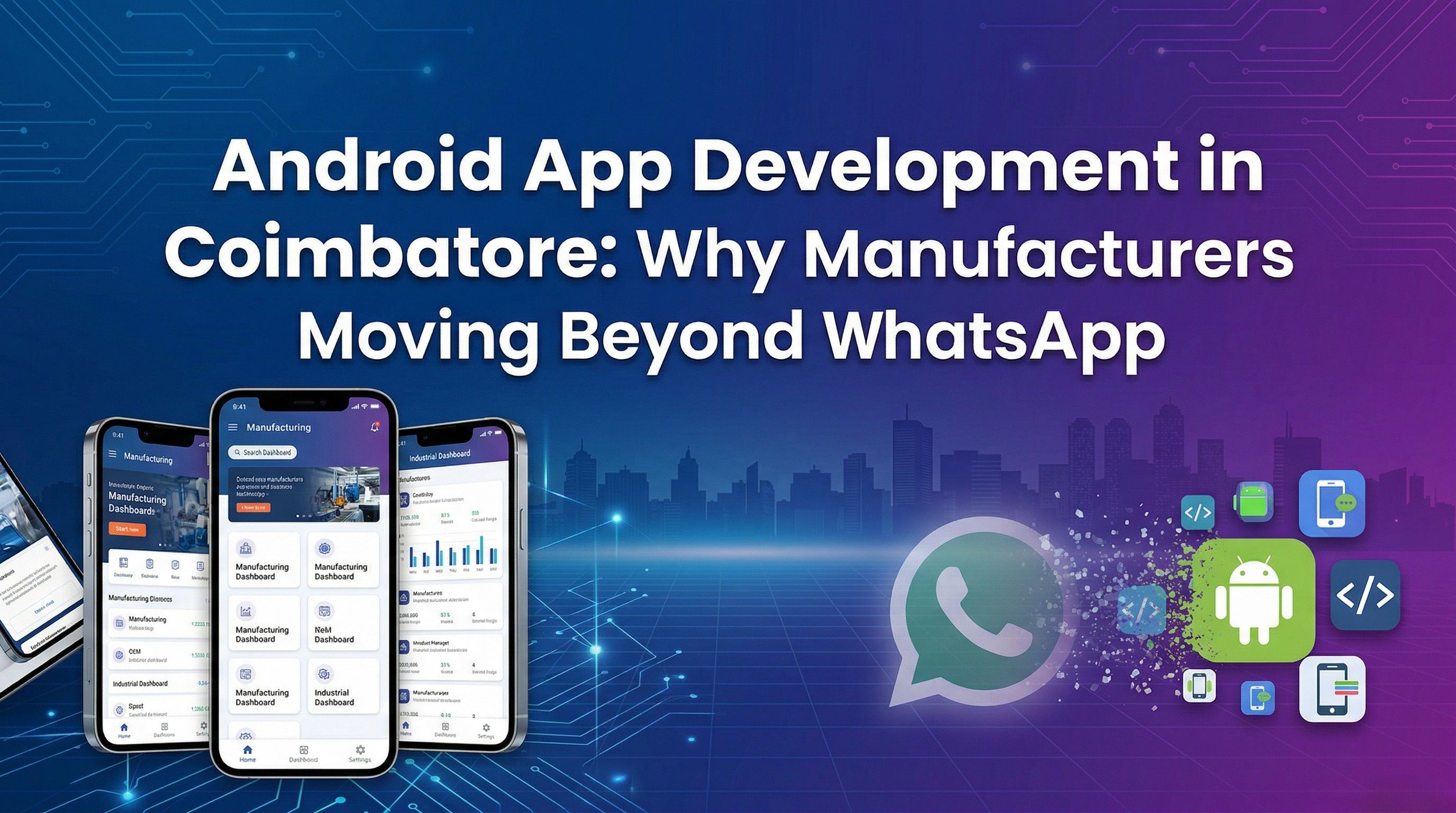
Android app development in Coimbatore is becoming increasingly important for manufacturers who are moving away from WhatsApp based operations. Walk into any manufacturing unit in Coimbatore’s SIDCO Industrial Estate or along Mettupalayam Road today, and you will find something that has quietly become the default operations tool for hundreds of businesses: WhatsApp. Order confirmations, daily attendance, quality check photos, delivery updates, and inventory requests — all running through group chats. It works, until it does not.
In 2026, a growing number of Coimbatore businesses — particularly manufacturers, textile exporters, and logistics companies — are making a deliberate shift. They are replacing informal WhatsApp workflows with purpose-built native Android applications. This is not a trend driven by technology for its own sake. It is being driven by operational pressure, and the numbers are starting to show it.
The WhatsApp Problem That Nobody Talks About
WhatsApp is free, familiar, and universally available on Android phones. For small businesses in Coimbatore, it was a natural first step toward digital communication. But as operations grow, the cracks become visible very quickly.
Consider a mid-sized textile exporter in Tiruppur managing orders from fifteen buyers across three states. Every order update happens on WhatsApp. Every stock query is a phone call or a message. By the time a message reaches the right person, gets actioned, and confirmation is sent back, two hours may have passed. Multiply that across twenty transactions a day. The inefficiency is invisible until someone starts measuring it.
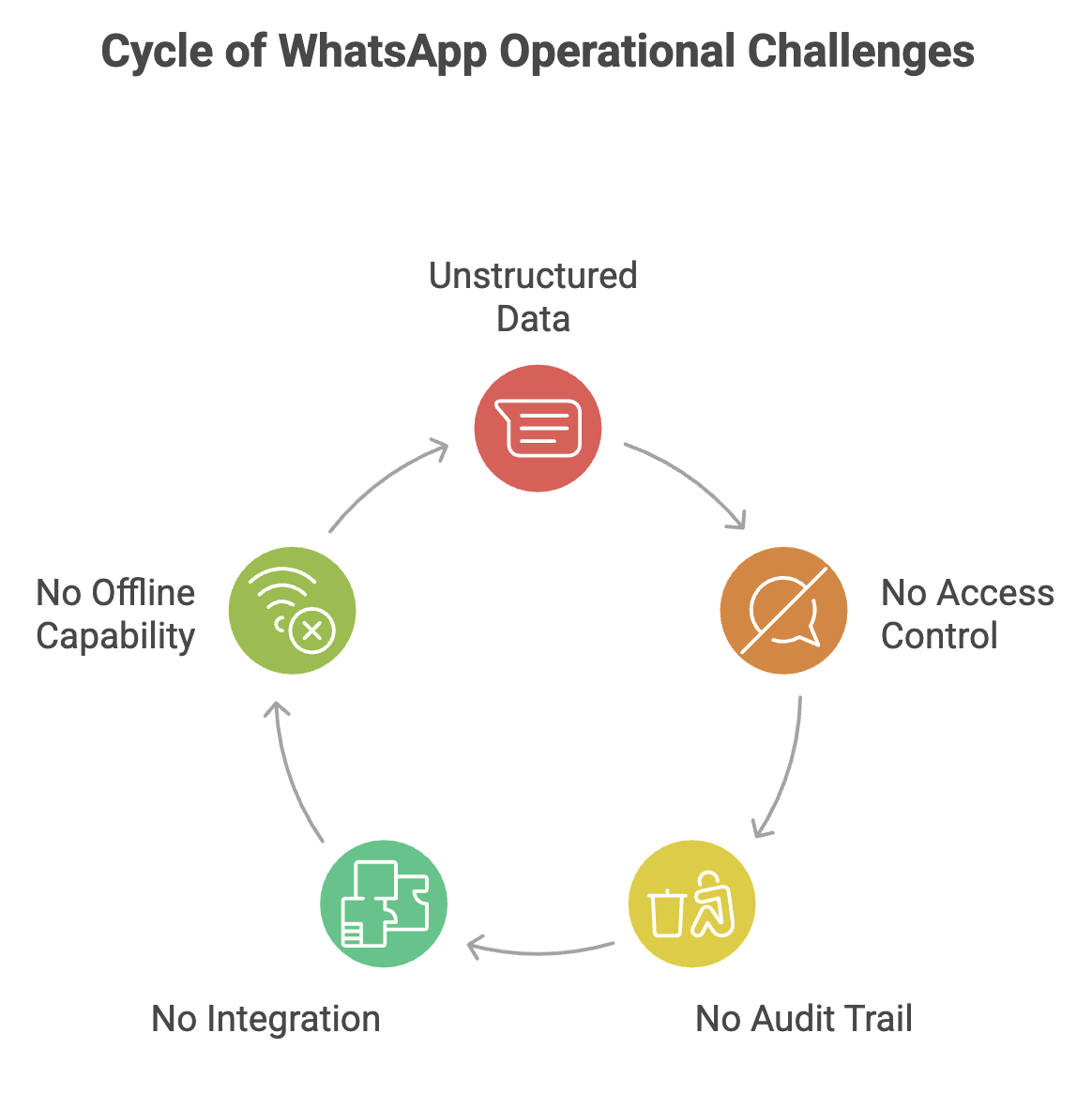
Here are the specific problems that Coimbatore manufacturers report most frequently with WhatsApp-based operations:
- No structured data — every message is unstructured text, making reporting impossible without manual extraction
- No access control — everyone in a group sees everything, including information meant only for managers
- No audit trail — deleted messages cannot be recovered, creating accountability gaps
- No integration — WhatsApp cannot connect to inventory software, billing systems, or ERP platforms
- No offline capability — field teams in areas with poor connectivity lose access entirely
None of these are small inconveniences. For a manufacturing business processing hundreds of transactions daily, each one represents a real cost — in time, errors, and missed opportunities.
Why Coimbatore Specifically Is Ready for This Shift
Coimbatore’s industrial base is different from that of metropolitan cities. The city’s manufacturing sector — spanning textiles, engineering goods, wet grinders, pump sets, and automotive components — is built on a foundation of mid-sized family businesses that have been running for decades. These are not startups. They have established operations, loyal workforces, and proven business models.
What they have historically lacked is affordable, practical technology that fits how they actually work — not how a software vendor in Bangalore assumes they work. That gap is closing in 2026 for three reasons.
First, Android smartphone penetration in Coimbatore’s workforce has crossed a threshold where deploying an app across an entire team is genuinely practical. Over 95% of workers in industrial areas of Coimbatore use Android devices, many running Android 10 or above.
Second, the cost of custom Android app development in Coimbatore has come down significantly. Five years ago, building a native Android application meant dealing with developers in larger cities, managing remote teams, and paying premium rates. Today, competent Android app development companies in Coimbatore build production-grade applications locally, at prices that make sense for mid-sized manufacturers.
Third, and most importantly, Coimbatore business owners are seeing peers make the shift and getting measurable results. Word spreads quickly in tight-knit industrial clusters like Peelamedu, Kurichi, and Singanallur.
What Native Android Apps Actually Replace — And What They Do Not
This is a point worth addressing directly, because the narrative around digital transformation often overpromises. Native Android apps do not replace your entire operation. They replace specific, well-defined workflows that currently have no structured digital home.
For a logistics company managing last-mile deliveries across Coimbatore and the Nilgiris, a native Android app can replace: the morning briefing call with route details, the end-of-day manual cash reconciliation, and the back-and-forth confirmation messages about delivery status. GPS tracking, digital signature capture, and real-time cash logging replace three separate informal processes in one application.
For a clinic in RS Puram managing patient appointments, a native Android app can replace: the phone call booking system, the handwritten register, and the reminder message sent manually by staff. It does not replace the doctor. It removes the administrative friction that wastes 40 minutes of staff time every morning.
For a textile exporter in Tiruppur, a native Android app can replace: twelve separate WhatsApp groups with a single structured order management dashboard accessible to the right people, with the right permissions, showing the right data in real time.
Why Native Android — Not Hybrid or Cross-Platform
When businesses in Coimbatore start exploring Android app development, they often encounter terms like React Native, Flutter, and Ionic — cross-platform frameworks that promise to build one app that works on both Android and iOS. For most Coimbatore manufacturers, this is a solution designed for a problem they do not have.
Given that nearly the entire workforce uses Android, there is no meaningful iOS user base to serve. Cross-platform development introduces compromises in performance and hardware integration that matter specifically in industrial environments — apps that need to work with the phone camera for quality inspection photos, GPS for route tracking, and Bluetooth for device connectivity cannot afford the overhead that hybrid frameworks introduce.
Native Android applications built in Kotlin run faster, consume less battery, and handle offline scenarios more reliably. For field workers using mid-range Android phones in areas with inconsistent internet, these are not minor differences. They determine whether the app is actually used or quietly abandoned.
Why Android App Development in Coimbatore Is Growing in 2026
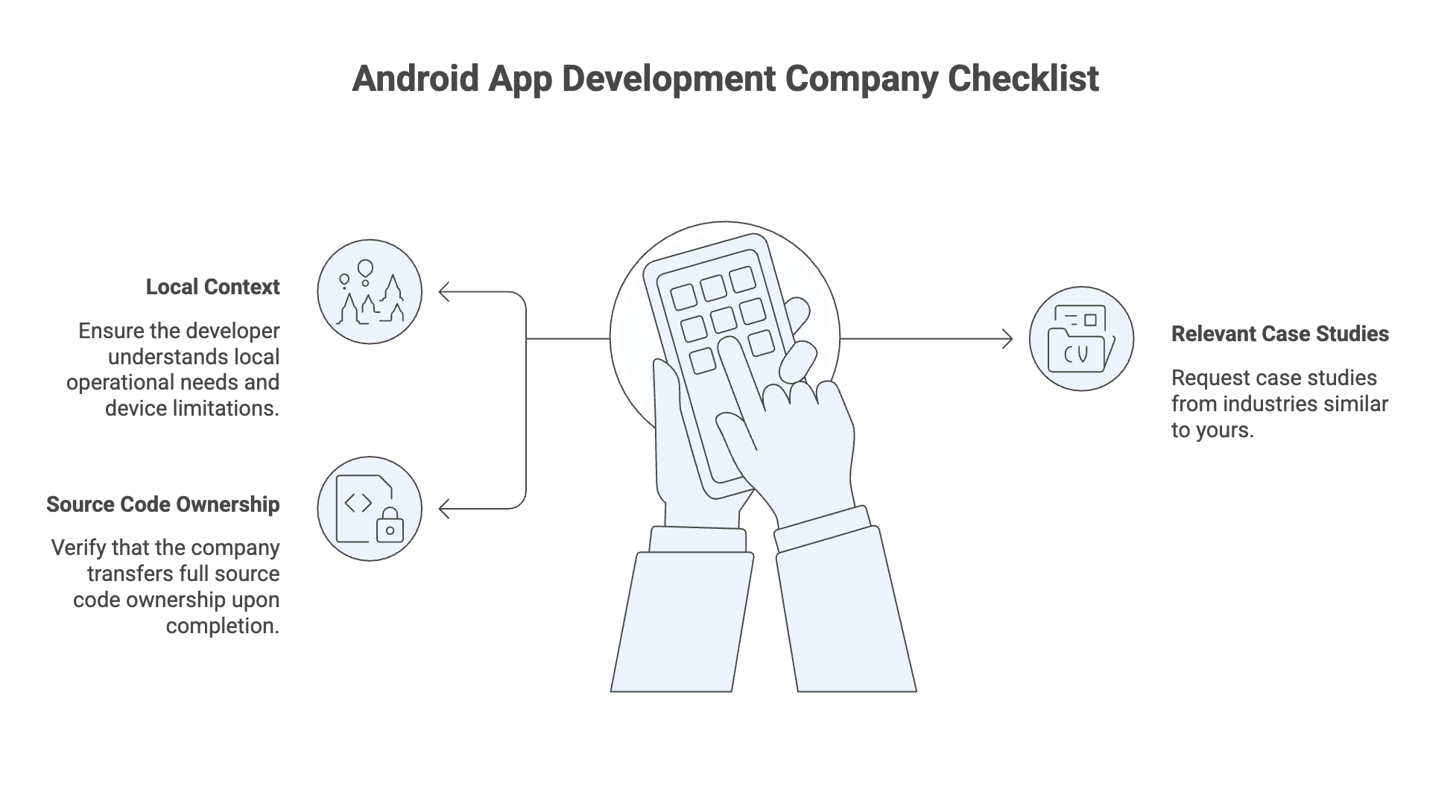
The growth of Android app development in Coimbatore means there are now many options available to local businesses. Not all of them are equal. Before committing to a development partner, there are specific things worth verifying.
Local operational context matters more than it might seem. A developer who has only built consumer apps for metro-based startups may not understand what it means to build for field workers on older Android devices, or for businesses that have never used software before and need interfaces that work clearly in both Tamil and English.
Ask for case studies from relevant industries. A portfolio of e-commerce apps does not tell you whether a team can build a reliable offline-capable inventory app for a factory floor. Ask specifically about projects in manufacturing, logistics, or healthcare — the sectors where Android app development in Coimbatore is generating the most practical value right now.
Verify source code ownership terms before signing. The best Android app development companies in Coimbatore transfer full source code ownership to the client on project completion. If a vendor requires you to pay ongoing fees to access your own application code, that is a structural problem worth avoiding.
The Cost Reality for Coimbatore Manufacturers in 2026
Android app development cost in Coimbatore varies based on what you are actually building. A focused MVP application that automates one or two core workflows — field team reporting, for example, or appointment booking — typically falls in the range of ₹2.5 to ₹5 lakh for a well-scoped project with a competent local team.
A full business application with multiple user roles, backend API integration, and ERP connectivity typically sits between ₹5 and ₹12 lakh depending on complexity. Enterprise-grade applications with custom backend architecture and offline sync protocols start above ₹12 lakh.
Compared to the ongoing cost of inefficient manual processes — missed orders, reconciliation errors, field team miscommunication, SaaS subscription fees — the investment typically pays back within the first year for businesses that have identified the right problem to solve.
The Shift Is Underway — And It Is Practical, Not Aspirational
The move from WhatsApp to native Android applications among Coimbatore manufacturers is not about following a technology trend. It is about solving specific operational problems that have been tolerated for too long because the alternatives used to be expensive, complicated, or built for someone else’s business context.
In 2026, those barriers are lower. The Android app developers are here. The devices are already in workers’ hands. The problems are clear and well-understood. What remains is the decision to move from a workaround to a solution.
If you are a manufacturer, logistics business, or healthcare provider in Coimbatore looking to replace informal workflows with a native Android application built specifically for how your operation works — Noukha builds exactly that. The conversation starts with your problem, not a proposal.
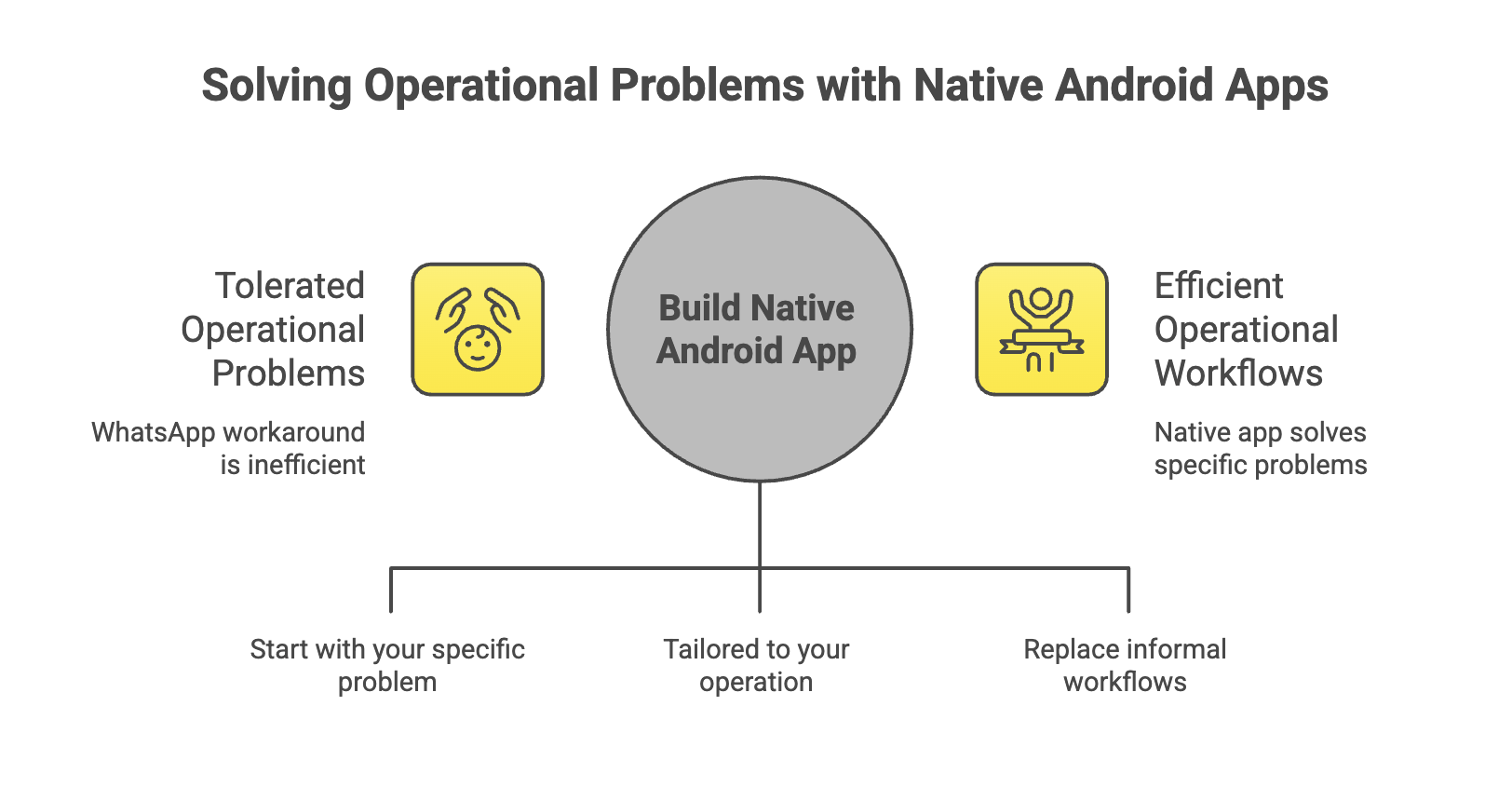
For businesses in Coimbatore and Tamil Nadu that have been managing operations through WhatsApp groups and informal processes, the move to a purpose-built Android application does not have to be complicated or expensive.
The right starting point is a direct conversation about the specific workflow causing the most friction in your operation right now — not a feature list, not a budget discussion.
Noukha is an Android app development company in Coimbatore that works with manufacturers in SIDCO and Peelamedu, textile exporters in Tiruppur, logistics businesses across the Nilgiris corridor, and healthcare providers in RS Puram — building Android applications around how those operations actually work, not how a software template assumes they work.
The first conversation is free and takes under an hour.