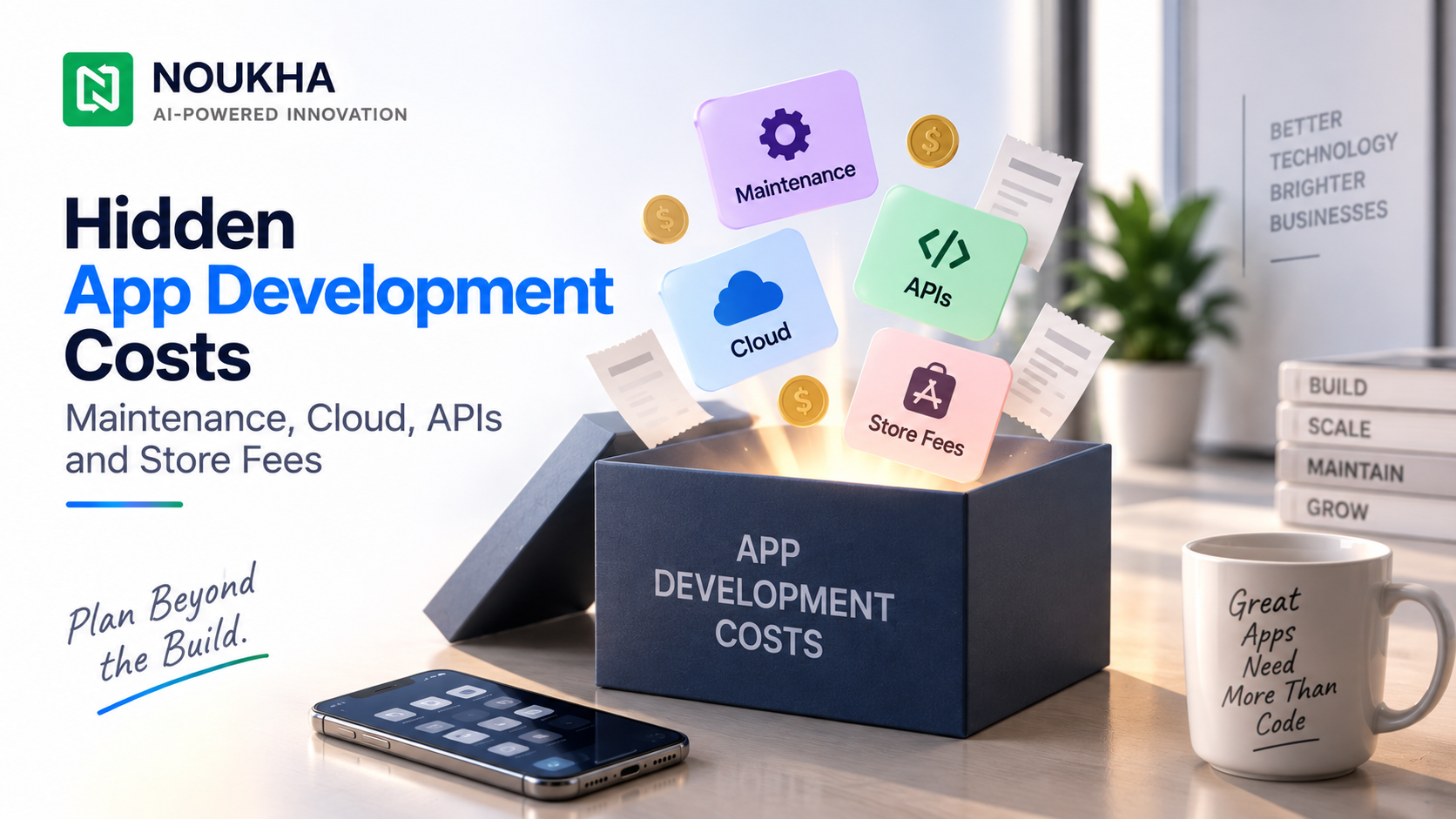
Hidden App Development Costs Maintenance Cloud APIs and Store Fees
An app budget is incomplete when it covers only design and initial development. A production product also needs cloud infrastructure, third party services, security work, store administration, monitoring, support and regular updates. These costs start during development and continue for as long as the app remains available.
The exact amount depends on usage, data sensitivity, integrations, release frequency and service levels. The useful planning method is to identify each cost driver, define its unit and model how it changes as users and transactions grow.
Maintenance is ongoing product work
Mobile operating systems, device behavior, libraries and store policies change. Maintenance covers compatibility updates, dependency upgrades, defect correction, performance tuning and routine release work. It should be planned as a recurring operating cost rather than an emergency reserve.
Separate corrective maintenance from product development. Fixing a crash or adapting to an operating system change keeps the current product working. Adding a new loyalty program changes the product. Combining both in one vague maintenance allowance makes forecasting and prioritization difficult.
Cloud cost grows with product behavior
Cloud invoices may include compute, databases, file storage, content delivery, logs, backups, network transfer and managed security services. User count alone does not explain cost. A video app, location app and text based workflow can have very different infrastructure profiles at the same number of active users.
Create estimates for launch, expected growth and a high usage event. Record assumptions such as requests per user, storage per account, average file size, retention period and outbound data. AWS provides a pricing calculator for planned workloads, and other major cloud providers offer equivalent tools. Revisit the estimate after real usage data becomes available.
Third party APIs create variable cost and dependency
Maps, messaging, identity verification, email, payments, analytics, artificial intelligence and media processing are often priced by request, user, message or transaction. A small pilot may remain within a free tier while a successful launch moves quickly into paid usage.
For each service, document the billable unit, included allowance, overage rate, regional availability, rate limits and fallback plan. Review whether retries or poorly designed workflows can multiply usage. Cost controls should include alerts, quotas and dashboards rather than relying on a monthly invoice to reveal a problem.
App store accounts and commercial fees
The Apple Developer Program currently lists a 99 US dollar annual membership fee, with local currency pricing where available. Google Play lists a 25 US dollar one time registration fee. These account fees are small compared with development, but the accounts should be owned by the publishing organization and included in launch planning.
Apps that sell digital goods or subscriptions may also be affected by store commissions and program rules. The applicable rate depends on the product, program eligibility, region and transaction structure. Confirm current terms directly with Apple and Google before finalizing a revenue model.
Privacy and store compliance require work
Apple requires developers to provide information about app privacy practices, including the practices of integrated third party code. Google Play requires developers to complete an accurate Data safety section. This means the product team must maintain a data inventory and understand what every software development kit collects or shares.
Compliance effort includes privacy review, consent flows, account deletion, retention rules, store declarations and evidence for regulated sectors. These tasks involve product, engineering and legal review. They should appear in the schedule and budget rather than being assigned to the final submission week.
Security costs begin before launch
Security work includes threat assessment, access controls, secure coding, dependency checks, code review, penetration testing, remediation and incident preparation. Sensitive applications may also need audit logging, stronger identity controls, independent assessments or regulatory documentation.
Budget for remediation after testing. A security review that finds problems without time to correct and retest them does not make the product ready. The cost model should include both assessment and response.
Quality assurance needs devices and environments
Testing requires representative phones, tablets, operating system versions, network conditions and account states. Teams may also need device cloud services, test automation infrastructure, sandbox accounts and test data. The matrix expands when the app supports accessibility, multiple languages, payments or offline behavior.
A small device sample can miss failures that affect important user groups. Define supported devices and minimum versions before estimating QA. The decision affects development, testing and ongoing compatibility work.
Operations and customer support continue after release
Production apps need crash reporting, performance monitoring, log retention, uptime alerts and an incident process. Customer support needs tools, response targets and a route to engineering when a defect blocks users. These costs rise with product complexity and service expectations.
Plan for store reviews, release notes, phased rollouts and emergency updates. A product with weekly releases needs more release operations than one with quarterly changes, even when both have the same user count.
Cost planning table
| Cost area | Typical unit | Main driver | Control |
| Cloud infrastructure | Monthly usage | Traffic storage and data transfer | Budgets alerts and architecture reviews |
| APIs and services | Request user or transaction | Feature usage and retries | Quotas monitoring and fallback design |
| Maintenance | Monthly team capacity | Change frequency and technical debt | Planned backlog and upgrade calendar |
| Security | Assessment and remediation | Data sensitivity and risk | Requirements testing and ownership |
| Store operations | Account and transaction terms | Platforms and revenue model | Owned accounts and policy review |
| Support | Team time and tools | Users complexity and service level | Triage process and product analytics |
Noukha’s mobile app development cost guide for the USA provides the main project cost framework. Teams comparing delivery options can also review the mobile app development company in USA page.
Build a twelve month operating forecast
- List every recurring service and its billable unit.
- Estimate launch expected and high usage scenarios.
- Separate maintenance from new product features.
- Include security compliance testing and remediation.
- Assign owners for cloud API and store spending.
- Review actual cost per active user and per transaction each month.
- Update the forecast before major campaigns releases or integrations.
Frequently asked questions
How much should a company reserve for app maintenance
There is no reliable universal percentage. Estimate the team capacity required for compatibility updates, defects, dependency upgrades, monitoring and release work. Products with sensitive data, many integrations or frequent releases need a larger recurring allowance.
Are cloud costs high for a new app
They can be modest at low usage, but the architecture and data profile matter. Video, large files, artificial intelligence requests and heavy data transfer can create cost before the user base becomes large.
Are Apple and Google developer fees the only store costs
No. Account fees are only one category. Digital goods and subscriptions may be subject to commissions and program terms. The team must also budget for store assets, privacy declarations, review responses and release operations.
Which app costs are easiest to miss
Third party API usage, log storage, security remediation, customer support, accessibility testing, analytics changes and operating system upgrades are often omitted from the first estimate.
Final recommendation
Approve an app budget only after the team has modeled the first year of operation. Development creates the product. Maintenance, infrastructure, services, security and support keep it usable. A clear cost model gives each item a unit, an owner and a growth assumption.