Table of Contents
- Introduction
- Why AI App Development Has Become a Business Priority
- Why Enterprises Prefer an AI App Development Company in USA
- Key Business Benefits of Partnering with a US AI App Development Company
- Industries Driving Demand for AI App Development in 2026
- What Enterprises Should Look for Before Choosing an AI App Development Company in USA
- Why 2026 Is the Right Time to Invest in AI-Powered Applications
- Conclusion
- Frequently Asked Questions
Introduction
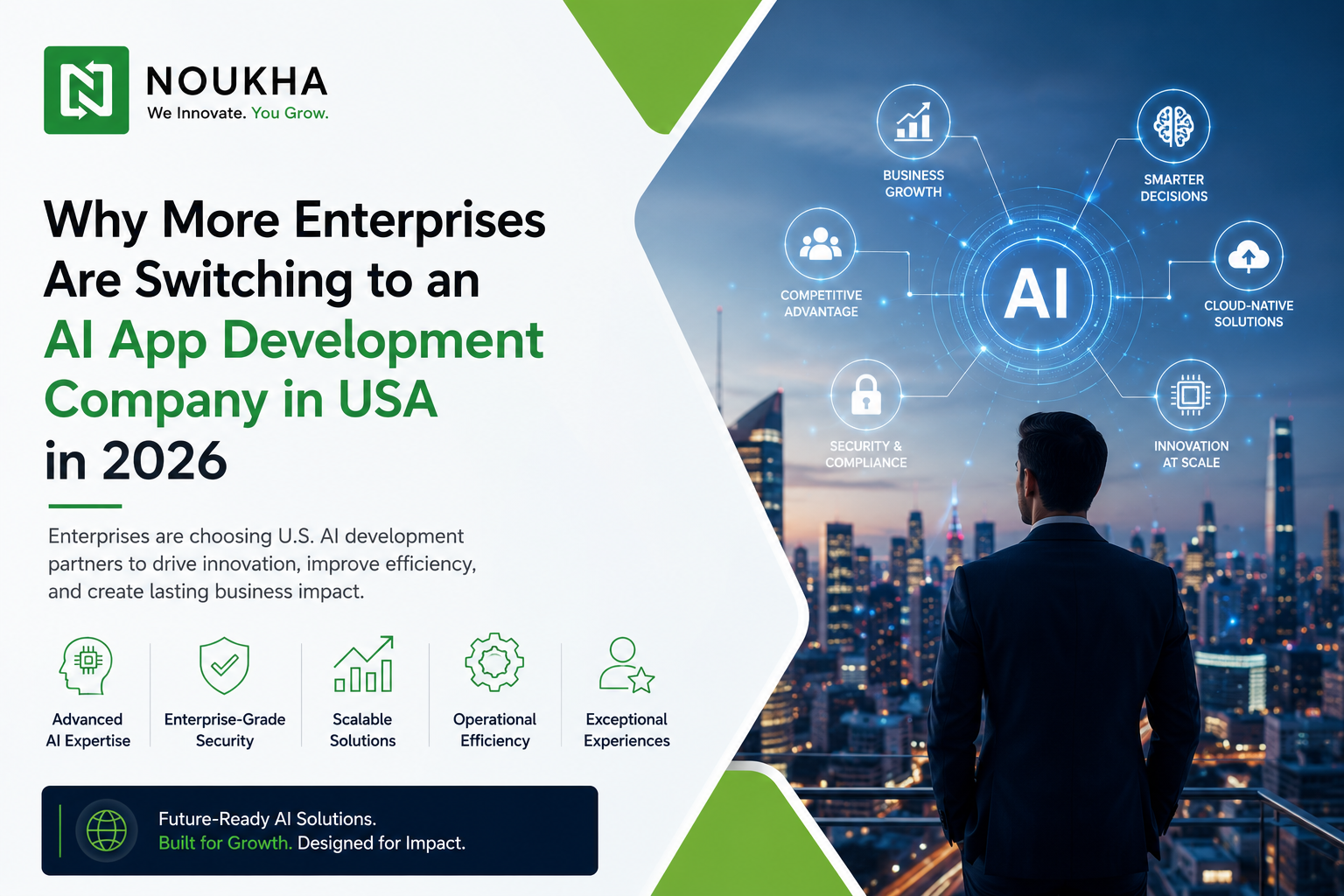
Something shifted in how enterprise leaders talk about AI between 2024 and today. The conversations have moved from exploration to execution. Boards are no longer asking whether AI belongs in the product roadmap. They are asking why deployment is taking so long. That urgency is one of the clearest signals of why working with a specialized AI App Development has become a deliberate strategic choice rather than a vendor preference.
The switch is not just about capability. It is about finding partners who understand the full weight of enterprise AI delivery: the compliance environment, the integration complexity, the data governance requirements, and the organizational change that comes with AI adoption at scale. This article examines what is driving that shift and what enterprises should look for when making the move.
Why AI App Development Has Become a Business Priority
Three years ago, AI projects lived in innovation labs and innovation budgets. Today, they sit inside core product plans and operational transformation initiatives. That migration happened because the technology matured faster than most forecasters anticipated, and the early movers in enterprise AI are now reporting outcomes that are impossible to ignore.
AI application development services are delivering measurable returns in process automation, customer experience quality, and data-driven decision-making. Machine learning solutions that once required months of specialist effort to configure are now accessible through development frameworks that experienced teams can deploy at a fraction of the previous cost and timeline.
What has not simplified is the implementation work. Building AI-powered applications that actually perform in production, integrate cleanly with existing systems, and hold up under enterprise security scrutiny is still complex work that requires genuine expertise. That is the capability gap driving enterprises toward dedicated AI development partners.
Why Enterprises Prefer an AI App Development Company in USA
Access to Advanced AI Expertise
The concentration of AI engineering talent, research output, and production deployment experience in the US technology sector is significant. Firms operating in this environment have direct access to the latest advances in large language models, computer vision, natural language processing, and AI automation, and they are applying those advances in production environments, not just research settings.
For enterprise buyers, this means development partners who are not learning on the job. They have shipped AI applications, dealt with the failure modes that only appear at scale, and built the operational practices that keep AI systems performing reliably over time.
Strong Focus on Security and Compliance
Security standards in US-based enterprise software development are shaped by some of the most demanding regulatory environments in the world. Development teams that routinely work with healthcare organizations, financial institutions, and government contractors build compliance into their engineering practice rather than treating it as a final-stage review.
For enterprises evaluating AI integration services, this means the difference between a partner who can deploy into your production environment and one who creates new risk exposure in the process. Data governance, access controls, audit logging, and model explainability are treated as engineering requirements, not optional features.
Scalable Enterprise-Grade Solutions
Cloud-based AI applications that perform well in a pilot environment often fail when they encounter production load, real user behavior, and the complexity of live data. US-based AI development companies with enterprise experience architect for scale from the beginning, which means infrastructure decisions, API design, and model serving approaches that hold up as the business grows.
Scalable AI applications are not simply more powerful versions of the same tool. They are designed with the assumption that requirements will change, data volume will increase, and new use cases will emerge. That architectural discipline is what distinguishes enterprise-grade AI development from rapid prototyping.
Faster Innovation and Technology Adoption
The pace of change in AI technology is unlike anything in previous software cycles. New model capabilities, development frameworks, and deployment patterns emerge continuously. Development teams embedded in this environment adopt and evaluate new capabilities as part of their standard practice, which means enterprise clients benefit from advances without needing to track them internally.
Key Business Benefits of Partnering with a US AI App Development Company
Improved Operational Efficiency
Business process automation built on AI handles tasks with a depth and flexibility that traditional rule-based systems cannot match. AI agents read context, adapt to variation in inputs, and complete workflows that previously required human review at every exception. The result is higher throughput at lower cost per transaction, with fewer errors and faster cycle times.
Better Customer Experiences
Natural language processing and AI mobile app development capabilities allow businesses to build customer-facing applications that understand intent and respond intelligently. Whether that is a support interface, a product recommendation engine, or a personalized content experience, the quality gap between AI-powered and conventional implementations is visible to customers and measurable in satisfaction data.
Data-Driven Decision Making
Predictive analytics built into enterprise workflows give leaders access to forward-looking intelligence that historical reporting cannot provide. Supply chain disruptions, demand pattern shifts, churn risk, and revenue opportunities become visible earlier, which means decision-makers can act on information rather than react to outcomes.
Long-Term Cost Optimization
The ROI case for AI product development is strongest when it is evaluated over a multi-year horizon. Initial development investment is offset by reductions in labor cost for automated processes, lower error rates in data-intensive workflows, and improved customer retention from better experiences. Organizations that measure AI returns over eighteen to twenty-four months consistently find stronger results than those evaluating against short-term metrics.
For enterprises mapping out what an AI engagement looks like in practice, Noukha’s AI application development services offer a structured path from use case identification through production deployment, designed around measurable business outcomes.
Industries Driving Demand for AI App Development in 2026
Healthcare
Clinical documentation, prior authorization, patient communication, and diagnostic support workflows are being redesigned around AI capabilities. The productivity recovery for clinical staff and the accuracy improvements in documentation are producing clear operational benefits, with compliance requirements making the custom development approach a necessity rather than a preference.
Financial Services
AI consulting services and development partnerships are helping banks, insurers, and investment firms accelerate fraud detection, automate regulatory reporting, and build personalized financial experiences. The speed and accuracy improvements in credit decisioning and risk analysis are among the most clearly documented enterprise AI outcomes to date.
Retail and Ecommerce
Demand forecasting, AI-powered search, dynamic pricing, and automated customer service are central to how leading retailers are pulling ahead of competitors still relying on conventional platform capabilities. The conversion rate and retention improvements from well-implemented AI personalization are measurable and persistent.
Manufacturing
Computer vision systems for quality control, predictive analytics for equipment maintenance, and AI-assisted production planning are delivering measurable improvements in yield, uptime, and throughput. Manufacturing AI applications have moved well past the pilot stage at organizations that started early, with the benefits now visible at the operational reporting level.
Logistics and Supply Chain
Route optimization, inventory forecasting, disruption detection, and documentation automation are all areas where AI applications are producing direct cost and reliability improvements in logistics operations. The complexity of supply chain data makes this one of the strongest natural fits for machine learning solutions in any industry.
What Enterprises Should Look for Before Choosing an AI App Development Company in USA
AI Technology Expertise
Look for demonstrated experience with the specific technologies your use case requires, whether that is large language models, computer vision, predictive analytics, or AI automation frameworks. Ask for production examples and ask about failure modes. A team that has shipped AI applications knows what goes wrong and how they handled it.
Industry Experience
Domain knowledge reduces delivery risk significantly. A partner who understands your industry’s data environment, compliance requirements, and user expectations will produce better-fit solutions and require less time on context-setting. Generic AI development experience does not substitute for understanding the specific operational context your application needs to work within.
Development Process
AI development is iterative. Requirements evolve as model outputs are evaluated against real data. An agile development process that supports adaptation and keeps stakeholders informed throughout is better suited to AI delivery than a fixed-scope approach that becomes misaligned before the project concludes.
Security Standards
Verify that your development partner’s security practices meet your organizational requirements before engagement begins. Data handling policies, access controls, model governance, and compliance certifications should be documented and verifiable. Security standards that are unclear at the evaluation stage rarely improve once a project is underway.
Post-Launch Support
AI models require ongoing maintenance. Data distributions shift, user behavior changes, and business requirements evolve. A development partner who offers structured post-launch support, including monitoring, retraining pipelines, and performance optimization, is more valuable over time than one whose engagement ends at deployment.
Why 2026 Is the Right Time to Invest in AI-Powered Applications
The maturity of the current AI development ecosystem makes 2026 a particularly favorable time to invest. Foundation models are stable enough for production use, deployment infrastructure is proven, and the pool of enterprises with documented AI ROI is large enough to inform realistic business cases. The risk profile for AI investment is meaningfully lower than it was two years ago.
At the same time, the competitive dynamic is accelerating. Organizations that have been building AI capability for eighteen to twenty-four months now have data assets, fine-tuned models, and operational AI practices that function as genuine competitive advantages. The gap between early movers and late adopters is not narrowing. It is widening with each quarter that passes.
Digital transformation through AI is no longer a forward-looking initiative. It is a present-tense competitive requirement for enterprises that want to maintain their market position. The window for investing ahead of the curve has not closed, but it is narrowing.
Enterprises ready to evaluate their AI investment options can find a practical starting point by reviewing the enterprise AI development services offered by Noukha, where the focus is on building toward outcomes that matter to the business rather than technology demonstrations.
Conclusion
The shift toward specialized AI App Development Companies in USA reflects a broader maturation in how enterprises approach AI investment. The organizations making this move are not chasing trends. They are responding to the reality that AI capability has become a competitive factor, and that building it well requires partners with the depth to deliver it at enterprise standards.
Choosing the right AI development partner in 2026 means looking for technical expertise, industry experience, proven security practices, and the ability to support AI applications over time as requirements evolve. Those qualities are what separate development relationships that produce lasting business value from engagements that generate activity without delivering outcomes.
If your organization is evaluating AI development partners and wants to understand what a well-structured engagement looks like, the team at Noukha is available to discuss your requirements and help you map a path from your current position to the AI capabilities your business needs.
Frequently Asked Questions
Why should enterprises choose a US-based AI app development company over offshore alternatives?
US-based AI development companies offer advantages in regulatory compliance, data governance standards, time zone alignment for enterprise clients, and access to the latest AI research and tooling. For enterprises operating in regulated industries or handling sensitive data, the compliance infrastructure that US firms operate within is often a deciding factor.
What types of AI applications do enterprise development companies typically build?
Enterprise AI development companies build a wide range of applications including intelligent process automation systems, AI-powered customer service platforms, predictive analytics tools, natural language processing applications, computer vision systems, and AI-integrated mobile and web applications. The specific scope depends on the business use case and existing technology environment.
How should enterprises evaluate the ROI of AI app development before committing to a project?
ROI evaluation should begin with identifying the specific process or outcome the AI application is intended to improve, then establishing baseline metrics for that process. Common ROI inputs include labor hours per transaction, error rates, customer satisfaction scores, and cycle times. A qualified development partner will help structure a pre-project business case and identify the measurement framework needed to track returns accurately after deployment.