Table of Contents
- Introduction
- Why Businesses Are Moving Beyond Traditional Chatbots
- The Rise of AI Employees: What Has Changed?
- Why Custom AI App Development Is the Driving Force
- Real Business Use Cases Across Industries
- The Technologies Powering the New Generation of AI Apps
- Key Considerations Before Building an AI Employee
- What the Future Holds for AI-Driven Businesses
- Frequently Asked Questions
Introduction
Businesses have spent the last few years experimenting with AI chatbots to automate customer support, answer routine questions, and shorten response times. These tools delivered real value, but they also revealed clear limits. Today’s organizations need AI systems that understand business processes, draw on internal knowledge, work across departments, and complete meaningful tasks with little human oversight.
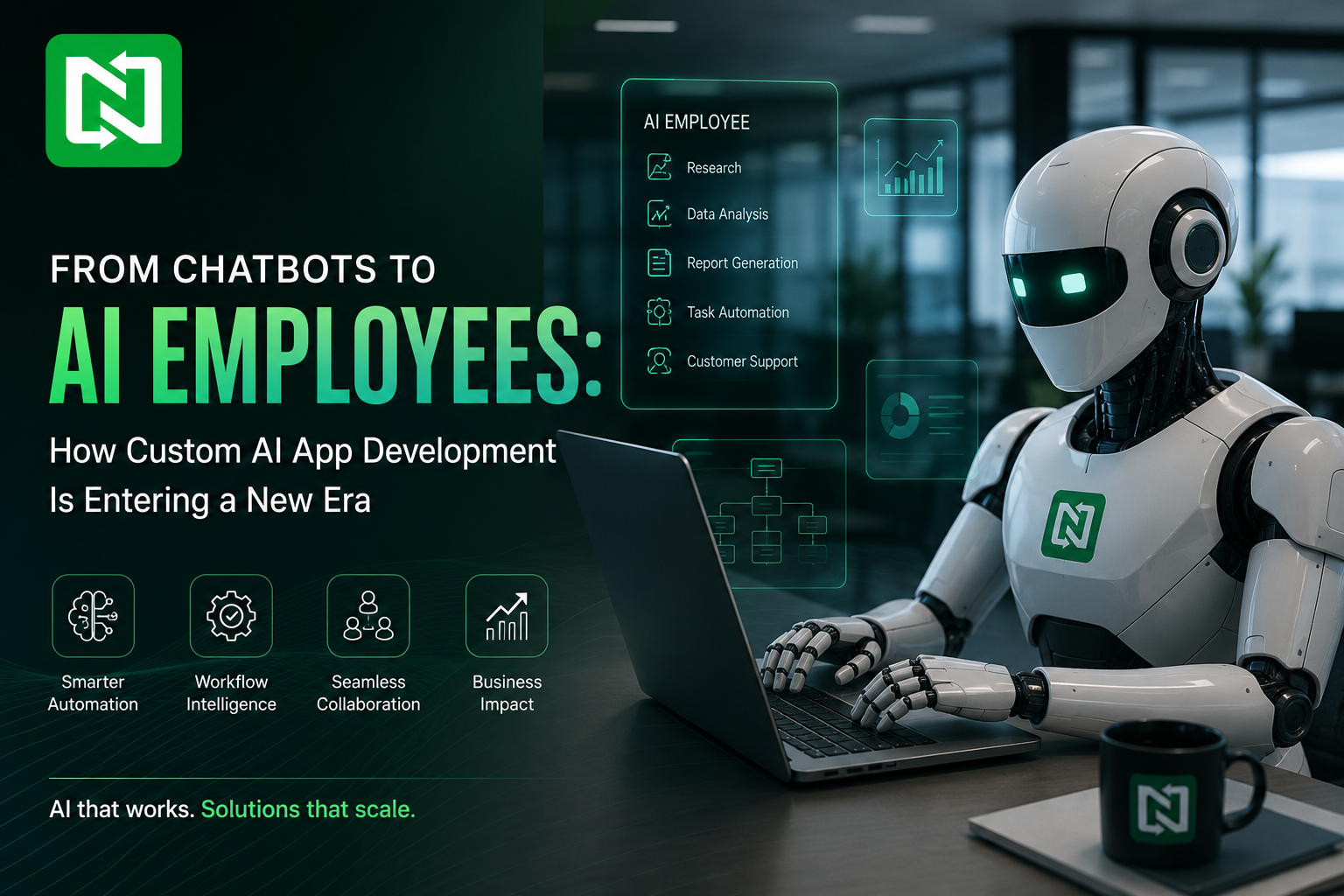
That shift has given rise to AI employees: intelligent applications built to handle complete workflows rather than simply reply to messages. Behind this transformation is custom AI app development, which allows businesses to build AI solutions shaped around their own operations, data, and goals rather than settling for generic tools.
This article looks at why companies are moving past traditional chatbots, how AI employees are changing daily operations, and why custom AI applications have become a strategic investment rather than a passing experiment.
Why Businesses Are Moving Beyond Traditional Chatbots
Chatbots Solved Only Part of the Problem
Early chatbots were built around scripted conversations. They could answer common questions but struggled the moment a request fell outside their predefined paths. Most had little real understanding of a company’s products, policies, or internal data, and none could take independent action. A chatbot could tell a customer how to reset a password, but it couldn’t actually update a record, flag an exception, or route the issue to the right team without a human stepping in.
Modern Businesses Need More Than Conversations
Companies now expect more from their AI investment. They want systems that can automate multi-step workflows, support decisions with real data, connect across the software platforms they already use, and improve over time by learning from organizational information. This is less about answering questions and more about getting work done, which is exactly where AI employees come in.
The Rise of AI Employees: What Has Changed?
What Is an AI Employee?
An AI employee is an application designed to carry out operational work, not just hold a conversation. Instead of waiting for a question and returning a static answer, it can review information, apply business logic, and complete a task from start to finish, much like a team member handling a defined role.
Capabilities That Define AI Employees
A few capabilities separate AI employees from earlier generations of AI tools:
- Autonomous task execution without step-by-step prompting
- Multi-step reasoning across a sequence of related actions
- Business process automation tied to real operational workflows
- Collaboration with existing software, from CRMs to internal databases
- Context-aware decision making based on company-specific data
Together, these capabilities allow an AI employee to function as a working part of a team rather than a support widget bolted onto a website.
Why Custom AI App Development Is the Driving Force
Every Business Operates Differently
No two companies run identical workflows, even within the same industry. A generic AI product, built to serve thousands of businesses at once, can only offer a narrow, one-size-fits-all experience. It cannot account for a specific approval chain, a proprietary pricing model, or the exact way a support team escalates issues.
Building AI Around Business Processes
Custom development closes that gap. It allows an AI system to be shaped around a company’s actual data, internal workflows, business rules, security requirements, and industry compliance obligations. An AI app development company can design an AI employee that reflects how a business genuinely operates, rather than forcing the business to adapt to a rigid template.
Long-Term Competitive Advantage
A custom AI application also behaves differently from a typical software subscription. It grows with the business, adapts as processes change, and becomes a durable operational asset rather than a licensed tool that resets in value the moment the subscription ends. Over time, that difference compounds into a meaningful competitive edge.
Real Business Use Cases Across Industries
AI employees are already reshaping operations across sectors:
- Healthcare: intelligent scheduling, patient intake support, and administrative documentation assistance
- Finance: automated compliance checks, fraud pattern review, and faster client onboarding
- Manufacturing: predictive maintenance alerts and supply chain coordination
- Retail and Ecommerce: personalized product recommendations and automated inventory decisions
- Enterprise Operations: internal knowledge assistants, HR workflow automation, and cross-team reporting
Each of these examples reflects the same underlying pattern: AI moving from answering questions to performing defined, valuable work.
The Technologies Powering the New Generation of AI Apps
Large Language Models (LLMs)
Large language models give AI applications the ability to understand and generate natural language, forming the reasoning core behind most modern AI employees.
AI Agents
AI agents extend LLMs with the ability to plan, take action, and use external tools, which is what allows an AI employee to complete tasks rather than just describe them.
Retrieval-Augmented Generation (RAG)
RAG connects an AI application to a company’s own documents and data sources, so responses are grounded in accurate, current information instead of general knowledge alone.
Model Context Protocol (MCP)
MCP standardizes how AI systems connect to external tools and data sources, making it easier to build AI applications that integrate cleanly with existing business software.
Enterprise Integrations
Strong enterprise AI solutions connect directly into the platforms a business already relies on, from CRMs and ERPs to internal databases, so AI employees can act within existing systems rather than alongside them.
Key Considerations Before Building an AI Employee
Define Business Objectives
A successful AI employee starts with a clear problem to solve, not a general desire to “add AI.” Specific objectives shape scope, design, and success measures.
Data Quality
AI systems are only as reliable as the data behind them. Clean, well-organized, accessible data is a prerequisite for accurate, trustworthy outputs.
Security and Governance
Any AI application handling business or customer data needs proper access controls, monitoring, and compliance safeguards built in from the start, not added afterward.
Choosing the Right AI Development Partner
The right partner brings technical depth in AI application development along with an understanding of business process automation, security, and industry-specific compliance, which is often the difference between a proof of concept and a production-ready AI employee.
What the Future Holds for AI-Driven Businesses
AI is steadily moving into every business function, from operations and finance to customer experience and internal support. As this happens, the businesses that treat AI as a customized extension of their own processes, rather than a generic add-on, will build a clearer competitive advantage than those relying on off-the-shelf tools alone.
Preparing for this shift means investing in intelligent workflow automation now, while AI application development is still maturing and the field for differentiation remains wide open. Businesses that begin building this foundation today, through thoughtful custom AI solutions, will be far better positioned as AI transformation becomes standard practice rather than a competitive differentiator.
Frequently Asked Questions
What is the difference between a chatbot and an AI employee?
A chatbot is designed to answer questions within a limited conversational scope. An AI employee goes further, completing multi-step tasks, applying business logic, and working across systems with minimal human input.
Why is custom AI app development better than off-the-shelf AI tools?
Off-the-shelf tools offer a generic experience built for a broad market. Custom AI app development is shaped around a specific company’s data, workflows, and compliance needs, which leads to more accurate, relevant, and useful outcomes.
Which industries benefit the most from AI employees?
Healthcare, finance, manufacturing, retail, and enterprise operations are seeing some of the clearest gains today, though any industry with repetitive, data-heavy workflows stands to benefit from AI employees.
AI employees represent a meaningful step beyond the chatbot era, and businesses that invest early in tailored solutions are positioning themselves for long-term advantage. If you’re exploring what this could look like for your organization, contact our team to talk through your goals and how a custom AI employee could fit into your operations.