
Introduction
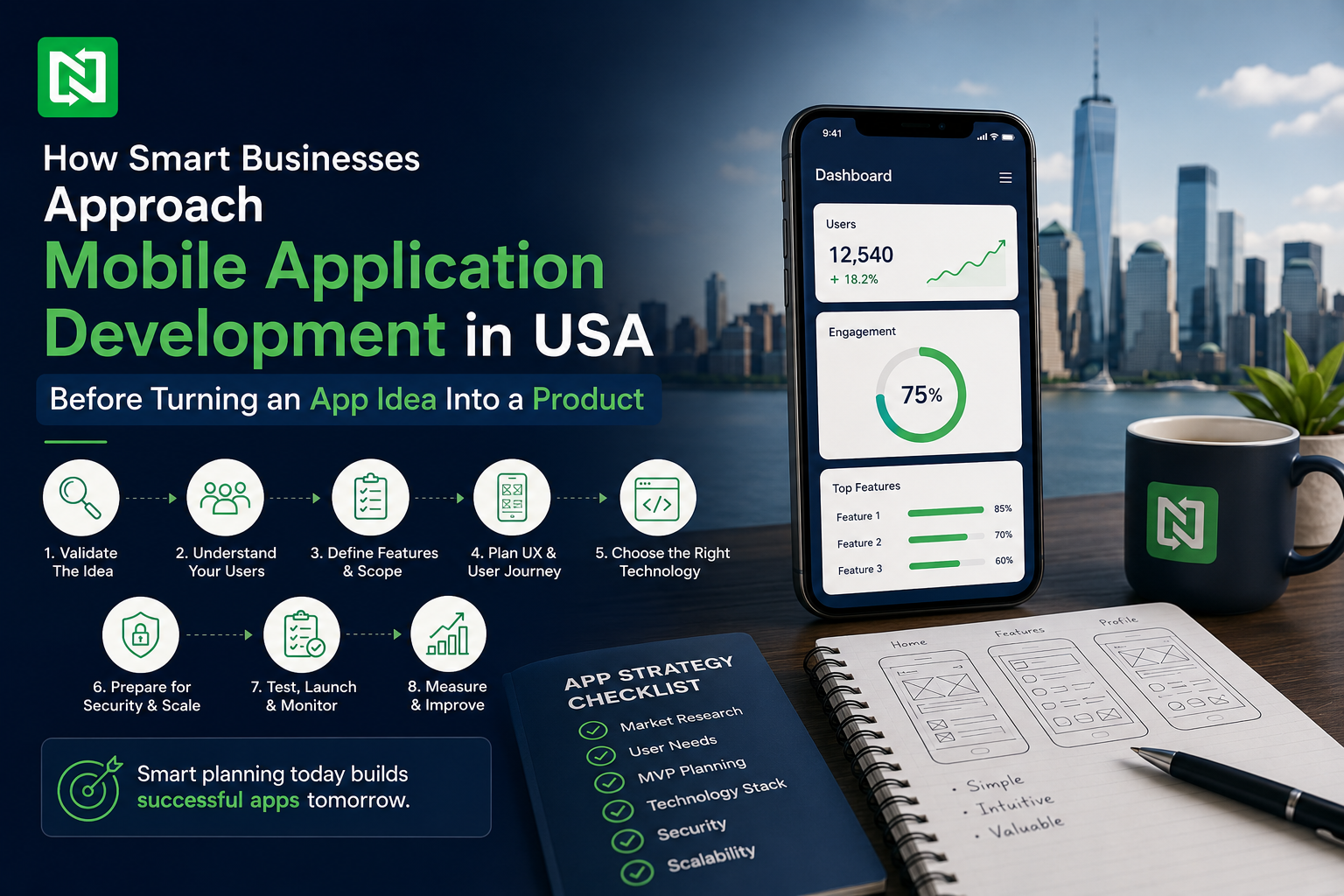
Most people assume that building an app begins with writing code. In practice, the decisions that matter most usually happen long before a single line of code is written. Businesses that succeed with Mobile App Development in USA approach the process methodically, starting with a clear understanding of the problem they are solving, the users they are solving it for, the market they are entering, the functionality the product actually requires, the technical constraints they will operate within, and the way success will eventually be measured.
Planning is often misread as a way of slowing things down. In reality, it exists to reduce uncertainty before significant time, budget, and engineering effort are committed. A business that spends a few weeks validating assumptions almost always saves months of rework later. This article walks through the practical steps that smart businesses take before development begins, and why each step protects the eventual product.
Validating the App Idea
Before any design or development work starts, it is worth asking a direct question: does this app solve a real problem for real people? Many app ideas fail not because the technology was poorly built, but because the underlying need was never confirmed.
A useful validation process typically examines:
- Existing alternatives, including competitors and informal workarounds people already use
- Genuine user pain points, rather than assumed ones
- Evidence of market demand
- How competitive solutions currently perform, and where they fall short
Once these questions are explored, businesses can use practical, low-cost validation methods rather than relying on guesswork:
- Customer interviews that surface real language and real frustrations
- Short surveys distributed to a relevant audience
- Clickable prototypes that simulate the experience without full development
- Landing pages that test interest before a product exists
- Small-scale experiments, such as limited pilot groups
Early validation does not guarantee success, but it substantially reduces the risk of investing heavily in an idea that users do not actually want or need.
Understanding the Target Users
Once there is reasonable confidence in the problem, the next step is understanding exactly who the app is for. Skipping this stage often leads to products that are technically functional but practically unused.
Businesses generally look at:
- Demographics, where genuinely relevant to product decisions
- Digital behaviour, including the devices and platforms users already rely on
- Underlying needs, not just stated preferences
- Technical familiarity and comfort with mobile interfaces
- Expectations around speed, simplicity, and support
User journey mapping is one of the more effective tools here. It typically covers four stages:
- Before opening the app, including how a user discovers it and what motivates the first download
- During onboarding, when first impressions and early friction are formed
- During the primary task, which represents the core value the app is meant to deliver
- After completing the task, including whether the user returns or recommends the app to others
This kind of research directly shapes which features matter and how the interface should be designed, rather than leaving those decisions to assumption.
Defining Features and Product Scope
With a validated idea and a clear picture of the target user, businesses can begin defining what the product actually needs to do. A common mistake at this stage is trying to build everything at once.
It helps to separate features into clear categories:
- Core functionality that delivers the primary value of the app
- User-facing features that support day-to-day use
- Administrative features needed to manage content, users, or operations
- Integrations with existing systems or third-party services
- Future enhancements that can wait until later versions
This is where MVP planning becomes important. A minimum viable product should represent the core value proposition of the app in a usable form, not simply an incomplete or stripped-down version of the final product. The goal is to release something that solves the primary problem well, gather real feedback, and expand from there with evidence rather than assumption.
Planning UX and the Customer Journey
Before development begins, the experience of using the app should already be designed. This includes wireframes that map out screen structure, user flows that define how someone moves from one action to the next, and prototypes that allow early testing of navigation and information architecture.
Good UX planning also accounts for how apps are actually used in the real world, not just how they appear in a design file. This includes:
- Different screen sizes and device types
- Slow or unreliable network connections
- Accessibility for users with different needs
- One-handed usage, which is common on mobile devices
- Error states that clearly explain what went wrong
- Empty states that guide users when there is no content yet
Businesses that work with experienced mobile app development services tend to treat UX as a planning discipline rather than a final polish step, because decisions made here directly affect development complexity later.
Selecting Technology and Architecture
Technology decisions should follow product requirements, not the other way around. One of the earliest choices is whether to build natively for a single platform or use a cross-platform approach that targets multiple platforms from a shared codebase. Each option carries practical trade-offs around performance, development speed, and long-term maintenance.
Beyond that initial choice, businesses need to consider the full technology stack:
- Frontend frameworks and mobile interface tools
- Backend systems that handle business logic
- APIs that connect the app to other services
- Databases suited to the type and volume of data involved
- Cloud infrastructure for hosting and scaling
- Analytics tools for measuring usage
- Third-party services for functions like payments or notifications
Technology choices should be driven by actual product requirements, the needs of the target users, expected performance, security considerations, required integrations, and long-term maintainability, rather than simply following current trends.
Preparing for Security, Performance, and Scale
Security cannot be treated as something added near the end of a project. It needs to be considered from the earliest architecture decisions. This includes authentication methods that confirm user identity, authorisation rules that control access to data and actions, data protection practices, secure handling of API requests, and secure storage of sensitive information.
Performance and scalability deserve the same early attention. Businesses should think through:
- Loading times across different devices and connection speeds
- Server capacity to handle growth in users
- Database performance under increasing load
- Behaviour under poor network conditions
- Crash monitoring to catch issues quickly
Planning architecture with future growth in mind helps businesses avoid difficult, expensive technical changes later, such as rebuilding core systems after the app has already gained real users.
Testing, Launch, and Product Improvement
Testing should happen well before users encounter major problems on their own. A thorough process typically includes functional testing to confirm features work as intended, device compatibility testing across different hardware and operating system versions, usability testing with real users, performance testing under realistic conditions, and security testing to identify vulnerabilities before launch.
Launch is not the end of the process. It is the point where real learning begins. After release, businesses should pay close attention to analytics that show how the app is actually used, app store reviews, direct user feedback, retention patterns, feature adoption rates, and ongoing crash monitoring.
This evidence becomes the foundation for meaningful product improvement. Rather than guessing what to build next, businesses can prioritise changes based on how real users behave. Working with an experienced mobile app development company can make this ongoing cycle more structured, since technical teams can translate user data into practical engineering decisions. Ultimately, careful planning combined with the right development approach reduces avoidable product and technical risk, giving the app a stronger foundation to grow on.
Frequently Asked Questions
How should a business validate an app idea before development?
Validation typically involves talking directly to potential users, running surveys, testing prototypes or landing pages, and observing whether there is genuine interest before committing to full development.
Should businesses build every planned feature into the first version?
No. The first version should focus on the core value proposition of the app. Additional features are usually better added after launch, based on real user feedback and usage data.
What is the most important technology decision before app development?
There is no single universal answer, since the right technology depends on the product’s requirements, target users, performance needs, and long-term goals. The key is choosing a stack that matches these factors rather than following trends.
If your business is exploring mobile application development in the USA and wants practical, experienced guidance through this process, you are welcome to contact our team to discuss your project.