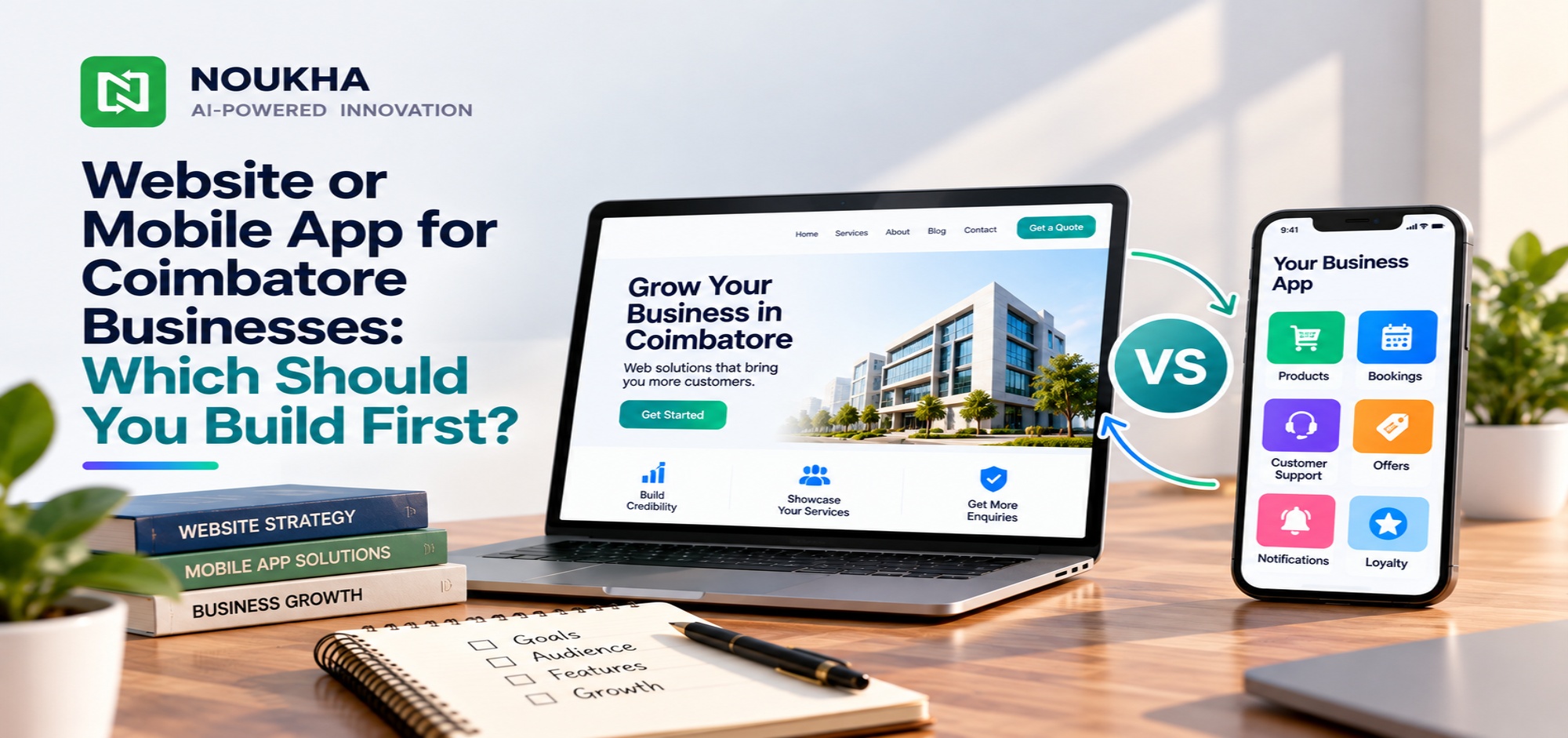
Website or mobile app for Coimbatore businesses is an important decision for owners planning to invest in digital growth. Whether you run a manufacturing company in Ganapathy, a boutique in RS Puram, a coaching centre in Saibaba Colony or a food business serving customers across Kongu Nadu, choosing the right digital platform can affect your budget, customer reach and long-term growth.
The good news is that you can make this decision with a few honest questions about your customers, your goals and your budget. This guide walks you through them in plain language, so you can pick a starting point with confidence. If you decide a website is your first move, a local web design agency can help you plan it properly from day one.
Website or Mobile App for Coimbatore Businesses: How to Decide
Choosing a website or mobile app for Coimbatore businesses depends on customer behaviour, business goals, budget and the features required. A website is often a practical starting point for businesses that need online visibility and enquiries, while a mobile app may be more suitable for services that depend on frequent customer interactions or device-specific features.
The Short Answer: Most Businesses Should Start With a Website
For the majority of small and mid-sized companies in the city, a website is the smarter first build. It is faster to launch, cheaper to maintain, and often easier to find through Google Search. An app, on the other hand, asks people to take extra steps before they ever meet your brand. They must find the app in an app store, download it, wait for installation and then trust your business enough to keep it on their phone.
Why a Website Usually Comes First
Customers Search Before They Call
Think about how you choose a dentist, a wedding caterer or a machine spare supplier today. You probably type a question into Google, scan a few results and open two or three pages. Your customers do exactly the same. When someone searches for something like “CNC job work near Peelamedu” or “best interior designer in Coimbatore,” they are looking for a web page, not an app download.
It Costs Less to Launch and Is Easier to Change
Depending on scope, content readiness and approvals, a business website can go live in a matter of weeks, and you can edit prices, photos and offers without a long release cycle. An app may require separate builds for Android and iOS, app-store approvals and regular updates to remain compatible with new mobile operating systems. For a business still testing its market, that flexibility matters a great deal.
It Supports Every Other Channel
Your website becomes the home base for everything else. Your Instagram bio links to it. Your WhatsApp Business catalogue can link to it. Your printed brochures carry its address on a QR code. Even if you build an app later, the site continues to bring in new visitors who have never heard of you.
When a Mobile App Deserves to Go First
A website is not always the right opening move. There are clear situations where an app earns its place at the front of the queue.
Your Customers Return Often and Expect Convenience
If customers use your service weekly or daily, an app can become part of their routine. Think of a neighbourhood grocery delivery service, a tiffin subscription, a gym with class bookings or a salon chain with loyalty rewards. Push notifications, saved addresses and one-tap reordering can make repeat purchases easier, and that convenience is hard to match in a browser.
Your Service Relies on Phone Features
Some ideas simply work better on a handset. Live location tracking, camera-based scanning, offline access and biometric login are often easier to deliver inside an app. Delivery tracking, field surveys and ride-based services fall into this category.
You Need a Tool for Your Own Team
Not every app is meant for customers. Many manufacturers and distributors in the region use internal apps for sales-visit tracking, stock checks, attendance management and order entry. If your main challenge is inefficient field operations rather than weak lead generation, an internal app may bring a faster return than a public website.
If your idea fits one of these situations, speaking with mobile app development specialists in the city early on can save you from expensive redesigns later. They can help you decide which features belong in the first version and which can wait.
Android First, or Both Platforms Together?
If you do decide on an app, the next question is which phones to target. In India, Android accounts for the vast majority of smartphone usage, while iOS accounts for a much smaller share. For a business serving local customers across different income groups, this difference can be significant.
Starting with Android lets you reach more people with a single build and a smaller initial investment. It also makes it easier to gather feedback before you commit to a second platform. Many startups launch on Android, learn what users actually want and then add iPhone support once the product has proven demand.
There are exceptions. If your target audience is premium, such as luxury retail, high-end fitness or professional services aimed at business owners, iPhone users may deserve equal attention from the beginning. If you lean toward the first approach, Android-focused developers can scope a lean first release that tests your idea without overspending.
A Simple Way to Decide
Use the following questions as a quick filter. Answer them honestly, and a pattern usually appears.
| Question | If yes, lean toward |
| Do new customers find you through Google searches? | Website |
| Do you need to show a portfolio, price list, or credentials? | Website |
| Do customers buy from you several times a month? | App |
| Does your service need location, camera, or offline features? | App |
| Is your main problem managing staff or fieldwork? | Internal app |
| Is your budget currently limited? | Website |
If most of your answers point to a website, begin there. If they point to an app, build a focused version with only the essential features. In both cases, resist the urge to build everything at once.
What to Expect on Budget and Timeline
Costs vary widely depending on features, design quality and the team you hire, so be cautious of anyone who quotes a flat figure without understanding your needs. As a general guide, a business website can take a few weeks to build, while a simple custom app may take two to four months. More complex apps often take four to nine months or longer.
Also plan for what happens after launch. Websites need hosting, security updates and content refreshes. Apps need bug fixes, store compliance updates and support for new phone versions. A realistic budget includes at least a year of maintenance, not just the build itself.
Ask every vendor these three practical questions before signing:
- Who owns the source code and the domain after delivery?
- What does support cost once the project is live?
- Can you see live examples of similar work for businesses in your sector?
Common Mistakes Coimbatore Businesses Should Avoid
Building an App Because Competitors Did
A rival launching an app does not mean you need one. Many apps sit unused because the business never gave customers a reason to install them. Before you build, be clear about what the app will do that a mobile-friendly website cannot.
Ignoring Mobile Performance on the Website
Most visitors will open your site on a mobile device, often over a variable network connection. Slow loading, tiny text, or buttons that are hard to tap will send them straight back to the search results. Speed and mobile-friendly design are not optional extras. They directly affect enquiries and your visibility in Google search results.
Skipping Local Search Basics
A site without a clear address, service area, phone number and a verified Google Business Profile misses easy wins. Local buyers often search with phrases such as “near me” or the name of a locality. Mention the neighbourhoods and industries you serve so that both search engines and potential customers understand where you operate.
A Practical Roadmap for the Next 90 Days
- Weeks 1–2: Write down your main goal, whether that is generating more leads, making repeat orders easier, or improving team coordination. Study three competitors and note what they do well.
- Weeks 3–6: Build or refresh your website with clear service pages, customer proof, a fast mobile layout, and visible contact options.
- Weeks 7–10: Track which pages generate enquiries and which questions customers keep asking. Collect these insights in one place.
- Weeks 11–12: Use that evidence to decide whether an app is justified and, if so, which three features it must have at launch.
Frequently Asked Questions
Can I start with a website and add an app later?
Yes, and it is a common path. A well-built website gives you traffic, customer feedback and brand credibility. When you later build an app, you already know what your users value, which makes the project more focused.
Is a mobile-friendly website enough for my business?
For many service providers, manufacturers and retailers, yes. If customers mainly need information, quotes or bookings, a fast and responsive site covers most needs without the cost of an app.
Final Thoughts
The right first step depends on how your customers find you and how often they buy. For most businesses in Coimbatore, a well-built website delivers visibility, trust and leads at a lower cost. For businesses built around frequent use, device-specific features, or field operations, a carefully scoped app can be the better starting point. Either way, begin small, measure what happens and grow from there.
If you are still unsure which route fits your goals, a short conversation can bring clarity. Contact Us to talk through your idea and get practical advice on what to build first.