For years, AI app monetization has become one of the biggest priorities for businesses building intelligent applications. For years, AI within an app was treated as an expense. Companies budgeted for compute, model access, and engineering time the same way they budgeted for servers or customer support, as a necessary cost that made the product better but did not directly make money. Companies budgeted for compute, model access, and engineering time the same way they budgeted for servers or customer support, as a necessary cost that made the product better but did not directly make money. That thinking is changing fast. Businesses are now building AI features that customers pay extra for, that close deals faster, and that create entirely new products from data companies already own. This shift is why demand for experienced AI app developers USA businesses trust has grown so quickly over the past two years.
The Shift from Cost Center Thinking to Revenue Center Thinking
What Made AI a Cost Center in the First Place
Early AI adoption inside apps was mostly about internal efficiency. Chatbots reduced support tickets, automated workflows cut manual hours, and recommendation engines improved conversion by small margins. These were valuable improvements, but they were measured in savings, not sales. The budget for AI usually sat next to infrastructure and operations, reviewed the same way a company reviews hosting bills or software licenses. Every AI interaction also carries a real, variable cost because compute is billed per token or per call, which made finance teams cautious about scaling AI features without a clear return.
What Changed the Equation
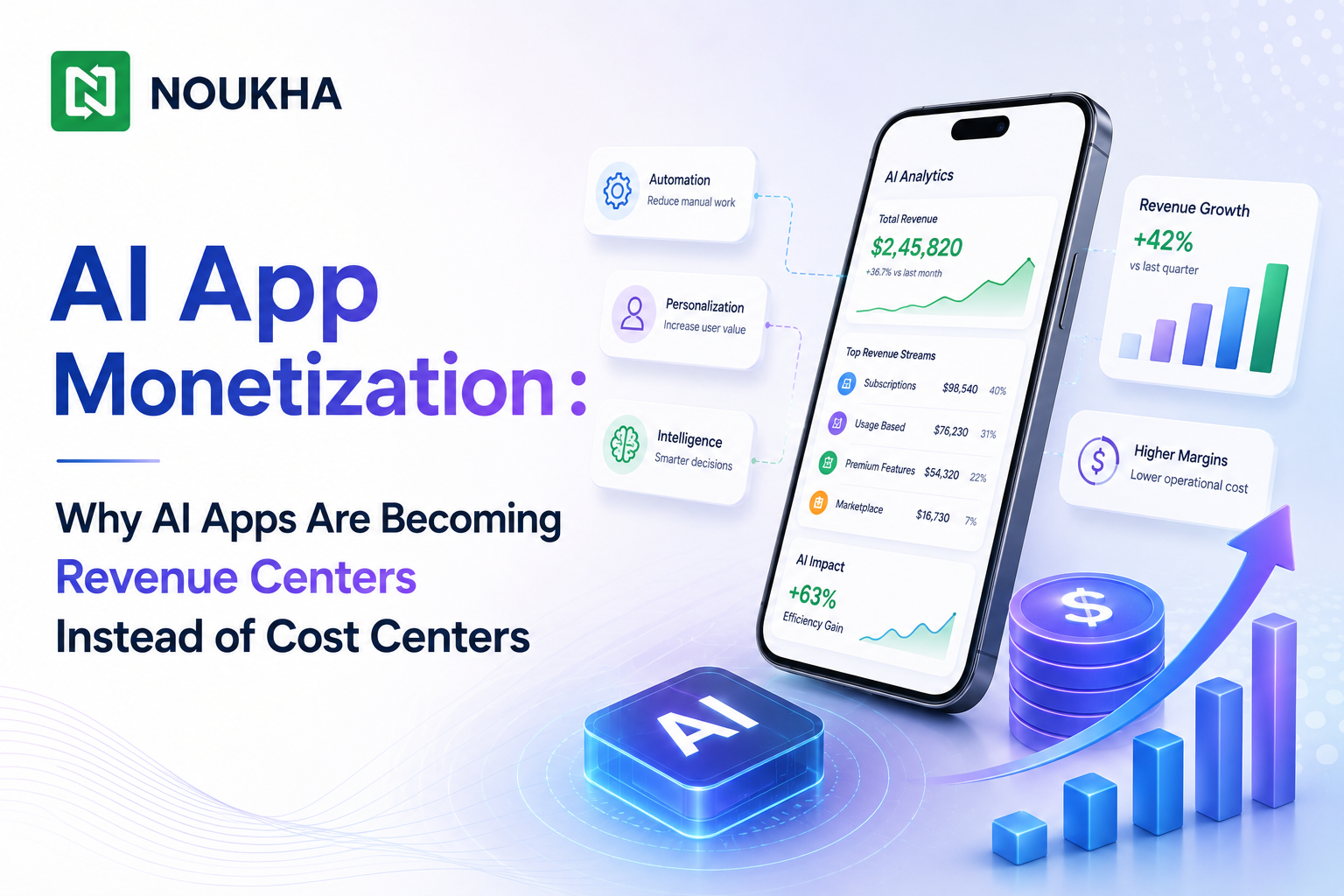
Three things shifted the conversation. First, AI capabilities matured enough to handle tasks customers will pay for directly, such as generating content, summarizing documents, or automating a workflow end to end, rather than just assisting a human doing it. Second, companies learned to price AI features separately instead of bundling them for free, turning what used to be a cost into a premium subscription tier. Third, AI made it possible to package existing data as a new, sellable product, something that was technically possible before but rarely practical at scale. Together, these changes moved AI from the operations ledger to the revenue ledger for a growing number of businesses.
How AI Apps Generate Direct Revenue
Premium AI Features Inside Existing Products
The most common model is straightforward. A software product adds an AI capability, such as automated reporting, smart search, or content generation, and places it behind a higher priced plan. Users who see clear time savings or better output upgrade on their own, creating a product-led growth loop where the AI feature effectively sells itself. This works best when the AI feature solves a task the user was already paying someone else to do manually.
Usage-Based and Outcome-Based Pricing
Because AI costs scale with usage, many companies now price it the same way. Instead of a flat monthly fee, customers pay per generation, per resolved query, or per successful outcome. Outcome-based pricing takes this further by charging only when the AI actually delivers a result, such as a qualified lead or a completed task. This model aligns the vendor’s incentives with the customer’s results, which tends to increase trust and reduce resistance during the sales process, though it requires solid measurement infrastructure to track what counts as a successful outcome.
Turning Data Into a Sellable Asset
Businesses generate data every day that they never turn into revenue. AI changes that by making it fast and affordable to clean, analyze, and package that data into insights other businesses will pay for.
Example: Retail and Consumer Insights
A retail chain that once treated transaction data as pure storage cost can anonymize purchase patterns and sell trend reports to brands that want to understand regional buying behavior. The underlying data already existed. What changed is that AI made the analysis fast enough to turn into an ongoing, sellable product instead of a one-time internal report.
AI Powered Sales and Lead Automation
AI also generates revenue indirectly by making sales teams more effective. Lead scoring models flag which prospects are most likely to convert, automated follow up keeps deals from stalling, and AI assisted proposals shorten the time between a first conversation and a signed contract. None of this shows up as a separate line of revenue, but it measurably increases how much revenue a sales team closes with the same headcount.
Why Some AI Apps Still Behave Like Cost Centers
Ignoring Unit Economics
Not every AI feature earns its keep. When a company adds AI to increase engagement without checking whether that engagement converts to revenue, the cost per user can quietly climb faster than the benefit. A feature that costs only a small fraction of revenue per user is usually fine. The same feature can become a structural problem once average revenue per user drops or usage increases without a matching rise in conversions or retention.
Copying Features Without a Monetization Plan
Many teams add AI because competitors have it, not because they have identified a clear willingness to pay. This produces apps with impressive AI capabilities that never convert those capabilities into pricing power. Without a monetization plan built before development starts, even a technically excellent AI feature stays a cost with no offsetting revenue.
AI App Monetization: What It Takes to Build an AI App That Pays for Itself
Start With the Revenue Model, Not the Feature List
The apps that succeed as revenue centers usually start by asking what customers would pay for, then build the AI feature to match that answer. This is the opposite of building an impressive AI demo first and figuring out pricing later. Deciding early whether the model will be a premium tier, a usage fee, or an outcome-based charge shapes everything from the user interface to the underlying architecture.
Design for Measurable Outcomes
An AI feature that cannot prove its own value struggles to justify its price. Building the right tracking into the product from day one, such as measuring time saved, tasks completed, or leads generated, gives both the business and its customers a clear way to see the return, which supports renewal and expansion revenue over time.
Choose the Right Development Partner
Turning an AI idea into a feature customers will pay for requires more than access to a model. It requires engineers who understand pricing, latency, data pipelines, and compliance together, since a mistake in any one of these areas can turn a promising feature into an expensive liability. This is why many businesses now work with experienced AI app developers in USA rather than treating AI integration as a side project for an existing team. The right partner helps validate the monetization model before writing production code, which avoids the common mistake of building first and pricing later.
Industries Where AI Apps Are Already Revenue Centers
Software as a service companies increasingly bundle AI copilots and generation tools into higher tiers, directly lifting average revenue per account. Retail and ecommerce platforms use AI for dynamic pricing and personalized recommendations that measurably increase order value. Financial services firms use AI for fraud detection and underwriting speed, cutting losses while approving more good customers faster. Healthcare scheduling platforms use AI to reduce no shows and staff workload, freeing up capacity that translates into more billable appointments. In each case, the AI feature is priced or tied to an outcome finance teams can measure, which is what separates a revenue center from a cost center.
How to Evaluate an AI Application Development Company
Choosing the right partner matters as much as choosing the right AI model. A capable AI application development company USA businesses trust will ask about your monetization strategy before proposing an architecture, rather than jumping straight to a technical build. Look for a team that has shipped AI features tied to actual pricing changes, not just demos. Ask how they measure success, whether that is conversion lift, retention improvement, or cost per resolved task, and confirm they have experience with the usage-based billing and data infrastructure revenue generating AI features depend on. Security and compliance experience matters too, particularly for apps handling financial or health data.
Frequently Asked Questions
Can a small business realistically turn an AI feature into a revenue stream?
Yes. The scale of the business matters less than whether the AI feature solves a task customers already pay to have done manually. A well scoped feature with clear pricing can generate revenue even for a small team, as long as the cost per use stays well below the price charged.
How long does it take before an AI feature becomes profitable?
This depends on the pricing model and adoption rate, but most teams see a clear signal within two to three billing cycles once usage data and conversion numbers stabilize. Outcome-based and usage-based models tend to reveal profitability faster than flat subscription bundles, since cost and revenue move together.
What is the biggest mistake companies make when monetizing AI features?
The most common mistake is launching a feature before deciding how it will be priced, which usually leads to giving it away for free until it becomes too expensive to sustain. Deciding on the pricing model before development begins avoids this problem entirely.
Do AI features always need to be a separate paid add on?
No. Some AI features work better as part of a value proposition that justifies a higher overall subscription tier, rather than a standalone charge. The right approach depends on how directly the AI feature is tied to a specific, measurable outcome versus a general improvement in product quality.
Conclusion
Successful AI app monetization starts with a clear pricing strategy and measurable business outcomes. AI within an app no longer has to be treated as an unavoidable expense. When it is built around a clear pricing model, tied to measurable outcomes, and developed by a team that understands both the technology and the business model behind it, AI becomes one of the most direct ways to grow revenue rather than simply support it. If you are planning an AI feature and want to make sure it is built to pay for itself from day one, contact us to discuss what a revenue focused AI strategy could look like for your product.