
Table of Contents
Introduction
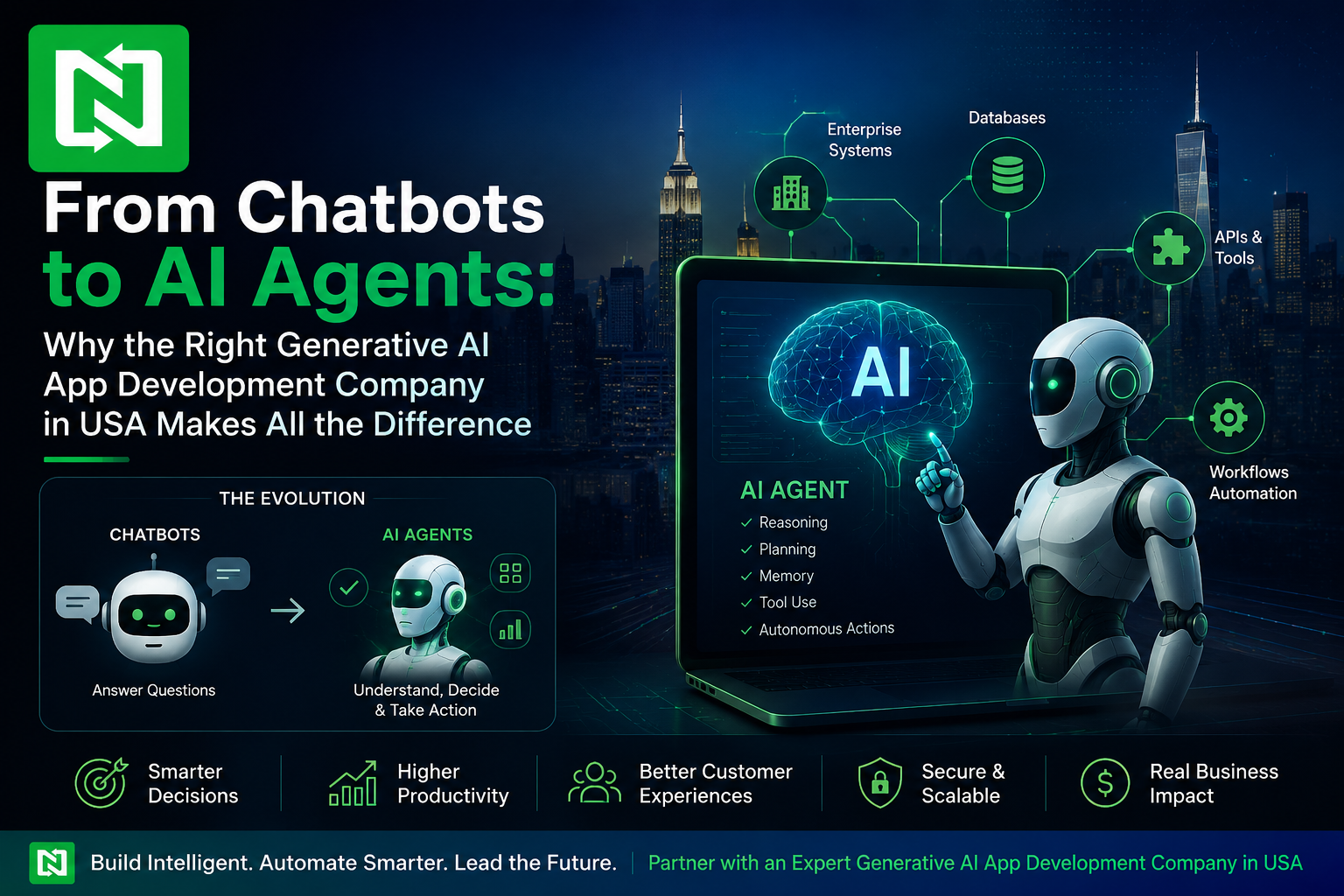
The Evolution From Chatbots to AI Agents
Why Businesses Are Investing in Generative AI Applications
What Makes AI Agents More Powerful Than Traditional Chatbots
How a Generative AI App Development Company in USA Delivers Better Results
Common Mistakes Businesses Make When Building Generative AI Apps
How to Choose the Right Generative AI App Development Company in USA
The Future of Generative AI and Intelligent AI Agents
Conclusion
Introduction
Generative AI has transformed the way businesses interact with customers, automate operations, and deliver personalized digital experiences. While chatbots introduced automated conversations, modern AI agents are capable of reasoning, planning, learning, and completing complex tasks with minimal human intervention. However, building these intelligent systems requires more than integrating a language model. It demands strategic planning, secure architecture, seamless integrations, and continuous optimization. Choosing the right Generative AI App Development Company in USA can determine whether your AI investment becomes a competitive advantage or an expensive experiment.
1. The Evolution From Chatbots to AI Agents
How conversational AI has evolved
Early conversational tools relied on scripted decision trees that could only respond to a narrow set of anticipated inputs. The introduction of large language models changed this dynamic, allowing systems to understand nuanced language, context, and intent rather than matching keywords.
The limitations of traditional chatbots
Traditional chatbots struggle with tasks that require memory across a conversation, multi-step reasoning, or access to live business systems. They are useful for answering simple questions but quickly reach their limits when a request becomes complex.
What defines an AI agent
An AI agent combines a language model with reasoning capabilities, tool access, and memory, allowing it to plan a sequence of actions and execute them with limited supervision. Rather than simply generating a response, an agent can retrieve data, call APIs, and complete multi-step workflows.
Why AI agents represent the next generation of business automation
AI agents extend automation beyond static rules into adaptive decision-making, allowing businesses to handle exceptions and edge cases that older automation systems could never manage effectively.
2. Why Businesses Are Investing in Generative AI Applications
Improving customer engagement
Generative AI enables natural, context-aware conversations that feel more helpful and less robotic, improving satisfaction across support and sales interactions.
Automating repetitive workflows
Tasks such as data entry, document summarization, and routine correspondence can be handled by AI systems, reducing manual workload across departments.
Increasing employee productivity
By handling research, drafting, and administrative tasks, generative tools free employees to focus on judgment-based work that requires human expertise.
Accelerating business decision-making
AI systems can synthesize large volumes of information quickly, giving leadership teams faster access to insights that once took analysts days to compile.
Creating personalized digital experiences
Generative AI allows businesses to tailor content, recommendations, and support interactions to individual users at a scale that manual personalization cannot match.
3. What Makes AI Agents More Powerful Than Traditional Chatbots
Context-aware conversations
Unlike scripted chatbots, AI agents maintain context across a conversation and across sessions, allowing for more natural and coherent interactions over time.
Multi-step task execution
Agents can break a complex request into smaller steps, complete each one in sequence, and adjust their approach based on intermediate results.
Integration with enterprise systems
Modern AI agents connect directly with CRMs, databases, and internal tools, allowing them to retrieve real data and take real actions rather than offering generic responses.
Autonomous decision support
Agents can evaluate options against defined business rules and recommend or take action within approved boundaries, reducing the need for constant human oversight.
Continuous learning and improvement
Through feedback loops and retraining, agents become more accurate and useful over time as they are exposed to more real-world interactions.
4. How a Generative AI App Development Company in USA Delivers Better Results
AI strategy and business consulting
Experienced teams begin by identifying which business processes are genuinely suited to generative AI or agentic automation, rather than applying the technology indiscriminately.
Selecting the right LLMs and AI technologies
Choosing between different large language models, retrieval-augmented generation approaches, and vector database technologies requires a clear understanding of the specific use case, cost constraints, and performance requirements. This is where structured Generative AI development services make a measurable difference, since the right technology stack directly affects accuracy, latency, and long-term maintainability.
Secure architecture and data privacy
Enterprise-grade AI applications require careful handling of sensitive data, access controls, and compliance considerations built into the architecture from day one.
Custom AI agent development
Rather than relying on generic templates, skilled developers design agents around specific workflows, tools, and business rules unique to each organization.
Deployment, monitoring, and continuous optimization
Post-launch monitoring tracks model performance, usage patterns, and failure cases, allowing teams to refine prompts, retrain models, and improve reliability over time.
5. Common Mistakes Businesses Make When Building Generative AI Apps
Treating AI as a plug-and-play solution
Some organizations assume that connecting to a language model API is sufficient, overlooking the engineering work required to make outputs reliable and relevant.
Ignoring data quality and governance
Generative AI systems built on inconsistent or poorly structured data produce unreliable outputs that quickly erode user trust.
Choosing technology before defining business goals
Selecting a specific model or framework before clarifying the problem being solved often results in solutions that do not align with actual business needs.
Overlooking scalability and security
Applications that work well in a demo can fail under real production load or expose sensitive data if scalability and security are not addressed early.
Not planning for long-term AI improvements
Treating a generative AI application as a finished product rather than an evolving system limits its accuracy and relevance as business needs change.
6. How to Choose the Right Generative AI App Development Company in USA
Evaluate Generative AI expertise
Look for demonstrated experience across large language models, prompt engineering, and agentic frameworks rather than general software development alone.
Review AI case studies and industry experience
Concrete examples with measurable outcomes provide a far more reliable indicator of capability than marketing language.
Assess security and compliance capabilities
Particularly for regulated industries, confirm that the team has experience implementing data privacy controls and compliance requirements within AI systems.
Understand the development methodology
A transparent, structured process with clear milestones reduces risk and keeps stakeholders aligned throughout development.
Look for long-term AI partnership and support
Generative AI systems require ongoing refinement, so the right partner remains engaged well beyond initial deployment.
7. The Future of Generative AI and Intelligent AI Agents
Autonomous AI agents
Agents capable of independently completing complex, multi-step business processes with minimal human intervention are becoming increasingly practical across industries.
Multi-agent collaboration
Systems in which multiple specialized agents coordinate to complete larger workflows are emerging as a powerful approach to complex enterprise automation.
Industry-specific AI assistants
Tailored assistants built around the specific terminology, workflows, and compliance needs of a given industry are proving more effective than generic tools.
Agentic AI for enterprise automation
Businesses are increasingly applying agentic AI to end-to-end processes such as procurement, customer onboarding, and financial reconciliation. Organizations exploring scalable AI solutions are finding that agentic approaches often deliver stronger returns than isolated chatbot deployments.
Responsible and explainable AI
As adoption grows, businesses are placing greater emphasis on transparency, explainability, and responsible use of AI systems that influence real decisions.
Conclusion
Generative AI is rapidly moving beyond simple chatbots to intelligent AI agents capable of transforming how businesses operate. Organizations that invest in the right strategy and partner with an experienced Generative AI App Development Company in USA are better positioned to build scalable, secure, and future-ready AI solutions. As AI agents continue to evolve, businesses that embrace this shift today will gain a significant competitive advantage tomorrow. If you are ready to explore how generative AI and AI agents could transform your business, reach out to Noukha for a consultation.
Frequently Asked Questions
1. What is the difference between a chatbot and an AI agent?
A chatbot primarily answers predefined questions, while an AI agent can understand context, make decisions, execute tasks, and interact with multiple systems autonomously.
2. Why should businesses hire a Generative AI App Development Company in USA?
An experienced development company provides AI strategy, secure architecture, custom model integration, enterprise-grade development, and ongoing optimization to maximize ROI.
3. What industries benefit most from Generative AI applications?
Healthcare, finance, retail, manufacturing, logistics, education, customer support, and SaaS companies are among the industries gaining significant value from Generative AI and AI agents.