
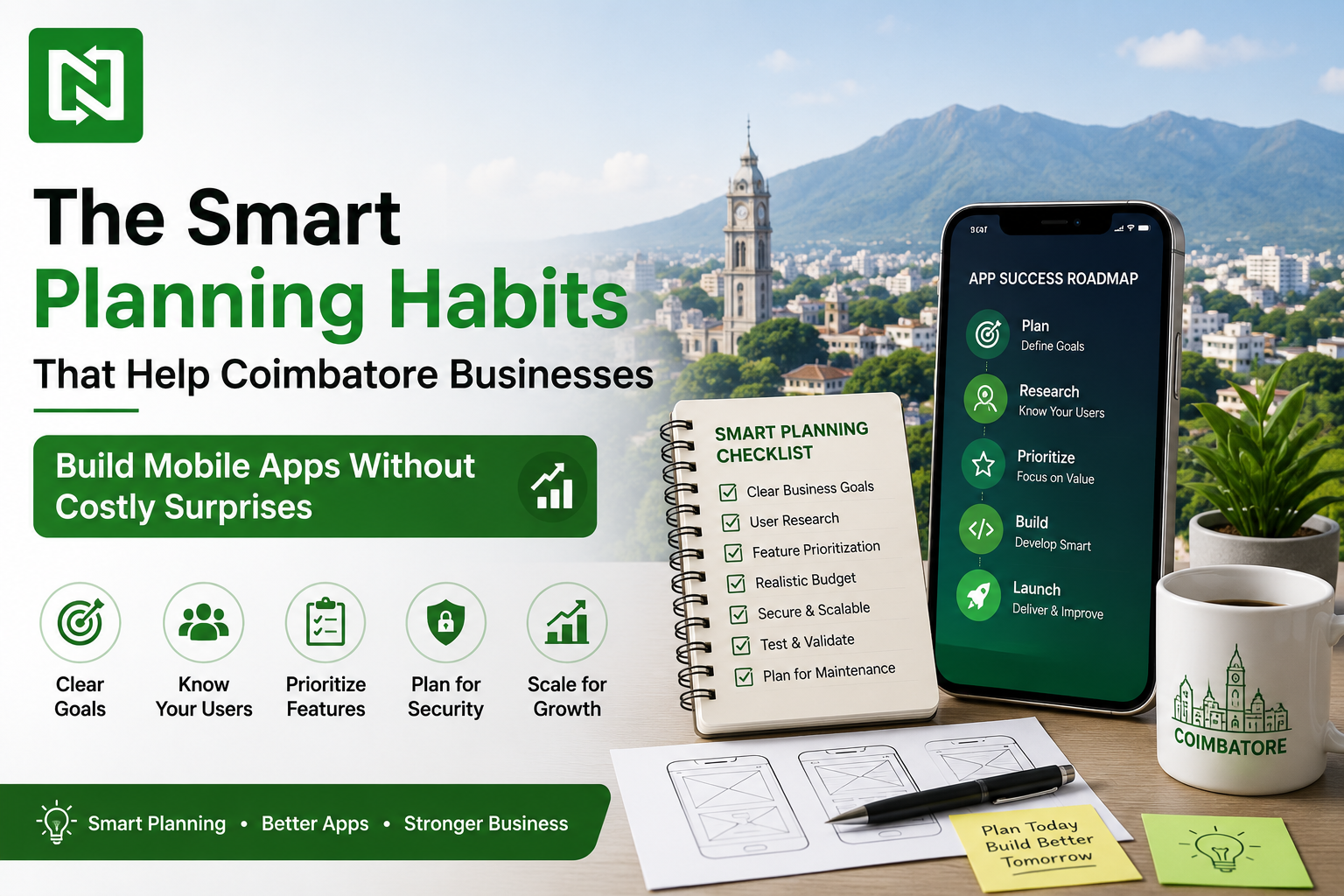
Mobile applications have become a central part of how businesses in Coimbatore serve customers, manage operations, and compete in a digital first market. From retail and manufacturing to healthcare and professional services, more companies are exploring mobile solutions to streamline processes and stay relevant. Yet many businesses jump straight into development without a clear plan, which often leads to delays, budget overruns, and products that fail to meet real needs. Working with an experienced mobile app development company in Coimbatore is only useful when paired with sound planning from the start. This article is a practical guide to the planning habits that help businesses reduce risk, control costs, and build applications that genuinely support their goals. It is meant to be a reference for founders and decision makers approaching their first or next app project with clarity and confidence.
Why Planning Determines App Success
Planning Reduces Business Risk
Every app project carries uncertainty, from technical decisions to user adoption. A structured planning phase reduces that uncertainty by identifying risks early, before money and time are committed to development. It also allows business owners to allocate resources more effectively, whether that means budget, staff time, or vendor coordination. A clear direction from the start means teams spend less time revisiting decisions midway through development.
Setting Realistic Expectations
Planning is where budget expectations, timelines, and feature priorities are set honestly. Businesses that skip this step often discover costs and delays only after development has begun, which is far more expensive to correct. A realistic plan accounts for design, development, testing, and post launch support from day one, so there are fewer surprises later.
Aligning Technology With Business Objectives
Technology choices should always follow business goals, not the other way around. Before deciding on a platform, framework, or feature set, businesses need to be clear about what the app is meant to achieve. This alignment ensures the application supports long-term scalability rather than becoming a short-term fix that needs to be rebuilt within a year or two.
Understanding Business Goals Before Development
Identifying the Core Business Problem
A mobile app should solve a genuine business problem, not simply follow a trend. Before writing a single requirement, it helps to ask what specific challenge the app is meant to address, whether that is reducing manual work, improving customer communication, or opening a new sales channel.
Defining Success Metrics
Clear metrics give a project direction and make it possible to measure whether the app is actually working. Common examples include:
- Customer engagement, such as app opens or session length
- Revenue growth from app driven sales or bookings
- Operational efficiency, such as reduced processing time
- User retention over weeks and months
- Process improvements in day to day operations
Mapping Customer Journeys
Understanding how customers currently interact with the business, and how they would ideally interact through the app, helps teams design features that fit real behaviour rather than assumptions. This mapping exercise often reveals gaps that would otherwise be missed until after launch.
Researching Users and the Local Market
Understanding Customer Expectations
Users judge apps quickly, often within the first few interactions. Understanding what customers expect in terms of speed, simplicity, and functionality helps shape a product that feels intuitive rather than confusing.
Studying Competitor Apps
Reviewing competitor apps, both locally and nationally, helps businesses understand baseline expectations in their industry. This is not about copying features, but about recognizing what users already consider standard.
Considering Regional User Behavior
Coimbatore businesses benefit from paying attention to local market preferences and industry specific requirements, particularly in sectors like manufacturing, textiles, and retail that are strong in the region. India has also seen rapid mobile first adoption, with a large share of internet users accessing services primarily through smartphones, which makes thoughtful mobile design important.
Collecting Early User Feedback
Gathering feedback before and during development, through surveys, interviews, focus groups, or prototype testing, helps validate assumptions early. This is far less costly than discovering a design flaw after the app has already been built.
Prioritizing Features That Deliver Real Value
Building a Minimum Viable Product
An MVP includes only the core features needed to solve the primary problem and test it with real users. This approach reduces risk by limiting the initial investment, allows for faster market validation, and keeps early development costs lower than building a fully featured product upfront.
Separating Essential and Optional Features
Not every feature idea needs to be part of the first release. Grouping features into essential, useful, and optional categories helps teams focus resources on what matters most before considering additions.
Planning Future Enhancements
Iterative development, where new features are added in phases based on user feedback and data, tends to produce stronger long-term products than trying to launch everything at once. This also spreads investment more predictably over time.
Budgeting and Timeline Planning Without Guesswork
Estimating Costs Realistically
A realistic budget accounts for design, development, testing, deployment, and ongoing maintenance, not just the initial build. Businesses that only budget for development often find themselves underprepared for the costs that follow launch.
Planning Development Phases
Most successful projects move through a similar sequence: discovery, UI or UX design, development, quality assurance, and launch. Understanding this sequence in advance helps businesses set realistic timelines and know what to expect at each stage.
Managing Scope Changes
Requirements often evolve as a project progresses. Having a clear process for evaluating and approving scope changes, rather than adding features informally, protects both the budget and the timeline. This is one reason many businesses look for structured mobile app development services, which typically include defined change management as part of the engagement.
Preparing for Post Launch Investment
An app is rarely finished at launch. Budgeting for updates, bug fixes, and improvements after release is essential, since ongoing investment is what keeps an application relevant and functional over time.
Building for Growth, Security, and Maintenance
Scalable Architecture
Applications should be built on architecture that can handle growth in users, data, and features without requiring a complete rebuild, especially for businesses expecting to expand or add functionality over time.
Data Security and Compliance
Security should be considered from the earliest planning stages, not added later. Key areas include:
- Authentication to verify user identity
- Encryption to protect sensitive data
- Secure APIs for safe data exchange
- Data privacy practices that respect user information
Regular Updates and Performance Monitoring
Ongoing attention to bug fixes, feature improvements, and performance optimization keeps an app reliable and competitive. Unmaintained apps tend to lose users as performance issues accumulate.
Planning Long Term Maintenance
Factoring maintenance into the original plan, rather than treating it as an afterthought, reduces long-term costs and prevents the kind of technical debt that makes future updates more difficult and expensive.
Common Planning Mistakes Businesses Should Avoid
Starting Without Clear Requirements
Beginning development before requirements are documented often leads to scope confusion, rework, and disagreements between stakeholders and development teams.
Ignoring User Research
Skipping user research can result in an app that looks polished but does not match how customers actually behave, which affects adoption after launch.
Underestimating Testing
Reducing testing time to meet a deadline is a common but costly mistake, since it increases the likelihood of bugs reaching real customers.
Forgetting Ongoing Maintenance
Some businesses budget only for the initial build and are caught off guard by the ongoing costs of updates, security patches, and platform compatibility changes. Treating mobile app project planning as a one time exercise rather than an ongoing responsibility is one of the most common and avoidable mistakes businesses make.
Conclusion
Successful mobile app projects are built on disciplined planning, not just good development execution. Businesses that invest time in understanding their goals, researching their users, prioritizing features thoughtfully, and budgeting realistically tend to reduce unnecessary costs, improve project quality, and deliver better customer experiences. Just as importantly, this approach helps businesses build scalable mobile applications while minimizing the risks that commonly derail app projects.
If your business is considering a mobile app and wants to approach the process with a clear, well researched plan, it may help to contact our experts for an initial discussion focused on your specific goals and challenges.
FAQs
Why is planning important before mobile app development?
Planning helps businesses clarify goals, understand users, and set realistic budgets and timelines before committing resources to development. It reduces the risk of costly changes later and improves the likelihood that the finished app actually meets business needs.
How can businesses avoid unexpected app development costs?
Unexpected costs usually come from unclear requirements, scope changes, and underestimated testing or maintenance needs. Businesses can avoid this by documenting requirements early, building in a buffer for scope changes, and budgeting for post launch support from the start.
What should businesses prioritize before starting mobile app development?
Businesses should prioritize a clear understanding of the problem the app is solving, research into user needs and local market behavior, and a realistic budget and timeline that includes testing and ongoing maintenance, not just the initial build.