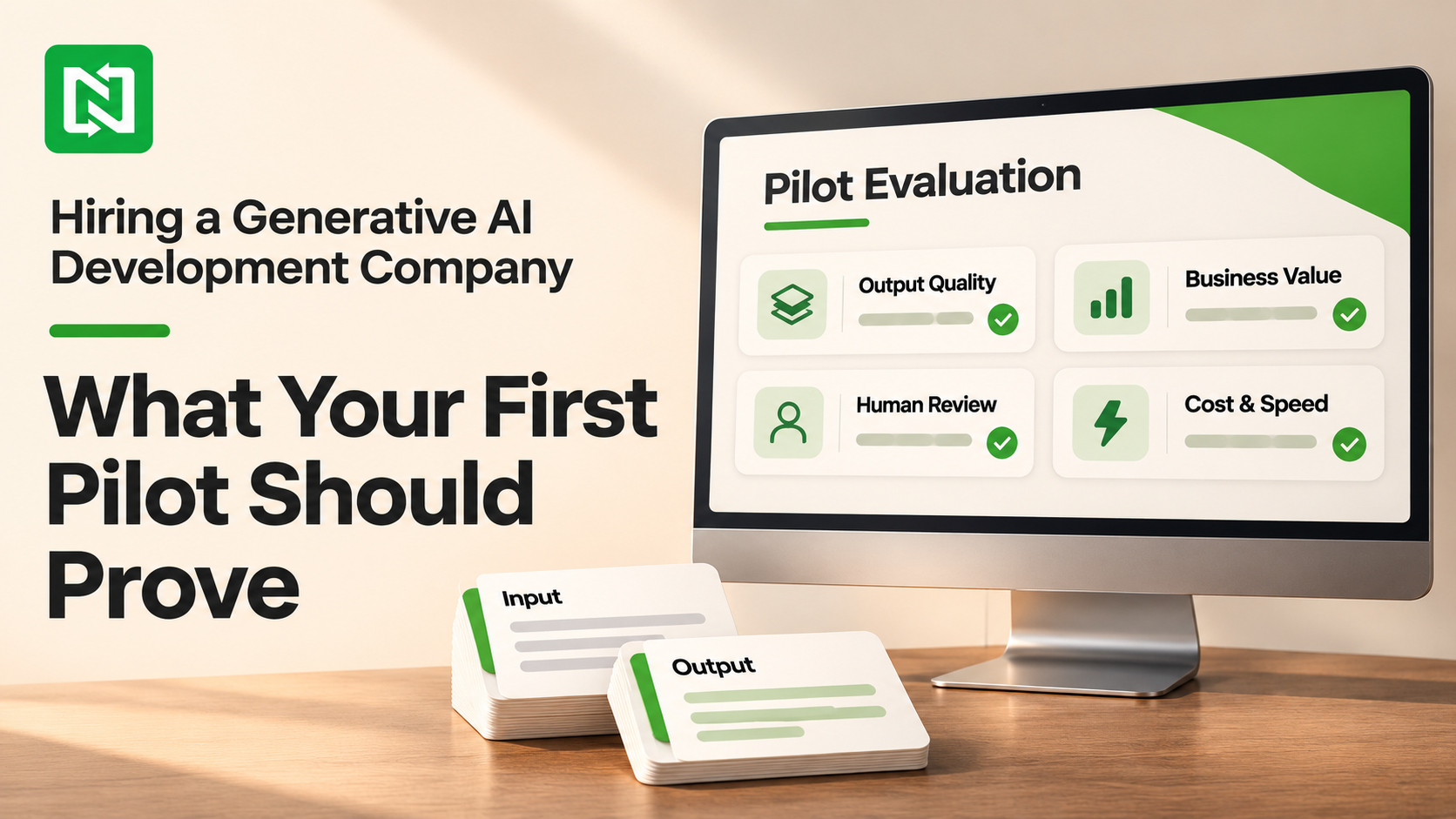
Hiring a Generative AI Development Company is an important step towards building an AI solution that delivers measurable business value. Most generative AI pilots do not stall because the model is weak. They stall because nobody agreed on what the pilot was supposed to prove. If you are evaluating a US-based generative AI development partner, the first project is your best chance to learn whether the idea, the data, and the working relationship can survive contact with real work.
Why the First Pilot Carries So Much Weight
The scope you choose, the metrics you track, and the way a vendor reports bad news all become precedent. A pilot that only produces a polished demo teaches you very little, because demos are built to look good under friendly conditions. A useful pilot is closer to an experiment. It has a hypothesis, a baseline for comparison, and a result that could genuinely go either way.
A Demo Answers a Different Question
Almost any capable team can get a language model to produce an impressive answer from a hand-picked example. The harder question is whether the system holds up when inputs are messy, when staff are rushed, and when a wrong answer lands in front of a real customer.
The Real Cost of an Unclear Goal
Gartner identified unclear business value, poor data quality, inadequate risk controls, and escalating costs as major reasons generative AI projects fail to progress beyond the proof-of-concept stage. These challenges are not necessarily model-related. Many stem from planning, data readiness, and risk management, which can be addressed before development begins.
Five Things a First Pilot Should Prove
1. The Problem Is Worth Solving
Start with a workflow that already carries a measurable cost, such as hours spent drafting support replies, time needed to summarize contracts, or the size of a claims backlog. If nobody can state today’s numbers, nobody can say later whether the pilot helped.
Capture the baseline first
Record current handling time, error rate, and volume for a few weeks before the build begins.
2. Your Data Is Ready Enough
Generative systems depend on the documents, tickets, and records you feed them. A good pilot exposes gaps early: outdated policies, duplicate files, inconsistent naming, and content locked in formats that are hard to parse. Learning this in week two is cheap. Learning it after launch is not.
Check access and permissions
Confirm who is allowed to see which records. A retrieval tool that fails to enforce existing access permissions can expose sensitive information to unauthorized colleagues, even when the data remains within your network.
3. Quality Holds Up in Realistic Conditions
Build an evaluation set from representative real-world cases, covering both routine and difficult situations. For many focused pilots, 100 or more examples is a useful starting point, although the right size depends on workflow complexity, risk, and available data. Have subject matter experts score outputs against agreed criteria such as accuracy, completeness, tone, and source citation. Include adversarial cases too, such as vague questions, contradictory documents, malicious instructions, and requests the system should decline.
4. The Risks Can Be Managed
Ask how the system handles invented facts, prompt injection, sensitive data, and logging. Useful references exist to structure the conversation, including the OWASP Top 10 for Large Language Model Applications (2026 edition) and the NIST Generative AI Profile, which accompanies its AI Risk Management Framework. These resources help organizations identify vulnerabilities, assess risks, and set safeguards, and the NIST framework is voluntary and adaptable. A vendor does not need to recite them, but should be able to explain which controls apply to your case and why.
5. The Economics Survive Growth
Pilot costs are misleading because volume is small. Ask for a projection of cost per request at ten times and one hundred times the pilot load, including model usage, hosting, monitoring, human review, and any extra infrastructure. Gartner has noted that generative AI costs are less predictable than those of other technologies, so request a range with clearly stated assumptions rather than relying on a single estimate.
Scoping a Pilot That Can Actually Fail
Choose One Workflow and One User Group
Narrow scope is a strength. One workflow with one team gives you clean feedback and a fair comparison with the old process. Several use cases at once blur the results and stretch the timeline. When planning your first proof-of-concept project for generative AI, resist showcasing everything the technology can do.
Write Pass and Fail Criteria Before Development Starts
Agree on thresholds in writing. For example, you might require that reviewers rate at least 90 percent of answers acceptable, that handling time drops by a stated margin, and that no restricted record is ever exposed. The numbers should come from your business, not from the vendor’s sales deck.
Define what counts as a stop
Decide in advance which result would end the project. This removes the temptation to rationalize a weak outcome once money and enthusiasm have been invested.
How to Judge a Vendor Before You Sign
Questions That Reveal Real Delivery Experience
Put these to every shortlisted team and compare the answers side by side:
- Who will build and review the work, and where are they based?
- What will we own at the end, including prompts, evaluation sets, and code?
- How do you measure output quality, and can we see an anonymized evaluation report?
- Where does our data travel, and which model providers can access it?
- Have you ever advised a client to stop a pilot, and why?
The last question is the most revealing. A partner who has never recommended stopping is probably selling rather than advising.
When evaluating a Generative AI Development Company, look beyond technical expertise and assess its ability to manage data quality, establish measurable performance standards, address security risks and deliver a pilot aligned with your business goals.
Look Beyond Rankings
Listicles and ranking pages can help you build a shortlist, but they rarely show how a team behaves when results are mediocre. Review case studies, speak with past clients, and examine the range of generative AI build services across the United States a team offers. Architecture, evaluation, integration, and ongoing monitoring matter as much as access to a model.
Red Flags Worth Noticing
- A fixed price quoted before anyone has looked at your data
- No written evaluation plan
- Unwillingness to discuss limitations or past failures
- Vague answers about data handling
- No clear plan for handover and documentation
A Realistic Six-to-Eight-Week Pilot Timeline
Timelines depend on project complexity, data readiness, and integration needs, but a focused pilot can often be completed within six to eight weeks. The outline below is a six-week starting schedule, with extra time for complex integrations, security reviews, or further testing.
Weeks One and Two: Discovery and Data
Finalize the use case, capture the baseline, audit your sources, and assemble the evaluation set.
Weeks Three and Four: Build and Iterate
Develop the first working version and run it against the evaluation set. Adjust retrieval, prompts, and guardrails based on observed failures rather than hunches.
Weeks Five and Six: Real Users and Review
Put the system in front of a small group of actual users, gather feedback, and compare results with your baseline. Close with a written readout covering quality scores, costs, risks, and a clear recommendation.
Turning Results Into a Decision
When the pilot ends, you should be able to pick one of three outcomes.
Proceed
Quality targets were met, the cost model holds at higher volume, and someone inside your company owns the risks.
Adjust
The idea shows promise, but gaps remain. Perhaps the data needs cleanup, the scope should narrow, or a different model fits better. A second, shorter round may be justified.
Stop
A clean stop is a good result. You spent a small amount to avoid a large one, and you now know what your data and teams would need before trying again.
Conclusion
A first pilot is not a down payment on a bigger contract. It is a structured way to learn whether an idea, a dataset, and a delivery partner fit together. Insist on a measurable baseline, written pass and fail criteria, honest cost projections, and a vendor willing to tell you when the answer is no. If you want help scoping a pilot along these lines, reach out to the Noukha team and describe the workflow you have in mind.
Frequently Asked Questions
How long should a first generative AI pilot take?
Most focused pilots run six to eight weeks. Data readiness and integration needs are the biggest factors, so a messy document library or a complex internal system can extend the schedule.
How much should a pilot cost?
There is no universal figure because scope, model choice, and integration work vary widely. Ask for an itemized estimate that separates build effort, ongoing usage fees, and human review, along with a projection at higher volume.
Who should own the evaluation?
You should. Your subject experts are best placed to judge whether an answer is correct and useful. The vendor can supply tooling and run the tests, but the scoring standard should come from your side.
Do we need perfectly clean data before starting?
No. You need an honest view of its condition. One purpose of the pilot is to surface gaps in coverage, accuracy, and access rights while the cost of fixing them is still low.
What if the pilot does not meet its targets?
Treat it as information. Review where the failures occurred, whether they trace back to data, scope, or model choice, and decide whether to adjust or stop.