Introduction
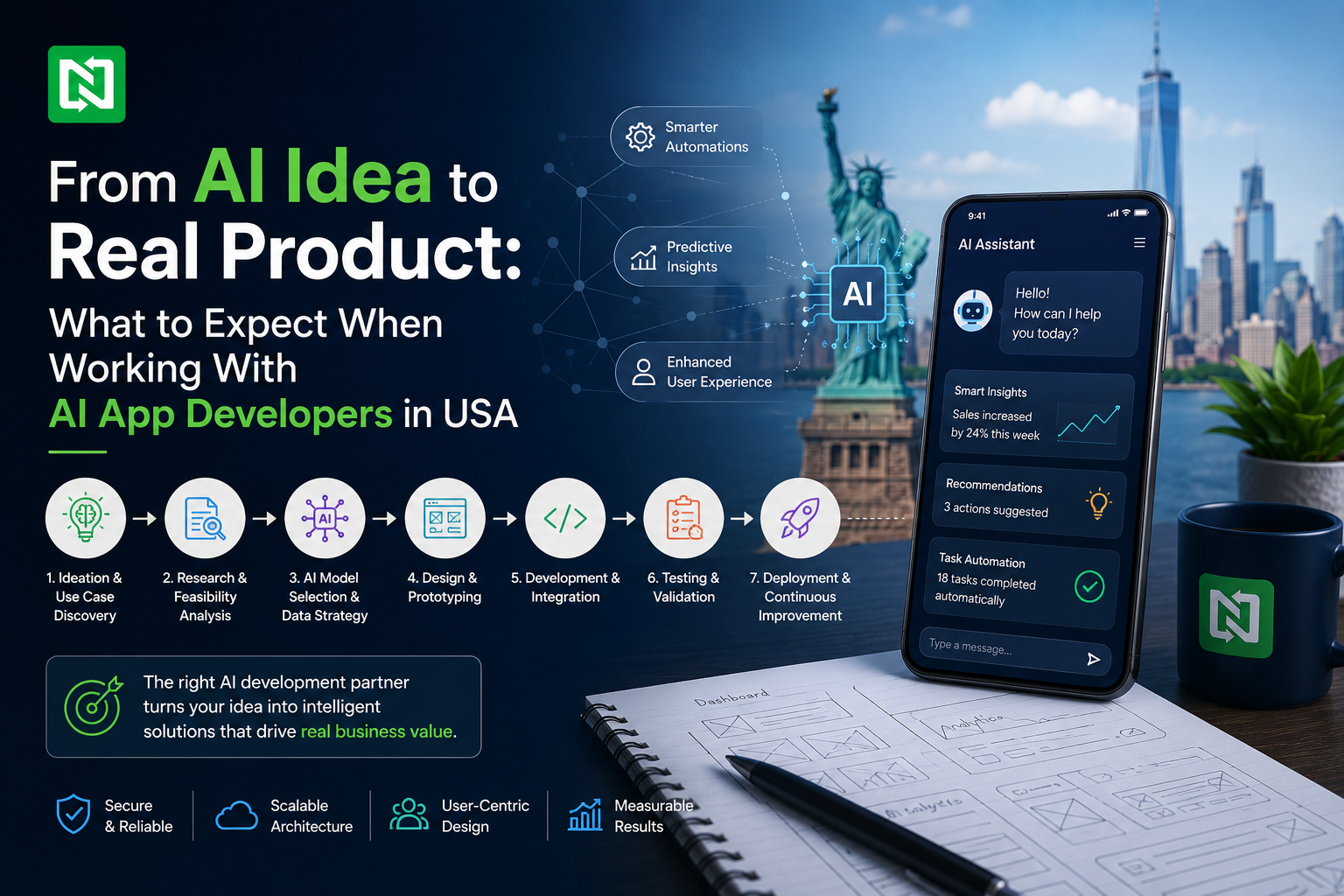
There is often a wide gap between having an interesting AI idea and turning that idea into a reliable, working product. Modern AI applications rarely rely on a single technology. They typically combine machine learning, generative AI, large language models, APIs, databases, automation, and traditional application logic working together as one system.
Businesses that work with experienced AI App Developers in USA quickly learn that AI development is not purely a technical exercise. It involves product decisions about what the AI should actually do, data decisions about what information it relies on, engineering decisions about how it is built and connected, testing decisions about how it is evaluated, and governance decisions about how it is monitored and controlled once it is live. Understanding this upfront helps set realistic expectations for the entire process.
Many businesses approach their first AI project expecting a straightforward build, similar to a conventional app or website. In practice, AI projects tend to involve more discovery and iteration, since a model’s behaviour often becomes clear only once tested against real inputs. Setting realistic timelines and staying open to refining the approach as evidence comes in tends to produce better outcomes than treating AI as a fixed specification to be built and shipped.
Turning an AI Idea Into a Real Use Case
Before any technical work begins, it helps to ask a few direct questions. What decision or task should AI actually improve? Who benefits from that improvement? What currently takes too much time or effort using existing methods? And just as importantly, where does human judgement need to remain part of the process?
Not every application needs AI to be useful. Some problems are better solved with simple, predictable logic that is easier to build, test, and maintain. There is a meaningful difference between using AI because it genuinely solves a real problem more effectively than alternatives, and adding AI simply because it is currently popular. Businesses that start with a clear use case, rather than a general enthusiasm for AI, tend to end up with more focused and more useful products.
It also helps to be honest about where AI is likely to struggle. Tasks that require strict consistency, tightly regulated outputs, or perfect accuracy every time may not be good candidates for AI on their own, even if AI can still play a supporting role. Framing the use case around a specific, measurable outcome, rather than a broad ambition such as “add AI to the app,” makes it far easier to evaluate later whether the feature actually delivered value.
Choosing the Right AI Approach
Once a genuine use case is identified, the next step is choosing an appropriate technical approach. This might involve generative AI for creating content or responses, predictive machine learning for forecasting outcomes, recommendation systems for personalising results, AI-powered automation for handling repetitive tasks, or conversational interfaces for natural interaction with users.
There is also a practical decision about how that AI capability is sourced:
- Existing AI APIs that provide ready-made capabilities
- Open-source models that can be adapted for specific needs
- Custom models built for a particular problem
- Retrieval-augmented generation, which combines a model with a business’s own data sources
The right approach depends on the actual use case, the data available, cost considerations, performance requirements, privacy constraints, and the broader technical environment the application needs to fit into. There is rarely a single correct answer that applies to every situation.
Data, Models, and Integration Requirements
Data quality has a direct impact on how well an AI application performs. Businesses need to consider the accuracy of their data, its relevance to the task at hand, how complete it is, and how well it is organised for practical use.
AI applications also rarely operate in isolation. They frequently need to connect with existing systems, including:
- CRM systems that hold customer information
- ERP systems that manage core business operations
- Mobile applications that serve as the primary user interface
- Internal databases specific to the business
- Customer support platforms that handle service interactions
An AI system is only as useful as the information, infrastructure, and workflows supporting it. Strong models built on poor or disconnected data rarely deliver the results businesses expect.
Integration work often takes longer than businesses initially anticipate, particularly when data lives across multiple systems that were never designed to communicate with one another. Planning for this early, including how data will be accessed, cleaned, and kept up to date, tends to prevent delays later in the project.
Designing AI Around the User
AI features need to support a real user workflow rather than existing as an isolated capability. This means designing clear inputs so users understand what information the system needs, producing understandable outputs rather than opaque results, providing appropriate feedback during processing, handling errors gracefully, and building in human review where it matters.
Users should also be able to recognise when an AI system is uncertain about its output, and they should have a clear way to correct or challenge results that seem wrong. This kind of transparency builds trust and reduces the risk of users relying on inaccurate information without realising it.
Businesses working with experienced AI application development teams tend to treat this user-facing design work as a core part of the build, not an afterthought layered on once the underlying model is complete.
Accuracy, Reliability, and Human Oversight
AI systems come with real limitations that businesses need to plan around. These include hallucinations, where a model generates plausible but incorrect information, false positives in classification or detection tasks, general model limitations tied to training data, and inconsistent outputs across similar inputs.
To manage these limitations, AI systems need clear evaluation criteria, including:
- Accuracy of the outputs produced
- Overall response quality
- Task completion rates
- Latency and response speed
- Ongoing user feedback
Human review remains important in many workflows, particularly those involving high-impact or sensitive decisions, such as financial, medical, legal, or safety-related contexts. AI can support these decisions, but full automation is not always appropriate, and businesses should be cautious about removing human oversight from consequential outcomes.
Security, Privacy, and Responsible AI
Security considerations for AI applications overlap with traditional software security, but they also introduce their own concerns. Businesses need strong access controls, encryption of sensitive data, secure API design, clear data retention policies, and reliable authentication mechanisms.
Responsible AI practices deserve equal attention. This includes actively considering bias in model outputs, maintaining transparency about how the system works and its limitations, protecting user privacy throughout the data lifecycle, preserving meaningful human oversight, and ensuring automated decisions are used appropriately rather than applied blindly to sensitive situations. Where regulation is relevant to a specific industry or region, businesses should confirm actual requirements with qualified experts rather than assuming universal rules apply.
These considerations matter most in sectors such as healthcare, finance, and other areas where automated outputs can directly affect people’s outcomes. Even outside heavily regulated industries, treating privacy and transparency as core design requirements, rather than optional extras, tends to build more durable trust with users over time.
Testing, Deployment, and Continuous Improvement
Testing an AI application differs meaningfully from testing conventional software, because outputs are not always perfectly predictable. A thorough approach typically includes model evaluation against defined benchmarks, testing across edge cases that the system might handle poorly, prompt testing for generative AI components, regression testing to catch new issues introduced by updates, and adversarial testing to identify how the system might be misused or manipulated.
Once an AI application is deployed, monitoring becomes an ongoing responsibility rather than a one-time task. Businesses typically track accuracy over time, actual usage patterns, operating costs, response times, failure rates, and direct user feedback.
Working with an experienced AI development partner can make this continuous cycle far more manageable, since teams familiar with AI systems can interpret monitoring data and translate it into practical improvements. AI products, more than most software, tend to need continuous evaluation and refinement well after the initial launch, because model behaviour, user needs, and available data all continue to evolve.
Frequently Asked Questions
Do AI applications always require custom AI models?
No. Many applications can rely on existing AI APIs or open-source models, particularly for well-established tasks. Custom models are usually reserved for more specialised or unique requirements.
How long does it take to build an AI application?
Timelines vary significantly depending on the complexity of the use case, data readiness, required integrations, and the level of testing needed. There is no fixed timeframe that applies to every project.
Can AI completely replace human decision-making?
Generally, no. AI can support and accelerate decisions, but human oversight remains important for sensitive, high-impact, or ambiguous situations where judgement and accountability matter.
If you are exploring how to work with AI app developers in USA to bring your idea to life, feel free to contact our team to discuss your specific requirements.