Introduction
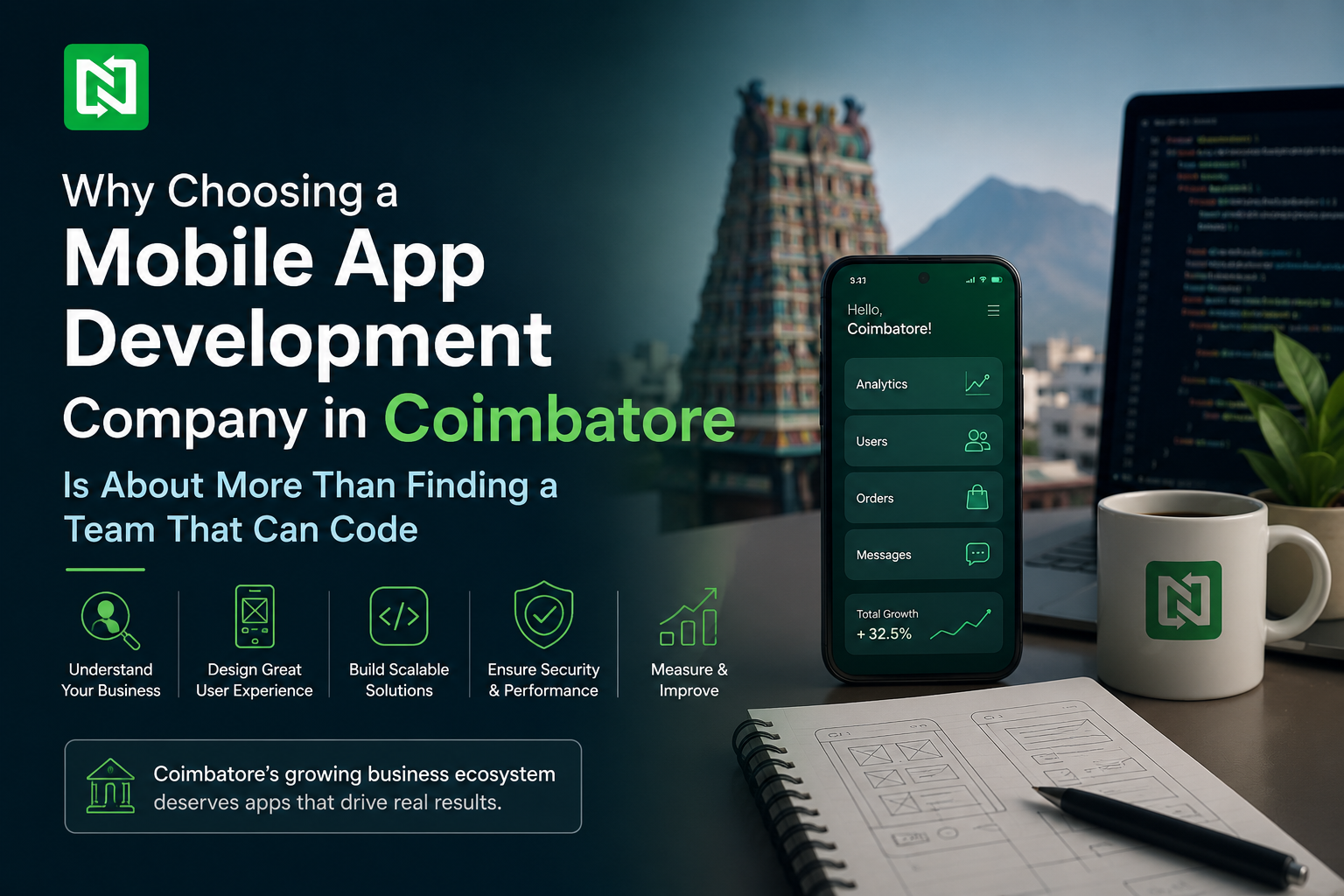
When businesses start looking for development partners, the search often narrows quickly to a simple question: who can write the code fastest and cheapest? That framing misses most of what actually determines whether an app succeeds. Choosing a Mobile App Development Company in Coimbatore a decision that touches product thinking, user experience, engineering discipline, testing rigour, security, performance, and the ability to keep improving an app after launch, not just the ability to produce working code.
Coimbatore has grown into a genuine technology and business hub over the past decade, with a mix of established industry and a rising base of software talent. That growth means businesses have more options than ever, which makes it more important, not less, to know what actually separates a capable development partner from one that simply codes what it is told. This article walks through what that evaluation should actually look like.
Why Coding Skills Alone Are Not Enough
There is a meaningful difference between building an application and building an application that people actually use. Writing functional code is a necessary skill, but it does not by itself guarantee a good product. A development team also needs to understand user behavior, translate business requirements into features that matter, and make sensible calls about usability and prioritization along the way.
A code-first approach, where a team simply builds whatever is asked without questioning it, tends to produce predictable problems:
- Unnecessary features that add complexity without adding value
- Interfaces that are technically functional but confusing to use
- Poor performance because architecture decisions were never questioned
- Applications that become difficult to maintain as they grow
- Major components that need to be rebuilt later because early choices did not hold up
None of these problems show up in a coding test or a portfolio review. They show up months after launch, when the cost of fixing them is far higher than the cost of getting them right the first time.
Understanding the Business Problem Before Development
Good development starts with discovery, not with a specification document. Before any screens are designed, a capable partner should be asking who will actually use the application, what problem it solves for them, what alternatives already exist, and what would make this particular application genuinely valuable rather than just another option.
Once those questions have real answers, they can be turned into a practical scope through a few concrete steps:
- Defining a minimum viable product that captures the core value
- Mapping out user journeys for the primary tasks
- Documenting functional requirements
- Documenting technical requirements
- Prioritizing features based on impact rather than convenience
A focused first release, built around a clear MVP, often teaches a business more than a feature-heavy launch. It gets the core idea in front of real users faster, and the feedback from that first version is far more useful than assumptions made in a planning meeting.
User Experience and Product Design
User experience is not a layer applied after development. It needs to shape decisions from the beginning, because the structure of an application often determines how easy or difficult it is to use well. This includes simple navigation, a clear information hierarchy, as few unnecessary steps as possible, accessibility for a wide range of users, and interaction patterns that stay consistent throughout the app.
Changing major UX or workflow decisions late in development tends to create disproportionate complexity, since screens, data models, and business logic are often built around the original flow. Common areas where this matters include:
- Registration and account creation
- Checkout or payment flows
- Search and filtering
- Notifications
- Account and profile management
Getting these flows right early, rather than patching them after development is well underway, tends to save significant rework later.
Choosing the Right Technology Approach
Technology decisions should be treated as a genuine trade-off rather than a default choice. Native iOS development and native Android development each offer strong performance and full access to platform-specific features, but they typically require separate codebases for each platform. Cross-platform development allows a single codebase to target multiple platforms, which can reduce development time and cost, though it may involve trade-offs in certain performance-sensitive or platform-specific scenarios.
The right choice depends on several practical factors:
- Which platforms the target users actually use
- How complex the application needs to be
- Performance requirements for the specific use case
- Development timeline and budget
- Available technical resources and expertise
- How the application will be maintained over time
There is no universally correct answer here. A capable development partner will walk through these trade-offs honestly rather than defaulting to whatever approach they happen to specialize in.
Security, Performance, and Scalability
What happens after an application starts gaining real users matters just as much as how it was built. Security needs to be treated as a foundational concern rather than something addressed after a problem occurs. This includes secure authentication, proper data protection, secure API design, secure storage of sensitive information, appropriate permission handling, and keeping dependencies updated as vulnerabilities are discovered.
Performance deserves equally serious attention, including loading times across different devices, reliability under inconsistent network conditions, battery consumption, crash rates, and how quickly APIs respond under real usage.
Architecture decisions made early also need to account for the future, including growth in users, growth in data volume, additional features, and new third-party integrations. Businesses that work with experienced mobile app development services tend to see architecture planned with this kind of growth in mind from the outset, rather than treating scalability as a problem to solve later.
Communication, Testing, and Project Transparency
The development process itself has a direct influence on the quality of the final product. Clear milestones, documented requirements, regular progress reviews, clearly defined responsibilities, and transparent issue tracking all help keep a project aligned with what the business actually needs, rather than drifting based on assumptions.
Testing should run throughout development rather than being treated as a final checkpoint. A thorough approach typically includes functional testing to confirm features work correctly, device testing across different hardware and operating system versions, usability testing with real users, performance testing under realistic conditions, security testing to catch vulnerabilities, and regression testing to make sure new changes have not broken existing functionality.
Postponing testing until immediately before launch tends to surface serious issues at the worst possible time, when there is little room left to address them properly. Teams that test continuously catch problems while they are still cheap and straightforward to fix.
Measuring Whether the App Is Actually Working
Launching an app is not the same as succeeding with it. Once an application is live, a business needs a way to actually understand how it is performing. Useful metrics include downloads, activation rate, daily active users, monthly active users, retention, conversion rate, crash-free sessions, session duration, and feature adoption.
Analytics and direct user feedback, taken together, can reveal a great deal that is not visible from the outside. They can show which features users consistently ignore, where users abandon a workflow partway through, where performance problems are quietly driving people away, and which areas genuinely need improvement based on real behavior rather than internal opinion.
This is where the value of a genuine development partner, rather than a team that simply delivers code and moves on, becomes clear. Working with an experienced app development partner means having support that continues past launch, helping interpret this data and turn it into practical next steps. An application that is never measured after release is, in a real sense, still unfinished. If your business is evaluating options and wants to talk through what a thoughtful development process actually looks like, you are welcome to contact our team for a practical conversation.
Frequently Asked Questions
What should businesses look for beyond coding skills?
Businesses should look for product thinking, genuine discovery and requirements work, UX judgement, sound technology decisions, security and performance discipline, structured testing, transparent communication, and a plan for measuring the app after launch.
Should every mobile app start with an MVP?
In most cases, starting with a focused MVP is a sound approach, since it gets a core version in front of real users quickly and provides genuine feedback to guide further development. There can be exceptions depending on the specific business context.
Is native development always better than cross-platform development?
No. Native development offers strong performance and full platform access but usually requires separate codebases, while cross-platform development can reduce cost and timeline with some trade-offs. The right choice depends on the specific project’s requirements, budget, and goals.