A new category of software is quietly replacing the apps many businesses built just a few years ago. Agentic apps can plan, make decisions, and take actions toward a defined goal instead of simply waiting for a tap or typed command before reporting the outcome. Gartner expects 40 percent of enterprise applications to include task-specific AI agents by the end of 2026, up from less than 5 percent in 2025, highlighting how quickly agentic AI is moving from experimentation toward mainstream enterprise software. Companies trying to keep pace are increasingly turning to AI app development specialists rather than attempting to retrofit agents onto software that was never designed to act independently.
What Makes an App “Agentic” in the First Place
The term is often used loosely in marketing, so it helps to be precise about what actually separates an agentic app from everything that came before it.
Agentic Apps vs Chatbots vs Traditional Software
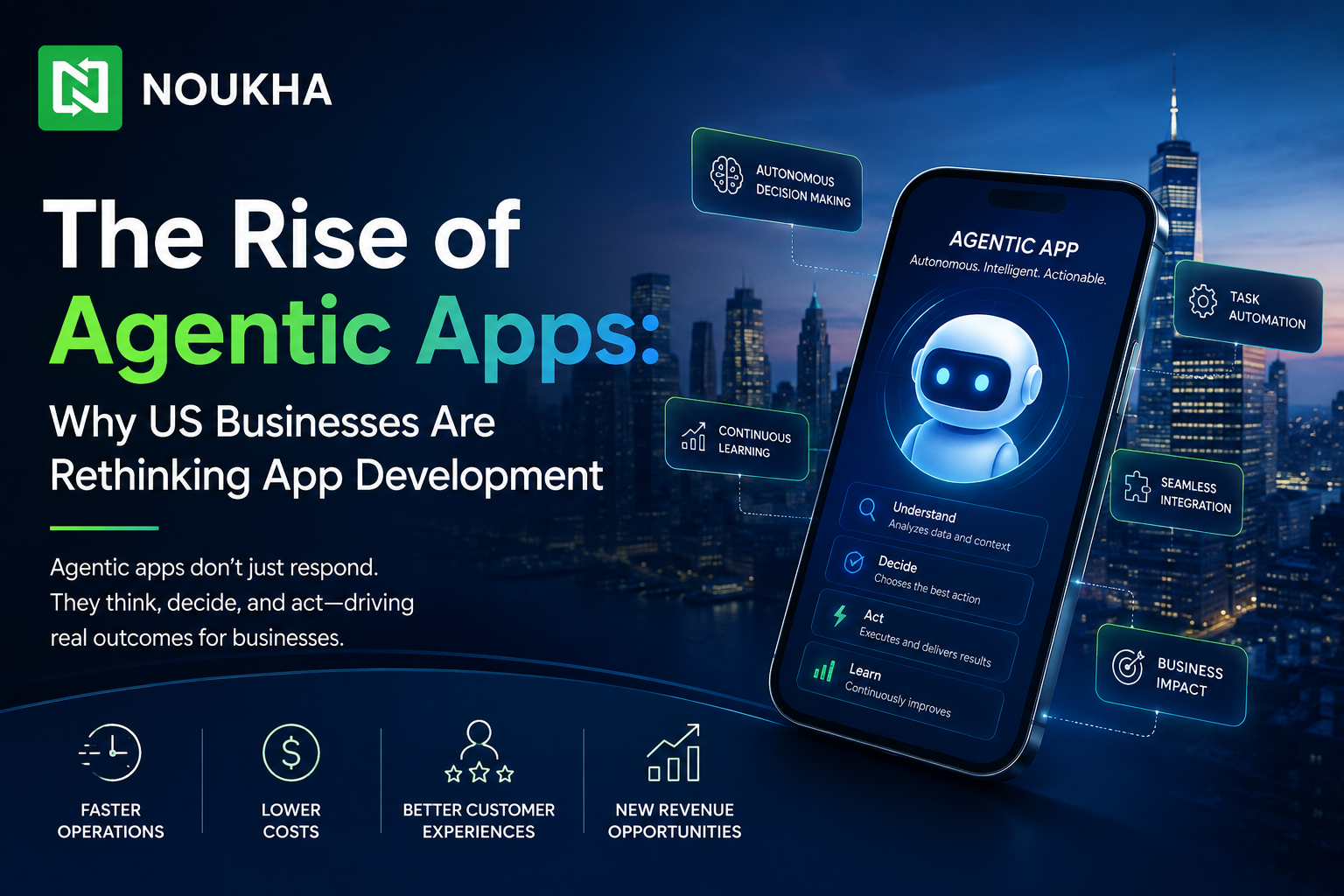
Traditional software runs on fixed logic. It does exactly what it was coded to do and needs a developer to update it whenever business rules change. A chatbot improves on this by responding conversationally, but it still only answers what it is asked. An agentic app goes further. It can read a customer’s history, check an order system, draft a response, and escalate to a human with a summary already prepared, all without being told each individual step. The defining characteristic of an agentic app is goal-oriented autonomy, not simply conversation.
Why the Distinction Actually Matters for Businesses
This is not a semantic argument. A chatbot that answers questions still requires a human to act on the answer. An agentic app can complete the task itself, within boundaries a business sets in advance. That difference changes what a piece of software is actually worth to a company, and it explains why so many US businesses are re-evaluating how they build and buy software in the first place.
The Numbers Behind the Shift
The pace of change here is unusual even by software industry standards, and the data backs up what businesses are already noticing anecdotally.
Adoption Is Accelerating Faster Than Most Enterprise Tech
McKinsey’s latest research found that 88 percent of organizations regularly use AI in at least one business function. Its research also found that 23 percent of respondents have scaled an agentic AI system somewhere in their organization, while another 39 percent are experimenting with agentic AI. The global AI agents market is estimated at $10.9 billion in 2026, up from approximately $7.6 billion in 2025, according to Grand View Research, a jump of more than 40 percent in a single year.
The US Is Leading, But Production Still Lags Intent
US enterprises are showing particularly strong interest in agentic AI, although experimentation continues to outpace full-scale deployment. The gap between companies exploring agentic AI and companies actually running it at scale remains wide, and closing that gap is where most of the real competitive advantage is likely to show up over the next few years.
Why US Businesses Are Rethinking How Apps Get Built
The shift underway is not just about adding a feature. It is prompting companies to reconsider the entire process of how software gets designed.
From Fixed Logic Trees to Goal-Driven Systems
Older applications were built around explicit rules: if this happens, do that. Every new scenario required a developer to write new logic and redeploy the application. Agentic systems instead operate around goals and available tools, using a language model to reason through unfamiliar situations rather than failing outside a predefined script. This means the underlying architecture of an agentic app looks fundamentally different from a conventional one, not just its interface.
Rebuilding Around Agents Instead of Bolting Them On
Businesses that simply add an AI chat widget to an existing application rarely see meaningful results, since the surrounding workflow was never designed for autonomous action. Companies seeing real value instead work with an experienced AI application development team in the United States to redesign the underlying workflow itself, deciding which decisions can safely be delegated to an agent and which still require a human in the loop, before writing a single line of code.
Where Agentic Apps Are Already Changing Business Operations
Customer-facing functions have become the clearest proving ground for agentic software, largely because the volume of repetitive, well-defined requests makes automation easier to measure.
Customer Support Is the Clearest Early Example
Several AI customer-service platforms have reported significant improvements in automated resolution rates and the volume of conversations handled without human intervention. The practical shape of this matters more than any single headline figure.
What This Looks Like in Practice
An agentic support system does not simply search a help article and paste back an answer. It checks order status, verifies account details, drafts a personalized response, and either resolves the issue outright or hands off to a human agent with full context already attached. That last step, the intelligent handoff, is often what separates a genuinely agentic system from a more limited chatbot wearing agentic branding.
The Risks Nobody Talks About Enough
Despite the momentum, many agentic AI projects are still struggling to move beyond experimentation, making careful planning as important as technical capability.
Why So Many Agentic Projects Get Cancelled
Gartner has projected that more than 40 percent of agentic AI projects will be cancelled by the end of 2027, largely due to unclear business value, rising costs, or inadequate risk controls rather than any failure of the underlying technology. Ambition frequently outpaces the groundwork needed to support it.
Governance and Data Quality Are the Real Bottleneck
The organizations pulling ahead are rarely the ones with the biggest AI budgets. They tend to be the ones treating governance, data quality, and integration readiness as foundational work rather than something to figure out after launch. An agent making decisions on incomplete or inconsistent data will make confident, well-reasoned mistakes, which are often harder to catch than the obvious kind. Working with developers who focus specifically on production-ready AI systems, rather than treating agentic features as an experimental add-on, tends to shorten the distance between a promising pilot and something a business can actually rely on.
Governance is becoming a defining challenge as agentic AI moves into production. Gartner predicts that by 2027, 40 percent of enterprises will demote or decommission autonomous AI agents because of governance gaps identified after production incidents, a reminder that oversight has to be built in from the start rather than added after something goes wrong.
What a Practical Agentic Strategy Looks Like for a Business
None of this requires an all-or-nothing transformation to get started.
Start With One Well-Defined Workflow
Rather than attempting to make an entire application agentic at once, a practical approach is to begin with a single, well-bounded process, such as first-line customer support or invoice processing, where success can be measured clearly and the consequences of an early mistake are limited. Expanding scope comes later, once the first workflow proves reliable.
Choose the Right Development Partner
Few companies outside the software industry have the specialized expertise to design, build, and govern agentic systems entirely in-house. Partnering with an experienced AI application development team can help businesses reduce technical risk and move more efficiently from an initial pilot to production.
Conclusion
Agentic apps are not a passing trend layered on top of existing software categories. They represent a genuine shift in how applications are designed, from fixed rules that require constant human updates toward systems that can reason, act, and adapt within clearly defined boundaries. US businesses that treat this as an architectural decision, not just a feature request, are the ones most likely to see real value rather than another stalled pilot. If your organization is exploring what an agentic approach could look like for your workflows, contact us to talk through where to start.
Frequently Asked Questions
What exactly is an agentic app?
An agentic app is software built around AI agents that can plan, reason, and take multi-step actions toward a goal with limited human supervision, rather than simply responding to a single prompt or following a fixed set of rules.
How is an agentic app different from a chatbot?
A chatbot typically answers a question or drafts a response based on user input, leaving the person to act on it. An agentic app can complete the underlying task itself, such as verifying an account, updating a record, or resolving a request, within boundaries the business defines in advance.
Why do so many agentic AI projects get cancelled?
Analysts point to unclear business value, underestimated costs, and weak governance as the leading causes, rather than limitations in the underlying AI technology itself. Projects that skip careful workflow redesign and data preparation are especially prone to stalling after the pilot stage.
Is agentic AI only useful for large enterprises?
No. While large companies with over 1 billion dollars in revenue currently show the highest adoption and interest, agentic capabilities are increasingly accessible to mid-market and smaller businesses through specialized development partners rather than requiring an in-house AI team.
What is a reasonable first step for a business considering an agentic app?
Identifying one well-defined, high-volume workflow, such as customer support or document processing, and redesigning it around an agent’s capabilities is generally a more effective starting point than attempting to make an entire application agentic at once.