
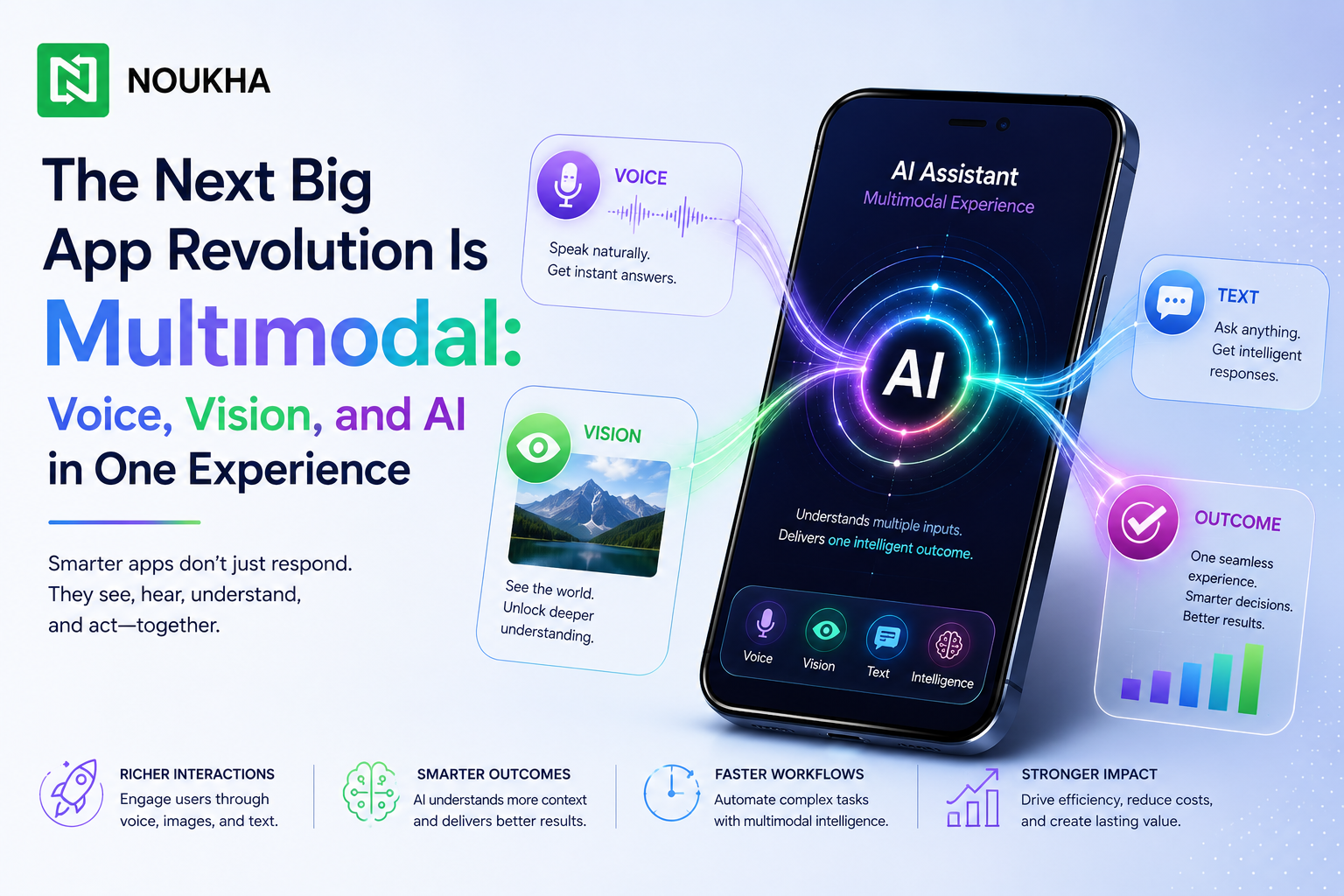
Beyond Text Boxes and Voice Commands
A multimodal app is one that can accept and reason across more than one type of input, text, voice, images, or video, within a single interaction, rather than forcing each input type into its own separate feature. A user might snap a photo of a broken appliance, describe the issue out loud, and receive a single coherent response that references both what the model saw and what it heard. That kind of fluid interaction was technically possible before, but it often required stitching together separate systems. This could produce a disjointed experience where the voice assistant had little awareness of what the image recognition system had identified.
Why This Shift Is Happening Now
Advances in multimodal AI models have made it increasingly practical for systems to process text, images, audio, and video within the same AI experience, reducing the need to treat every input type as a completely separate workflow. That architectural shift is what allows an app to feel like it is having one conversation across formats instead of juggling disconnected tools stitched together behind the scenes. Industry researchers tracking this space note that two years ago, multimodal AI mostly meant a chatbot that could describe an uploaded image. Today it increasingly means a single system reasoning across audio, video, documents, and live conversation within the same experience.
The Numbers Behind the Multimodal Shift
Adoption Is Already Mainstream, Not Experimental
Market research estimates place the global multimodal AI market at roughly 3 billion to 3.3 billion dollars in 2026, with annual growth rates of more than 36 percent projected through the decade, depending on the research firm. That growth reflects a genuine shift in enterprise priorities, as more organizations move multimodal features out of pilot projects and into production workflows across customer service, document processing, and quality inspection.
Voice AI Has Moved Past the Experimental Stage
Voice AI has also moved beyond experimentation, with businesses increasingly exploring voice agents for customer support, sales, scheduling, and other conversational workflows. Combined with vision and text capabilities in the same interaction, voice is increasingly treated as one input among several rather than an isolated channel handled by a separate system.
Where Multimodal Apps Are Already Winning
Document Intelligence That Actually Reads Documents
One of the clearest returns on multimodal investment shows up in document processing. Systems combining vision and language understanding can extract structured information from invoices, contracts, and forms, reducing the amount of manual data entry required in document-heavy workflows. For businesses processing large volumes of paperwork, this is often one of the higher return on investment use cases in the entire multimodal category, since the cost of manual entry compounds every single day it continues.
Vision Plus Voice in Customer Support
Insurance and field service apps are a good example of where this compounds quickly. A customer can photograph vehicle damage, describe what happened out loud, and have the app cross reference that combined input against policy coverage to help generate a settlement recommendation faster, a workflow that previously required a human adjuster to manually review each piece separately.
Fraud Detection Gets Sharper With More Signals
Combining multiple signals can help fraud detection systems identify inconsistencies that may be difficult to detect when transaction data, documents, voice, or images are analyzed independently. Adding modalities does not just add convenience. It closes gaps that a text-only or voice-only system would have missed entirely, since a fraudulent claim that looks legitimate on paper often reveals itself through inconsistencies between what a document states and what a voice or image actually shows.
What This Means for Businesses Building Apps in 2026
Retrofitting Is Harder Than Building Multimodal First
Apps originally built around a single input type tend to need substantial rework to add a second or third modality cleanly, since voice, vision, and text each carry different latency, storage, and privacy requirements. Bringing in an AI app development team early in the design process tends to avoid the kind of bolted-on integration that becomes obvious to users the moment they try to use two input types together.
Regulatory Requirements Are Arriving Alongside the Technology
In the European Union, certain high-risk AI systems are subject to specific requirements under the EU AI Act, with obligations being introduced in phases. Businesses using multimodal AI in areas such as healthcare, credit, and insurance therefore need to consider compliance, documentation, risk management, and human oversight from the design stage, rather than treating it as an afterthought once the feature already works.
Fewer Systems to Monitor, Not More
A counterintuitive benefit of building multimodal-first is that it can actually simplify a technical stack rather than complicate it. Unified models that handle voice, text, and reasoning in a single pass can reduce the number of separate systems a team needs to monitor, version, and debug compared with stitching together dedicated speech recognition, vision, and language tools as separate products.
How to Approach Building a Multimodal App
The starting point is rarely trying to support every input type at once. It usually makes more sense to identify the single workflow where combining inputs solves a real problem, a support ticket that includes a photo, a form that gets filled out by voice, and build that well before expanding further. The right development partner can help identify which combination of voice, vision, and text actually serves your specific users rather than adding modalities simply because the underlying models now support them.
Conclusion
The apps winning attention in 2026 are not the ones with the most features. They are the ones that let a user speak, show, and type within a single, coherent interaction instead of forcing a choice between them. That shift is already reshaping customer support, insurance, healthcare, and document-heavy industries, and the businesses adapting early are building a real advantage before multimodal becomes the baseline expectation rather than the differentiator. If you are ready to explore what a multimodal experience could look like for your own app, contact us and we can help you map out where to start.
Frequently Asked Questions
What is a multimodal AI app?
A multimodal AI app can accept and reason across more than one type of input, such as text, voice, images, or video, within the same interaction, rather than handling each input type as a separate, disconnected feature.
Why are businesses moving toward multimodal apps now?
Advances in multimodal AI models have made it far more practical to build and deploy combined, fluid interactions at scale. Enterprise interest has followed quickly, with more organizations moving multimodal features out of pilot projects and into production workflows across customer service, document processing, and quality inspection.
Which industries benefit most from multimodal AI apps?
Document-heavy industries such as insurance, finance, and healthcare, along with customer support and manufacturing quality inspection, tend to see the clearest returns, since these workflows naturally involve combining visual information, spoken input, and text-based records.
Is it harder to add voice and vision to an existing app later?
Generally yes. Voice, vision, and text each involve different latency, storage, and privacy considerations, so apps built around a single input type from the start often require substantial rework to add additional modalities cleanly rather than as a bolted-on feature.
Does multimodal AI raise any regulatory concerns?
It can, particularly in high-stakes areas such as healthcare, credit decisions, and insurance claims. Under the EU AI Act, certain high-risk AI systems are subject to specific obligations being introduced in phases, so businesses working in these areas need to consider compliance, documentation, and human oversight from the design stage.
Do multimodal apps actually simplify technical infrastructure?
In many cases, yes. A unified model handling voice, text, and reasoning together can reduce the number of separate systems a team needs to monitor and maintain compared with running dedicated speech recognition, vision, and language tools as separate products.