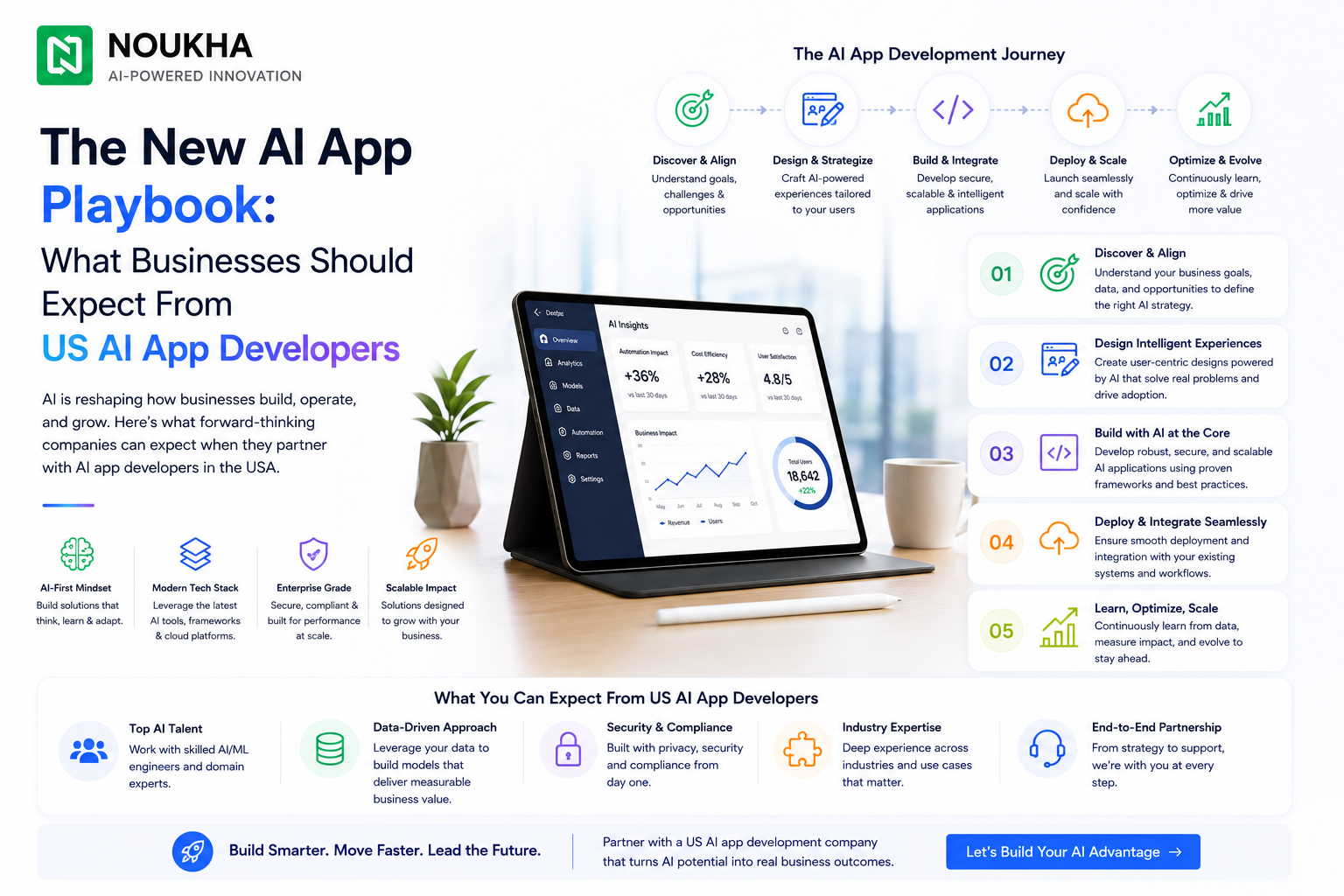
Until recently, many companies exploring artificial intelligence were willing to start with a working demo or proof of concept. That bar has moved. Boards now ask for measurable outcomes, not just a chatbot that looks impressive in a meeting. This shift has changed what businesses should reasonably expect when they hire ai app developers USA companies rely on, and it has made the difference between a flashy prototype and a dependable product far more visible than it used to be.
Why AI App Development Now Means Something Different
The term AI app development used to cover fairly simple integrations, a chat widget wired to a language model API, or a basic recommendation feature bolted onto an existing product. The scope has widened considerably. Today it can mean retrieval systems grounded in private company data, autonomous agents that call external tools, and machine learning pipelines that can incorporate new data through controlled retraining and deployment processes.
From Chatbots to Production Systems
Generative AI, large language models, computer vision, and natural language processing are no longer experimental add-ons. They sit inside core workflows such as fraud detection, document review, customer support, and supply chain forecasting. That change in scope also raises the stakes, because a model making a wrong call inside a live business process is a different problem than a chatbot giving an odd answer in a demo.
The Demo to Deployment Gap
Many AI pilots struggle to make the transition from experimentation to reliable production systems. The common reason is not that the underlying model was weak, but that nobody planned for evaluation, monitoring, security, or the messy edge cases that show up once real users and real data are involved. Understanding this gap is the first thing a business should walk into a development conversation knowing.
What Businesses Should Expect From a Development Partner
A Discovery Phase Before Any Code
A credible partner starts by defining the use case, the success metric, and whether the available data is actually good enough to support it. Skipping this step is one of the most common reasons AI projects run over budget, since teams often discover data quality problems only after the build has already started.
A Proof of Concept With a Real Budget Ceiling
Before committing to a full build, it is reasonable to expect a focused proof of concept that tests the riskiest assumption in the project within a controlled budget. This keeps the financial exposure low while giving both sides evidence of whether the approach actually works for the specific business problem.
Why Small Pilots Matter
A small pilot forces clarity. It is much easier to tell whether an AI feature is genuinely useful when it is tested against a narrow, well-defined task than when it is bundled into a large release alongside a dozen other features.
The Engineering Work Behind a Working AI Application
Model Selection and Orchestration
Choosing a model is rarely a one-time decision. Different tasks often call for different models, and a well-built application routes requests intelligently to balance accuracy, latency, and cost. This is one of the areas where experienced AI app developers in USA tend to add the most value, since orchestration decisions made early in a project are expensive to unwind later.
Retrieval and Grounding
Most business applications need a model to reason over private company information rather than general internet knowledge. This is typically handled through retrieval systems that fetch relevant documents or records and feed them to the model as context before it generates a response.
Reducing Hallucination With RAG
Retrieval-augmented generation, commonly shortened to RAG, connects a language model to an organisation’s data by retrieving relevant information and providing it as context for the model’s response. When designed with source attribution, it can also make answers easier to verify. It does not eliminate hallucinations, but well-designed retrieval and grounding can reduce unsupported answers by giving the model relevant source material to work from. The degree of improvement depends on factors such as retrieval quality, how documents are chunked and ranked, and how carefully the system is evaluated.
Guardrails, Evaluation and Observability
Safety Before Scale
Guardrails cover input filtering, output checks, and boundaries around what a model is allowed to do inside an application. These should be treated as part of the build itself rather than something added right before launch, since retrofitting safety controls onto a finished system is far harder than designing them in from the start.
Monitoring Cost and Latency
Once an AI feature is live, ongoing visibility into response quality, response time, and token or compute cost becomes essential. Without this, a feature that performed well in testing can quietly degrade or become expensive to run at scale without anyone noticing until the bill or the complaints arrive.
Where AI Applications Are Creating the Most Business Value
Industries Moving Fastest
Healthcare organisations are using AI applications for document intelligence, administrative automation, and increasingly clinical decision support, with appropriate human oversight remaining important for high-impact decisions. Financial services firms are applying similar techniques to fraud detection and document review, where speed, consistency, and accuracy all matter. Retail and ecommerce businesses are leaning on AI for personalised search and content generation, and logistics companies are using computer vision and forecasting models to reduce manual quality checks and improve planning accuracy.
A Practical Way to Prioritise Use Cases
Rather than trying to apply AI everywhere at once, it usually helps to rank potential use cases by two factors: how much manual effort the task currently consumes, and how tolerant the process is of occasional errors. A high-effort, error-tolerant task, such as drafting a first version of a document, is a much safer starting point than a low-effort, error-sensitive task where a mistake has real consequences.
Questions Worth Asking Before Signing a Contract
A short evaluation checklist can save a business from a costly mismatch later:
- Can the vendor show a system running with real users, not only a demo
- Which specific models, retrieval tools, and monitoring stack do they use
- Is evaluation and safety testing part of the build, or an afterthought
- Who owns the resulting code, data, and model assets once the project ends
- Do they have experience with the compliance needs of your specific industry
Ownership, Compliance and Long-Term Support
Who Owns the Code, Data and Model Assets
Ownership terms vary widely across vendors, and this is worth clarifying before any contract is signed. A business should know in writing whether the source code, infrastructure configuration, and any fine-tuned model assets transfer fully to them. This can depend on several separate factors, including custom code, training or fine-tuning outputs, datasets, prompts, evaluation data, and the licence terms attached to any third-party foundation models used in the build. Unclear ownership can create vendor lock-in long after the original project is finished.
Compliance Considerations for Regulated Industries
Healthcare, finance, and other regulated sectors bring additional requirements around data handling, audit trails, and access controls. Businesses in regulated sectors should expect a development partner to explain the specific legal, regulatory, and assurance requirements relevant to the project, which may include HIPAA requirements for applicable healthcare data and SOC 2 controls or reports where relevant to the organisation’s vendor risk requirements, rather than offering only general reassurances about security.
Choosing the Right Partner for the Work Ahead
Not every vendor that lists artificial intelligence on its website has actually shipped a production system. It is worth asking direct questions about past deployments, team structure, and how a project would be scoped for your specific use case. Working with an established ai application development company USA businesses have used before can shorten this evaluation, since a track record of completed, working systems says more than any pitch deck.
Frequently Asked Questions
How long does it take to build a custom AI application?
A focused proof of concept is often delivered in a matter of weeks. A production-grade application with integrations, security review, and compliance requirements generally takes a few months, depending on the scope and how ready the underlying data already is.
What is the difference between generative AI and an AI agent?
Generative AI creates new content such as text, code, or images from a prompt. An AI agent goes further by planning a sequence of steps and calling external tools or systems to complete a task with some degree of autonomy. Many modern applications combine both approaches.
Do businesses need their own data science team to use AI application services?
No. Most external development partners handle model selection, data pipelines, and deployment as part of the engagement. An internal data science team can be useful for ongoing tuning, but it is not a prerequisite for getting a first AI product built and launched.
How much does AI app development typically cost?
Cost depends heavily on scope, data readiness, and integration complexity, so there is no single fixed number. A small proof of concept is the most affordable way to validate an idea before committing to a larger, milestone-based build.
What should a business ask about data privacy before starting a project?
It is reasonable to ask exactly where data is stored, who can access it, whether it is used to train any shared or third-party models, whether it is retained by third-party model providers and under what contractual terms, and how it would be deleted or returned at the end of the engagement.
Conclusion
The businesses getting real value from artificial intelligence in 2026 are not necessarily the ones that moved first. They are the ones that treated the build like any other serious software investment, with a clear use case, a realistic budget for testing, and a partner willing to explain exactly how the system works rather than just how impressive it looks. If your team is weighing this decision and wants a straightforward conversation about scope and cost before committing to anything, you can contact us to talk through what a first working version could realistically look like for your business.