
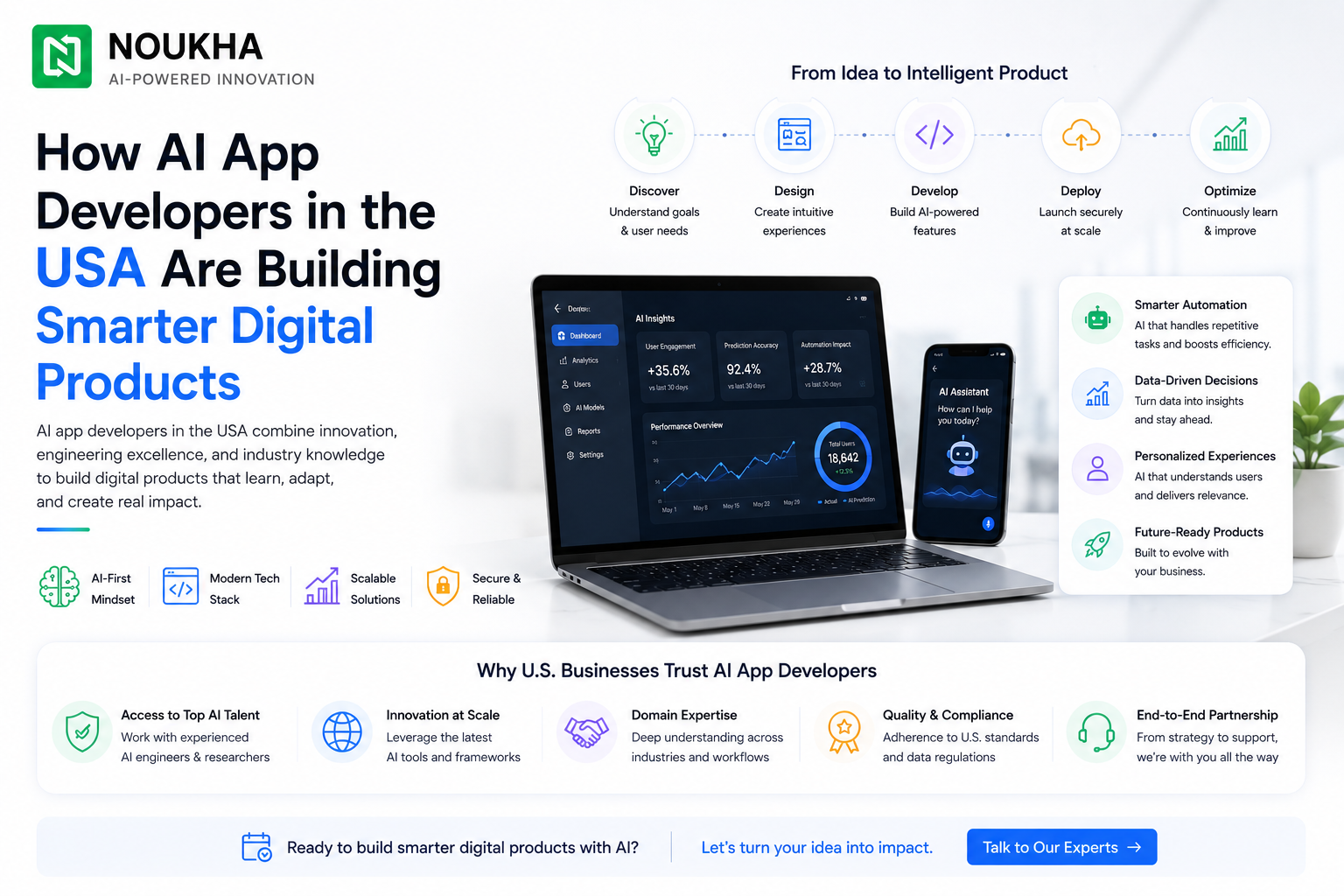
More American businesses are moving beyond conventional app functionality and exploring products that can personalise experiences, automate workflows, and support decisions with AI. This is the core reason AI App Developers in USA are rethinking how software gets built, moving away from purely static features and toward systems that respond intelligently to real user behaviour. From healthcare platforms that flag risks before a doctor even asks, to retail apps that adjust pricing and recommendations in near real time, the bar for what counts as a good digital product is shifting for many teams. This article looks at how that shift is actually happening on the ground, what separates a genuinely smart app from a gimmick, and what business owners should understand before starting an AI build of their own.
The Shift From Basic Apps to Intelligent Digital Products
For most of the last decade, mobile and web apps were built around fixed workflows. A user tapped a button, the app performed a predetermined action, and the experience stayed largely the same for every user. That model is not disappearing, since predictable, deterministic workflows still matter for many use cases, but it is increasingly being supplemented by AI-driven experiences that can adapt to users, data, and changing conditions. The market for AI-powered applications is expanding rapidly as businesses use AI for personalisation, automation, search, decision support, and workflow optimisation. That growth is not happening simply because AI is trendy. It is happening because businesses are seeing measurable returns from apps that personalise experiences, automate repetitive work, and surface insights that a static interface never could.
What “Smarter” Actually Means in App Development Today
The word “smart” gets used loosely in marketing, so it helps to be specific about what it actually involves in a modern build.
Beyond Chatbots and Into Agents and Automation
Early AI features in apps were mostly conversational, a chatbot bolted onto a support page. Development teams have since moved toward AI agents that can complete multi-step tasks with varying degrees of autonomy, intelligent automation that handles backend processes without constant human triggers, and predictive systems that anticipate what a user needs before they ask. A logistics app, for example, might dynamically recommend or trigger a route change based on traffic, weather, delivery constraints, and real-time operational data, rather than simply notifying a dispatcher of a delay after the fact.
Personalisation and Real-Time Decision-Making
The second major shift is speed. Older recommendation engines updated periodically, sometimes overnight. Some newer systems process behavioural signals in near real time, allowing them to adjust what a user sees within the same session, though not every modern recommendation system operates this way. This matters most in sectors like retail, finance, and media, where a delayed recommendation is often a missed one.
How Development Teams Approach a Smarter Build
Building an intelligent product is not the same process as building a conventional app with a few AI features added on top. Teams that specialise in this work, including an experienced AI application development company USA businesses choose for complex projects, generally follow a more deliberate sequence before writing production code.
Discovery and Use-Case Validation Before Code
The first step is rarely technical. It is figuring out whether AI actually solves the problem at hand or whether it is being added because it sounds impressive. A proof of concept or minimum viable product is usually built first to validate the idea against real data and real users, which reduces the risk of investing heavily in a direction that will not hold up in production.
Choosing the Right AI Stack
Machine learning, natural language processing, computer vision, and generative AI each solve different problems, and a competent team will not default to the same stack for every project. A healthcare diagnostic tool needs different underlying models than a customer service assistant or a fraud detection system, and mixing these up early leads to expensive rework later.
Data Architecture and Compliance
An intelligent app is only as good as the data feeding it, and in regulated industries that data has to be handled carefully from day one. Healthcare projects may need to meet HIPAA requirements depending on the data involved and the app’s relationship with covered entities or business associates, while apps processing the personal data of individuals in the European Economic Area may need to comply with the GDPR, depending on the circumstances and scope of processing. Financial applications may also be subject to sector-specific requirements covering areas such as privacy, cybersecurity, consumer protection, recordkeeping, and financial regulation.
Why Data Quality Shapes the Final Product
Clean, well-structured data determines whether an AI feature actually performs or quietly underdelivers after launch. Teams that skip this step often ship a feature that works in a demo but degrades once it meets messy, real-world inputs, which is one of the more common reasons AI projects stall after the initial rollout.
Industries Leading the Adoption Curve
Healthcare, finance, retail, logistics, manufacturing, and education are among the sectors actively applying AI to operational and customer-facing workflows in the United States. Healthcare providers use AI to support diagnostics and patient triage. Financial institutions rely on it for fraud detection and risk scoring. Retailers use it for dynamic pricing and inventory forecasting, while manufacturers apply predictive maintenance models to reduce downtime on production lines. Education platforms are increasingly building adaptive learning paths that adjust difficulty and content based on how a student is actually performing, rather than pushing everyone through the same fixed curriculum. Each of these industries has different regulatory pressure and different tolerance for error, which is part of why a one-size-fits-all approach to AI development rarely works well in practice.
Cost and Engagement Models for AI App Development in the USA
Budget is usually the first practical question business owners ask, and the honest answer is that it varies widely based on scope. Some 2026 industry estimates place US AI app development at roughly twenty five thousand to three hundred thousand dollars or more, with hourly rates varying widely by team location, seniority, specialisation, and project complexity, commonly cited in the twenty five to one hundred fifty dollar range. Businesses evaluating AI app developers USA companies can work with often benefit from flexible engagement models, starting with a smaller proof of concept before committing to a full build, which gives founders and enterprise teams a way to de-risk the investment before scaling it.
What to Look for When Choosing a Development Partner
Technical Depth Over Trend-Chasing
A strong partner should be able to explain clearly why a particular model or architecture fits your use case, not just list buzzwords like generative AI or large language models. Genuine technical depth in machine learning, NLP, and computer vision tends to show up in how a team asks questions during discovery, not just in their marketing copy.
Industry Experience and Post-Launch Support
A team that has already built for your sector will move faster and avoid mistakes that come from learning your industry’s compliance and workflow requirements from scratch. Ongoing support matters just as much as the initial build, since AI systems can experience data or concept drift as user behaviour, input distributions, and real-world conditions change, and a product that is not maintained can gradually lose accuracy.
The Road Ahead: Multi-Agent Systems and Enterprise AI
The next phase of this shift is already visible in enterprise deployments. Rather than a single AI feature handling one task, some businesses are exploring multi-agent systems where several AI agents coordinate across different parts of a workflow, from processing customer data to triggering downstream actions in other software. This kind of orchestration is more complex to build correctly, since each agent needs clear boundaries around what it can access and act on. This is one of the areas attracting significant enterprise attention and investment in 2026, although scaled multi-agent deployments are still an emerging practice rather than the norm. Teams that have already established suitable data, integration, and governance foundations may be better positioned to expand from single-agent features toward multi-agent workflows than those starting from scratch.
Bringing It All Together
The apps winning attention in the United States right now are not the ones with the flashiest AI label attached. They are the ones built on a clear understanding of the problem, a data foundation that can actually support intelligent features, and a development process that treats compliance and long-term maintenance as part of the build rather than an afterthought. If you are considering a similar project and want a team that approaches it this way, you can contact us to talk through what a smarter build could look like for your business.
Frequently Asked Questions
How much does it cost to build an AI-powered app in the USA?
Industry estimates commonly place focused AI proof-of-concepts around twenty five thousand dollars and larger production systems at three hundred thousand dollars or more, although actual costs vary substantially depending on complexity, data requirements, and the number of integrations involved.
How long does it take to build a smart app with AI features?
A proof of concept can often be validated in a matter of weeks, while a full production build with proper testing, compliance review, and integration work typically takes several months, and enterprise-grade multi-agent systems can take longer still.
Do small businesses actually need AI features in their app?
Not always. AI adds real value when it solves a specific, measurable problem such as reducing manual work or improving personalisation. It is rarely worth adding purely because competitors are doing it, which is why a proper discovery phase matters before committing to a build.
What industries benefit most from AI app development right now?
Healthcare, finance, retail, logistics, and manufacturing currently show the strongest returns, largely because each has repetitive, data heavy processes that automation and predictive models can meaningfully improve.
How do I know if a development team is genuinely experienced in AI?
Look for teams that ask detailed questions about your data and use case before proposing a solution, that can explain trade-offs between different AI approaches, and that offer a smaller proof of concept before a full commitment.