
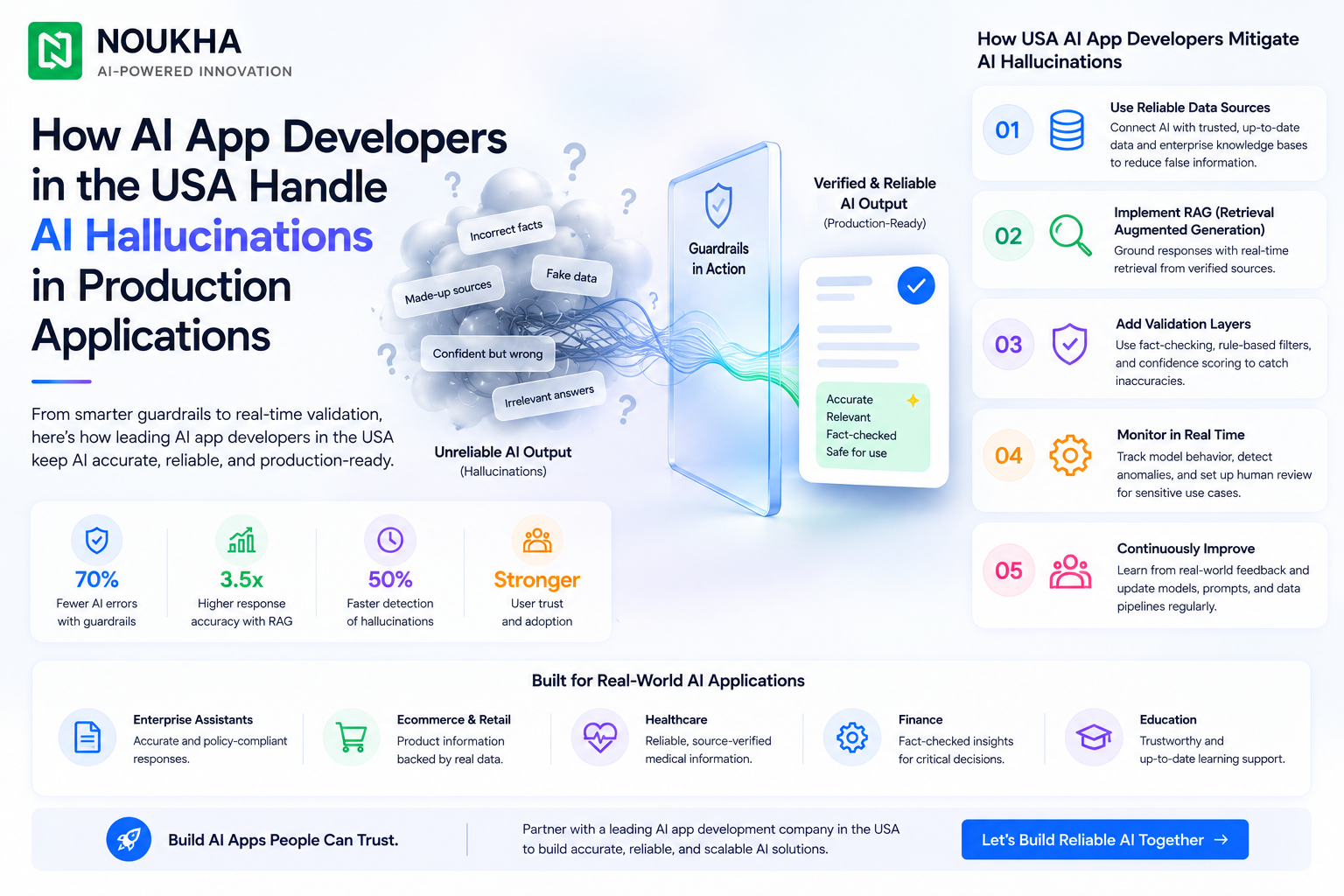
A support bot that invents a refund policy. A medical intake tool that misreads a lab value and states it with total confidence. A finance app that quotes a tax rule that does not exist. These are not edge cases anymore, they are the everyday risk that comes with shipping large language models into real products. AI App Developers in USA are increasingly building entire engineering workflows around one question: how do you catch a hallucination before a user does. This article looks at the practical methods teams use once an AI feature moves past the demo stage and into a live application that people depend on.
What Counts as a Hallucination Once an App Is Live
In a demo, a hallucination is amusing. In production, it is a support ticket, a compliance flag, or a lost customer. Once real users and real data are involved, the definition sharpens: a hallucination is an output that presents false or unsupported information as factual, including information that is not supported by reliable retrieved context or verified tool results.
Factual errors versus fabricated sources
Some hallucinations are simple factual mistakes, a wrong date or an incorrect statistic. Others are more dangerous because they look sourced. A model might state “according to the company handbook” or “per the API response” when no such handbook section or API field exists. This second type is harder to catch through casual reading because the confidence and format make it feel verified.
Misread tool results
A growing share of production issues come from agents that call an external tool correctly but then misinterpret the result. If a database query times out and the agent reports “no records found” instead of “the lookup failed,” the user receives a false answer caused by poor tool-error handling rather than a purely factual hallucination. Teams that treat both categories the same way tend to miss the fixes each one actually needs.
Why the Problem Gets Worse After Launch
Teams often assume the riskiest phase is pre-launch testing, but many hallucination issues only surface once a product is handling live traffic.
Data drift and messier real-world inputs
Test data is clean. Real users type incomplete questions, paste screenshots as text, or ask about edge cases nobody scripted for. As the range of inputs widens, so does the chance that retrieval misses relevant context and the model fills the gap on its own.
Context window pressure
Longer conversations and larger documents push more information into a single prompt. As context becomes larger or more complex, models may be more likely to overlook relevant information or produce unsupported inferences, which is one reason ungrounded answers tend to show up in extended sessions rather than short, single-turn ones.
Grounding the Model Before It Ever Answers
A significant part of hallucination mitigation happens before generation, through grounding, retrieval, and prompt design, but validation and monitoring remain important after generation as well. Grounding means providing the model with relevant, trusted information and designing the system to prioritize that context over unsupported generation.
Retrieval scoped to the right documents
Retrieval-augmented generation pulls relevant passages from an approved knowledge base and feeds them into the prompt alongside the user’s question. The key design decision is scope: retrieving too broadly reintroduces the risk of the model blending unrelated facts, while retrieving too narrowly leaves gaps that get filled with guesses.
Deciding what should never be retrieved
Just as important as what gets pulled in is what gets excluded. Outdated pricing pages, draft documents, or superseded policy versions left in a knowledge base are a common source of confidently wrong answers, since the model has no way to know a document is stale unless the system tells it so through metadata and expiry rules.
Prompt constraints that ask for citations
Instructing the model to cite the specific passage it used, and to say “not found in the provided context” when nothing matches, gives the system an explicit fallback when the required information is not present instead of encouraging an unsupported answer.
Structured Output and Validation at the API Layer
Free-form text is harder to police than structured data. Many businesses working with an AI application development company in the USA now use structured outputs, returning responses in a fixed schema such as JSON with defined fields, so that downstream code can validate the shape of a response before anything reaches the user. It is worth being clear about what this does and does not do: a schema check confirms a response has the right fields and format, not that the information inside those fields is factually correct.
Schema checks and rejection loops
If a field expects a date and the model returns a sentence, or a required source field is empty, the response is rejected and regenerated rather than passed through. This does not eliminate hallucination but stops a whole category of malformed or unsupported answers from reaching the interface.
Guardrail models as a second opinion
Some pipelines use a separate model or evaluation component to check the main model’s output against retrieved source material and flag mismatches. This is one common pattern rather than the only option, and it catches contradictions a single-pass system would miss, at the cost of extra latency that has to be budgeted for.
Evaluation Pipelines Run Before Every Release
Shipping an update to a live AI feature without regression testing can allow quality problems to reach production unnoticed.
Golden datasets and repeatable test sets
Teams often build a curated set of representative questions, expected answers, and evaluation criteria, then run every model or prompt change against that set before release. Where there is no single correct answer, the criteria describe what an acceptable response needs to include or avoid, and a drop against that bar blocks the release rather than reaching production first.
Sampling real conversations for human review
Automated scoring catches obvious errors, but subtle hallucinations, especially ones involving nuance or domain-specific claims, still need a human reviewer to periodically sample live conversations and rate accuracy. This is slower but remains one of the more reliable signals available.
Monitoring the Application After It Ships
Grounding and evaluation reduce risk before launch. Monitoring is what catches what got through anyway.
Signals for Flagging Potentially Unreliable Answers
Some systems track signals that may correlate with unreliable answers, such as retrieval quality, source coverage, or inconsistencies between the response and retrieved material, and route those interactions for review or add a visible disclaimer rather than presenting them with full confidence.
Feedback loops from support and user reports
When a user flags an answer as wrong, that report is worth more than most synthetic test cases because it reflects an actual failure in production. Teams that route these reports back into the golden dataset build a test set that keeps pace with real usage instead of one frozen at launch.
This risk-based approach also aligns with the NIST AI Risk Management Framework and its Generative AI Profile, which emphasize managing AI risks across design, development, deployment, use, and evaluation rather than treating reliability as a one-time launch task.
Where Human Oversight Still Matters Most
No amount of tooling fully removes the need for a human checkpoint in certain contexts. Applications involved in high-impact health, financial, or legal decisions may require stronger human oversight, particularly when an incorrect output could materially affect a person, rather than allowing a fully automated response for anything the system flags as uncertain. This is less about a lack of confidence in the technology and more about matching the level of oversight to the actual stakes of a wrong answer. AI app developers USA teams working in regulated or high-impact environments may treat this as a design requirement from the start rather than a feature added after an incident.
A Practical Checklist for Teams Building AI Features
- Ground responses in retrieved, verified context rather than open-ended model knowledge
- Keep the knowledge base current and remove outdated documents from retrieval
- Validate structured outputs before they reach the user interface
- Run every prompt or model change against a golden test set before release
- Monitor live traffic for low-confidence signals and route them for review
- Feed real user-reported errors back into testing rather than only into a backlog
Hallucinations are not a problem any single feature solves once and forgets. They are managed continuously, through grounding, validation, evaluation, and monitoring working together, with human review reserved for the situations where the cost of being wrong is highest. Teams that treat this as an ongoing discipline rather than a launch checklist tend to see fewer surprises once real users start relying on the product. If you are weighing how to build this kind of reliability into your own application, you can contact us to talk through what a monitoring and evaluation setup would look like for your use case.
Frequently Asked Questions
Can AI hallucinations be eliminated completely?
No current method removes hallucinations entirely. The goal in production systems is to reduce their frequency, catch them before they reach the user, and limit the damage when one slips through.
Is retrieval-augmented generation enough on its own?
Retrieval can reduce hallucinations by grounding responses in relevant documents, but it does not guarantee accuracy on its own. The model can still misread or blend retrieved passages, which is why validation and monitoring are used alongside it.
How often should a golden test set be updated?
A practical approach is to update it when new types of real-world questions, failures, or edge cases are identified, rather than on a fixed schedule, so the test set reflects actual usage patterns instead of only the scenarios anticipated at launch.
Do smaller AI features need the same level of oversight as large ones?
The right level of oversight depends on the consequences of a wrong answer rather than the size of the feature. A simple FAQ bot needs less scrutiny than a tool involved in a medical, legal, or financial decision.
What role do AI app developers in the USA play in reducing hallucination risk?
They are typically responsible for the full pipeline, from choosing what data the model can access to setting up evaluation and monitoring, rather than treating hallucination reduction as a single setting to switch on.