Building an AI powered application is not the same project as building a traditional app with a database and a few screens. Traditional software generally follows explicitly defined rules, making its behaviour more predictable for a given set of inputs and conditions. AI systems can identify patterns, generate outputs, or make predictions based on models that have been trained or configured using data, which means their behaviour has to be tested, measured, and monitored in ways conventional software rarely required. Founders exploring this space often start by researching AI Application Development Company in USA before committing to a build, and understanding how that work actually gets structured, from the first discovery call to the weeks after launch, helps set realistic expectations before a single line of code is written.
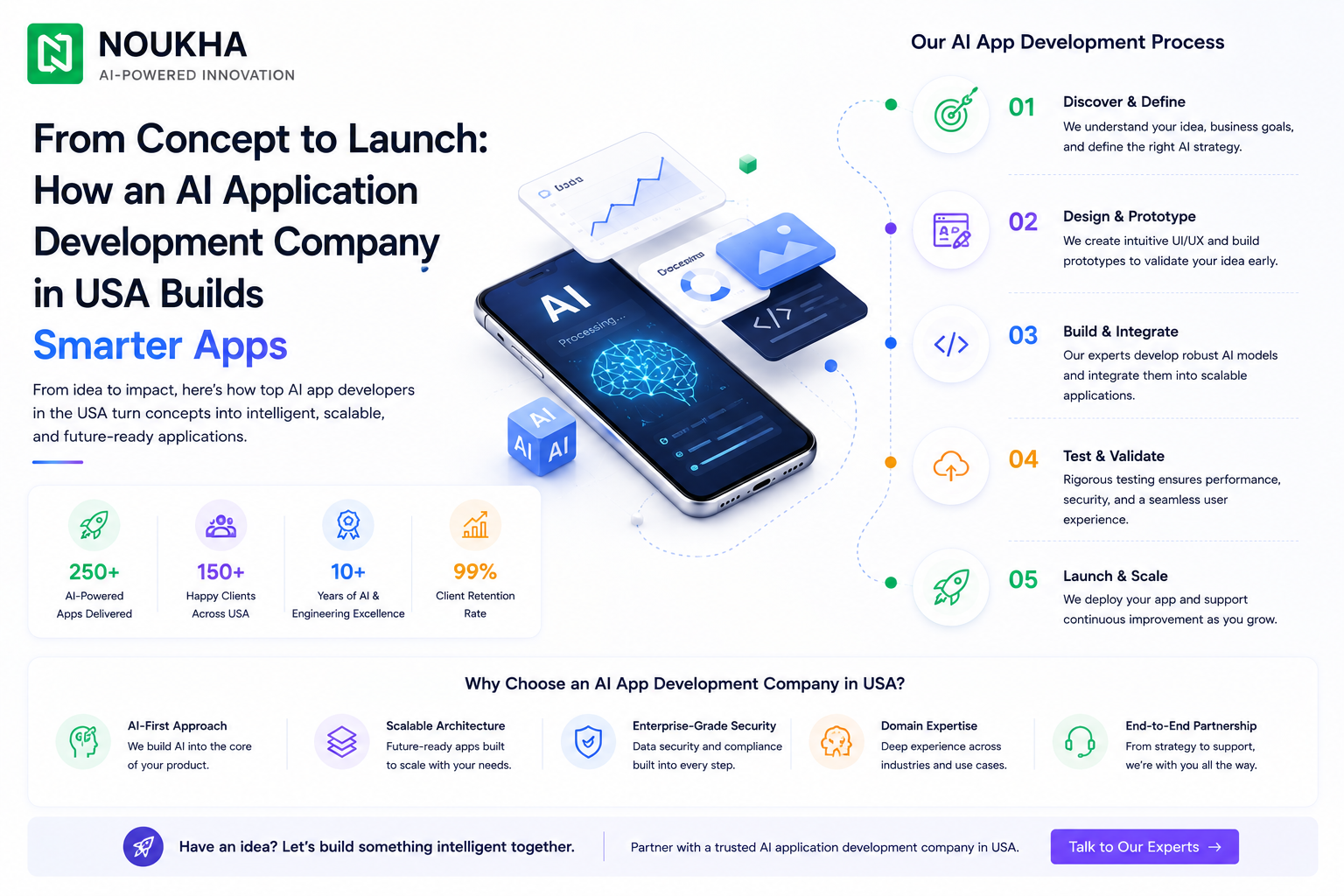
In short, building an AI application typically involves problem discovery, data assessment, architecture and model selection, application development, AI-specific evaluation, staged deployment, and continuous monitoring. Unlike most conventional software, AI applications call for ongoing evaluation because model outputs can vary and production conditions can change after launch.
Why the AI Build Process Looks Different From Traditional Development
Conventional software is generally more deterministic because its behaviour is primarily defined by explicit rules and logic, and if something breaks, the fix usually involves finding and correcting a specific line of that logic. An AI system behaves differently because it identifies patterns in data rather than only following instructions written line by line. That difference changes several stages of the build, from how requirements are gathered to how the finished product is tested before launch.
Probabilistic Systems Need a Different Lifecycle
Because outputs are probabilistic rather than fixed, requirements in an AI project are often discovered iteratively. A team begins with a business problem, explores the available data, experiments with a few approaches, and only then gets a clear picture of what is realistically achievable. This is one reason AI projects often require an iterative lifecycle alongside conventional software development practices.
Stage One: Discovery and Problem Definition
Deciding Whether AI Is Actually the Right Tool
Not every problem needs a machine learning model. A well-run discovery phase starts by checking whether a simpler solution, a search feature, a rule-based workflow, or a basic form, would solve the problem just as well. Skipping this question is one of the more common reasons AI projects end up over-engineered for what they actually needed to do.
Setting a Measurable Success Metric
Before any design or engineering work begins, a clear metric should be agreed on, whether that is response accuracy, time saved per task, or a reduction in manual review hours. Without an agreed metric, it becomes very difficult later to judge whether the finished product actually worked.
Stage Two: Data Readiness and Architecture
Auditing the Data Before Any Model Work Begins
Many teams assume their data is ready long before it actually is. Labelling inconsistencies, missing fields, and gaps in coverage for certain user segments can remain hidden until a detailed data audit is performed, which is why assessing data quality early can save considerable time later.
Choosing the Right Architecture and Model Approach
This stage also decides whether the application will rely on an existing foundation model, a fine-tuned version of one, a retrieval-augmented generation architecture, or a combination of several models handling different tasks. Architecture decisions made here are expensive to reverse later, which is why experienced AI app developers in USA tend to spend real time on this stage rather than rushing straight into building screens.
Stage Three: Building the Application
Prompt Engineering, Fine-Tuning, and Orchestration
Depending on the use case, the build stage might involve careful prompt design, fine-tuning a model on domain-specific examples, or building retrieval pipelines that ground responses in company data. Larger applications often route different tasks to different models, balancing accuracy, speed, and cost rather than relying on a single model for everything. For agentic applications, this stage may also include tool calling, workflow orchestration, permissions, and guardrails around what the system is allowed to do on its own.
Security, Privacy, and Governance Requirements
Before development goes too far, teams should define who can access the underlying data, where sensitive information is stored, how model inputs and outputs are handled, and what level of human oversight is required for high-impact decisions. These requirements can influence architecture, vendor selection, testing, and deployment decisions, so it is worth settling them early rather than retrofitting them after the application is built.
Integrating With Existing Systems
An AI feature rarely exists in isolation. It usually needs to read from and write to a company’s existing databases, customer systems, or internal tools, and this work is frequently underestimated in early project timelines. Planning for these connections during the build stage, rather than after testing has started, tends to prevent costly rework.
Stage Four: Testing and Evaluation
Beyond Traditional QA
Standard software testing checks whether a feature behaves as expected against a defined set of inputs. AI systems need this too, but they also need evaluation methods that assess whether the model’s outputs are accurate, safe, and consistent across a wide range of realistic scenarios, including ones the original training data may not have covered well.
Evaluating Model Outputs, Not Just Code
This typically includes prompt testing, adversarial testing to see how the system responds to unusual or malicious inputs, and security testing focused on risks such as prompt injection, sensitive information disclosure, insecure output handling, and excessive agency, where a system takes actions beyond what it should. A feature that passes conventional QA can still fail this kind of evaluation if its outputs are unreliable under real-world conditions.
Stage Five: Deployment and Launch
Staged Rollouts Reduce Risk
Rather than releasing an AI feature to every user at once, a graduated rollout, starting with internal users, then a small beta group, then a soft launch, then a full release, gives a team the chance to catch problems before they affect the whole user base. This approach can reduce the impact of unexpected issues by allowing teams to identify and address problems before expanding access to everyone.
What Changes the Day After Launch
For many traditional applications, launch marks the transition into routine maintenance. For an AI application, it also begins an ongoing cycle of evaluation and monitoring, because outputs can be affected by changes in user behaviour, production data, prompts, retrieval sources, application logic, or the underlying model itself. This is one of the clearer differences between working with a general software vendor and choosing an ai application development company USA team that plans for this kind of continued attention after go-live.
Stage Six: Monitoring and Continuous Improvement
Watching for Model Drift
Model drift happens when the patterns a model learned during training no longer match how users or data behave in production. Monitoring after launch can cover several distinct areas, including model drift, data drift, application performance such as uptime and response times, model quality such as accuracy and latency against agreed benchmarks, safety signals, and user behaviour such as where people get stuck or which features go unused.
Iterating Based on Real Usage
The feedback collected after launch feeds directly back into the product. Features that users ignore get reconsidered, prompts that produce inconsistent answers get refined, and edge cases that show up in real usage get added to the evaluation set so the same issue does not resurface in a future update.
Who Is Usually Involved Across These Stages
A typical build draws on a mix of roles rather than a single generalist engineer. A product or business analyst usually leads discovery and keeps the scope tied to a measurable outcome. Data engineers handle collection and pipeline work, machine learning engineers focus on model selection and orchestration, and backend developers manage integration with existing systems. A QA, evaluation, or testing specialist may assess model outputs rather than just interface behaviour. On smaller projects these roles can overlap, but each function still needs to be covered by someone on the team.
What Founders and Product Teams Should Prepare Before Kickoff
A few things tend to make the entire process faster and less painful:
- A clearly written problem statement rather than a general idea of wanting AI
- Access to representative data, even if it is messy or incomplete
- A named point of contact who can make product decisions quickly
- Realistic time set aside for testing and feedback, not just for the initial kickoff call
- An understanding that the product will keep evolving after launch, not stop there
Frequently Asked Questions
How long does it take to go from concept to a launched AI application?
Timelines vary widely depending on scope, data readiness, and integration complexity. A focused proof of concept may take a few weeks, while a production-ready application with integrations, evaluation, security testing, and staged rollout can take several months.
What is the biggest reason AI projects get delayed?
Data readiness is one of the most common causes. Teams often assume their existing data is clean and complete, only to discover labelling gaps or missing coverage once model work is already underway, which pushes the timeline back.
Does an AI application need constant retraining after launch?
Not necessarily constant retraining, but it does need ongoing monitoring. Some applications are updated through controlled retraining cycles when drift is detected, while others rely more on refining prompts, retrieval sources, or evaluation rules based on how the system performs in production.
Should a business build with an existing foundation model or train something custom?
Many business applications can be built using existing foundation models, sometimes combined with fine-tuning or retrieval mechanisms, rather than training a model from scratch. Training a foundation model from scratch is resource intensive and is usually only justified for organisations with highly specific requirements, substantial data, and the infrastructure to support that training.
What should a business look for in a development partner for this kind of project?
Evidence of systems running with real users, a clear explanation of how evaluation and monitoring are handled after launch, and a willingness to discuss data ownership and security in specific rather than general terms are all reasonable things to ask for before committing to a build.
Conclusion
Going from a rough concept to a working AI application involves more stages than most teams expect. Treating discovery, data readiness, evaluation, and post-launch monitoring as deliberate parts of the lifecycle, rather than steps to rush through, can help reduce avoidable rework later on. Treating the build as a structured process rather than a single sprint is usually what separates a feature that works in a demo from one that holds up with real users. If you are planning an AI product and want to talk through what this process would look like for your specific use case, you can contact us to walk through the scope, timeline, and realistic next steps.