AI Agent Development for US Businesses can encounter problems long before the first line of code is written. The project brief is where most of these efforts are won or lost. A vague request leads to vague estimates, drifting scope, and a tool nobody trusts. A sharp brief does the opposite. It gives a development team the context to ask better questions, price the work honestly, and deliver something your staff will actually use. This guide covers what a strong brief contains, why each part matters, and which gaps tend to slow US teams down. If you are still exploring options, you can also look at how building AI agents for American companies is typically scoped by specialist teams.
Why the Brief Matters More Than the Model
Most buyers start by asking which language model or framework to use. That is a reasonable question, but it is rarely the one that decides success. AI models evolve quickly, but switching between them can involve additional integration work, testing, costs, and performance considerations. What does not change quickly is your business context: the process you want to improve, the data you hold, the people who will rely on the result, and the rules you must follow.
A brief captures that context in one place. Think of it as the shared source of truth between your internal stakeholders and the people building the agent. When it is thorough, vendors can respond with realistic plans. When it is thin, every proposal looks different, and comparing them becomes guesswork.
Start With the Business Problem
Define the workflow, not the technology
Begin with a plain description of the task as it works today. Who starts it, which tools they open, where they get stuck, and how long it takes. An AI agent is a software system designed to pursue a defined goal by planning steps, using available tools, and performing tasks with varying degrees of human supervision. That makes it a poor fit for a problem you cannot describe step by step.
A useful test is to write the workflow as if you were training a new hire. If you can explain the steps, the exceptions, and the sign-off points, you are ready to hand the same description to a development team.
Set measurable outcomes
Every brief should name what success looks like in numbers you already track. Avoid goals such as “be more efficient” or “use AI.” Pick a baseline and a target instead.
Examples of useful metrics
- Average handling time for a support ticket or intake form
- Share of requests resolved without human intervention
- Hours of manual data entry removed each week
- Error or rework rate on a specific document type
- Time from lead inquiry to first qualified response
If you do not have a baseline yet, say so. A good partner will suggest a short measurement period before building begins.
Describe What the Agent Should and Should Not Do
Scope of autonomy
Agents sit on a spectrum. Some only draft suggestions for a person to approve. Others take actions such as sending emails, updating records, or issuing refunds. Your brief should state where on that spectrum the first release belongs.
A practical approach is to list actions in three groups: things the agent may do freely, things it may do only after approval, and things it must never do. Writing this down early prevents painful surprises later and shapes the whole architecture.
Human handoff rules
No agent handles every case. Describe when it should stop and pass work to a person. Common triggers include low confidence, a frustrated customer, a transaction exceeding a specified value, or a request involving legal or medical matters. Also note who receives the handoff and what context they should see, so the person does not have to start from scratch.
Data, Systems, and Integrations
Data sources
An agent is only as useful as the information it can reach. List the sources it will need, such as a CRM, help desk, knowledge base, shared drives, databases, or email. For each one, note who owns it, how current it is, and whether it is clean enough to rely on. Many projects stall because outdated documents or inconsistent records were discovered halfway through development.
Tools and APIs
Spell out the systems the agent must connect to and whether those systems expose reliable interfaces. Legacy platforms without documented APIs can add real effort. Teams that offer a tailored agent built around your existing software stack will usually ask for sandbox access, sample records, and a point of contact on your IT side. Mention these early so the timeline reflects them.
Access and permissions
Decide which accounts the agent will act under and what it is allowed to read or change. The principle of least privilege applies here: give it only the access its tasks require. Separate test and production environments, and say who can approve access requests on your side.
US-Specific Compliance and Risk
Privacy and sector rules
The United States does not have a single comprehensive federal consumer privacy law. Instead, businesses must consider a combination of federal sector-specific regulations and state privacy laws. As of November 2026, 24 states have enacted comprehensive consumer privacy legislation, although the laws differ in their scope, applicability, and requirements. Healthcare organizations may need to comply with HIPAA, while certain financial institutions are subject to the Gramm-Leach-Bliley Act (GLBA). Businesses handling California residents’ personal information may also need to comply with the California Consumer Privacy Act (CCPA), as amended by the California Privacy Rights Act (CPRA), and its implementing regulations.
Your brief does not need to be a legal analysis, but it should identify the regulations that may apply, the types of sensitive data involved, and whether your legal or compliance team must review the design. For healthcare-related projects, also clarify whether a Business Associate Agreement (BAA) is required when the AI development provider handles protected health information (PHI). If you are unsure about your obligations, include a legal and compliance review as part of the discovery phase.
Security and auditability
State any security standards or assurance requirements your customers or partners expect, such as a SOC 2 report, relevant security certifications, or specific vendor review questionnaires. Remember that SOC 2 is an independent assurance framework, not a legal requirement in itself. Also ask how the agent will log its actions. When an agent sends a message or changes a record, you should be able to see what it did, why it did it, and what information it used. Audit trails matter for troubleshooting, and they matter even more when a regulator or client asks questions.
Quality, Testing, and Evaluation
Agents behave probabilistically, so testing looks different from traditional software testing. Your brief should describe how you will judge quality.
Start by collecting real examples: typical requests, tricky edge cases, and a few cases that went badly in the past. These become a test set the team can run after every change. Define what counts as a good answer, who reviews borderline cases, and what error rate you can tolerate for each type of task. An inaccurate meeting summary may have limited consequences, whereas an incorrect figure on a customer invoice could create financial and operational problems.
Also plan for life after launch. Models, data, and customer behavior can change over time, so ask how performance will be monitored and who will update prompts, adjust tools, or fine-tune models when necessary. You can also use the NIST AI Risk Management Framework as a voluntary reference for establishing structured AI risk management, testing, and monitoring practices.
Budget, Timeline, and Team
Phased delivery
Share a realistic budget range and a target date, along with what drives that date, such as a product launch or a seasonal peak. Then ask for phased delivery. A narrow first release that handles one workflow well teaches you more than a large build that tries to cover everything. It also gives stakeholders something concrete to react to within weeks rather than months.
Ownership and handover
Clarify who owns the code, prompts, evaluation sets, and any fine-tuned assets at the end of the project. Ask about documentation, training for your staff, and ongoing support terms. Also consider where your data will be processed and stored, whether third-party model providers will have access to it, how long the data will be retained, and what deletion obligations apply. When comparing experienced AI agent development firms serving the US market, these terms are as important as the price.
How to Evaluate the Proposals You Receive
A good brief makes proposals easier to judge. Look for responses that restate your problem in their own words, flag risks you did not mention, and propose a measurable first milestone. Be cautious of replies that promise full automation of complex work, skip over data quality, or avoid questions about testing.
Choosing the right partner for AI Agent Development for US Businesses also means evaluating how well the team understands your workflows, security requirements, integration needs and long-term business goals.
It also helps to ask for relevant past work, a named project lead, and a clear explanation of how the team handles errors in production. Reference calls with earlier clients can reveal how a vendor behaves when things do not go to plan.
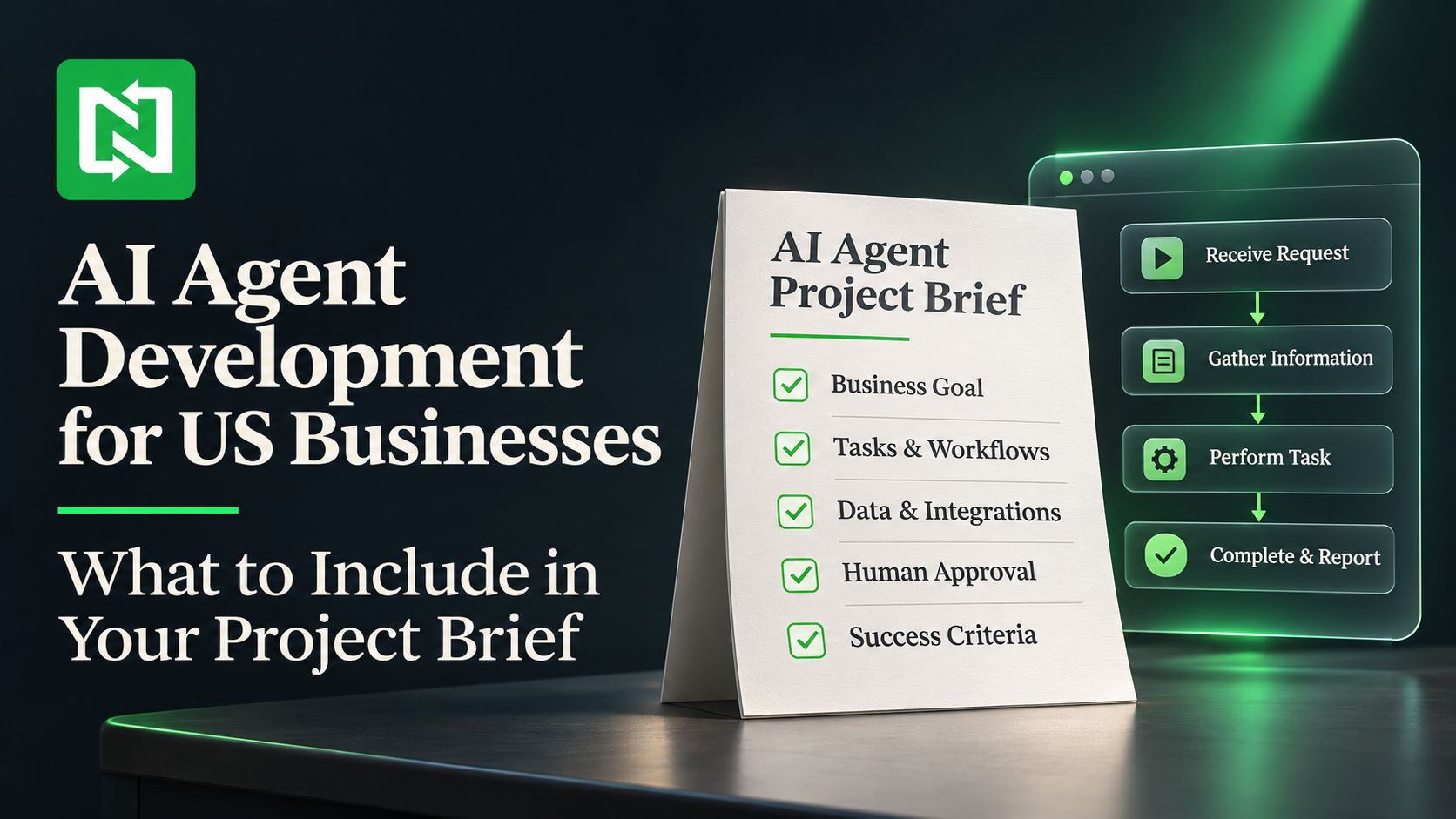
A Quick Checklist Before You Send Your Brief
- A one-paragraph summary of the problem and who it affects
- The current workflow, step by step, with known pain points
- Success metrics with baselines and targets
- Allowed, approval-only, and forbidden actions for the agent
- Handoff rules and the people who receive escalations
- Data sources, systems, and access constraints
- Applicable regulations and security expectations
- Test examples and acceptance criteria
- Budget range, timeline, and phasing preferences
- Ownership, support, and handover expectations
Conclusion
A strong brief does not need to be long. It needs to be specific about the problem, honest about constraints, and clear about how results will be measured. When those pieces are in place, the technical decisions become easier, vendor conversations become more productive, and the finished agent has a far better chance of earning daily use. If you have a draft brief or only a rough idea, you can get in touch with the Noukha team to talk through scope, risks, and a sensible first phase.
Frequently Asked Questions
How long should an AI agent project brief be?
Two to five pages is usually enough. Focus on clarity over length. A concise brief with a defined workflow, success metrics, data sources, and constraints is more useful than a long document full of general goals.
What is the difference between an AI agent and a chatbot?
A traditional chatbot primarily responds to user messages within a conversation. An AI agent can go further by planning multi-step tasks, calling tools, accessing or updating connected systems, and working toward a defined goal. However, the distinction depends on the system’s capabilities rather than a universally fixed definition. These additional capabilities make clear permissions, testing, and human oversight particularly important.
Do I need clean data before starting?
Not perfect data, but you should know its condition. Share where the information lives, how often it changes, and what quality issues you are aware of. A discovery phase can then decide what to fix before development begins.
Which US regulations should I mention in my brief?
That depends on your industry and customers. Common examples include HIPAA for health information, the Gramm-Leach-Bliley Act for financial data, and state laws such as the California Consumer Privacy Act. Ask your legal or compliance team to confirm which ones apply.
Should the first version be fully autonomous?
Usually not. Many teams begin with an agent that drafts or recommends, while a person approves the action. Autonomy can then expand as test results and real-world performance build confidence.
How do I measure whether the agent is worth the investment?
Compare results against the baseline you recorded before launch. Track time saved, resolution rates, error rates, and customer or employee satisfaction, then weigh those gains against build and running costs, including model usage and maintenance.