back to home

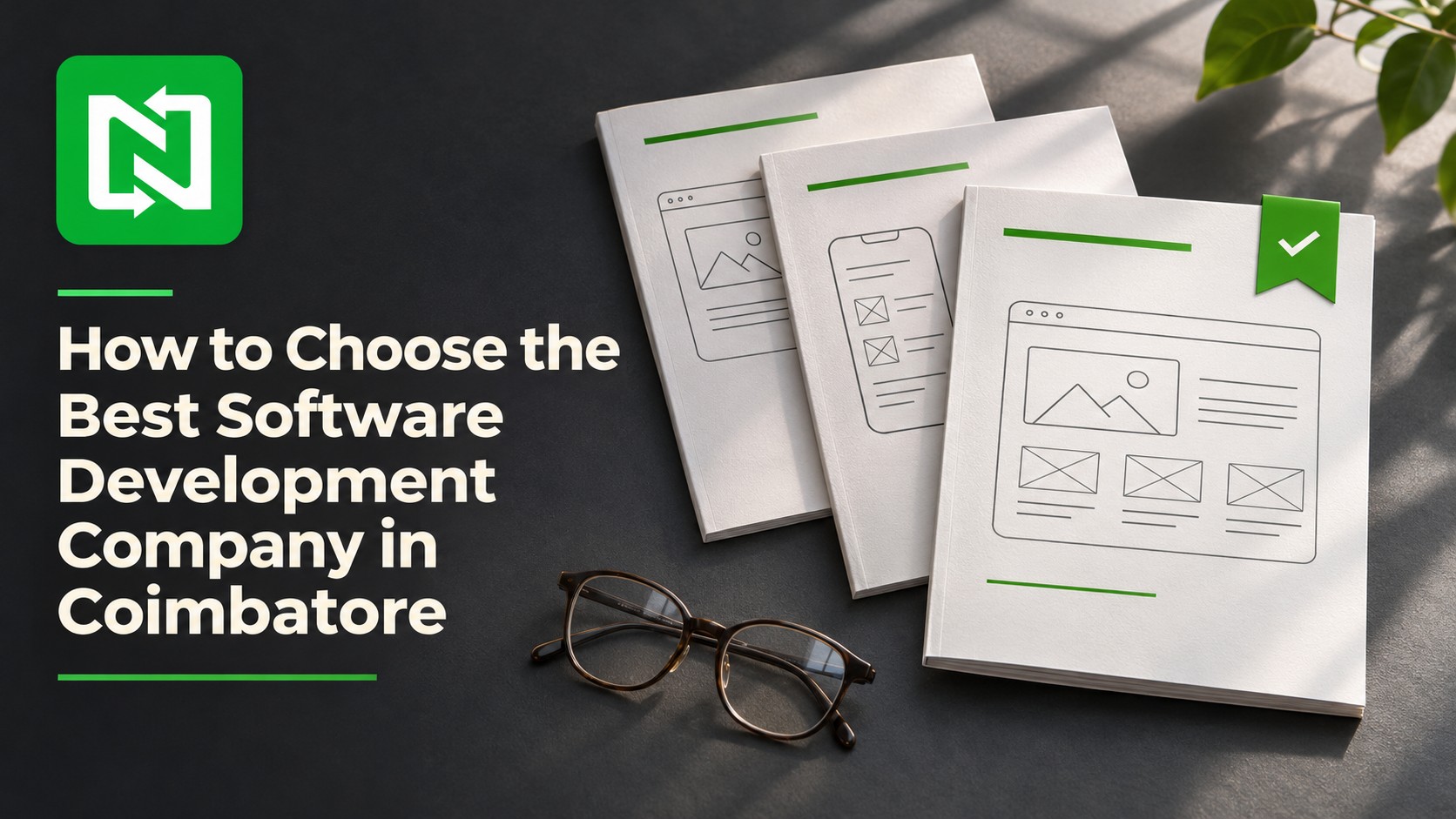
How to Choose the Best Software Development Company in Coimbatore

How to choose software development company in Coimbatore is an important question for businesses planning to build custom software, modernise existing systems or develop a new digital product. The right development partner should understand your business requirements, recommend suitable technologies and follow a reliable development process. However, comparing companies based only on pricing or technical claims can lead to the wrong decision. This guide explains seven practical steps to help you shortlist, evaluate and choose a software development partner in Coimbatore.

Coimbatore has become a serious option for this decision. This guide walks you through a practical seven-step process to choose the best software development company in Coimbatore for your specific project, rather than just the one with the loudest marketing.

Why Coimbatore Is a Smart Place to Find a Software Partner

Coimbatore used to be known mainly for textiles and manufacturing. Today it is Tamil Nadu’s second-largest city and a recognised IT destination. A 2023 NASSCOM report, as covered by ThePrint, ranked it the 13th best start-up destination in India, and industry analysts quoted there say tier-2 cities like Coimbatore contribute roughly a quarter of Tamil Nadu’s software exports.

The city has dedicated tech parks, a deep base of engineering colleges, and homegrown product companies such as KGiSL and Kovai.co alongside global delivery centres. For you as a buyer, that means a large pool of experienced developers, and typically a lower cost of living than Bengaluru or Chennai, which can keep project pricing competitive.

A big talent pool also means a big range in quality. That is why a structured selection process matters.

How to Choose Software Development Company in Coimbatore: 7 Steps

Step 1: Define What You Need Before You Search

Most failed software projects start with a vague brief. Before you contact a single company, write down the following:

  • The business problem, not just the feature list. For example, “reduce order processing time from two days to two hours”.
  • Type of solution: a custom web application, a mobile app, an ERP or CRM, or an integration between existing tools.
  • Users and scale: who will use it and how many, now and in two years.
  • Budget range and deadline. Even a rough range helps vendors propose realistic options.
  • Must-haves versus nice-to-haves. This protects your first release from scope creep.

A one-page brief is enough. If you cannot write one, a good company will help you through a short discovery phase (see Step 7). If you want a sense of how a structured build is scoped, see our overview of custom software development services.

Step 2: Build a Shortlist of Coimbatore Software Companies

Aim for three to five companies. Use several sources so your shortlist is not shaped by one directory’s paid listings:

  • Google search and Google Business Profiles (look at the quality of recent reviews, not just the star rating).
  • Review platforms such as Clutch, which verify clients and show project sizes.
  • Referrals from other business owners, local industry bodies and your own network.
  • LinkedIn, to see the real team, their tenure and the work they talk about.

Check that each company actually does the type of work you need. A firm that mostly builds brochure websites is not automatically the right fit for a workflow-heavy web application or a mobile app.

Step 3: Evaluate Portfolio and Real Case Studies

A portfolio shows what a company says it can do. A case study shows what it actually achieved. Look for:

  • Projects similar to yours in complexity, industry or technology.
  • Measurable outcomes, such as faster processing, more orders or fewer manual hours.
  • Live products you can open and try, not only screenshots.
  • Evidence that the company stayed on after launch to improve the product.

Ask directly which team members worked on each project and whether they are still with the company. You can browse examples of our work on the portfolio page.

Step 4: Check Technical Depth and Process

You do not need to be technical to test this. Ask each company to explain, in plain language, how they would approach your project. Strong teams can describe:

  • Their development methodology (Agile sprints, demo cadence, how change requests are handled).
  • Their recommended tech stack and why it fits your goals instead of just their habits.
  • How they handle testing, code reviews, security and deployment.
  • Who your single point of contact will be, and how often you will hear from them.

If a company promises everything is possible, in any stack, in a few weeks, treat that as a warning sign. Specific answers beat confident ones. Our companion guide, Software Development Company in Coimbatore: What to Look For, goes deeper on the technical and process checks.

Step 5: Talk to Past Clients

Reference calls are the most underused step in vendor selection. Ask for two or three clients and, if possible, one whose project did not go perfectly. Useful questions include:

  • Was the project delivered on time and close to the original budget?
  • How did the team handle surprises or changing requirements?
  • Was communication proactive or did you have to chase updates?
  • Would you hire them again, and for what kind of project?

Step 6: Compare Proposals, Not Just Prices

When proposals arrive, resist sorting them by price. A low quote often leaves out testing, documentation, design or support, which return later as change requests. Compare them side by side on:

  • Scope clarity: what is included, and what is explicitly excluded.
  • Timeline with milestones and review points.
  • Team composition and the seniority of the people assigned.
  • Payment schedule tied to deliverables rather than only dates.
  • Post-launch support and warranty period.

For realistic budget ranges and pricing models, read our breakdown in Best Software Development Company in Coimbatore: Cost, Services & Tips.

Step 7: Start With a Paid Pilot or Discovery Phase

Before signing a large contract, consider a small paid engagement of two to four weeks. This can be a discovery workshop, a clickable prototype or a single module. You will learn how the team communicates, how they handle feedback and how closely their estimates match reality, at a fraction of the full project’s risk.

A company confident in its process will welcome this. One that pushes you to sign everything up front deserves extra questions.

Quick Scorecard to Compare Your Shortlist

Rate each company from 1 to 5 on the criteria below, then total the scores. Adjust the weights if some factors matter more to you.

Criteria What to look for Suggested weight
Relevant experience Similar projects, industries and scale 25%
Technical approach Clear stack rationale, testing and security practices 20%
Communication Single point of contact, regular demos, quick responses 15%
Client references Positive, specific feedback from verified clients 15%
Proposal quality Clear scope, milestones and exclusions 15%
Post-launch support Defined support terms and maintenance options 10%


Common Mistakes to Avoid

  • Choosing purely on the lowest quote.
  • Skipping reference checks because the website looks impressive.
  • Starting without a written scope, so every change becomes a dispute.
  • Not clarifying who owns the source code and design files.
  • Treating launch day as the finish line and ignoring maintenance.

Frequently Asked Questions

How long does it take to choose a software development company?

Plan for two to four weeks: a few days to define your brief, about a week to shortlist and hold intro calls, and one to two weeks to review proposals and references.

Should I choose a local Coimbatore company or an outsourced team elsewhere?

Both can work. A local team makes in-person workshops and quick catch-ups easy, which helps on complex or fast-changing projects. What matters most is the quality of process and communication, not only location.

Is a fixed-price or time-and-material contract better?

Fixed price suits well-defined projects with a stable scope. Time-and-material or a dedicated team suits evolving products. Many businesses start with a fixed-price discovery phase and then move to a flexible model.

What should be in the contract?

At minimum: detailed scope, milestones and payments, intellectual property ownership, confidentiality, a support or warranty period and exit terms. Have a lawyer review it for larger projects.

Conclusion

Choosing the best software development company in Coimbatore comes down to fit, proof and process: a team that has solved problems like yours, can show evidence, and works in a way you can see and trust. Follow the seven steps above and you will make the decision on evidence rather than on sales pitches.

Ready to discuss your project? Talk to our team for a free discovery conversation, or explore our software development services first.

Author

  • Noukha

    Ramanathan Alagappan is the Founder & CEO of Noukha Technologies with 13+ years of experience in product engineering and technology leadership. He has previously served in senior engineering and CTO roles, where he played a key role in building and scaling products from zero to one, particularly in SaaS and platform-driven businesses. His work today focuses on AI-powered systems, scalable software architectures, and helping businesses turn ideas into reliable, production-ready products.

Previous article
MVP Development for US Startups: Fixed-Price Project or Monthly Development Team? Every founder reaches a similar decision early on. The idea has shown initial promise, some funding or savings are set aside, and a development partner is ready to start. Then comes the question that shapes the next several months: do you pay a fixed price for a defined project, or do you bring in a monthly development team that works alongside you? For anyone building an MVP as a US startup, this choice affects your budget, your speed to market, and how easily you can react when real users disagree with your assumptions. This guide compares both models in plain language so you can decide with confidence. Why the Engagement Model Matters So Much A minimum viable product (MVP), a concept popularized by Eric Ries in The Lean Startup, is an early version of a product designed to test a business hypothesis and generate validated learning with the least necessary effort. That purpose creates a tension. Fixed-price contracts reward certainty, while early products are defined by uncertainty. Monthly teams reward flexibility, while early budgets are defined by limits. Neither model is better in every case. Each one distributes risk differently. In a fixed-price project, the development company generally takes on more responsibility for delivering the agreed scope within the contracted price, while you carry the risk of building something that may not meet actual user needs. With a monthly team, you take on more responsibility for managing the overall budget and engagement duration, but retain greater flexibility to change priorities as you learn. Knowing where the risk sits is the quickest route to a good decision. How a Fixed-Price MVP Project Works You and the development company agree on a defined scope, a timeline, and a total cost before work begins. The scope usually lives in a document that lists screens, features, integrations, and acceptance criteria. Payments are often tied to agreed milestones, such as design approval, delivery of a working beta, and final handover or launch, depending on the contract. Where a Fixed Price Fits Well It tends to suit founders whose requirements are already clear, often because they have run customer interviews, tested a clickable prototype, or are digitizing a process that is well understood. It also fits situations where the budget ceiling cannot move, such as a pre-seed check, a grant, or an approval that sets a hard number. Where a Fixed Price Struggles The weak point is change. Product assumptions often shift once people tap through a real build, and each shift becomes a change request that needs pricing and approval. That process slows momentum and can create friction. Change Request Handling Ask how change orders are priced and approved before you sign. A clear process with a short turnaround keeps small adjustments from turning into disputes. Acceptance Criteria Phrases like “user-friendly onboarding” invite disagreement. Measurable criteria, such as the devices, operating system versions, and user flows that must work at handover, protect both sides. How a Monthly Development Team Works Here you pay a recurring monthly fee for a team, typically a mix of developers, a designer, a QA engineer, and a project lead, who work on your product for an ongoing period. Priorities are set in short sprints, often one to two weeks, and you can reorder the backlog as you learn. The monthly cost is generally predictable when the team composition and agreed workload remain consistent, although the overall investment depends on how long the engagement continues and whether additional resources are required. Where a Monthly Team Fits Well This model works when the product direction will probably evolve, when you plan to ship updates often, or when you want people who build up context about your users over time. Where a Monthly Team Struggles The model asks more of you. Someone on your side must own priorities and answer questions quickly, otherwise the team waits while the fee keeps running. Without a clear goal, spending can drift. Product Ownership If nobody on your side can act as product owner, a monthly team can feel unfocused. Some founders appoint a fractional product manager or advisor for this reason. Budget Guardrails Set a monthly cap, ask for sprint demos and short reports, and agree on a review point, such as right after the first release, where you decide to continue, resize, or pause. Fixed-Price Project vs Monthly Team at a Glance Factor Fixed-Price Project Monthly Team Budget visibility Total cost agreed up front Predictable monthly cost; total depends on duration Flexibility Changes go through change requests Priorities can shift every sprint Best for scope that is Well defined and validated Evolving or exploratory Your time commitment Heavy at the start, lighter during the build Steady, weekly involvement Risk sits mainly with Development company on agreed delivery obligations; you on product-market fit You on engagement duration and budget; both parties on product direction After launch Usually needs a separate support agreement Team continues with product context Five Questions That Point You Toward the Right Model How Settled Is Your Scope? If you can list every core feature and explain why each one matters, a fixed price is realistic. If you often catch yourself saying “we will see after launch,” a monthly team is the safer fit. What Does Your Runway Look Like? Short runways may favor a clearly defined budget, which a fixed-price project can provide. Longer runways, or funding tied to traction milestones, may make a monthly development team more suitable when ongoing testing and iteration are priorities. Who Owns Product Decisions? A fixed-price project needs strong decisions up front. A monthly team needs good decisions every week. Be honest about which rhythm your calendar can support. How Quickly Do You Need User Feedback? If a pilot customer or investor demo is waiting, a tightly scoped fixed release gives you a clear date to work toward. If you plan to release to a small beta group and iterate, a team model keeps the cycle between idea and feedback short. What Happens After Launch? An MVP is rarely finished at launch. Bug fixes, store review feedback, and early feature requests follow, so decide who handles them and how they are billed. The Hybrid Path Many Founders Choose A popular compromise splits the journey into stages. Begin with a short paid discovery phase to sharpen scope, fix the price for a tightly defined first release, then move to a monthly team for iteration. When you shortlist partners for app development for a US-based MVP, ask whether they offer both models and how they manage the move from one to the other. A team that sells only one model will naturally recommend it, so look for people willing to explain trade-offs for your situation. In the same spirit, when comparing an app development company for startups in the US, request examples of how they scoped earlier first releases and how they handled changes that appeared mid-build. Contract Details US Founders Should Review Whichever model you choose, the paperwork protects your investment. The points below are general information, not legal advice, so have a qualified attorney review the final agreement. • Intellectual property: Ownership of code, designs, and other project deliverables depends on applicable law and the contract terms. Include a written intellectual property assignment covering the deliverables created for your company. Also clarify ownership or licensing rights for pre-existing tools, third-party components, and open-source software used in the project. • Access and accounts: request repository access from the first day, and keep app store, cloud hosting, and analytics accounts registered in your company name. • Acceptance and warranty: define what counts as complete and whether a bug-fix period follows delivery. • Data handling: If the app collects personal information, discuss data security, storage, retention, deletion, and third-party access. Identify the privacy laws that may apply based on your users’ locations, the type of information collected, and your business activities. US privacy requirements vary by state and industry, so seek legal guidance where necessary. • Exit terms: confirm notice periods, documentation, and a handover plan in case the relationship ends. Frequently Asked Questions Is a fixed price always cheaper than a monthly team for an MVP? Not necessarily. A fixed price looks cheaper because the total is stated up front, but change requests and rework can add to it. A monthly team can cost more overall if the engagement runs long. Compare the likely total over your first year, including post-launch work. Can I switch from a fixed-price project to a monthly team later? Yes, and many founders do. Ask for documentation, repository access, and a handover plan in the original contract so the transition is smooth. How long does it take to build an MVP? It depends on the number of features, the platforms you target, integrations, and design depth. A reliable partner estimates after a discovery session, not before. What should an MVP include? Only what is needed to test your core assumption. Pick one primary user and one main job the app does for them. Hold back secondary features until you have evidence they matter. Final Thoughts The choice between a fixed-price project and a monthly development team comes down to how clearly you have defined your requirements and how much flexibility you need. If your scope is well defined and your budget is capped, a fixed-price project offers greater cost visibility. If you expect to test assumptions, gather user feedback, and adjust priorities frequently, a monthly team provides greater flexibility. If you sit somewhere in between, a staged approach lets you have a little of both. Whatever you pick, put scope, ownership, and handover in writing, and keep user learning at the center of every decision. If you would like to talk through your idea and the model that suits it, contact us and we will help you plan the next step. About Noukha: Noukha is a technology services company that builds mobile apps and digital products for businesses.
Next article

Leave a reply

Please enter your comment!
Please enter your name here

Latest article