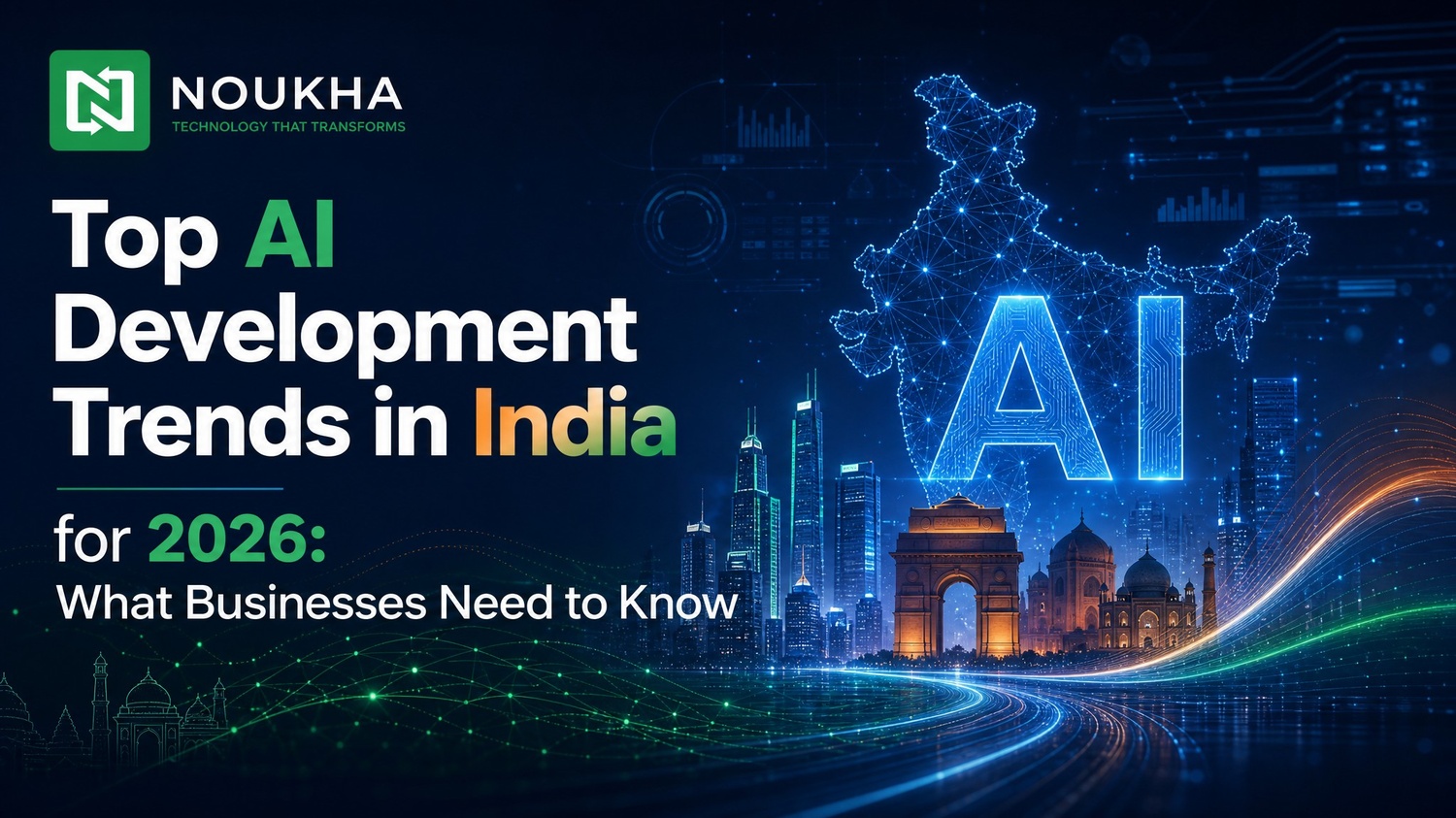
AI Development Trends in India are reshaping the global technology landscape in 2026. India is not merely catching up to the global AI economy. In several important respects, it is leading it. With the world’s largest pool of engineering talent, a maturing start-up ecosystem, and government initiatives actively accelerating AI adoption, India has quietly become one of the most consequential players in the global AI development landscape.
For business leaders evaluating where to build, source, or partner for AI projects, understanding what is happening inside the Indian AI sector right now is not just useful background. It is essential market intelligence. The trends shaping AI development in India in 2026 will directly affect the cost, quality, and speed of AI projects across industries worldwide.
This article covers the major AI development trends emerging from India in 2026, what is driving them, and what they mean for businesses that want to leverage India’s capabilities as a competitive advantage.
India’s AI Market: The Numbers Behind the Momentum
India’s AI market was valued at approximately $6 billion in 2024 and is projected to grow at a compound annual rate of over 25% through 2030, according to NASSCOM research. By 2026, AI-related services exports from India are expected to exceed $8 billion, making it one of the fastest-growing segments of the country’s technology export economy.
India’s AI talent pool crossed 416,000 professionals in 2025, according to a Quess Corp report, and is projected to more than double to 1.25 million by 2027 at a 15% annual growth rate. The Indian Institute of Technology network, along with over 200 private engineering colleges that have added dedicated AI and machine learning programs, is producing graduates with hands-on model development and deployment skills at a scale no other country currently matches.
Stanford University’s 2025 Global AI Vibrancy Index ranks India third globally in AI competitiveness, behind only the United States and China, ahead of Germany. Importantly, that talent is increasingly staying in India rather than emigrating, as domestic salaries and project opportunities have grown significantly.
Recent 2026 data shows India’s startups are pivoting to AI applications after missing the infrastructure boom, with venture investors betting on enterprise tools and services in 2026. The GCC (Global Capability Center) ecosystem is also sharpening its AI edge, with AI agents taking charge of enterprise workflows.
Trend 1: Generative AI Is Moving from Experiment to Production
Twelve months ago, most Indian AI development companies were running generative AI pilots. In 2026, those pilots are converting to production deployments at a rapid pace. Businesses across financial services, media, retail, and enterprise software are moving generative AI from innovation labs into core product workflows.
Indian development teams are at the center of this transition. The expertise required to fine-tune large language models on proprietary data, build retrieval-augmented generation pipelines, and integrate generative AI safely into enterprise systems has become a genuine differentiator for Indian AI development companies. These are not skills that can be acquired overnight, and teams that built this capability early are now well positioned to serve the growing global demand.
For businesses evaluating AI consulting services or custom AI software development, this shift means that Indian partners are increasingly capable of delivering production-grade generative AI systems, not just demonstrating the technology.
Trend 2: Agentic AI Is Creating a New Category of Development Work
The most significant new development pattern in India’s AI sector in 2026 is the rapid rise of agentic AI. Unlike traditional AI systems that respond to inputs, agentic AI systems take sequences of autonomous actions to complete goals. They browse, retrieve information, write, analyse, and execute tasks across connected tools with minimal human intervention.
Indian development teams are building agentic systems for use cases ranging from automated research and competitive intelligence to customer onboarding workflows and multi-step financial operations. The technical complexity of these builds is substantially higher than standard AI feature integration, and demand for skilled agentic AI developers is currently outpacing supply even within India.
Gartner predicts that by 2028, 33% of enterprise software applications will include agentic AI capabilities. Companies that begin building agentic systems now are establishing a learning advantage that will compound over time.
Trend 3: Domain-Specific AI Models Are Replacing General-Purpose Solutions
Early enterprise AI often meant applying large, general-purpose models to business problems and accepting the accuracy tradeoffs that came with them. In 2026, the trend in India’s AI development sector has shifted decisively toward domain-specific models trained or fine-tuned on industry-specific data.
Indian AI companies serving healthcare clients are building models trained on Indian patient data, clinical terminology, and regional diagnostic patterns. Those serving legal services clients are building contract analysis models tuned to Indian and international commercial law. Financial services clients are receiving fraud detection models calibrated to local transaction patterns and regulatory frameworks.
This specialization produces materially better results than off-the-shelf solutions. Domain-specific models typically outperform general-purpose models on industry-specific tasks, with industry benchmarks showing 15-40% improvements in accuracy for specialized use cases. For businesses evaluating AI solutions for businesses, the ability of a development partner to build and fine-tune domain-specific models is now a key evaluation criterion.
Trend 4: AI for Bharat: Products Built for India’s Domestic Market
One of the most distinctive trends in Indian AI development in 2026 is the rise of AI products built specifically for India’s domestic market rather than as exports for Western clients.
India has 1.4 billion people, 22 officially recognized languages, and a massive population of first-time internet users whose needs are not well served by AI systems built with Western data and assumptions. Indian AI companies are building multilingual voice AI that works across Hindi, Tamil, Bengali, Telugu, and other major languages. They are building AI-powered agricultural tools for small-scale farmers, healthcare triage systems for Tier 2 and Tier 3 cities, and fintech solutions for populations that remain underserved by traditional banking infrastructure.
This domestic focus is producing AI systems with capabilities that have significant global relevance, particularly for businesses serving diverse, multilingual, or emerging market audiences.
Trend 5: The Rise of Full-Stack AI Development Firms
India’s AI development landscape has historically been fragmented, with separate firms handling data science, software development, and deployment infrastructure as distinct specializations. In 2026, a consolidation trend is underway. Full-stack AI development firms are emerging that handle the entire lifecycle from data strategy and model development through application integration, mobile delivery, and production operations.
For businesses evaluating AI implementation services, this consolidation is positive news. Working with a single partner that can handle the entire stack reduces coordination overhead, improves accountability, and typically accelerates delivery timelines. If you are looking for an AI development company in India that can take a project from data assessment to deployed product without handoffs between multiple vendors, that capability is increasingly available from mature Indian firms in 2026.
Trend 6: Enterprise AI Adoption Is Accelerating Across Indian Industries
Domestic enterprise AI adoption inside India is growing at a pace that is reshaping the sector from within. Indian banks, insurance companies, telecommunications providers, and manufacturing conglomerates are investing heavily in AI to manage costs, improve customer experiences, and compete with digitally native challengers.
This domestic demand has an important effect on the quality of Indian AI development talent. Engineers working on production AI systems for Indian banks and telecom companies are accumulating real-world deployment experience at scale, not just building demos or maintaining third-party integrations. That experience makes them more capable partners for international clients who need AI systems that perform under genuine business conditions.
PwC’s 29th Annual Global CEO Survey: India Perspective (2026) found that 91% of Indian CEOs are increasing AI adoption with strong foundations, with highest growth in financial services, healthcare, and manufacturing
Trend 7: AI and Mobile Are Converging in India’s Development Ecosystem
Mobile is not just a delivery channel in India; it is the primary interface through which hundreds of millions of people access digital services. India has over 740 million active smartphone users, making it the world’s second-largest smartphone base after China.
As a result, Indian AI development firms have built deep expertise in embedding AI capabilities directly into mobile applications, with particular attention to performance on mid-range hardware, low-bandwidth environments, and multilingual interfaces.
For businesses building AI-powered mobile products that need to perform at scale across diverse user environments, this expertise is directly relevant. Noukha’s team, which includes dedicated mobile app development specialists in Chennai, brings this mobile-first AI integration capability to both domestic and international client projects.
What These Trends Mean for Businesses Evaluating AI Partners
The trends above have practical implications for how businesses should approach AI partner selection in 2026.
First, the gap between the best Indian AI development companies and average ones has widened significantly. Generative AI, agentic systems, and domain-specific model development require specialized expertise that not every firm has acquired. Evaluating a partner’s specific capabilities in these areas, rather than treating all AI development companies as equivalent, is essential.
Second, the era of AI as a standalone technology project is ending. The most effective deployments integrate AI into existing workflows, data systems, and user experiences, requiring coordinated expertise across data engineering, model development, application development, and product design. Partners who can bridge those disciplines deliver better results than those who specialize in only one layer.
Third, speed to production matters more than it did two years ago. The competitive advantage of early AI deployment is real and measurable. Businesses that prioritize delivery speed without sacrificing quality are outpacing those that treat AI projects with the extended timelines that traditional software projects once required.
How Noukha Supports AI Development Across India and Globally
Noukha is an AI and software development company with a team that works across the full AI development lifecycle. The practice covers generative AI integration, custom model development, data pipeline architecture, and production deployment, with particular depth in financial services, healthcare, and enterprise SaaS.
The team is structured to work with clients across time zones, handling both strategic AI consulting engagements and hands-on custom AI software development projects. The approach emphasizes business outcomes, with project scoping built around measurable success criteria rather than deliverable lists.
If you are planning an AI initiative and want to understand how India’s evolving capabilities could benefit your project, contact Noukha to discuss your requirements with the team.
Looking Ahead: India’s AI Development Sector Through 2027
The trajectory for India’s AI development sector through 2027 points toward deeper specialization, more sophisticated delivery capability, and increasing global market share in high-value AI engineering work.
The regulatory environment is also evolving. India’s Digital Personal Data Protection Act (DPDPA), with rules notified in November 2025, requires full operational compliance by May 2027, driving AI teams to build privacy-compliant data pipelines from the ground up. This regulatory discipline, while requiring investment, is producing AI systems that are better suited to global deployment in markets with strict data governance requirements.
For businesses that have been watching India’s AI sector from a distance, 2026 is a practical inflection point. The capability is there. The talent is there. The track record of production deployments is growing. The question is no longer whether Indian AI development companies can deliver enterprise-quality AI systems. It is whether your business is ready to engage with them effectively.
Frequently Asked Questions
1. How much does AI development cost in India compared to the US?
AI development in India typically costs 40 to 60% less than equivalent work in the US or UK, without a proportional reduction in quality for well-chosen partners. Senior AI engineers in India typically command salaries that are substantially lower than those of their Western counterparts, and development companies pass a portion of that cost advantage to clients. A project that might cost $300,000 in the US can often be executed for $120,000 to $180,000 with an experienced Indian development partner.
2. How long does an AI development project typically take in India?
Timelines depend on scope and complexity. A focused AI feature integration for an existing product typically takes 12 to 20 weeks. A custom AI application built from discovery through production deployment typically takes 20 to 36 weeks. Indian development teams working across time zones can often compress timelines by running parallel workstreams during overlapping hours, which is a practical advantage for global clients.
3. What are the key benefits of working with an AI development company in India?
The primary benefits are cost efficiency, access to a large and growing talent pool, strong English-language communication skills, and increasing depth in specialized AI domains including generative AI, computer vision, and NLP. Indian AI firms have also accumulated significant enterprise deployment experience over the past three years, which reduces project risk compared to working with less experienced teams regardless of geography.
4. What AI technologies are Indian development companies most capable with in 2026?
Indian AI development teams in 2026 have strong capability in large language model fine-tuning and RAG pipeline development, computer vision and image classification, time-series forecasting and anomaly detection, on-device ML for mobile using TensorFlow Lite and Core ML, and agentic AI system architecture. Domain-specific model development for financial services, healthcare, and logistics is also a notable strength.
5. How do I choose the right AI development company in India for my project?
Prioritize firms with production deployment experience in your industry or for your type of AI use case. Ask for case studies with specific metrics rather than portfolio showcases. Evaluate their data strategy process, as this is where most AI projects succeed or fail. Assess communication responsiveness and their ability to explain technical constraints in business terms. A firm that asks detailed questions about your business objectives before proposing a technical solution is typically a better long-term partner than one that leads with a technology pitch.