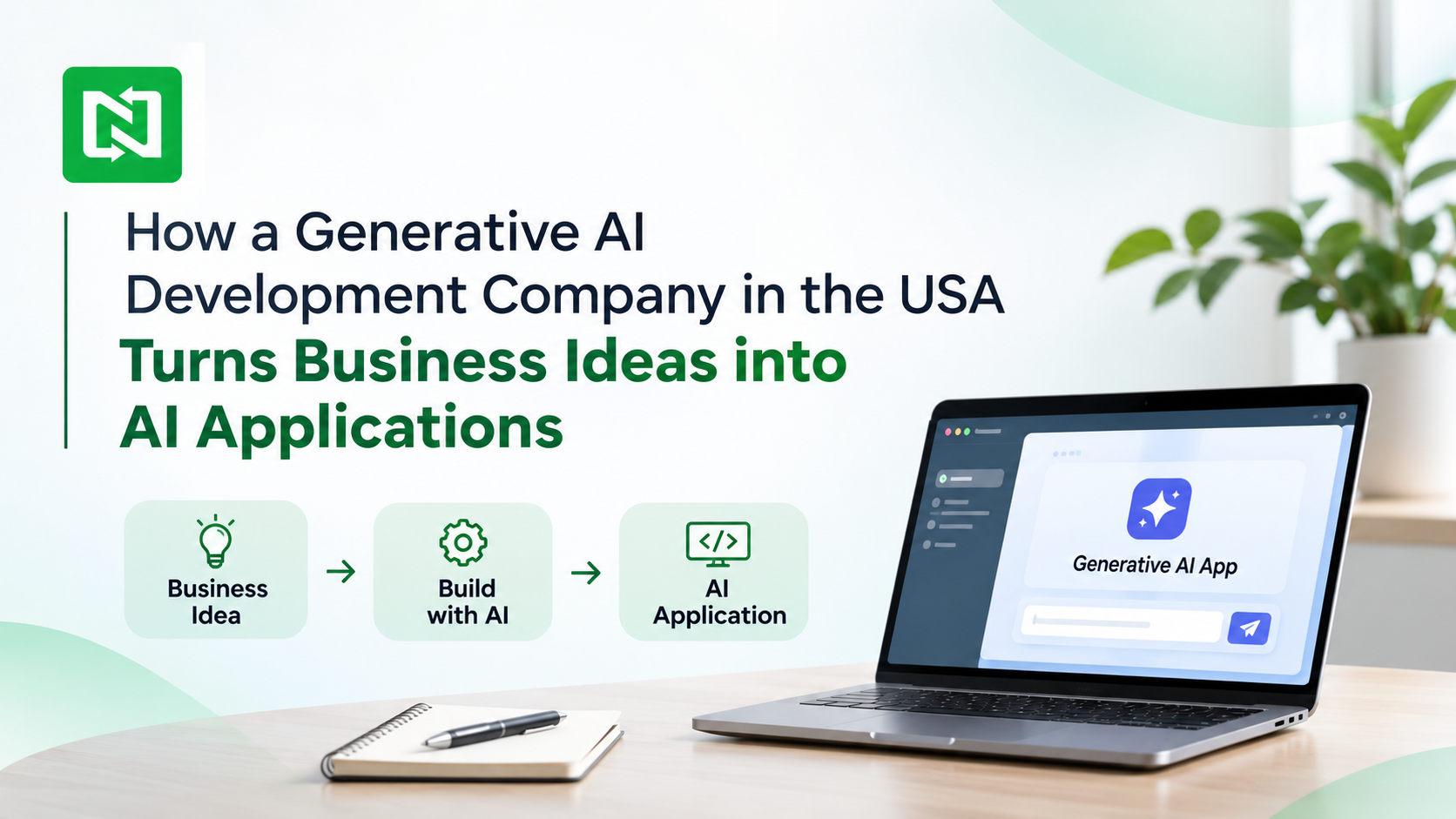
A generative AI development company in USA helps businesses turn promising AI ideas into practical applications that employees can use and trust. A sales director may want proposals drafted in minutes. A support lead may need customers to receive accurate answers at midnight. A founder may want to make years of internal documents searchable. The challenge is turning these ideas into reliable, working products.
That is where an experienced generative AI development partner serving US businesses can add value. This guide explains how the development process works, from discovery and proof of concept to deployment, and what separates a short-lived AI pilot from an application people use daily.
Why Good AI Ideas Stall Before They Become Products
McKinsey’s 2025 State of AI survey found that 88% of respondents said their organizations regularly use AI in at least one business function, yet only about one-third had begun scaling it across the enterprise. Using AI and capturing value are different things. Many teams run experiments, see impressive demos, and then watch momentum fade. The causes are surprisingly predictable.
Fuzzy Goals
An idea such as “use AI for customer service” is a direction, not a requirement. Without a named user, a measurable outcome, and clear limits on what the system must never do, engineers end up guessing and stakeholders end up disappointed.
Data That Is Not Ready
Models are only as useful as the context they receive. Policies buried in scattered PDFs, outdated wiki pages, and inconsistent product names lead to confident but wrong answers. Organizing company knowledge often takes more effort than the model work itself.
No Plan for Adoption
A tool that sits outside daily workflows gets ignored. If agents must open a separate tab to use an assistant, usage tends to drop within weeks.
Stage One: Discovery and Use Case Selection
Good builds start with conversations, not code. Discovery often lasts one to three weeks, depending on scope and stakeholder availability, and involves operations, IT, legal, and the people who will use the product every day. Legal and security leaders should join early, because late objections can derail a nearly finished build.
Questions That Shape the Project
Strong teams ask who the user is, what that person does today, which step wastes the most time, what a wrong answer would cost, and which systems hold the relevant data. Clear answers prevent expensive rework later.
Ranking Ideas Honestly
Most companies arrive with several candidates. A simple scoring method covering business impact, technical feasibility, data readiness, and risk usually reveals one or two worth funding first. High-impact ideas with weak data are not discarded. They are scheduled for later.
Stage Two: Proving the Concept Before Spending Big
Before committing the full project budget, smart teams run a short proof of concept for a generative AI idea (PoC). The aim is not a polished product. It is evidence.
In many projects a pilot runs four to eight weeks. The team builds the simplest functional version of the core workflow and tests it against real examples from the business, such as 200 genuine support tickets or 50 past contracts. Success is defined in advance with numbers: answer accuracy, response time, cost per request, and how often a human reviewer must step in.
Often the most valuable result is a clear decision. Sometimes the numbers justify scaling up. Sometimes they show the problem needs better data or a narrower scope. Discovering this in six weeks rather than six months can save significant time and resources.
Stage Three: Choosing the Right Architecture
Picking the Right Model
No single model fits every job. Providers such as OpenAI, Anthropic, Google, and Meta differ in reasoning quality, speed, context length, and price. Some businesses prefer hosted models for convenience. Others run open-weight models inside their own cloud account to keep sensitive data under tighter control. A good engineering team tests several options on your own examples instead of relying on public leaderboards.
Grounding Answers in Your Own Data
Retrieval-augmented generation (RAG) lets an application look up passages from approved documents before writing a reply. This keeps answers current and makes it possible to show sources, although it reduces hallucination risk rather than removing it. Fine-tuning, by contrast, changes how a model behaves, such as matching a brand voice or output format, and is not a substitute for retrieving current knowledge. Many production systems combine both.
Agents and Tool Use
Newer applications go beyond answering questions. They can check an order status, create a ticket, or update a CRM record. That power brings risk, so tool access should be least-privilege, logged, and gated by approvals for sensitive actions.
Stage Four: Building, Testing, and Securing the Application
Testing Beyond the Demo
Traditional software tests look for exact outputs. Generative systems need evaluation sets, automated scoring, and human review because one question can produce many wordings. Teams track hallucination rate, relevance, tone, and failure patterns, then rerun the same tests after every change.
Security and Compliance
Applications that process personal, confidential, or regulated information must meet the privacy, security, and contractual requirements that apply to the data and jurisdiction. Healthcare projects may involve HIPAA obligations, and enterprise buyers often ask for SOC 2 reports, which are attestations rather than certifications. The OWASP Top 10 for LLM applications lists risks such as prompt injection and sensitive information disclosure, while the voluntary NIST AI Risk Management Framework gives US organizations a shared vocabulary for governing AI risk. Neither guarantees compliance on its own. Responsible builders treat security, privacy, evaluation, and governance as part of the first sprint, not as a final checklist.
Fitting Into Existing Tools
An assistant is far more useful inside the CRM, helpdesk, or document system people already open each morning. Integration work decides whether the product is adopted.
Stage Five: Launch, Monitoring, and Improvement
Launch rarely means switching everything on at once. Teams release to a small group, gather feedback, and expand in waves. After that, monitoring becomes a permanent job: tracking usage, cost, answer quality, and model updates from providers, as these can quietly change application behavior. Human review stays in place for sensitive outputs, and the evaluation set grows as new edge cases appear.
Measuring Whether the Application Is Worth It
Leaders often ask how to measure the return on an AI project. The best answer is to choose metrics before building, not after. Pick two or three that connect to money or time, such as average handling time in support, hours spent drafting documents, first-response speed, or conversion on generated content. Record a baseline from the current process so improvements can be proven.
Quality metrics matter alongside savings. A tool that saves ten minutes but introduces errors can cost more than it saves, so track corrections made by reviewers and complaints from users. Review the numbers every quarter and retire features that do not earn their place.
How Long Does It Take and What Does It Cost?
People asking how long it takes to build a generative AI app want a number, and the honest answer is a range. Discovery takes weeks, a pilot takes a month or two, and a production release typically takes three to six months depending on integrations and compliance needs. Costs follow the same pattern. The main drivers are scope, data preparation, the number of integrations, security requirements, and ongoing usage fees from model providers. Be cautious about any quote that ignores operating costs, since inference and monitoring continue after launch.
What to Look for When Choosing a Build Partner
If you plan to hire outside help, look for full-cycle generative AI development services shaped around American business needs rather than a vendor that simply resells model access. A few questions worth asking:
- Can they show shipped applications with measurable results, not only demos?
- How do they evaluate quality, and will you see the numbers?
- What is their approach to data privacy, access control, and audit logs?
- Is pricing transparent, including costs after launch?
- Will your team receive documentation and training so you are not locked in?
Examples of Ideas That Became Working Products
A regional law firm might build an assistant that summarizes contracts and flags unusual clauses for a lawyer to confirm. An online retailer could generate first-draft product descriptions that editors refine, shortening catalog turnaround. A logistics company may let dispatchers ask plain-language questions about shipments and receive answers drawn from several internal systems. Each example starts with a simple idea that becomes a useful application through discovery, testing, and careful implementation. What they share is a narrow starting point, clean source material, and a team willing to measure results honestly.
Turning Your Idea Into Something Real
Building an AI application is a disciplined process: define the problem, validate it on a small scale, choose the right architecture, test thoroughly, protect data, and keep improving after launch. Teams that follow each stage carefully are more likely to deliver reliable applications that users trust. If you have an idea waiting for the right plan, contact us to talk through your goals, your data, and the best first step.