
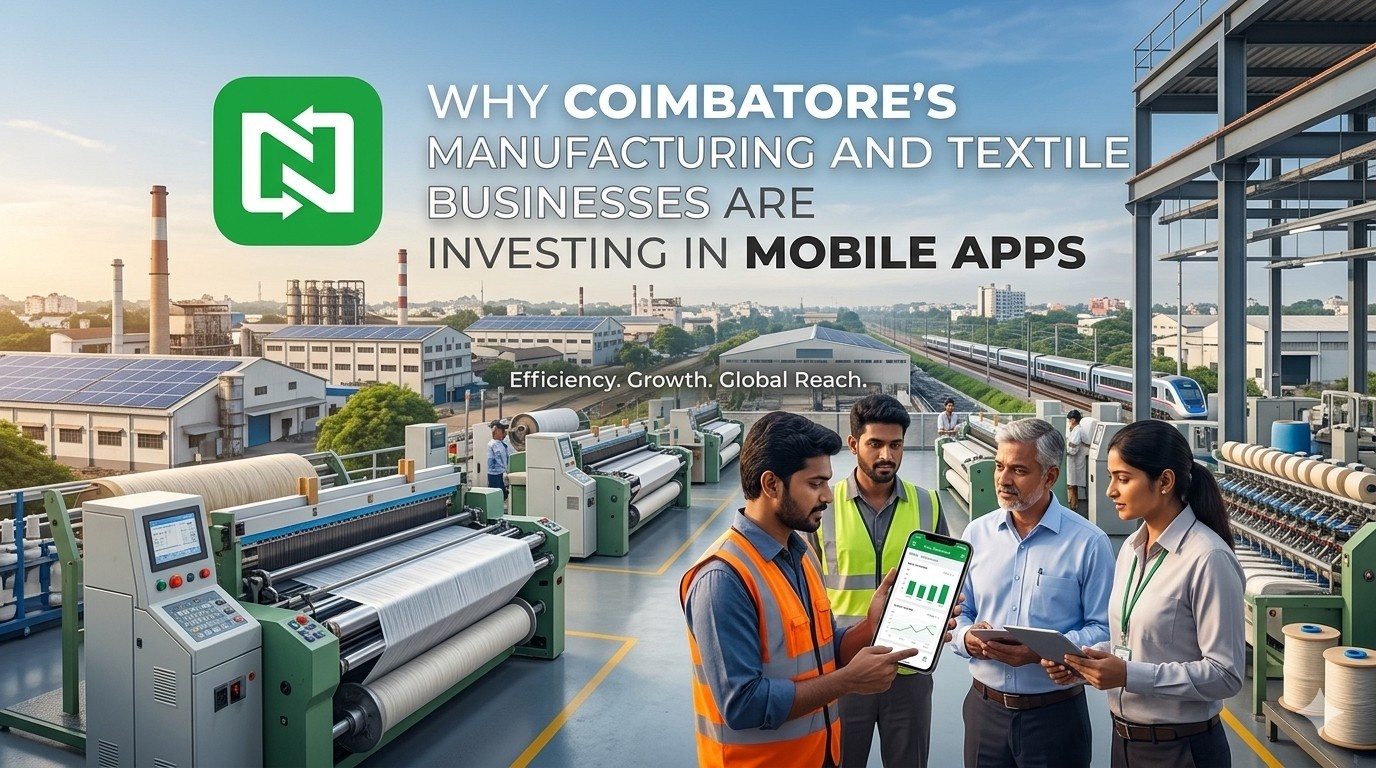
Mobile apps for manufacturing in Coimbatore are becoming essential for solving operational challenges like inventory mismatches, dealer order errors, and lack of real-time visibility From textile mills to pump manufacturers, mobile apps are becoming a core part of daily operations rather than an optional upgrade.
What is newer – and what this article is about – is the shift happening inside those industries. Mobile app development companies in Coimbatore are increasingly fielding enquiries not from retail startups, but from textile mills, pump manufacturers, knitwear exporters, and engineering firms. The question they are asking is not “should we build an app?” – it is “where do we start?”
1.Why Mobile Apps for Manufacturing in Coimbatore Are Growing Now
Three converging forces are driving this shift in Coimbatore’s manufacturing sector:
| India pump market (2024) | USD 2.90 Billion | Source: ResearchAndMarkets |
| Projected pump market (2030) | USD 4.14 Billion (CAGR 6.11%) | Source: ResearchAndMarkets |
| India inventory software market (2024) | USD 167.1 Million | Source: Grand View Research |
| Projected inventory software (2033) | USD 457.9 Million (CAGR 12.3%) | Source: Grand View Research |
| India IoT devices market (2024) | USD 2.89 Billion → USD 10.3B by 2030 | Source: Grand View Research |
| Coimbatore pump sector | Supplies 40%+ of India’s pump requirements | Source: Tamil Nadu Govt. |
The pump and motor manufacturing sector in Coimbatore – home to CRI Pumps, Texmo Industries, Mahendra Pumps, and over 50,000 engineering units – supplies more than 40% of India’s pump requirements. The textile ecosystem stretching from Coimbatore to neighbouring Tirupur (Asia’s largest knitwear exporter) runs one of the highest-volume B2B dealer and distribution networks in South India.
Both sectors share a common pain point: the operational data that drives decisions – inventory levels, dealer orders, field sales activity, production schedules, workforce attendance – still lives in spreadsheets, WhatsApp messages, and paper registers for a significant portion of businesses. That is the gap mobile apps fill.
2. Use Case: Inventory Tracking Apps for Textile Mills
A mid-sized spinning mill in Coimbatore typically manages raw cotton stock, yarn inventory across multiple counts, work-in-progress at different production stages, and finished goods awaiting dispatch – all simultaneously. The challenge is that these four stages often sit in different registers, managed by different people, with no real-time visibility for the production manager or business owner.
A custom inventory tracking app for a textile mill typically covers:
- Real-time raw material stock levels with low-stock alerts
- Batch-level tracking from spinning through weaving to finished goods
- Dispatch recording and lorry receipt capture via mobile camera
- Daily production yield entry by shift supervisors on the floor
- Management dashboard showing stock-to-order ratios
| Industry Data Point
The global inventory management software market is growing at a CAGR of 8.4% through 2033, with the manufacturing segment holding the largest share at over 22% in 2024 (Grand View Research). In India specifically, the inventory management software market is projected to grow from USD 167 million in 2024 to USD 458 million by 2033 – a CAGR of 12.3%. Textile manufacturers are among the fastest adopters. Digital platforms including CRM and inventory tools have shown measurable gains in operational efficiency and customer engagement for textile wholesalers, according to a 2025 peer-reviewed study in Cogent Business & Management. |
For Coimbatore mills competing on export quality and delivery timelines to buyers in Europe and the Middle East, real-time inventory visibility is no longer a nice-to-have. A delayed shipment because the dispatch team did not know the yarn count was out of stock is a preventable cost – and an app is the most practical fix.
3. Field Sales Apps for Pump Manufacturers in Coimbatore
Pump manufacturers in Coimbatore distribute through a network of dealers, sub-dealers, and direct industrial buyers across Tamil Nadu, Karnataka, Andhra Pradesh, and beyond. A field sales team covering this geography – sometimes 20–50 reps – creates a coordination problem that no amount of WhatsApp groups can cleanly solve.
A field sales app built for a Coimbatore pump manufacturer typically includes:
- GPS-based visit logging: sales reps check in at dealer locations with auto-timestamp
- Digital order placement: rep submits order from the field, inventory syncs in real time
- Dealer-wise outstanding balance visibility: rep can see dues before negotiating new orders
- Daily call report submission: eliminates end-of-day paper reporting
- Territory performance dashboard for sales managers
| 💡 Why This Matters for Pump Manufacturers Specifically
Local manufacturers such as Shakti Pumps, KSB India, and Jyoti Ltd are adopting smart pump technologies and remote monitoring – reflecting an industry-wide shift toward digital operations (ResearchAndMarkets, 2025). Field sales apps are the ground-level complement to this trend: while IoT tracks pump performance remotely, a sales app tracks the dealer relationship that sells the pump. The India pump market is projected to grow from USD 2.90 billion in 2024 to USD 4.14 billion by 2030. Capturing that growth requires a distribution infrastructure that can scale – and paper-based field sales cannot. |
4. Dealer Management Apps for Knitwear Exporters
Tirupur, 50 km from Coimbatore, is Asia’s largest knitwear exporting hub – responsible for a significant share of India’s total garment exports of USD 17.3 billion in FY 2023–24 (Ministry of Textiles). Manufacturers here sell through a layered channel: buying agents, domestic distributors, branded retail chains, and direct export buyers.
Managing this channel manually creates specific, costly problems:
- Sample approvals delayed because the buyer’s feedback arrives via email and the design team is on WhatsApp
- Order duplication when the same style is confirmed verbally and in writing
- Dispatch disputes because the proof of delivery lives in a PDF no one can find
- Credit limit breaches because the accounts team does not have real-time order value visibility
A dealer management app for a knitwear exporter consolidates the channel into one place: catalogue with real-time stock availability, digital order placement, sample request tracking, payment status, and dispatch confirmation – all accessible from a phone.
| 📌 Mini Case Study: Knitwear Exporter, Tirupur Road, Coimbatore
A knitwear exporter based on Tirupur Road, Coimbatore – supplying private-label garments to buyers in the UK and UAE – was managing dealer orders across 18 domestic distributors using a combination of WhatsApp, email, and a shared Google Sheet that was perpetually out of date. The specific problems: order errors caused by miscommunication on style/size ratios, leading to fabric over-procurement; no visibility into which dealers had pending payments; and a 3–4 day delay between order placement and internal acknowledgement. After deploying a custom dealer management app – with a digital order form enforcing style/size/quantity selection, automated order confirmation, and a live payment status screen for each dealer – the business recorded a 40% reduction in order entry errors within the first quarter of go-live. The payment follow-up cycle shortened by 5 days on average, and the export documentation team reported fewer last-minute changes to shipment manifests. The app was built using Flutter for cross-platform deployment (iOS for the export team, Android for domestic dealers) with a lightweight Node.js backend and Firebase for real-time sync. Development timeline: 14 weeks. Approximate cost: ₹2,20,000. |
5. Use Case: Workforce Scheduling for Engineering Units
Coimbatore hosts more than 50,000 engineering and light manufacturing units – from precision tooling shops to auto component suppliers. Many operate multi-shift environments with contract workers, skilled machine operators, and permanent staff on different pay structures.
Workforce scheduling and attendance management for these units carries specific complexity:
- Contract workers rotate across shifts and departments – their attendance determines contractor billing
- Overtime calculations depend on machine-specific skill classifications
- Absenteeism on a CNC machine line can stall production for an entire shift
- Payroll is tied to attendance data, but data entry happens at the end of the week, not in real time
A workforce scheduling app for an engineering unit typically includes biometric or QR-based attendance capture, shift assignment with conflict detection, real-time absenteeism alerts to supervisors, and an automated timesheet export for payroll. Several Coimbatore units that have deployed such systems report significant reduction in payroll disputes and overtime miscalculations.
| 📊 Digital Transformation in Indian Manufacturing – The Broader Picture
India’s IoT devices market – the infrastructure underpinning factory digitisation – is growing from USD 2.89 billion in 2024 to a projected USD 10.3 billion by 2030 at a CAGR of 23.2% (Grand View Research). Industrial IoT solutions including smart sensors, predictive maintenance, and real-time monitoring are increasingly common in textiles, automotive, and engineering manufacturing. A textile factory in Coimbatore that installed vibration and current sensors on spinning machines reduced motor failures by 40% using real-time alerts – a documented outcome from an IIoT deployment reported by a Coimbatore-based industrial automation provider in 2025. Mobile apps are the interface layer of this broader digitisation: the tool through which supervisors receive those alerts, managers view dashboards, and field teams submit data from the floor. |
6. Measuring ROI of Manufacturing Apps
One of the most common reasons manufacturing businesses in Coimbatore hesitate before committing to app development is the difficulty of quantifying the return. Here is a practical framework for measuring it:
| ROI Metric | What to Measure | Realistic Gain (Based on Similar Deployments) |
| Order error rate | % of orders requiring correction or re-entry post-placement | 30–50% reduction within 2 quarters |
| Sales rep productivity | Dealer visits logged per week vs paper-based baseline | 20–35% increase in visit frequency |
| Inventory discrepancy | Difference between physical stock and recorded stock at month-end | 50–70% reduction in stockout incidents |
| Payment cycle | Days from invoice to payment confirmation | 3–7 day reduction in follow-up delay |
| Payroll processing time | Hours spent on attendance reconciliation and timesheet preparation | 40–60% reduction in admin time |
| Dealer onboarding time | Days from new dealer registration to first order placement | 60–80% reduction when using a self-service dealer app |
| Reporting latency | Time from event (sale/dispatch/attendance) to management visibility | Real-time vs 24–72 hour lag on paper |
How to Calculate Your Specific ROI
Start with a single, high-frequency problem. If your field sales team makes 200 dealer visits per month and 15% of orders come back with errors requiring correction, that is 30 error correction cycles per month. If each correction takes 45 minutes of staff time across sales, accounts, and dispatch – that is 22.5 hours per month of recoverable waste.
At a blended cost of ₹300/hour for that staff time, you are spending ₹6,750 per month – ₹81,000 per year – on a preventable process failure. A field sales app that eliminates that error rate pays for itself in under two years, even on a conservative estimate.
This is the calculation every manufacturing business in Coimbatore should run before calling it an expense. The app cost is a fixed number. The waste cost compounds every year you do not fix it.
7. Choosing the Right Type of App for Your Industry
| Business Type | Highest-ROI App Type | Primary Users | Key Integration |
| Spinning / Weaving Mill | Inventory tracking + production yield app | Production supervisor, store manager, owner | ERP or Tally for financial sync |
| Pump / Motor Manufacturer | Field sales + dealer order app | Sales reps, dealer network, sales manager | Billing software, inventory system |
| Knitwear / Garment Exporter | Dealer management + sample approval app | Merchandisers, buyers, domestic distributors | Export documentation software |
| Precision Engineering Unit | Workforce scheduling + job card app | Shift supervisors, HR, payroll team | Payroll software, timesheet system |
| Auto Component Supplier | Quality inspection + dispatch tracking app | QC inspectors, dispatch team, client liaison | ERP, barcode/QR scanning |
| Textile Machinery Manufacturer | After-sales service + warranty app | Service engineers, dealers, end customers | CRM, spare parts inventory |
Choosing a Mobile App Development Company in Coimbatore
When selecting a development partner, manufacturing businesses should evaluate:
- Experience with industrial workflows
- Ability to integrate with ERP and inventory systems
- Understanding of dealer networks and field sales operations
- Post-launch support and scalability
Working with a company that understands Coimbatore’s manufacturing ecosystem can significantly reduce development time and improve ROI.
Final Thoughts
Coimbatore’s manufacturing and textile businesses are not investing in mobile apps because it is fashionable – they are investing because the operational cost of not having real-time visibility, structured order management, and connected field teams is now greater than the cost of building the tool.
The businesses seeing the clearest returns are not those who built the most sophisticated app – they are those who identified one specific, high-frequency operational problem and built a focused solution for it. The dealer order error. The field visit that does not get logged. The inventory that does not match the system.
If you are a manufacturer in Coimbatore looking to work with mobile app development companies in Coimbatore, start with that one problem. Define it precisely. Then build the simplest app that fixes it.
FAQs
- How much does it cost to build a mobile app for a manufacturing business in Coimbatore?
Typical costs range from ₹5 lakhs to ₹10+ lakhs depending on features, integrations, and scale. - How long does development take?
Most apps take between 8 to 16 weeks. - Which industries benefit most from mobile apps?
Textile mills, pump manufacturers, engineering units, and exporters see the highest ROI. - Do these apps integrate with Tally or ERP systems?
Yes, most custom apps integrate with existing accounting and ERP tools.