Table of Contents
- Introduction
- Why So Many AI Projects Fail Before Delivering Business Value
- The Hidden Factors That Separate Successful AI Projects from Failed Ones
- The Role of an AI Development Company in USA in Building Successful AI Solutions
- How the Right AI Development Company Prevents Costly AI Failures
- Real-World AI Success Stories Across Industries
- How to Choose the Right AI Development Company in USA
- The Future of AI Development and Long-Term Business Success
- Frequently Asked Questions
1. Introduction
AI adoption is accelerating across nearly every industry, driven by competitive pressure and the broader push toward digital transformation. Yet a striking number of AI initiatives never deliver the business value their sponsors expected, even when the original idea was genuinely strong. Technology alone rarely determines whether an AI project succeeds. Strategy, data quality, execution discipline, and the right delivery partner matter just as much. This is exactly why working with an experienced AI Development Company in USA changes the outcome for so many organizations. Partnering with a capable AI Development Company in USA helps leaders avoid the common traps that quietly derail promising ideas. This article explains why AI projects fail, what separates the ones that succeed, and how to choose a partner that gets it right.
2. Why So Many AI Projects Fail Before Delivering Business Value
The Growing AI Adoption Boom
Organizations are investing heavily in AI to stay competitive and modernize operations. Digital transformation budgets increasingly prioritize AI, and few leadership teams want to fall behind as rivals adopt these capabilities first.
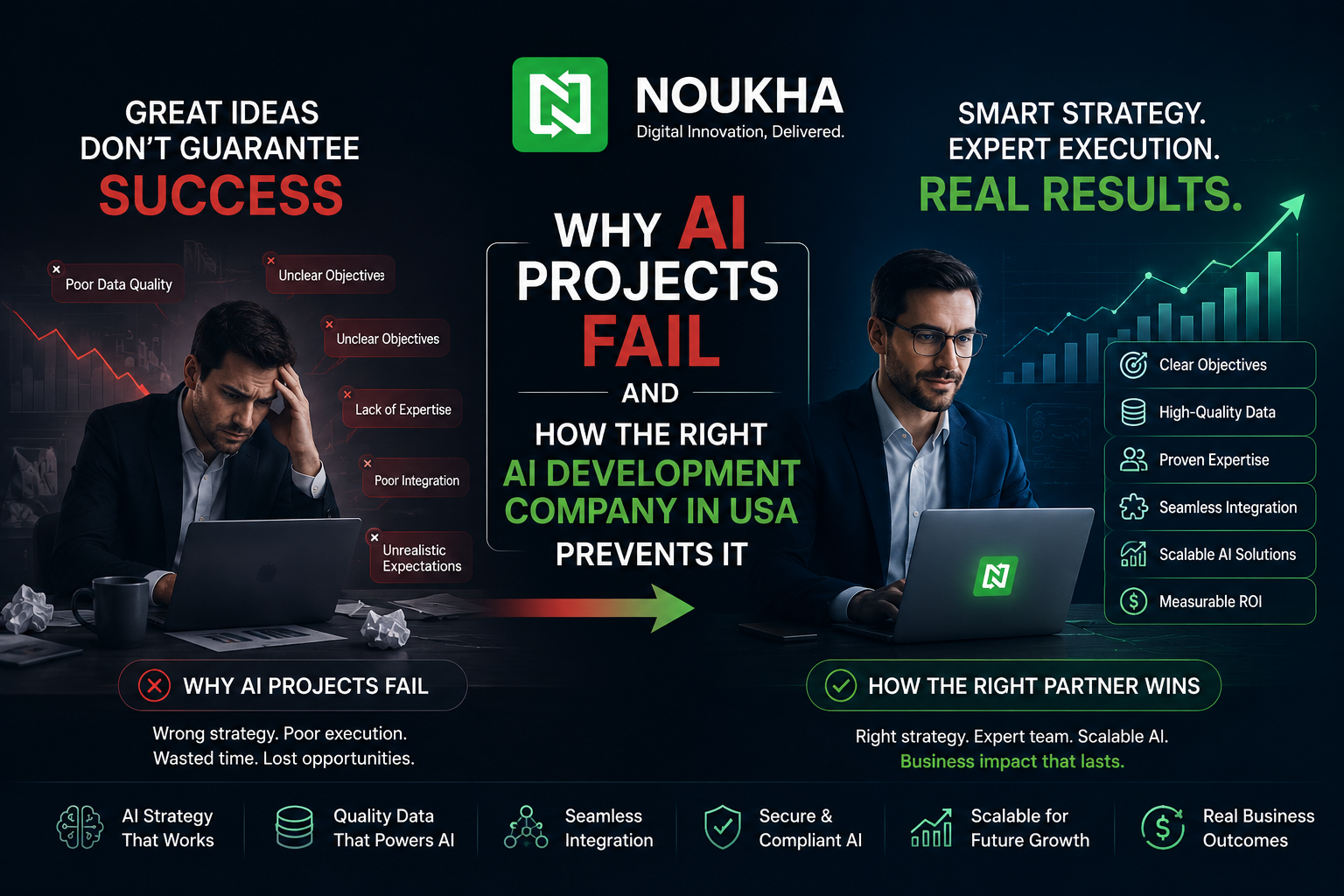
Great Ideas Alone Don’t Guarantee Success
Innovation and execution are not the same thing. A promising proof of concept shows an idea can work in theory, but many companies struggle once they move from experimentation into something reliable enough to run the business on.
Common Reasons AI Projects Fail
Projects most often fail because of undefined objectives, poor-quality data, weak executive alignment, unrealistic expectations, and inadequate planning before development even begins.
Technical Challenges That Slow AI Adoption
Legacy systems, infrastructure limitations, and gaps in security or compliance readiness routinely slow AI adoption. Performance optimization is often underestimated until the system faces real production load.
The Financial Impact of Failed AI Projects
Failed initiatives cost more than the direct investment. Delayed ROI, missed opportunities, and reduced confidence in future AI initiatives all compound the damage.
3. The Hidden Factors That Separate Successful AI Projects from Failed Ones
Starting with Business Problems Instead of Technology
Successful projects begin with a clear business objective and measurable outcome, then identify the highest-impact use case, rather than starting with a technology in search of a problem.
The Importance of High-Quality Data
Reliable data collection, careful preparation, strong governance, and a plan for continuous improvement determine model accuracy far more than the sophistication of the algorithm itself.
Building AI Around Existing Business Processes
AI that integrates cleanly with ERP, CRM, and other enterprise systems earns genuine user adoption, while a standalone tool disconnected from daily workflows tends to be ignored.
Setting Realistic Expectations from Day One
Successful teams set honest timelines, treat AI as a continuously optimized system rather than a one-time build, and agree on the KPIs that will define success before development starts.
Why Scalability Must Be Planned Early
Cloud infrastructure, model retraining plans, and performance monitoring need to be considered from the beginning, not bolted on after the first version struggles under real usage.
4. The Role of an AI Development Company in USA in Building Successful AI Solutions
Developing an AI Strategy Before Writing Code
A strong partner begins with a business assessment, an honest AI readiness evaluation, feasibility analysis, and a solution architecture and roadmap before any development work starts.
Selecting the Right AI Technologies
Machine learning surfaces patterns in historical data that support better predictions. Generative AI produces content and recommendations tailored to context. Natural language processing lets systems interpret documents and conversations, while computer vision handles visual inspection tasks. Predictive analytics ties these capabilities together into forward-looking insight that supports real decisions rather than novelty features.
Building AI Around Business Objectives
The strongest implementations focus on process automation, improved customer experience, intelligent decision support, and measurable productivity gains rather than technology for its own sake.
Managing AI Development from Discovery to Deployment
A disciplined partner manages the full lifecycle, from discovery and data preparation through model development, testing, deployment, and continuous improvement after launch.
Ensuring Security, Compliance, and Responsible AI
Privacy protection, security controls, governance frameworks, ethical AI practices, and regulatory compliance need to be built into the solution rather than addressed as an afterthought.
5. How the Right AI Development Company Prevents Costly AI Failures
Identifying Risks Before Development Begins
Assessing technical feasibility, business feasibility, resource requirements, and risk exposure before committing to a build prevents costly surprises later. This is the kind of upfront discipline that strong enterprise AI development services bring to every engagement.
Creating Scalable AI Architectures
Cloud-native design, well-planned API integrations, and architecture built for enterprise scale and high availability keep the solution reliable as usage grows.
Improving AI Model Performance Over Time
Continuous learning, ongoing monitoring, optimization, and structured feedback loops keep model performance accurate long after the initial deployment.
Driving Organization-Wide AI Adoption
Employee enablement, thoughtful change management, cross-functional collaboration, and consistent stakeholder engagement determine whether an AI solution actually gets used.
Measuring AI Success Through Business Metrics
Productivity gains, cost savings, revenue growth, customer satisfaction, and return on investment are the metrics that matter, not model accuracy in isolation.
Providing Long-Term Support Beyond Deployment
Ongoing maintenance, security updates, feature enhancements, and model improvements ensure the solution continues to deliver value well after launch.
6. Real-World AI Success Stories Across Industries
In healthcare, AI supports administrative automation and diagnostic assistance, reducing clinician workload. In financial services, fraud detection and risk scoring help institutions protect assets and streamline compliance. Retailers use AI for demand forecasting and personalized recommendations that influence revenue. Manufacturers apply computer vision for quality inspection and predictive maintenance. Logistics and supply chain teams rely on AI for route optimization, improving reliability. Across enterprise operations, AI-driven document processing cuts turnaround times from days down to hours.
7. How to Choose the Right AI Development Company in USA
Evaluate proven AI expertise: Look for a track record of production deployments, not just prototypes and demos.
Assess industry experience: A partner familiar with your industry’s regulatory and operational realities designs more practical solutions.
Understand their development methodology: Ask how they approach discovery, data readiness, iterative development, and deployment.
Review scalability and support capabilities: Confirm the architecture can grow with the business and that support continues after launch.
Security, compliance, and data governance: Understand how data ownership, privacy, and regulatory requirements are handled throughout the engagement.
Questions every business should ask before hiring: How will success be measured? What does the maintenance plan look like? How is data privacy protected? What happens if business requirements change mid-project?
8. The Future of AI Development and Long-Term Business Success
Enterprise AI adoption is moving toward autonomous AI agents capable of completing multi-step tasks, deeper generative AI integration into daily workflows, and decision intelligence that supports faster, better-informed choices. Responsible AI practices, including transparency and bias mitigation, are becoming a baseline expectation rather than a differentiator. Businesses that commit to a long-term AI strategy today, rather than treating AI as a series of disconnected experiments, will be better positioned for what comes next. This is why more organizations are turning to structured AI software development services that treat AI as core infrastructure rather than a passing initiative.
9. Frequently Asked Questions
Why do AI projects fail even when the idea is strong?
Most failures come down to execution, not the idea itself, including undefined objectives, poor data quality, weak alignment, and insufficient planning before development begins.
How does an AI Development Company in USA improve project success?
An experienced partner brings strategy, disciplined execution, and long-term support that address the gaps most in-house teams struggle to close alone.
What should businesses look for before hiring an AI Development Company in USA?
Look for proven expertise, relevant industry experience, a clear development methodology, scalability planning, and strong security and governance practices.
Conclusion
Great ideas are only the starting point for a successful AI initiative. The organizations seeing lasting results are the ones that pair strong ideas with clear business objectives, high-quality data, realistic expectations, and a development partner capable of executing at production scale. Avoiding the common failure points requires strategic planning and disciplined delivery, not just enthusiasm for the technology. If your organization is ready to move from AI experimentation to measurable business results, contact our AI experts at Noukha to discuss your AI transformation goals.