Table of Contents
- Introduction
- Why AI Experiments Generate Excitement but Rarely Business Value
- What Custom AI App Development Really Means for Modern Businesses
- AI Experiments vs Custom AI Applications: Understanding the Difference
- How Custom AI App Development Delivers Measurable Business Results
- Real-World Business Use Cases Across Industries
- How to Choose the Right Custom AI App Development Company in USA
- The Future of Custom AI App Development in USA
- Frequently Asked Questions
1. Introduction
Artificial intelligence has moved from research labs into boardrooms faster than almost any technology before it. Executives across every sector are experimenting with chatbots, automation scripts, and generative models, hoping to find a competitive edge. Yet most of these initiatives stay stuck at the pilot stage, generating impressive demos without changing how a business actually operates. This is where Custom AI App Development in USA changes the equation, moving companies from isolated experiments toward solutions built around their own workflows, data, and goals. Businesses that partner with an experienced team for Custom AI App Development in USA tend to see AI become a durable operating advantage rather than a passing trend. This article explains why that shift matters and how leaders can make smarter decisions about their AI investments.
2. Why AI Experiments Generate Excitement but Rarely Business Value
The Growing Popularity of AI Pilot Projects
Most companies start their AI journey with a proof of concept because it feels low risk and fast to deploy. A small team builds a demo, leadership gets excited, and the project earns internal buzz. A demo answers whether something can work, not whether it will work at scale, every day, inside real systems.
The Gap Between Innovation and Business Execution
A polished demonstration rarely accounts for messy production data or the operational friction of daily use. Many pilots impress in a meeting room and then quietly disappear because nobody defined the business outcome they were meant to produce.
Common Challenges That Stop AI Projects
Recurring issues stall AI initiatives: undefined goals, poor-quality data, fragmented systems, misaligned stakeholders, and the complexity of integrating AI into legacy infrastructure.
Why Scaling AI Is More Difficult Than Building It
Building a working model is only the beginning. Scaling requires resilient infrastructure, strong security, regulatory compliance, consistent performance under real load, and genuine adoption across departments.
The Hidden Cost of Continuous AI Experimentation
Every abandoned pilot consumes time and budget. Beyond the direct spend, competitors who commit to production-grade AI capture market advantage, and repeated failed experiments erode stakeholder confidence for the next initiative.
3. What Custom AI App Development Really Means for Modern Businesses
Defining Custom AI App Development
Custom AI app development means building intelligent applications designed specifically around a company’s processes, data, and objectives, rather than adopting a generic tool built for a broad market. A custom application solves your problem, using your data and your workflows.
Core Technologies Behind Modern AI Applications
A well-built application often draws on several technologies together. Machine learning identifies patterns in historical data to support better predictions. Generative AI produces content and recommendations tailored to context. Natural language processing helps systems understand documents and conversations. Computer vision interprets images for inspection tasks, while predictive analytics turns all of it into forward-looking insight for planning.
Building AI Around Existing Business Workflows
The strongest AI applications integrate directly with systems a company already relies on, including ERP platforms, CRM tools, and internal workflow software, turning AI into an embedded part of daily operations rather than a standalone feature.
Why Personalization Creates Better Business Outcomes
A model trained on a company’s own data and customer behavior consistently outperforms a generic tool trying to serve every industry at once, creating more relevant recommendations and a better experience for employees and customers alike.
Long-Term Value of Custom AI Applications
Because custom applications are built to scale and evolve, they deliver value well beyond initial deployment, extending as needs change and refining as more data becomes available.
4. AI Experiments vs Custom AI Applications: Understanding the Difference
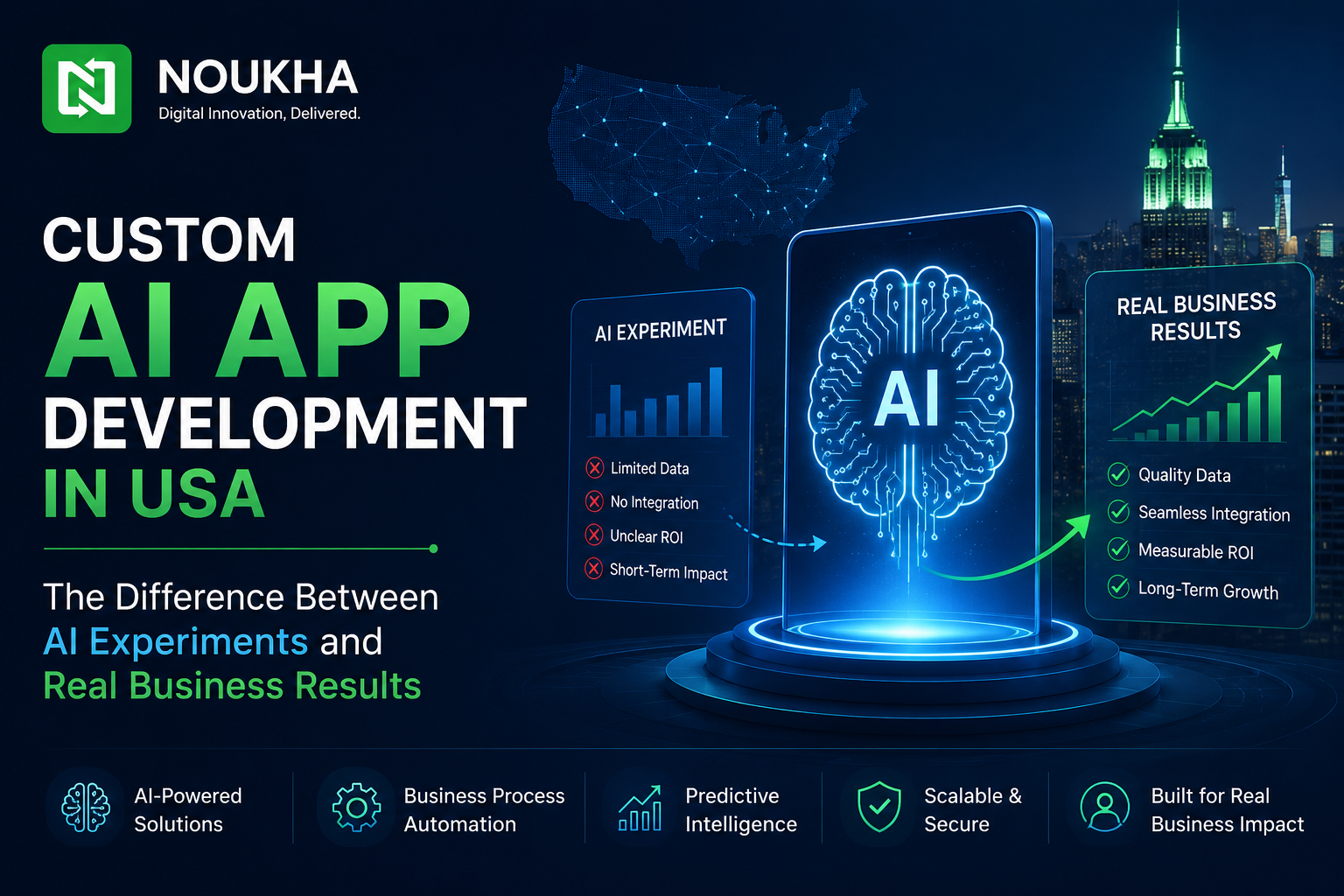
The distinction goes beyond technical sophistication. Purpose differs: experiments validate an idea, while custom applications solve a defined business problem. Development approach, data strategy, integration depth, scalability planning, security posture, regulatory compliance, and alignment to business KPIs all diverge sharply between the two.
| Factor | AI Experiments | Custom AI Applications |
| Business Impact | Limited, hard to quantify | Directly tied to measurable outcomes |
| Scalability | Rarely designed to scale | Built for production scale from the start |
| ROI | Difficult to prove | Tracked against defined KPIs |
| Maintenance | Often abandoned after testing | Actively maintained and improved |
| Long-Term Value | Short-lived interest | Sustained competitive advantage |
5. How Custom AI App Development Delivers Measurable Business Results
Automating High-Value Business Processes
Custom applications remove repetitive manual work from high-value processes, reducing operational cost while freeing employees to focus on judgment-based tasks.
Enhancing Customer Experiences with Intelligent Features
AI assistants, personalized recommendations, and smart support tools help businesses respond faster and more accurately to customer needs, building loyalty and reducing churn.
Improving Business Decisions with Predictive Intelligence
Forecasting models and risk analysis give leaders decision intelligence grounded in data rather than intuition alone.
Increasing Productivity Across Departments
The impact spans the organization: HR accelerates candidate screening, finance automates reconciliation, sales gets better lead scoring, and operations gain real-time visibility into performance.
Creating Sustainable Competitive Advantage
Companies that build durable AI capabilities gain an edge through faster innovation cycles, stronger customer retention, and improved profitability over time. This is precisely the outcome that mature enterprise AI solutions are designed to deliver, turning technology investment into a lasting operational asset.
Measuring ROI from Custom AI Investments
Practical KPIs include reduced process time, lower error rates, increased conversion, improved customer satisfaction, and cost savings per automated workflow.
6. Real-World Business Use Cases Across Industries
In healthcare, custom applications support administrative automation and diagnostic support, reducing clinician workload. In financial services, fraud detection and risk scoring help institutions protect assets and streamline compliance. Retailers use AI for demand forecasting and personalized recommendations that influence revenue. Manufacturers apply computer vision for quality inspection and predictive maintenance. Logistics providers rely on route optimization to cut costs and improve delivery reliability. Across enterprise operations, AI-driven document processing shrinks turnaround times from days into hours.
7. How to Choose the Right Custom AI App Development Company in USA
Technical expertise: Look for proven experience across machine learning, generative AI, and enterprise integration, not just prototype building.
Industry experience: A partner familiar with your industry’s regulatory realities will design more practical solutions.
Development methodology: Ask how the company approaches discovery, data readiness, iterative development, and deployment.
Scalability: Confirm the architecture handles growth in users, data volume, and future features.
Security: Evaluate data protection, access control, and secure model deployment practices.
Data governance: Understand how data ownership and compliance are handled throughout the engagement.
Questions to ask before hiring: How will success be measured? What does maintenance look like after launch? How is data privacy protected? What happens if requirements change mid-project?
8. The Future of Custom AI App Development in USA
The next phase of enterprise AI centers on generative AI embedded into daily workflows, autonomous AI agents capable of completing multi-step tasks, and hyper-personalization that adapts to behavior in real time. Responsible AI practices, including transparency and bias mitigation, will become a baseline expectation. Businesses that invest in a long-term AI strategy today, rather than isolated tools, will be better positioned for what comes next. This is why more organizations are turning to structured AI software development services that treat AI as core infrastructure rather than an experimental add-on.
9. Frequently Asked Questions
What is custom AI app development, and how is it different from using AI tools?
Custom AI app development builds applications around your specific data, workflows, and goals, while off-the-shelf tools offer generic functionality designed for a broad market.
How long does it take to develop a custom AI application?
Timelines vary based on complexity, but most projects move from discovery to a production-ready application within a few months, followed by ongoing refinement.
Why should businesses choose a custom AI app development company in USA instead of off-the-shelf AI software?
A dedicated partner tailors the solution to your exact business context, ensuring better accuracy, stronger integration, and measurable returns rather than a generic fit.
Conclusion
AI experimentation has value, but it is only the starting point. The businesses seeing real returns are the ones that move past isolated pilots and invest in applications built around their own data, workflows, and goals. Custom AI app development turns a promising idea into a dependable operational asset, one that scales, integrates, and improves over time. If your organization is ready to move beyond testing and start building AI that delivers measurable results, contact our AI experts at Noukha to discuss your AI project and map out the right path forward.