
Table of Contents
- Introduction
- Understanding the Real Business Challenge
- Why User Experience Is the Foundation of AI Applications
- How AI Developers Transform Complexity into Simplicity
- Technologies Behind Modern AI Applications
- Common Challenges During AI App Development
- Best Practices for Building User-Friendly AI Apps
- What Businesses Should Consider Before Starting
- Conclusion
- FAQs
Introduction
Solving a business problem with software takes more than writing code. It requires understanding the underlying process, the people who use it every day, and the outcome the business actually needs. This is the mindset experienced AI App Developers USA bring to every project, translating operational complexity into interfaces people can use without friction.
As AI becomes part of everyday business tools, the role of the developer has shifted. It is no longer just about building features. It is about designing systems that make advanced technology feel simple and predictable for the people relying on it daily.
This guide explains how AI developers approach complex business problems, what technologies power modern AI applications, common challenges teams face, and what businesses should consider before starting a project. Readers will also gain a practical framework for evaluating whether their own internal processes are ready for an AI-driven redesign.
Understanding the Real Business Challenge
Identifying operational pain points
Before any development begins, effective AI teams focus on identifying where time, accuracy, or consistency is being lost in current workflows. This often reveals problems that were previously accepted as unavoidable inefficiencies, such as manual data entry that has quietly consumed hours of staff time for years without anyone questioning it.
Defining measurable business goals
Clear goals, such as reducing processing time or improving response accuracy, give development teams a target to design toward, rather than building AI features for their own sake.
Understanding user expectations
Employees and customers interacting with AI-powered tools expect responses that feel relevant and immediate. Understanding these expectations early prevents costly redesigns later in the project, since retrofitting usability into a system built without user input is far more expensive than designing for it from the start.
Why User Experience Is the Foundation of AI Applications
AI should simplify, not complicate
The most effective AI applications reduce the number of steps a person needs to take to complete a task. If an AI feature adds confusion or extra clicks, it works against its own purpose.
Designing around user behavior
Good AI application design starts with observing how people actually work, not how a process is documented on paper. Real usage patterns often differ from official workflows, and design should reflect reality.
Balancing automation with human control
Full automation is not always the right answer. Many successful AI applications include checkpoints where a human can review, adjust, or approve an AI-generated output before it moves forward. This is especially important in areas like financial approvals or clinical documentation, where an incorrect automated decision could carry real consequences.
How AI Developers Transform Complexity into Simplicity
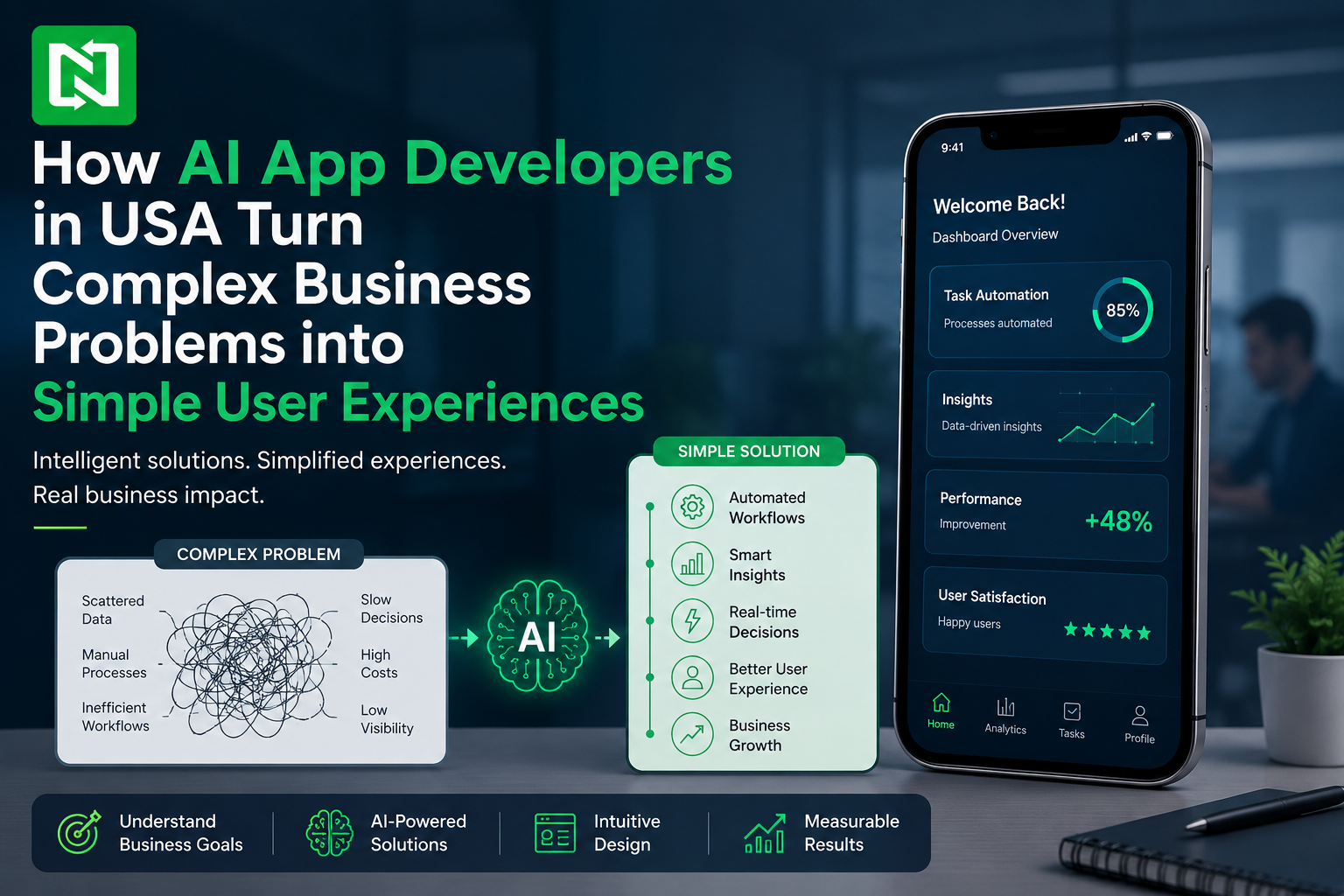
Breaking large problems into manageable workflows
Rather than trying to automate an entire process at once, experienced developers break it into smaller, testable components that can be refined independently.
Building intelligent automation
Automation is layered in gradually, starting with repetitive, low-risk tasks before expanding into more complex decision-making processes as confidence in the system grows.
Creating intuitive interfaces
Interfaces are designed so users interact with AI capabilities naturally, often through simple prompts, dashboards, or conversational elements, without needing technical knowledge of how the system works.
Continuous optimization using user feedback
AI applications are refined continuously based on real usage data and direct user feedback, allowing the system to improve accuracy and relevance over time.
Many businesses now rely on structured custom AI application development processes to ensure these improvements happen in a controlled, measurable way rather than through ad hoc changes.
Technologies Behind Modern AI Applications
Machine learning
Machine learning models identify patterns in data, enabling applications to make predictions, classifications, and recommendations based on historical information.
Generative AI
Generative AI creates content, summaries, and responses based on learned patterns, supporting tasks like drafting documents, generating reports, and powering conversational tools.
Natural language processing
Natural language processing allows applications to understand and respond to human language, enabling search, chat, and document analysis features that feel conversational rather than mechanical.
Computer vision and predictive analytics
Computer vision supports tasks like image recognition and quality inspection, while predictive analytics helps businesses anticipate outcomes such as demand, risk, or maintenance needs before issues occur. Together, these technologies are often combined within a single application rather than used in isolation, since real business problems rarely fit neatly into one category of AI.
Common Challenges During AI App Development
Poor data quality
AI models depend heavily on the data used to train and operate them. Incomplete, outdated, or inconsistent data directly affects the reliability of the final application, and cleaning this data often takes longer than teams initially expect.
Model accuracy
Achieving consistent accuracy requires ongoing testing and refinement, particularly when an application is applied to varied real-world scenarios rather than controlled test conditions. Teams that skip this step often see strong initial demos followed by disappointing real-world performance.
System integration
Many AI applications need to work alongside existing software, databases, and workflows. Integration challenges can significantly affect project timelines if not planned for early, particularly when legacy systems were never designed to share data with modern platforms.
Security and compliance
Handling sensitive business or customer data requires strict attention to security protocols and industry regulations, particularly in healthcare, finance, and other regulated sectors. Compliance requirements should be built into the application architecture from the beginning rather than added afterward as a patch.
Best Practices for Building User-Friendly AI Apps
Focus on business outcomes
Every feature should tie back to a measurable business outcome, whether that is faster processing, improved accuracy, or better customer satisfaction.
Test with real users
Direct feedback from actual users during development helps identify usability issues that internal teams may overlook, especially around unfamiliar AI-driven interactions.
Maintain transparency in AI decisions
Users are more likely to trust AI-driven recommendations when they can understand, at a basic level, how or why a suggestion was made. Simple explanations, such as highlighting which data points influenced a result, go a long way toward building that confidence.
Continuously improve performance
AI applications should not be treated as finished products at launch. Ongoing monitoring and refinement help maintain accuracy and relevance as business needs evolve.
What Businesses Should Consider Before Starting
Define the right use case
Not every business process needs AI. Successful projects start with a specific, well-defined problem where AI can provide clear, measurable value.
Choose the appropriate AI technologies
Different problems require different tools. Businesses should match the right combination of machine learning, generative AI, or predictive analytics to their specific use case.
Plan for scalability
Applications should be designed to handle growth in users, data volume, and complexity without requiring a complete rebuild later. This is particularly important for businesses expecting rapid adoption across multiple departments or regions.
Establish success metrics
Clear metrics, defined before development begins, make it possible to evaluate whether the application delivers real business value after launch.
Businesses exploring this path often look for experienced partners offering dependable AI-powered applications built around their specific operational needs rather than generic, one-size-fits-all software.
Conclusion
The real value of AI application development lies in simplicity. Complex business problems do not need complicated interfaces. They need thoughtful design, reliable technology, and a clear understanding of how people actually work. Businesses that prioritize user experience alongside technical capability are the ones seeing the strongest results from their AI investments.
As AI continues to shape how business software is built, working with experienced teams becomes increasingly valuable. Businesses ready to explore this path can Contact Us to discuss how a tailored AI application could support their specific goals.
FAQs
How do AI app developers simplify complex business processes?
Developers break large problems into smaller workflows, focus on intuitive interface design, and use continuous user feedback to refine how the application performs over time.
What industries benefit most from AI-powered applications?
Healthcare, finance, retail, manufacturing, and education see significant benefits, particularly in automation, personalized experiences, and improved decision-making accuracy.
What should businesses prepare before developing an AI application?
Businesses should define a clear use case, ensure reliable data quality, select appropriate AI technologies, and establish measurable success metrics before development begins.