
Table of Contents
- Introduction
- Why Business Value Matters More Than AI Complexity
- Characteristics of Practical AI Solutions
- Problems Businesses Successfully Solve Using AI
- Why Many AI Projects Never Deliver Results
- Measuring Business Impact Instead of Technical Achievement
- Human-Centered AI Creates Better Outcomes
- The Future of Practical Business AI
- Conclusion
- FAQs
Introduction
Artificial intelligence has become increasingly accessible across nearly every industry, from healthcare and finance to retail and logistics. Yet accessibility alone does not guarantee success. Many organizations that adopt AI discover that the technology looks impressive in a demo but fails to change how work actually gets done. Working with an experienced AI Development Company in USA can help businesses avoid this gap by focusing on outcomes rather than novelty. Successful AI adoption depends on solving real operational challenges, not on showcasing advanced algorithms for their own sake. Measurable business results, such as reduced costs or faster decisions, matter more than technical sophistication. This article looks at what separates AI that genuinely improves everyday operations from AI that simply appears innovative, offering business leaders a practical, non promotional guide to evaluating AI investments.
1. Why Business Value Matters More Than AI Complexity
Technology Is Only Part of the Solution
AI is a tool that supports business strategy, not a replacement for it. A sophisticated model built without a clear connection to a real operational need rarely delivers lasting value. Impressive demonstrations can generate excitement internally, but excitement fades quickly if the tool does not fit into how a team actually works day to day. Technology should serve the business, not the other way around.
Business Problems Should Define AI Projects
The most effective AI initiatives begin with a clearly defined business challenge rather than a general enthusiasm for artificial intelligence. Objectives should be established before any particular AI technology is chosen, ensuring that the solution is shaped by the problem rather than the other way around. This sequencing matters because it prevents teams from investing time and budget into a system that is technically impressive but poorly matched to the actual need it was meant to address.
Focusing on Outcomes Instead of Algorithms
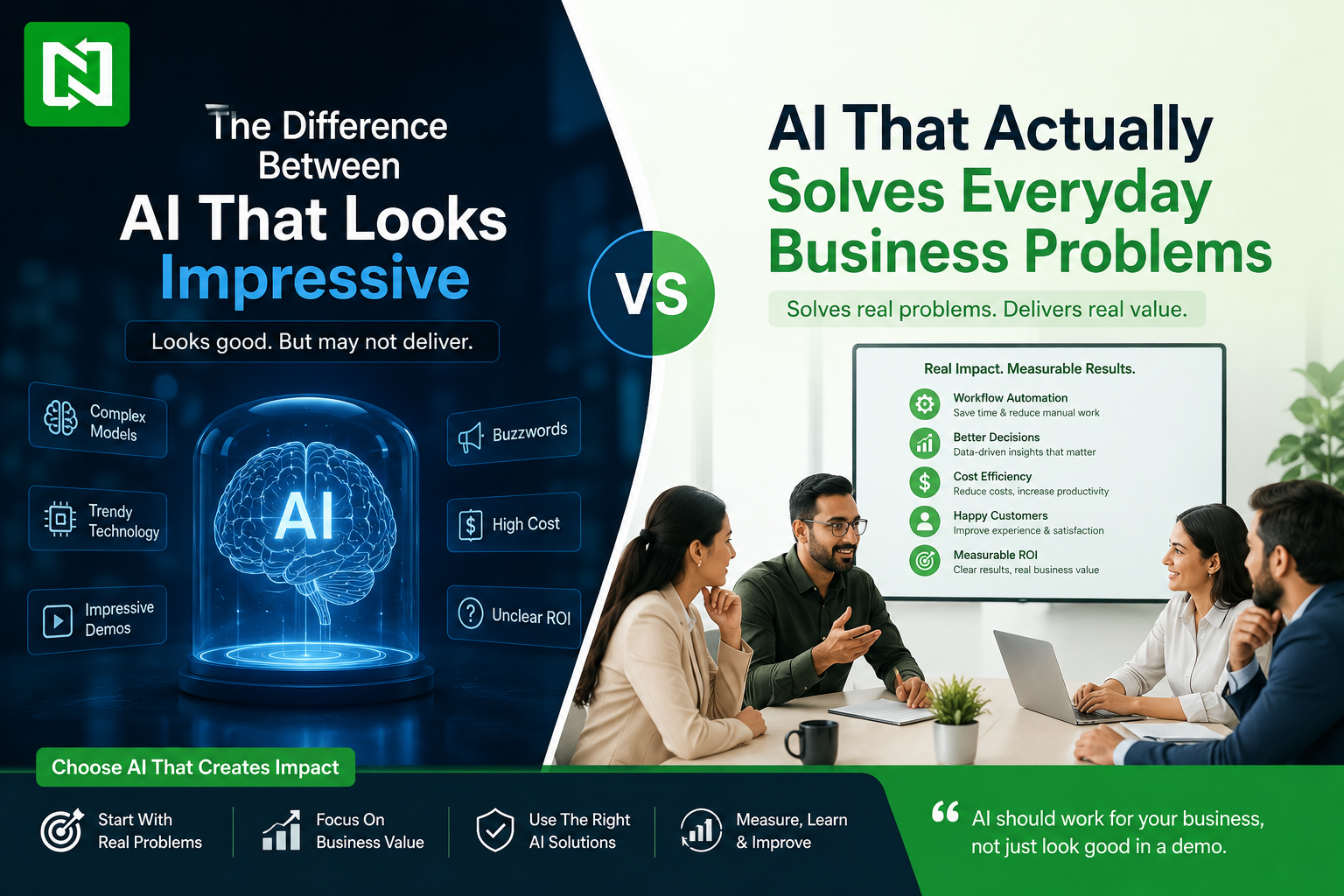
Practical AI adoption is measured by results such as cost reduction, operational efficiency, better customer experiences, and improved decision making, rather than by the complexity of the underlying model. A relatively simple system that reliably saves a team several hours a week often delivers more real value than an elaborate model that impresses stakeholders but rarely gets used.
2. Characteristics of Practical AI Solutions
Clear Business Objectives
Effective AI projects start with specific, measurable goals, such as reducing processing time by a defined percentage or lowering the volume of manual errors, rather than a general desire to use new technology.
Easy Integration With Existing Workflows
An AI solution that requires teams to abandon familiar processes often faces resistance, even when the underlying technology is strong. Practical AI fits into existing workflows and tools rather than forcing disruptive change that slows teams down while they adjust.
Reliable and Explainable Outputs
Business users need to understand and trust the outputs an AI system produces, especially when those outputs influence decisions that affect customers or revenue. Reliability and explainability build the confidence required for consistent, long term adoption across a team.
Continuous Learning and Improvement
The most useful AI systems improve over time as they process more real world data and receive ongoing feedback from the people who use them. Systems that remain static after deployment tend to fall behind changing business conditions.
3. Problems Businesses Successfully Solve Using AI
Customer Support Automation
AI powered tools can handle routine customer inquiries, freeing human agents to focus on more complex issues, a pattern seen widely in retail and SaaS businesses.
Workflow Automation
Repetitive administrative tasks, such as data entry and scheduling, can often be automated, reducing manual effort across departments.
Document Processing
In industries such as finance and healthcare, AI is commonly used to extract and organize information from large volumes of documents, saving significant manual review time.
Predictive Analytics
Manufacturing and logistics companies frequently use predictive models to anticipate equipment maintenance needs or forecast demand, reducing downtime and waste.
Personalized Customer Experiences
Retail and financial services businesses often use AI to tailor recommendations and communications based on individual customer behavior.
4. Why Many AI Projects Never Deliver Results
Poor Problem Definition
Projects that begin without a clear understanding of the problem being solved often produce technically functional systems that fail to create real value, because the team never agreed on what success would actually look like.
Low-Quality Data
AI systems are only as reliable as the data behind them. Incomplete, inconsistent, or biased data frequently undermines otherwise well designed projects, regardless of how advanced the modeling techniques are.
Unrealistic Expectations
Expecting AI to solve problems instantly, without proper testing and iteration, often leads to disappointment and premature project abandonment. Most practical AI systems require a period of refinement before they reach their full value.
Lack of Organizational Adoption
Even a technically sound AI system fails if employees do not trust it or understand how to use it. Organizational readiness, including training and clear communication, is often more important than the technology itself.
5. Measuring Business Impact Instead of Technical Achievement
Productivity Improvements
Effective AI implementations noticeably reduce the time required to complete specific tasks, freeing employees for higher value work.
Cost Reduction
Automating repetitive processes or improving forecasting accuracy often leads to measurable reductions in operational costs.
Customer Satisfaction
Faster response times and more personalized service, enabled by AI, frequently translate into improved customer satisfaction scores.
Faster Decision Making
AI driven insights can shorten the time it takes leadership to make informed decisions, particularly in data heavy environments.
ROI and Business Metrics
Meaningful metrics include return on investment, operational efficiency, customer retention, response time, and employee productivity. Businesses that work with providers offering custom AI development services often build measurement frameworks directly into a project from the start, ensuring impact can be tracked rather than assumed.
6. Human-Centered AI Creates Better Outcomes
AI as a Decision Support Tool
The most effective AI systems assist human decision makers rather than replacing their judgment entirely, particularly in situations involving nuance, context, or ethical considerations that a model cannot fully account for on its own.
Human Oversight Remains Important
Ongoing human oversight helps catch errors, biases, or edge cases that automated systems might otherwise miss, especially as those systems are applied to new or evolving situations.
Building Employee Trust
Transparent communication about how AI tools work, what data they use, and clear boundaries around their use, helps employees trust and adopt new systems more readily instead of viewing them with suspicion.
Ethical and Responsible AI Adoption
Responsible AI use includes safeguarding data privacy, avoiding harmful bias, and maintaining transparency about how automated decisions are made, particularly in industries where those decisions affect people directly.
7. The Future of Practical Business AI
Industry-Specific AI Applications
AI solutions tailored to the specific needs of an industry, rather than generic tools, tend to deliver stronger and more measurable results.
Smaller, Focused AI Systems
Many businesses are finding more success with narrowly scoped AI systems designed for specific tasks rather than broad, general purpose tools.
Responsible AI Governance
Clear governance frameworks help organizations manage risk as AI becomes more deeply embedded in daily operations.
Continuous Business Optimization
Trends such as generative AI, agentic AI, predictive analytics, intelligent automation, and retrieval augmented generation are increasingly being applied to solve specific operational problems rather than as standalone showcases. Companies offering enterprise AI implementation support often help organizations evaluate which of these approaches genuinely fits their workflow.
8. Conclusion
Successful AI initiatives are built around solving meaningful business problems rather than adopting technology for its own sake. Organizations that define clear objectives, prioritize data quality, invest in organizational readiness, and measure real business outcomes are far more likely to see lasting value from their AI investments than those chasing technical novelty. The businesses that benefit most from AI tend to treat it as one part of a broader strategy, not as a standalone solution. If your organization is exploring how AI can solve a specific operational challenge, feel free to contact our AI specialists to discuss your AI project.
9. FAQs
What makes an AI solution practical for businesses?
A practical AI solution addresses a clearly defined business problem, integrates smoothly into existing workflows, produces reliable and explainable outputs, and continues improving based on real usage.
Why do some AI projects fail despite advanced technology?
Many AI projects fail due to poorly defined problems, low quality data, unrealistic expectations, or a lack of organizational adoption, regardless of how advanced the underlying technology is.
How can businesses measure the success of AI initiatives?
Businesses can measure success through metrics such as return on investment, operational efficiency, cost reduction, customer retention, and improvements in employee productivity.