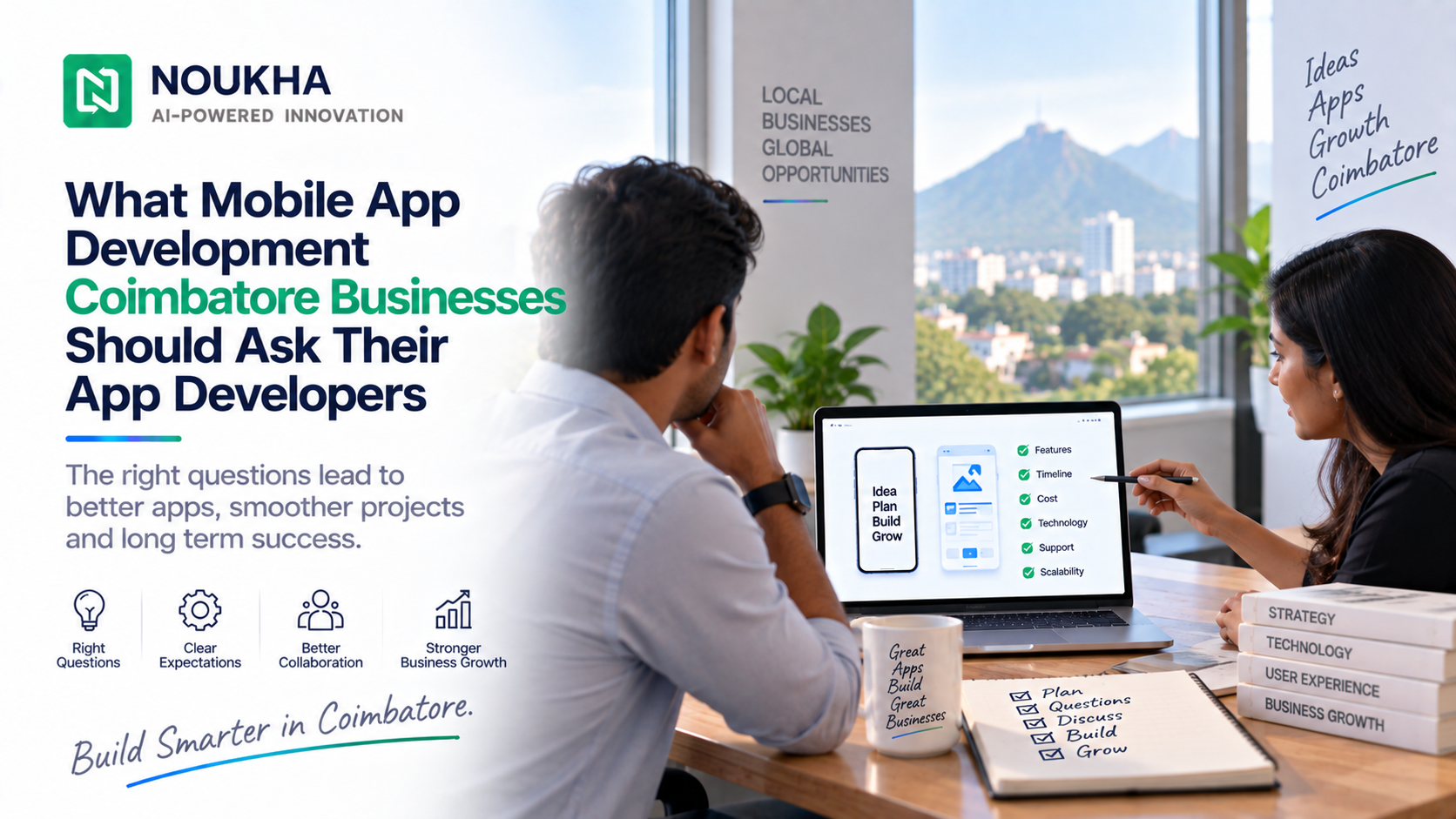
Coimbatore has an active technology and manufacturing ecosystem, and that has given local businesses a growing number of app development teams to choose from. For a business owner who is not a technical expert, this can still make the hiring process confusing. Every agency claims to build fast, scalable, and secure apps, but the real difference shows up only after the project starts. Before you sign a contract for mobile app development Coimbatore, it helps to know exactly what questions separate a dependable partner from one that will leave you with a half-finished product and a drained budget. This guide walks through the questions worth asking, why they matter, and what kind of answers should raise concern.
Why the Right Questions Matter Before You Commit
An app is not a one-time purchase. It is a product that needs planning, testing, updates, and ongoing maintenance long after the first version goes live. Many businesses focus only on cost and delivery date during early conversations, then discover later that the team had no clear plan for scaling, security, or support. Asking the right questions early gives you a realistic picture of how the developer works, how they communicate, and how they handle problems when things do not go as planned. It also shows you whether the team understands your industry, your users, and the outcome you actually want from the app, rather than just the features on a checklist.
Questions About the Development Process
How do you approach discovery and planning?
A capable team will not jump straight into coding. Ask how they gather requirements, map user journeys, and validate the idea before writing a single line of code. A short discovery phase that includes wireframes, a feature list, and a rough technical plan tells you the developer is thinking about the product as a whole, not just ticking off a task list.
What is your typical delivery timeline, and how do you handle delays?
Every project faces some delay at some point, whether from scope changes, third-party integrations, or app store review. What matters is how the developer communicates it. Ask for a sample project timeline and find out how often you will receive updates. A team that gives vague answers about delivery dates or refuses to break the project into milestones is a risk worth avoiding.
Native, cross-platform, or hybrid: which approach is right for your app?
This question needs a more careful answer than many businesses expect. Native development, meaning Native Android app development Coimbatore built with Kotlin and Android APIs, or native iOS built with Swift and Apple frameworks, can be the better choice when your app relies on advanced platform-specific features, demanding graphics, unusual hardware integration, or maximum control over platform behavior. But a well-engineered cross-platform app built with Flutter or React Native can perform very well for many everyday business applications, and it can reduce duplicated effort and cost since one codebase serves both platforms. Cross-platform is not automatically the same as a lightweight hybrid app, and native is not automatically faster or smoother. It is worth remembering that the backend, the admin dashboard, and any web portal connected to the app are usually built with separate technologies and carry their own cost, so ask the developer to price these components clearly rather than bundling everything under one number. Ask the developer to compare native and cross-platform options against your specific users, feature set, performance needs, in-house team skills, budget, and long-term maintenance plan, rather than accepting a one-size-fits-all recommendation. Cross-platform apps still need platform-specific testing and, in many cases, occasional native code for certain features.
Questions About Technical Depth and Quality
How do you test the app before release?
Testing is often the first thing cut when a project runs behind schedule, and that is exactly when bugs slip through to real users. Ask whether the team does manual testing, automated testing, or both, and whether they test across different device sizes and operating system versions. A good answer will mention specific stages such as functional testing, performance testing, and user acceptance testing before launch.
How do you handle data security and user privacy?
Any app that collects user data, whether it is a login, a payment detail, or a location, carries a responsibility to protect that information. Security is broader than encryption and login screens, and a developer should be able to speak to specifics rather than general reassurance. Ask the team to walk you through their approach to each of the following, since a proposal that skips most of these is worth questioning further:
- Data classification and minimization, meaning the app collects only what it genuinely needs
- Encryption for data in transit and at rest
- Secure password hashing along with session and token expiry rules
- Multi-factor or step-up authentication where the risk level justifies it
- Role-based access control for admin and backend users
- Secure storage and management of API keys and other secrets
- Input validation and protection against common API vulnerabilities
- Regular dependency and vulnerability scanning
- Logging, monitoring, and an incident response process
- Backups, tested restoration, and clear retention and deletion policies
- Penetration testing or an independent security review for higher-risk apps
- A defined process for applying security patches after launch
An app is not automatically secure simply because it uses HTTPS, a recognized cloud provider, or a service such as Firebase. Those choices are a starting point, not proof of a complete security program, so it is fair to ask what specific controls the team applies on top of them.
How will the app meet India’s data protection requirements?
India’s Digital Personal Data Protection Act, 2023 became fully operational once the Digital Personal Data Protection Rules, 2025 were notified in mid-November 2025, and the framework is coming into force in phases rather than all at once. Because the rollout is staggered, an app should not be described as already meeting every obligation in full, and a developer should be able to explain where the project currently stands rather than offering a blanket compliance claim. Useful questions to raise with your developer include:
- Who is the data fiduciary and who acts as the data processor for this app?
- What personal data is collected, and why is each item necessary?
- How is user notice and consent handled where it is required?
- Can users withdraw consent or exercise their applicable data rights?
- Where are the app’s data and backups hosted?
- How are third-party SDKs and vendors controlled and reviewed?
- How long is user data retained, and what triggers deletion?
- What is the breach notification and incident response process?
Sector-specific rules can add further obligations on top of this. Healthcare, fintech, payments, education, and apps aimed at children often carry additional requirements. Labels such as GDPR-compliant, RBI-compliant, or HIPAA-aligned should never be accepted at face value. Ask for the precise scope of the claim and the documented controls that support it.
What is your approach to performance and scalability?
An app that works fine with a hundred users can behave very differently with ten thousand. If a developer promises the architecture will support significant growth, that claim should be backed by assumptions and, ideally, test results rather than a marketing phrase. Reasonable questions to ask include:
- What daily and concurrent user numbers is the architecture designed for?
- What peak request volume and transaction load can it handle?
- How is database and storage growth planned for over time?
- What are the target response times and availability goals?
- Does the system use autoscaling and rate limiting, and how are they configured?
- Have load tests been run, or is one planned before launch?
- What would estimated cloud costs look like at different usage levels?
- Is there a rollback and disaster recovery plan if something fails after release?
If a proposal includes a specific scalability figure, ask what assumptions sit behind that number and how it will be verified before your app goes live with real users.
Questions About Team Structure and Communication
Who will actually be working on your project? Some agencies present senior talent during the sales pitch and then assign the real work to a different, less experienced team. Ask directly who your point of contact will be, what communication channels they use, and how frequently you can expect progress updates. It also helps to ask whether the team works in-house or outsources parts of the build, since that affects accountability if something goes wrong.
- Who is the dedicated project manager or lead developer for my app?
- What communication channels will be used, and how often will I receive progress updates?
- Can I speak directly with the developers if needed, not just a sales representative?
- What happens to my project if a key team member leaves mid-project?
Questions About Cost, Ownership, and Support
What is included in the quoted price?
A low quote can look attractive until you discover that testing, design revisions, or app store submission were never part of the package. Ask for a breakdown that separates design, development, testing, deployment, and any third-party service costs such as maps, payment gateways, or push notification tools.
Who owns the source code and design files?
This is a question many business owners forget to ask, and it can create serious problems later. Make sure the contract clearly states that you own the final source code, design assets, and any related documentation once the project is paid for and completed. Without this in writing, switching developers later can become far more expensive than it should be.
What does post-launch support cover, and is store maintenance included?
Launching the app is only the beginning. Operating systems update, app store policies change, and bugs surface once real users start interacting with the product. Store requirements also shift on a fixed schedule. As one current example, Google requires new Android apps and updates submitted to Google Play to target Android 16, API level 36 or higher, starting August 31, 2026, and existing apps generally need to target Android 15, API level 35 or higher to stay available to new users on newer Android versions. Requirements like this recur every year, so ask directly who is responsible for keeping the app aligned with Google Play and Apple App Store SDK, privacy, permission, and billing requirements, and whether that work is included in your support fee.
It is also worth being precise about app store submission itself. A developer can prepare and submit an app, but neither a developer nor an agency can guarantee that Google or Apple will approve it, since approval depends on the app itself, its metadata, privacy disclosures, permissions, content, account standing, and the platform’s current review rules. Confirm whether the quote covers store account setup, listing assets, privacy disclosures, the submission itself, responses to reviewer questions, and any resubmission work, and treat a promise of guaranteed approval as a warning sign rather than a reassurance.
Red Flags to Watch Out For During Discussions
Certain patterns in early conversations tend to predict trouble down the line. Watch out for vague answers about pricing, unwillingness to share past client references, pressure to sign quickly, or promises of an unrealistically fast turnaround for a complex app. A trustworthy team will be upfront about what is achievable within your budget and timeline, even if that answer is not what you were hoping to hear.
- No clear contract covering scope, cost, and ownership
- Reluctance to share a portfolio of completed apps
- Overpromising features that seem too advanced for the stated budget
- No mention of testing, security, data protection, or post-launch support
A team that cannot explain its post-launch responsibilities in plain terms creates avoidable operational risk for your business, since unresolved bugs and missed store deadlines become your problem once the app is live.
Why Working With a Local Team Can Be an Advantage
A Coimbatore-based team can make in-person meetings, site visits, and local-hours communication considerably easier, which is one practical reason businesses consider App developers in Coimbatore over a distant outsourced team. That said, a local address on its own does not prove expertise in UPI and other regional payment systems, Tamil-language interfaces, local logistics, ERP integration, or regional consumer behavior. Regional expertise is worth verifying directly through relevant case studies, client references, live demos, and specific experience with the payment, language, ERP, or operational requirements your particular app needs.
A Quick Checklist Before You Sign the Contract
- Discovery and planning process is explained clearly
- Native versus cross-platform choice is justified against your app’s actual needs
- Testing stages are documented, not just mentioned in passing
- Data security controls are specific, not limited to a general reassurance
- Data protection and consent handling questions have clear, current answers
- Scalability claims are backed by assumptions or test results, not a slogan
- Team structure and communication channels are confirmed in writing
- Full cost breakdown is provided, with no hidden add-ons
- Source code and design ownership is stated in the contract
- Post-launch support terms, store maintenance, and pricing are agreed upon upfront
Final Thoughts
Choosing an app development partner is less about finding the cheapest quote and more about finding a team that can explain their process clearly, stand behind their work after launch, and communicate honestly when challenges come up. The questions above are not meant to make the hiring process feel like an interrogation. They are meant to protect your budget, your timeline, and the long-term success of your app. A team that welcomes these questions and answers them with specifics is usually the one worth trusting with your project.
If you are planning a new app or want a second opinion on an existing project, reach out to our team of App developers in Coimbatore and contact us today to discuss your requirements, timeline, and budget in detail.