
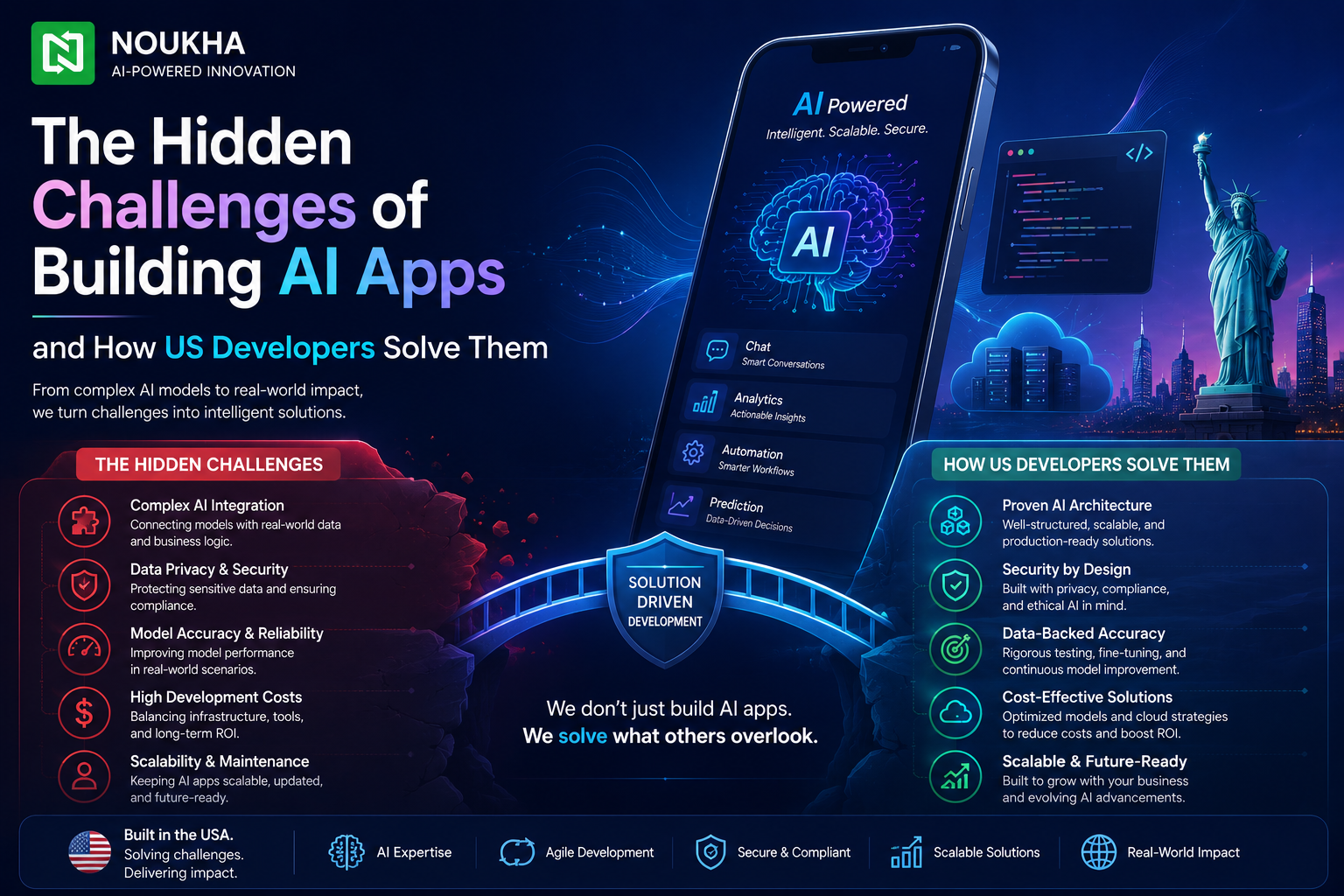
Building an AI solution has never been easier to demonstrate, yet turning that prototype into a reliable product can be far more challenging. A working concept can go from an idea to an impressive demo in a weekend, but the real engineering effort begins when it needs to handle real users, real-world data, security requirements, and sustainable operating costs. This is where experienced AI app developers in USA bring significant value, helping businesses move beyond prototypes and build reliable AI applications ready for production. This article explores the challenges that often emerge during this transition and the practical approaches teams are using to solve them in 2026.
Why Building an AI App Is Harder Than It Looks
The Gap Between a Demo and a Production Ready App
A chatbot that answers a handful of test questions correctly is not the same as a system that holds up against thousands of unpredictable user inputs, edge cases and adversarial prompts. Production readiness means handling malformed requests, rate limits, partial failures, inconsistent data and users who phrase the same question ten different ways, none of which show up in a quick internal demo.
Rising Investment, Uneven Returns
Enterprise spending on AI has climbed sharply, yet the return on that spending has not kept pace for many organizations. A widely cited 2026 enterprise adoption survey found that nearly four in five companies still run into significant challenges scaling AI beyond individual productivity gains, and fewer than a third report meaningful measurable return from generative AI initiatives so far. The pattern is consistent across industries: budgets are rarely the bottleneck, execution is.
Hidden Challenge 1: Hallucinations and Unreliable Outputs
Why Language Models Still Get Facts Wrong
Large language models generate the statistically likely next word, not a verified fact, which means confident sounding but incorrect answers remain a real risk even in the most capable current models. Independent research places hallucination rates in production generative AI systems somewhere between five and thirty percent depending on the domain, the model and how tightly the system constrains its outputs, a spread wide enough to be the difference between a helpful assistant and a liability in fields like healthcare, legal or financial services.
How Developers Reduce Hallucination Risk
The most effective mitigation is grounding the model in verified data rather than trusting its parametric memory alone, typically through retrieval augmented generation that pulls relevant facts from a trusted source before the model responds. Combining this with structured output validation, confidence scoring, human review for high stakes decisions, and an ongoing evaluation suite that tests against known correct answers gives teams a repeatable way to measure and reduce error rates rather than guessing at them.
Hidden Challenge 2: Unpredictable Infrastructure and Inference Costs
Budget Overruns Are the Norm, Not the Exception
More than half of enterprises report that their AI infrastructure costs exceeded original estimates by forty percent or more, usually because teams underestimate compute requirements for both training and, more commonly, ongoing inference at scale. A feature that costs a few cents per query in testing can become expensive quickly once it is handling millions of real user requests a month.
Cost Control Strategies That Actually Work
Inference pricing across the industry has fallen substantially over the past few years, which has made production grade AI genuinely affordable for mid sized companies rather than only the largest enterprises. Teams keep costs predictable by routing simple queries to smaller, cheaper models and reserving frontier models for genuinely complex requests, caching repeated queries, batching where latency allows, and monitoring cost per request as a first class engineering metric rather than an afterthought discovered on the monthly cloud bill.
Hidden Challenge 3: Data Quality, Privacy and Governance
Inconsistent Data Undermines Even Good Models
A model is only as reliable as the data it retrieves or was trained on, and most organizations underestimate how inconsistent their internal data actually is until an AI system starts surfacing the gaps. Two systems that both label a field customer status might mean entirely different things, and a model that blends both without lineage tracking will produce answers that sound plausible and are simply wrong.
Navigating a Patchwork of State Regulations
This has become its own engineering and legal challenge for teams building in the United States. There is still no single federal AI statute, so binding obligations sit mostly at the state level. Texas has a broad disclosure and discrimination law already in force, California has layered several AI specific rules covering transparency and automated decision technology, and Colorado has a narrower automated decision making framework scheduled to take effect from January 2027. For companies operating across state lines, this means compliance requirements can differ meaningfully depending on where a user is located, which is a major reason many businesses work with an experienced AI app development partner rather than trying to track every jurisdiction internally.
Hidden Challenge 4: Moving From Pilot to Production
Why Most AI Pilots Stall
A working pilot with a handful of internal users proves very little about how a system behaves at scale, under real latency constraints, with messy production data and genuine user intent rather than curated test cases. Many organizations get an encouraging pilot result and then struggle for months trying to translate that into a system reliable enough to put in front of paying customers.
Building for Monitoring, Drift and Continuous Evaluation
Unlike traditional software, an AI feature can quietly degrade even when no code changes, since model behavior shifts with updates from the provider, changes in user behavior, or drift in the underlying data. Production ready teams build automated evaluation pipelines that run continuously, track accuracy and cost over time, and flag regressions before users notice them, rather than relying on manual spot checks.
Hidden Challenge 5: Security and Unapproved AI Tool Sprawl
As AI agents get embedded deeper into internal workflows, security risk grows alongside capability. Recent enterprise survey data shows a significant share of executives believe their organization has already experienced a data exposure incident tied to an unapproved AI tool employees adopted on their own. Building AI features properly now includes access controls, audit logging of what data a model or agent touched, and clear policies on which tools are sanctioned for use with sensitive information, treated as core requirements rather than optional add ons.
Agentic systems raise the stakes further, since an agent that can take actions rather than only generate text needs guardrails around what it is actually permitted to do. Nearly every executive surveyed in a recent 2026 industry report said their company had deployed AI agents in the past year, yet governance frameworks for what those agents can access, modify or trigger have often lagged well behind the pace of deployment. Scoped permissions, approval steps for consequential actions, and clear rollback paths are becoming standard practice for any agent that touches production data or customer facing systems.
Why Businesses Choose AI App Developers in USA
Hiring engineers who genuinely understand both traditional software architecture and the newer discipline of applied machine learning remains difficult, and the skill set is different enough from conventional web or mobile development that many in-house teams underestimate the ramp-up time involved. Frameworks for retrieval, orchestration and evaluation are also evolving quickly, which means a stack chosen a year ago may already need revisiting. This is a large part of why many companies choose to bring in a specialist AI app development team in the USA for the initial build, even when they plan to maintain the product internally afterward, since the early architectural decisions are the ones that are most expensive to unwind later.
How Experienced Teams Solve These Problems in Practice
The common thread across every challenge above is that none of them are solved by a better prompt or a bigger model alone. They require proper system design: retrieval pipelines built on clean, well governed data, cost aware architecture from day one, continuous evaluation instead of one time testing, and compliance built into the product rather than bolted on afterward. Teams that treat an AI feature as a full software engineering discipline, not a novelty layer on top of an existing app, are consistently the ones who make it past the pilot stage and keep it running reliably in production.
Conclusion
The challenges behind a working AI application rarely show up in a demo, and that is exactly why they catch so many teams off guard. Hallucinations, unpredictable costs, messy data, a fragmented regulatory landscape and the jump from pilot to production are all solvable problems, but only with the right architecture and process behind them from the start. Getting this right the first time saves months of rework later.
If you are planning an AI feature or product and want it built to hold up in production, not just in a demo, contact us and our team can walk you through the right approach for your use case.