Why the Rules of AI App Development Are Changing
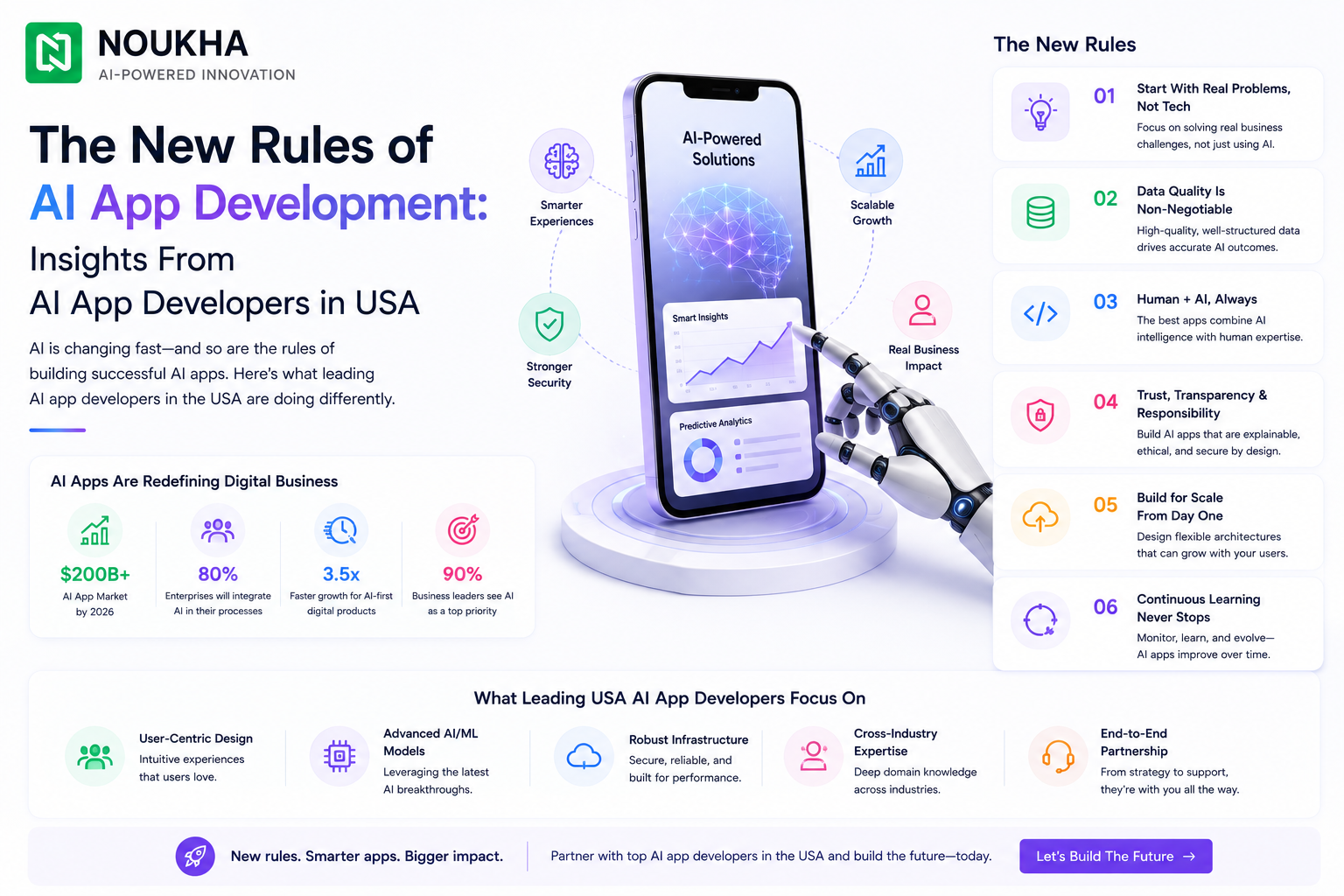
Conversations with AI App Developers in USA who work across healthcare, fintech and retail point to a consistent pattern in how AI apps are now built. For many AI applications, model capability is no longer the only major bottleneck. The harder challenges increasingly include compliance, evaluation, data governance and cost control, and the rules governing how these products get designed, tested and shipped have quietly changed. This article looks at what has actually shifted, based on how experienced teams are approaching AI app development today rather than on predictions about what might happen next.
Rule One: Compliance Is Built Into the Architecture, Not Bolted on Afterward
A state-by-state patchwork changes what “compliant” means
The United States does not currently have a single comprehensive federal AI law covering all AI systems and use cases. Instead, businesses may need to consider existing federal laws, agency requirements and state-level AI legislation, depending on their sector and how the AI system is used. California has introduced several AI-related laws with requirements covering areas such as frontier AI risk management, including SB 53’s risk-mitigation obligations for large-scale model developers, along with chatbot disclosures and rules on AI-generated content. Which rules apply depends on the type of AI system, the organisation involved and the use case. Colorado has also taken a sector-wide approach to regulating certain high-risk uses of AI, particularly automated decision-making systems that materially affect consequential outcomes, and its own framework has already been revised once since it was first introduced. Developers serving US customers need to track both current requirements and changes to state legislation, since the compliance picture for a single product can differ based on factors such as where it is offered, the organisation’s activities, the data involved and the use case.
What this means for apps that support consequential decisions
Not every AI app carries the same regulatory weight. AI applications used in areas such as employment, credit, healthcare, housing and insurance may face additional legal, regulatory or risk-management requirements depending on the specific use case and applicable jurisdiction. Where that applies, developers are building disclosure screens, audit logs and human review checkpoints into the product from the first sprint, rather than treating them as legal add-ons before launch. Apps outside these categories generally face lighter obligations, though transparency expectations around AI-generated content are becoming more common across the board.
Federal proposals are still evolving, not yet binding
Federal legislative and regulatory proposals in this space continue to evolve, so teams building for the US market should distinguish clearly between proposals under discussion and requirements that are already legally binding. Treating a draft bill as a compliance requirement, or ignoring one because it has not passed yet, can both lead to costly rework later.
Rule Two: Agentic Workflows Are Replacing Single-Purpose Chat Features
From answering questions to completing tasks
A basic chatbot that answers questions is no longer considered a differentiated feature. Many teams are now experimenting with agent-style workflows where the AI plans a sequence of steps, calls internal tools or APIs and carries a task through to completion, such as drafting a report, updating a record or scheduling a follow-up action. This is still an area of active experimentation rather than a settled standard; scaled, fully autonomous production use remains limited compared to how widely the idea is discussed.
Where human oversight still matters
Multi-agent and tool-calling systems introduce failure modes that a single-turn chatbot never had, since one wrong step can cascade into the next action. A practical approach for higher-risk agentic workflows is to keep a human approval step for anything irreversible, such as sending an email, processing a payment or modifying a customer record, while allowing the agent to handle lower-stakes, reversible tasks independently.
Rule Three: Evaluation Pipelines Get as Much Attention as Model Selection
Continuous testing against real usage data
Picking a capable model is now the easy part. The harder work is building an evaluation pipeline that tests the app against realistic prompts, edge cases and past user interactions before every release, not just once during initial development. Teams are increasingly maintaining their own evaluation datasets built from real support tickets, sample queries and known failure cases specific to their product, rather than relying only on generic benchmark scores. This direction also reflects the broader intent of NIST’s AI Risk Management Framework, which treats governance, measurement and risk management as activities that span the entire AI lifecycle rather than a one-time check before launch.
Catching drift and hallucination before users do
Model providers periodically update their systems, and an app that scored well on one version can behave differently on the next. Developers are addressing this by running automated regression checks whenever an underlying model changes, and by adding retrieval, citation or verification steps for use cases where an incorrect answer carries real cost, such as financial or medical information.
A national framework for structuring AI evaluations
In August 2026, NIST released an initial public draft of a new evaluation framework, referred to as TEVV-Athlon, and opened it for public comment. Rather than prescribing a single set of tests every AI system must pass, it gives organisations a structured, four-stage method for designing their own evaluations, applicable to large language models, agentic systems and multimodal models. Since it is still a draft under review, teams should treat it as an emerging point of reference rather than a finalised standard for now.
Human review is shifting toward a quality-assurance function
One scalable approach is to sample a percentage of live interactions on a rolling basis, flag low-confidence responses automatically, and route only the borderline cases to a human reviewer. This keeps quality oversight in place without needing a person to check every interaction as usage grows.
Rule Four: Data Governance Decides Whether an App Can Scale
Provenance, consent and the questions clients now ask upfront
Clients are asking more detailed questions before a project starts: where does training and reference data come from, who has access to it, and how is user data used once the app is live. Development teams that can answer these questions clearly, and that establish data lineage tracking early rather than treating it as documentation written after launch, can make enterprise security and procurement discussions considerably easier.
Avoiding lock-in with a single model provider
Many teams now design an abstraction layer between the app and the underlying model provider, so that switching between providers or model versions does not require rebuilding core application logic. An abstraction layer can reduce migration effort, although differences in model capabilities, APIs, context limits and output behaviour can still make provider changes technically significant. This has become a practical response to pricing changes, rate limits and the pace at which model providers release new versions, rather than a purely theoretical best practice.
Data residency questions for regulated industries
For apps handling healthcare, financial or government-related data, some clients now specify where data can be processed and stored, and which sub-processors an AI vendor is allowed to use. Development teams that document this clearly during the proposal stage, rather than after a contract is signed, tend to move through enterprise procurement faster.
Rule Five: Inference Cost Is a Design Decision, Not a Finance Problem
Matching model size to task complexity
Running every request through the largest available model is rarely necessary and adds unnecessary cost at scale. Developers are increasingly routing simple, high-volume tasks such as classification or short summarization to smaller, cheaper models, while reserving the most capable models for complex reasoning tasks that actually need them.
Choosing between proprietary and open-weight models
Open-weight models can also be attractive where organisations want greater control over deployment and data handling, including the option to host models within their own infrastructure. The choice between a proprietary API and a self-hosted open-weight model is increasingly made per feature within a single app, rather than as one blanket decision for the whole product.
What This Means for Teams Building in the US Market
Together, these shifts point to a simple takeaway: technical skill with large language models is no longer enough on its own. Businesses choosing an AI application development company in the USA today need a team that combines model expertise with compliance awareness, rigorous evaluation practices and a clear-eyed view of infrastructure cost. This is also why businesses are increasingly evaluating AI app developers in the USA based on how they handle governance, testing and long-term maintenance, not only on which models they can integrate into a demo.
Ranking lists that compare company size or client counts rarely answer the question that actually matters before a project starts: how will this team handle a compliance requirement that changes mid-build, or a model update that shifts your app’s behaviour overnight. Asking about evaluation practices, data handling and cost architecture during the first conversation tends to reveal more than a portfolio page does.
Frequently Asked Questions
Has AI app development become more regulated in the US?
There is still no single comprehensive federal AI law covering every AI system and use case. Businesses may need to consider existing federal requirements alongside state-level AI laws and sector-specific regulations, with California and Colorado among the most active states so far.
Do all AI apps need to follow the same compliance rules?
No. Apps that support consequential decisions may face stricter disclosure, risk-management, documentation or human-oversight requirements, depending on the jurisdiction and the specific use case.
Are AI agents ready to replace human review in app workflows?
Not entirely. Agentic features are widely used for lower-stakes, reversible tasks. A cautious production approach is to keep a human approval step for actions that are irreversible or carry financial, legal or safety consequences.
Why does inference cost matter this much in app design?
As usage scales, routing every request through the largest available model becomes expensive without improving results for simple tasks. Matching model size to task complexity keeps an AI app financially sustainable as it grows.
How do I know if my AI app idea needs a compliance-first approach?
If the app makes or materially influences decisions in areas such as employment, credit, healthcare, housing or insurance, the team should assess applicable legal, regulatory and risk-management requirements from the start rather than adding these later.
Conclusion
The rules of AI app development are changing for reasons that go beyond model capability. Regulation, evaluation requirements, user expectations, data governance and the cost of operating AI systems at scale are all becoming important design considerations. Teams that treat compliance, evaluation and cost management as part of the architecture, rather than as afterthoughts, are the ones building AI apps that hold up over time. If you are planning an AI app for the US market and want a team that builds with these rules in mind from day one, contact us to talk through your project.