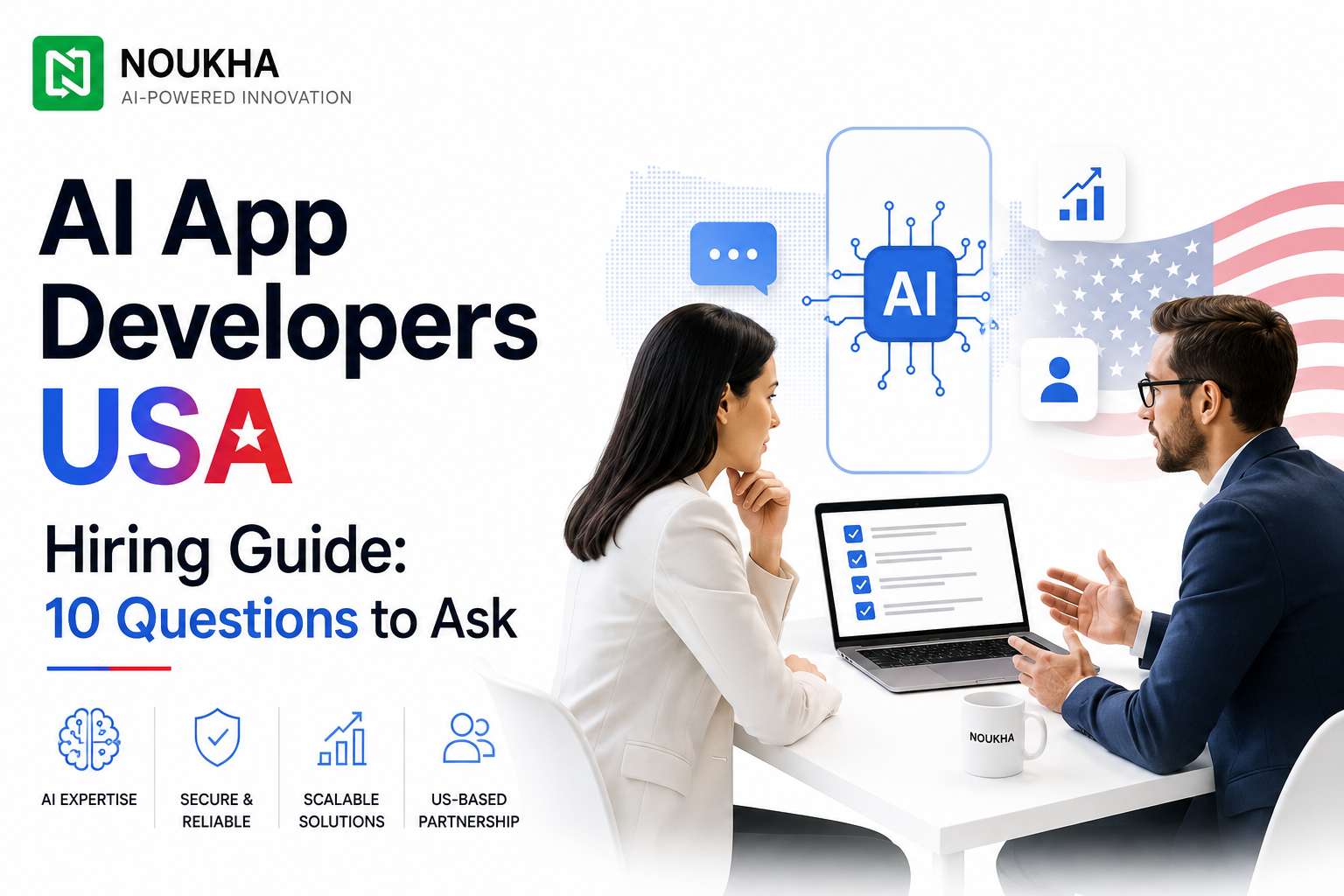
Every development agency in the country now lists AI somewhere on its homepage, which makes the actual hiring decision harder, not easier. Capability ranges from genuinely deep technical teams to a general software shop that added a chatbot integration and rebranded overnight. The only reliable way to tell the difference before signing a contract is to ask specific, pointed questions rather than relying on a polished pitch deck. This guide walks through ten questions worth asking any AI app development companies in the USA that businesses are considering, along with what a strong answer actually sounds like compared to a vague one.
Why Vetting Matters More With AI Than With Regular Software
Hiring mistakes in conventional software projects are usually recoverable. With AI, the cost of picking the wrong partner tends to compound faster, since the problems often surface only after real data and real users enter the picture.
The Failure Rate Behind the Hype
Industry surveys and research suggest that many AI initiatives fail to deliver their intended business value, often because of problems with data, project scope, organizational readiness, and implementation rather than the underlying AI technology itself. That distinction matters here, because most of the questions below are designed to surface exactly those organizational gaps before they become your problem.
Questions About Technical Depth and Experience
The first set of questions separates a team that has shipped working AI systems from one that has mostly built demos.
1. What AI Projects Have You Actually Shipped to Production?
A confident answer includes specifics: the type of system, the industry, roughly how long it has been running, and what changed between the pilot and the production version. A vague answer leans on logos and generic claims about “cutting-edge AI” without naming what the system actually does day-to-day.
2. How Do You Handle Data Quality and Readiness?
AI systems are heavily dependent on the quality, relevance, and consistency of the data they rely on. A team with real experience will ask pointed questions back about your data’s completeness, consistency, and format before committing to a timeline. A team that skips this step and jumps straight to a build estimate is a warning sign worth noting.
3. What Happens When the Model Doesn’t Work as Expected?
Every experienced AI team has had a model underperform at some point. The useful answer describes a specific process, such as how they diagnose the gap, what fallback options exist, and how they communicate a delay to the client. An answer that implies this never happens is not reassuring. It may be a sign that the team has not shipped enough real-world projects to encounter this scenario.
Questions About Ownership, Security, and Compliance
These questions protect you after the contract ends, not just during development.
4. Who Owns the Model, the Code, and the Training Data?
Ownership terms vary by vendor and contract. Some agreements may give the vendor rights to reuse certain components, tooling, or data under defined conditions, so clients should clarify ownership and permitted reuse before signing. Get explicit written confirmation covering the source code, any custom models or fine-tuning artifacts, prompts, embeddings or vector indexes, and both the customer data used and any derived datasets built during the project, rather than assuming standard ownership applies.
5. What Security and Compliance Standards Do You Follow?
When evaluating an AI application development company in the USA, this question should produce a specific, documented answer, not a general assurance. Ask whether the vendor maintains relevant security attestations or certifications, such as SOC 2 or ISO 27001, and whether its processes support applicable requirements such as HIPAA for healthcare data. Ask to see the relevant documentation and clarify exactly what systems and services are covered, since holding a certification does not automatically mean every project or process is compliant.
Questions About How the Engagement Actually Works
Technical skill matters, but so does whether the day-to-day working relationship will actually function for your team.
6. What Does Your Communication and Reporting Process Look Like?
Look for specifics: a defined cadence of updates, dashboards or metrics you will actually see, and a clear escalation path if something goes off track. Teams that answer with “we’re very communicative” but cannot describe an actual reporting rhythm often mean they will communicate reactively rather than proactively.
7. How Do You Handle Scope Changes Mid-Project?
Some scope changes are normal in AI projects because early testing can reveal limitations in the data, model, or workflow. What matters is whether the vendor has a controlled process for evaluating those changes, versus either resisting all changes rigidly or accepting every request without discussing the tradeoffs. Frequent or poorly controlled scope changes, on the other hand, can be a sign of inadequate discovery or planning at the outset.
A Simple Test: Ask for a Recent Example
Rather than accepting a general description of their process, ask for a specific recent example of a scope change and how it was handled. Teams with real experience can usually describe one in detail within seconds. Teams without much experience tend to answer in generalities because they don’t have a concrete story to draw from.
Questions About Long-Term Reliability
An AI system is not a one-time deliverable. It needs attention after launch to keep performing as conditions change.
8. What Happens After Launch: Who Maintains and Retrains the Model?
Model performance can change as real-world data, user behaviour, or underlying models change, so ongoing evaluation and monitoring matter as much as the initial build. The appropriate response may involve retraining, fine-tuning, updating retrieval data, changing prompts, or switching models entirely. Ask specifically who is responsible for this after launch and what it costs, since some AI app developers in the USA treat this as a separate, unbudgeted engagement rather than including it in the original scope.
9. How Do You Measure Success and ROI?
A strong answer ties back to a specific business metric agreed on before the project started, such as reduced processing time, improved conversion, or lower support costs, and describes how that metric is actually tracked. A weak answer focuses only on technical metrics like model accuracy without connecting them to a business outcome you actually care about.
The Question Most People Forget to Ask
Most hiring conversations focus entirely on success stories, which leaves an important blind spot unaddressed.
10. Can You Walk Me Through a Project That Didn’t Go as Planned?
How a team discusses a past failure often reveals more than how they discuss a success. A team willing to walk through what went wrong, why, and what they changed afterward demonstrates the kind of honest process management that tends to produce reliable long-term partnerships. A team that claims every project has gone smoothly may be giving you a highly selective view of its experience, or it may not have taken on enough complex work to encounter meaningful problems.
Putting the Answers Together
No single answer to any of these ten questions should be a dealbreaker on its own. What matters is the overall pattern.
Red Flags Worth Taking Seriously
A few patterns are worth treating seriously regardless of how polished the rest of the pitch is: reluctance to name specific past projects, vague answers about data ownership, an unwillingness to discuss what happens when something goes wrong, pricing that seems disconnected from the scope of work described, or no clear methodology for evaluating AI outputs, including how the team tests for hallucinations, accuracy, latency, safety, and regressions after a model or prompt change. None of these alone proves a vendor is unreliable, but two or three appearing together is a meaningful signal.
Conclusion
Choosing among AI app developers in the USA comes down to asking questions that go past the pitch deck and into how a team actually works, communicates, and handles the moments when things don’t go according to plan. The ten questions here are designed to surface exactly that, whether you’re evaluating a single freelancer or a full agency. If you would like help thinking through your specific project before you start those conversations, contact us and we can walk through what questions matter most for your particular use case.
Frequently Asked Questions
How many AI development vendors should I interview before deciding?
There is no fixed number, but speaking with at least three helps establish a baseline for what a strong answer to these ten questions actually sounds like, since the contrast between vendors is often more revealing than any single conversation alone.
Should I choose a specialized AI vendor or a general software agency that also does AI work?
It depends on the complexity of your project. A team that has shipped multiple AI systems to production, with clear answers about data readiness and model maintenance, generally carries less execution risk than a generalist agency treating AI as one service among many.
Is it normal for AI project costs to change after the project starts?
Some change is common as data reveals what’s actually achievable, but a vendor should have a clear, documented process for evaluating and pricing scope changes rather than open-ended cost creep with no explanation.
What is the biggest red flag when interviewing an AI development company?
Vagueness about past production projects, data ownership, or what happens when a model underperforms are among the clearest warning signs, since these are areas where an experienced team should be able to speak specifically and confidently.
Why does data readiness matter so much when hiring an AI developer?
AI systems depend heavily on the quality, relevance, and accessibility of the data they use, whether that is client data, a pretrained foundation model, retrieval-augmented sources, or structured databases, so a vendor that does not ask detailed questions about your data early in the conversation may be underestimating the actual scope of the work ahead.