A working prototype is easy to be proud of and surprisingly hard to build on. It looks finished in a demo, then falls apart the moment real users, real data volumes, and real edge cases show up. The United States has quietly remained the place where this gap gets closed at the highest stakes and the fastest pace. The country’s technology workforce includes more than 1.7 million software developer jobs on its own, part of a broader tech workforce that already tops 6 million professionals, according to Bureau of Labor Statistics and CompTIA figures, and AI-related work is now one of the fastest-growing parts of that output. For businesses trying to move an AI idea past the demo stage, working with an established AI app development in USA that builds through experienced, senior US-based engineering teams has become one of the more practical paths to getting there.
This article looks at what actually separates a scalable AI product from a polished prototype, why the US development ecosystem has become central to that transition, and what businesses should expect once they commit to scaling.
From Proof of Concept to Production: Why the Gap Is Widening
The distance between a working demo and a production-ready product keeps growing as AI systems get more capable and more complex. A prototype only needs to work once, in a controlled setting, in front of an audience that already wants to believe in it. A production system needs to work reliably, at volume, for users who have no patience for downtime or inconsistent results. Deloitte’s State of AI in the Enterprise 2026 survey found that the share of organizations describing AI as having a transformative effect on their business more than doubled year over year, from 12 percent to 25 percent, even as 84 percent of companies had not yet redesigned jobs or workflows around that capability – a sign that the gap between adopting AI and operationalizing it, not access to the technology itself, is now the defining challenge.
Globally, the underlying AI-in-software market reflects the same shift. IDC projects the worldwide AI-centric software market, covering AI platforms, infrastructure tools, and application development software, to grow from about 64 billion dollars to nearly 251 billion dollars by 2027. That kind of growth does not come from more prototypes. It comes from more products actually reaching users.
What Makes AI App Development in USA Ecosystem Different
The strength of the US position in this shift did not happen overnight, and it rests on a few structural advantages that are worth understanding before choosing where to build.
A Talent Pool Built for Scale
The US produces one of the largest concentrations of software engineering talent in the world, with roughly 1.7 million software developer jobs today and a broader tech workforce that CompTIA projects will grow from about 6.09 million in 2025 to 7.03 million by 2035. Computer and IT occupations are expected to add well over 100,000 openings a year through 2034, and median tech pay runs 127 percent above the national median wage, according to CompTIA’s State of the Tech Workforce 2025 report. That combination of scale and pay power means teams can be assembled quickly around a specific technical need, whether that is computer vision, natural language processing, or workflow automation, without the long hiring cycles common in smaller talent markets.
Engineering Depth Beyond Coding
A growing share of the work happening in the US goes well beyond writing model code. The country holds the highest concentration of AI computing capacity in the world, with hyperscalers collectively investing hundreds of billions of dollars into AI infrastructure through 2024 and 2025; Amazon’s capital expenditures exceeded 83 billion dollars in 2024, with a large share directed at AI-focused data centers, while Microsoft pledged roughly 80 billion dollars toward infrastructure in fiscal 2025. That density of compute, research, and capital means engineering teams built in the US are typically working closest to where the underlying models and infrastructure are actually advancing, rather than several layers removed from it.
Investment Without Cutting Corners
Cost is part of the story everywhere in tech, but in the US it shows up as a premium rather than a discount, and that premium buys something specific. AI-specialized software engineers earn roughly 14 percent more than non-AI senior engineers at the same level, a gap that reflects how much scarcer and more mature this particular skill set is domestically. What matters more for scalability is that this cost comes paired with engineering practices built around production-grade AI from the outset, rather than the retrofit that many teams have to do once a prototype outgrows its original assumptions.
Turning a Working Prototype Into a Scalable Product
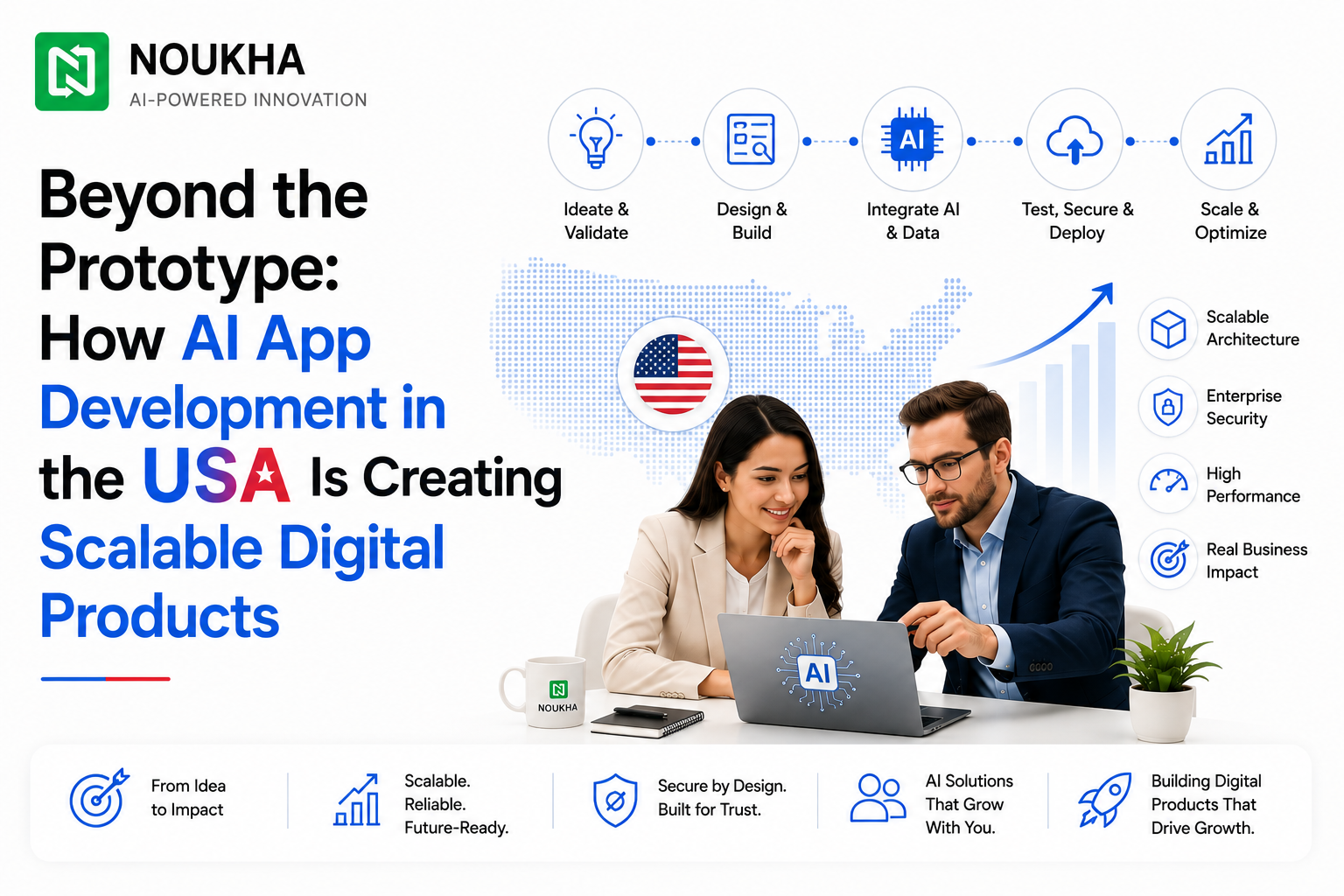
Moving from prototype to product is rarely about adding more features. It is about rebuilding the parts of the system that were never meant to survive real usage. Businesses that work with an experienced AI application development team in the USA typically go through a structured transition rather than a single big rewrite, addressing architecture, data handling, and reliability in stages rather than all at once.
Architecture Decisions That Support Growth
A prototype is usually built around whatever gets a demo working fastest, often with a single database, minimal error handling, and no real separation between components. Scaling a product means revisiting those choices: splitting monolithic code into services that can grow independently, introducing proper caching and queuing, and designing the system so that a spike in usage in one area does not take down the entire application.
Testing and Reliability at Production Scale
AI systems introduce a layer of unpredictability that traditional software does not have, since model outputs can vary even when inputs look similar. Scalable products account for this by building evaluation pipelines that continuously test model behavior against real-world scenarios, not just the curated examples used during the original prototype demo. Monitoring, logging, and fallback behavior for when a model gives a low-confidence or unexpected response all become standard parts of the build, rather than optional extras added after something breaks in production. Version control for models and prompts matters just as much here, since a small change upstream can quietly shift behavior across an entire product if it is not tracked and tested the same way application code is.
Industries Where This Shift Is Already Visible
The move from prototype to scalable product is already playing out across several sectors. E-commerce platforms use AI for personalized recommendations, dynamic pricing, and fraud detection at a scale that would be impossible to manage manually. Financial services firms are automating document processing and compliance checks that once required large manual review teams. Healthcare providers are piloting AI-assisted diagnostics and administrative automation, while agricultural technology companies are applying predictive analytics to crop health and yield forecasting. Each of these use cases started as a narrow prototype and only became valuable once it was rebuilt to handle real volume and real variability.
The scale of investment behind this shift is significant. The broader artificial intelligence software market, spanning customer engagement tools, predictive analytics, and platform infrastructure, is projected to grow from roughly 46 billion dollars globally in 2026 to more than 60 billion dollars by 2027. The US AI market alone is estimated at 83.2 billion dollars in 2026, about 16 percent of global AI spending, according to IDC’s Worldwide AI Spending Guide, up from a market that barely existed in this form just a few years earlier. That pace of growth reflects genuine product demand rather than short-term experimentation, since spending at that scale only comes from systems that businesses are actually paying to keep running.
How Domestic AI Engineering Investment Is Changing the Equation
One of the more significant shifts in recent years has been how much weight enterprises are putting behind in-house AI capability rather than treating it as a side initiative. Senior AI and ML engineers at top US companies now routinely command total compensation between 400,000 and 800,000 dollars, and that willingness to pay reflects a broader lesson from the market: MIT and NBER research found that 95 percent of generative AI pilots deliver no measurable impact on the bottom line, which has pushed many companies to invest in experienced execution rather than more experimentation. Businesses that want access to that caliber of engineering without building an entire internal team from scratch often turn to an established USA-focused AI application development partner that already has the infrastructure, processes, and senior engineering talent in place.
What to Expect When Scaling AI Products Built in the US
Businesses moving through this transition should expect a longer initial engagement than a typical prototype sprint, since scalability work involves data architecture, security review, and infrastructure planning that a demo never required. It is also reasonable to expect more structured communication, including regular checkpoints and shared visibility into testing results, since production readiness depends on catching problems before launch rather than after. Because both teams sit within the same country and often the same one or two time zones, real-time collaboration tends to be the default rather than something to engineer around, and rising expectations around data residency and sovereign AI compound that advantage: 83 percent of enterprises now view sovereign AI as at least moderately important to strategic planning, and 77 percent factor a solution’s country of origin into vendor selection, according to Deloitte’s 2026 State of AI in the Enterprise survey. Teams that manage this well tend to treat the prototype as a starting reference rather than a finished blueprint, rebuilding the parts that need it while preserving the product decisions that already proved out with real users.
Bringing It All Together
The gap between an impressive AI demo and a product that customers can depend on is where most AI initiatives quietly stall – the finding that 95 percent of generative AI pilots deliver no measurable financial impact is a blunt reminder of how real that stall point is. Closing that gap takes engineering depth, disciplined testing, and infrastructure planning that most prototypes were never built to need. The US technology ecosystem, with its scale of talent, its concentration of AI compute and capital, and its growing base of dedicated in-house AI teams, has positioned itself as one of the most reliable places to make that transition happen.
If you are ready to take your AI prototype toward a product that can handle real users and real scale, our team would be glad to help you plan the next step. Contact us to talk through your goals and see how a well-built AI application can grow with your business.