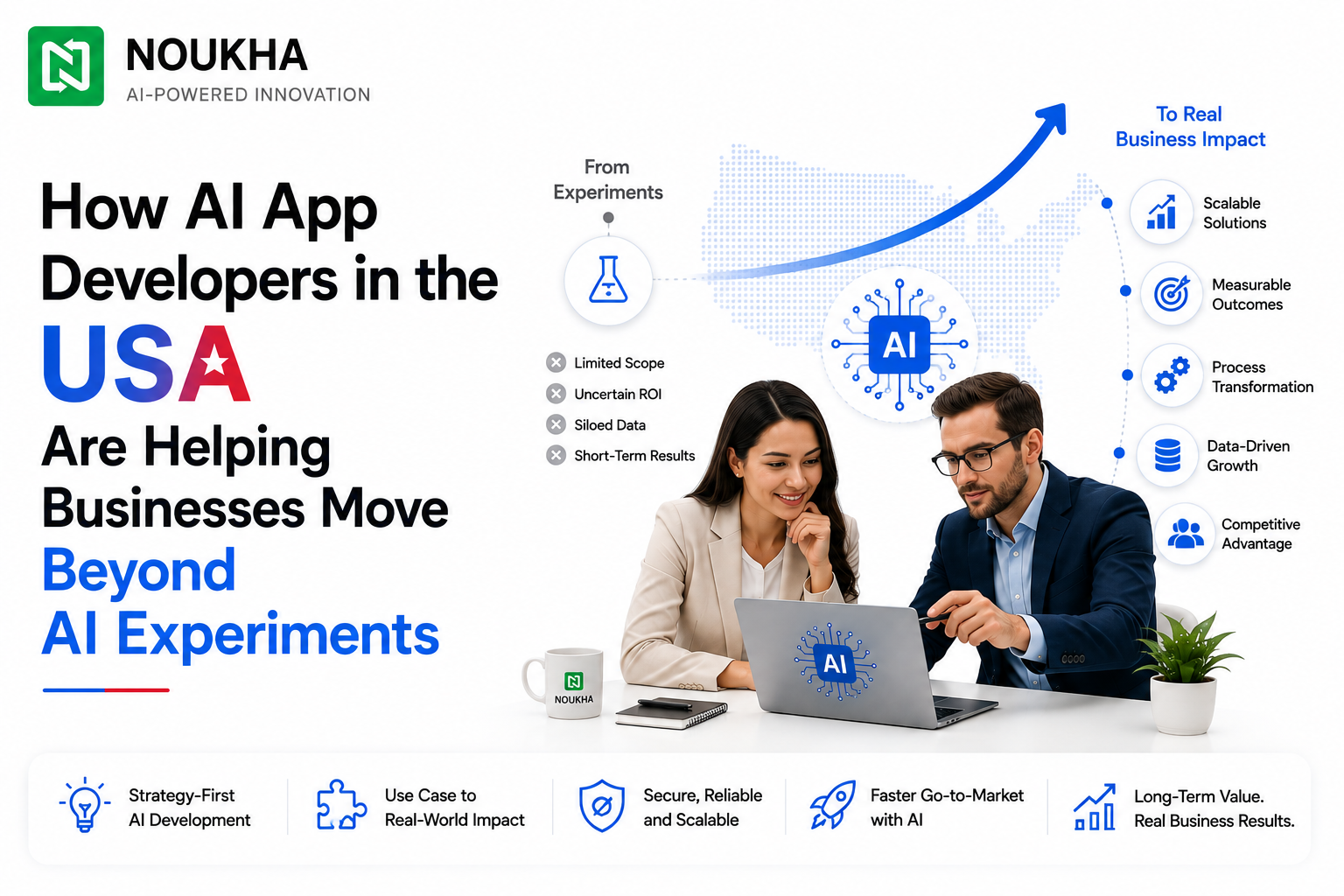
Generative AI use has become close to universal among American companies, with surveys putting adoption at roughly 95 percent of U.S. businesses in some capacity, a pace of uptake Bain has described as faster than the early rollout of cloud computing or mobile. Yet more careful measures tell a different story. The Federal Reserve Board’s own FEDS Notes research found that only about 18 percent of U.S. firms had actually adopted AI by the end of 2025, and McKinsey’s 2025 State of AI survey noted that nearly two thirds of organizations using AI in at least one function have not yet begun scaling it across the enterprise. That gap between trying AI and running on AI is exactly where AI app developers in USA teams are proving their worth, turning scattered pilots into applications that actually hold up in daily production use.
This article looks at why so many AI initiatives in the United States stall after the pilot stage, what separates companies that successfully scale AI from those that do not, and how the right development partner can move a business from experimenting with AI to running on it.
The State of AI Adoption in the United States
The headline adoption numbers can be misleading if read on their own. Depending on how the question is asked and who is surveyed, figures for U.S. AI adoption range from under 20 percent, per the Federal Reserve’s firm level data, to the mid 90s, per broader surveys that count any use of a generative AI tool. Stanford HAI’s 2026 AI Index places U.S. population level generative AI adoption at 28.3 percent, which actually ranks the country behind smaller markets such as Singapore and the United Arab Emirates on a per capita basis, even though the United States remains the largest single source of AI investment in the world.
That investment gap is real and sizable. Stanford HAI’s 2026 report found that private AI investment reached 344.7 billion dollars globally in 2025, an increase of about 127.5 percent from 2024, with U.S. investment alone reaching 285.9 billion dollars, more than twenty times the amount invested by the next highest country. Enterprise spending on generative AI specifically grew from roughly 11.5 billion dollars in 2024 to about 37 billion dollars in 2025, a jump industry analysts describe as one of the fastest scaling software categories on record. What this tells us is that capital and enthusiasm are not the bottleneck. The bottleneck is turning that spending into applications people actually rely on.
Why So Many AI Projects Stall Before They Scale
Gartner has forecast that 40 percent of enterprise applications will be integrated with task specific AI agents by the end of 2026, up from less than 5 percent in 2025, which signals real momentum. But moving from a demo to a working application inside a real business is a different challenge than building the demo itself. Many internal AI projects are built by teams experimenting with off the shelf tools or no code platforms, and those tools are genuinely useful for testing an idea. The trouble comes when a business tries to connect that experiment to its customer data, its existing software stack, its compliance requirements, and its support processes, and discovers that the prototype was never designed to carry that weight.
Common failure points include weak data pipelines that were never built for production volume, missing security and access controls, no clear owner once the pilot needs ongoing maintenance, and user interfaces that were fine for an internal demo but not for paying customers. None of these problems are really about whether the underlying AI model is good enough. They are software engineering and product problems, which is why businesses that treat AI adoption purely as a model selection exercise tend to stall earlier than businesses that treat it as an application development project from the start.
What Sets Businesses That Move Beyond Experiments Apart
Start With a Defined Business Outcome
Companies that successfully scale AI tend to start with a specific, measurable problem rather than a general mandate to use more AI. A support team might target first response time, a sales team might target lead qualification speed, a finance team might target the time it takes to close the books. Framing the work around a number that already matters to the business gives the entire project a benchmark that survives well past the pilot stage.
Build for Integration, Not Isolation
An AI feature that lives in its own separate tool rarely gets used consistently. The applications that stick are the ones built into the software employees and customers already use every day, whether that is a CRM, a support desk, an ERP system, or a mobile app. This is usually where a dedicated development team adds the most value, since integrating AI into existing systems safely requires a different skill set than prototyping a standalone chatbot.
Invest in Data and Governance Early
Data quality and access control issues are still among the most common reasons AI projects fail to reach production. Before scaling anything, it is worth auditing where relevant data actually lives, how consistent it is, and who is accountable for keeping the model’s behavior in line with company policy and applicable regulations. Businesses working with an experienced AI app development company in the USA often shorten this groundwork phase, since teams that have shipped production AI applications before already know which data issues tend to surface only after launch.
How AI App Developers in USA Build for Production, Not Just Pilots
Custom Application Architecture Over Generic Tools
Off the shelf AI assistants and no code builders are useful for testing an idea quickly, but they rarely scale cleanly to a specific business’s workflows, branding, and edge cases. Purpose built applications, designed around how a particular team actually works, tend to hold up better once real users and real data volume arrive. Many businesses find that a specialized US based AI application development team brings this perspective naturally, since wrapping proven AI models in an application designed for the business’s actual requirements, rather than the demo’s requirements, is what production work is built around.
Testing, Security, and Compliance From Day One
Production applications need testing, monitoring, and access controls that most quick prototypes skip entirely. This includes validating model outputs against expected behavior, logging decisions for auditability, restricting who can see sensitive data, and building in fallback behavior for the moments when an AI feature produces an unreliable or unexpected result. These steps take longer than building a demo, but they are the difference between a feature customers trust and one that quietly gets disabled after a bad experience.
Post-Launch Support and Iteration
AI applications are not static once they launch. Model behavior can drift as data changes, new edge cases surface once real users start relying on the tool, and business requirements evolve. Teams that plan for ongoing monitoring, retraining, and iteration after launch tend to see AI features improve over time, while teams that treat launch as the finish line often see performance quietly degrade.
Measuring Success: From Pilot Metrics to Business Metrics
A pilot is often judged by whether the demo worked. A production application needs to be judged by whether it moved a number the business actually cares about, such as reduced handling time, faster response rates, lower error rates, or measurable cost savings. It also helps to track total cost of ownership rather than just the initial build cost, since ongoing hosting, monitoring, human review, and maintenance all factor into whether an AI application is genuinely paying for itself. Separating pilot stage metrics from production stage metrics keeps expectations realistic and makes it far easier to decide which projects deserve a larger budget and which need to be redesigned.
Choosing the Right AI App Development Partner
Because so much of AI success depends on execution rather than the underlying model, the choice of development partner matters as much as the strategy behind the project. Look for a team that can show relevant production work, not just prototypes, along with a clear process for handling data securely, integrating with existing systems, and supporting the application after launch. A transparent conversation about timeline, ownership of the resulting code, and how success will be measured tends to separate partners who can actually deliver from those who can only demo.
Final Thoughts
AI adoption in the United States has reached a point where using the technology is no longer rare. What separates companies pulling ahead is whether they have moved past isolated experiments into applications that hold up under real business conditions. Getting there takes a clear outcome, integration with existing systems, attention to data and governance, and a development partner capable of carrying a project from prototype to production.
If your business is ready to move past isolated AI experiments and build an application that holds up in daily use, our team can help you plan, build, and support the right system for your goals. Contact us to discuss how a custom AI application can move your business from testing ideas to running on them.