Introduction
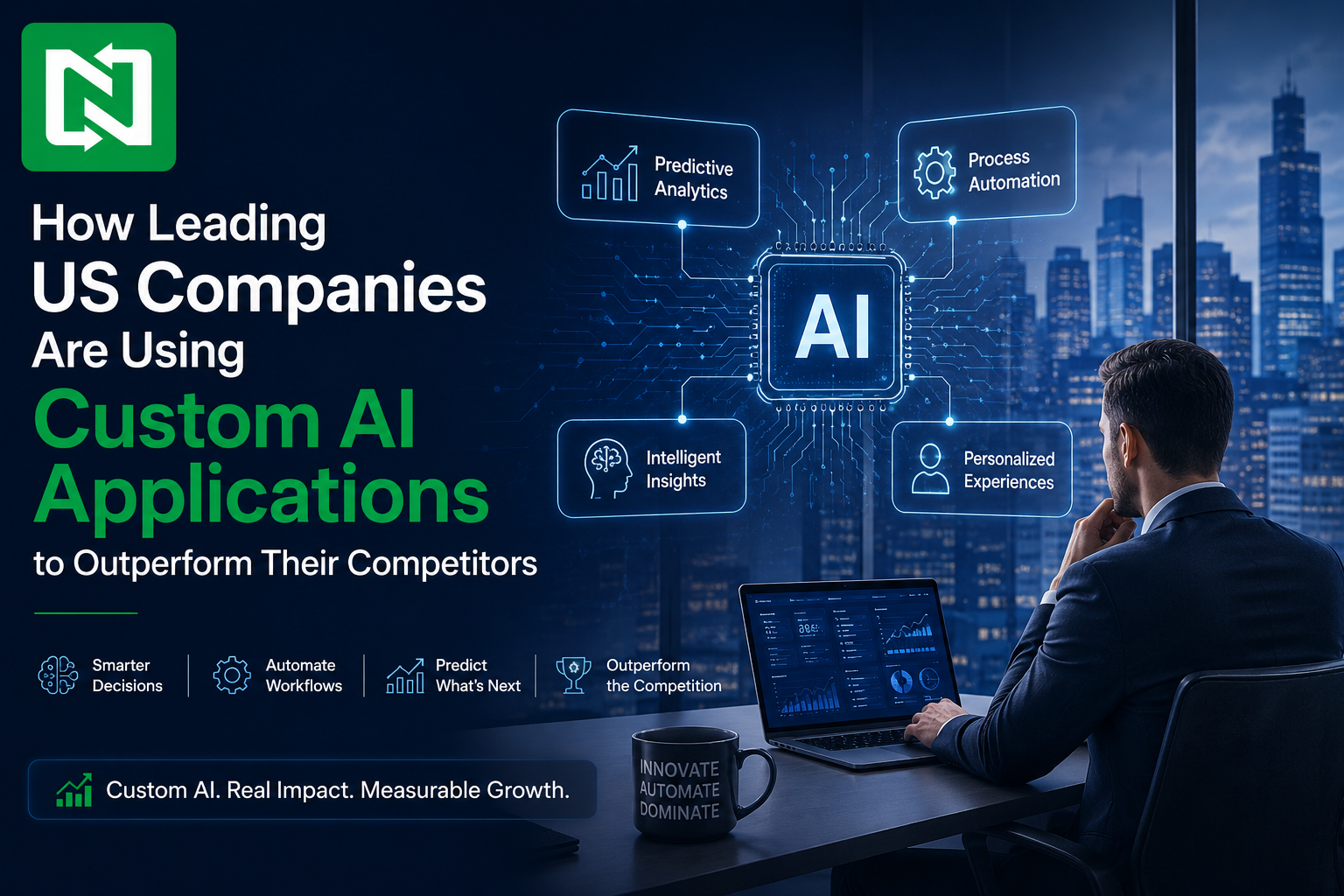
Artificial intelligence has moved well beyond experimentation. What began as pilot projects and proof-of-concept demos has become a core part of business strategy for companies across the United States. Organizations that once used AI for isolated tasks are now embedding it into everyday operations, customer interactions, and decision-making processes.
This shift has changed how companies think about technology partners. Working with an experienced AI Application Development Company has become less about experimenting with new tools and more about building systems that directly support revenue, efficiency, and customer experience. Leaders across industries are asking a different question than they did a few years ago. Instead of asking whether AI is worth exploring, they are asking how quickly it can be implemented in a way that delivers measurable results.
This article looks at why custom AI applications are transforming businesses, which industries are seeing the strongest results, and how companies can approach AI implementation without wasted effort or unclear outcomes.
Why Custom AI Applications Are Transforming Businesses
Generic AI tools can be useful for general tasks, but they rarely address the specific workflows, data structures, and compliance needs of an individual business. Custom AI applications close that gap.
Moving beyond generic AI tools allows companies to build systems trained on their own data and designed around their own processes. This creates a meaningful competitive advantage, since a solution built for a specific business is harder for competitors to replicate than an off-the-shelf product.
The benefits of customization extend beyond performance. Custom systems can integrate directly with existing business software, follow internal security requirements, and evolve as the company’s needs change. This level of fit is difficult to achieve with generic tools that are built for a broad audience rather than a specific organization. As a result, more companies are treating AI software development as a core part of their technology roadmap rather than a side project handled by a single department.
Industries Benefiting Most from Custom AI
While AI adoption spans nearly every sector, some industries have seen particularly strong results from enterprise AI solutions.
- Healthcare organizations use AI for administrative automation, diagnostic support, and patient data analysis
- Finance companies apply AI to fraud detection, risk assessment, and personalized financial recommendations
- Retail businesses use AI for demand forecasting, inventory management, and personalized shopping experiences
- Manufacturing relies on AI for predictive maintenance and quality control on production lines
- Logistics companies use AI to optimize routing, warehouse operations, and delivery scheduling
- Professional services firms apply AI to document review, research automation, and client reporting
Each of these industries shares a common pattern. AI works best when it is applied to specific, well-defined problems rather than deployed as a general solution without a clear purpose.
Business Problems AI Applications Solve
Custom AI applications tend to address a consistent set of business challenges across industries.
Automation reduces the time employees spend on repetitive tasks, freeing them for higher-value work. This is often referred to as business process automation, and it remains one of the most immediate returns on AI investment.
Customer experience improves when AI systems can respond quickly, personalize interactions, and resolve common issues without human intervention for every request.
Decision making becomes faster and more consistent when AI systems process large volumes of data and surface relevant insights in real time.
Predictive analytics allows companies to anticipate demand, identify risks, and plan resources before problems occur rather than reacting after the fact.
Operational efficiency improves as AI systems reduce manual errors and streamline workflows that previously required significant human oversight.
Key Features of High-Performing AI Applications
Not all AI applications deliver the same value. The most effective systems share several key characteristics.
- Machine learning models that improve over time as they process more data
- Natural language processing capabilities that allow systems to understand and respond to human language accurately
- Predictive intelligence that identifies patterns and trends before they become obvious through manual analysis
- Real-time analytics that provide up-to-date insights rather than delayed reporting
- Business system integrations that connect AI applications with CRM, ERP, and other core software already in use
Companies exploring AI-powered applications should evaluate these features carefully before selecting a development approach, since missing capabilities often become apparent only after deployment.
If your organization is evaluating options for AI application development, understanding these technical foundations helps ensure the final product actually solves the intended business problem.
Real Business Benefits of Custom AI Development
Companies that invest in custom AI solutions consistently report measurable improvements across several areas.
- Productivity increases as employees spend less time on manual, repetitive processes
- Cost savings result from reduced errors, faster processing, and more efficient resource allocation
- Faster decisions become possible when data is processed and presented in real time rather than compiled manually
- Personalization improves customer satisfaction and retention through tailored experiences at scale
- Competitive advantage grows as businesses respond to market changes more quickly than competitors relying on manual processes
These benefits compound over time. A well-implemented AI system does not just solve a single problem. It creates a foundation for continuous improvement across multiple areas of the business, particularly when paired with strong machine learning solutions and clean underlying data. Companies that track these outcomes closely are often better positioned to justify further investment in AI, since the results are grounded in measurable business impact rather than assumptions.
How Companies Successfully Implement AI Applications
Companies that see the strongest results from AI typically follow a structured implementation process rather than adopting tools without a clear plan.
Defining objectives ensures the AI initiative is tied to a specific business outcome, such as reducing support response times or improving forecast accuracy.
Choosing use cases carefully matters more than attempting to apply AI across every department at once. Starting narrow allows teams to prove value before expanding.
Preparing quality data is essential, since AI systems are only as reliable as the data they are trained on. Poor data quality is one of the most common reasons AI projects underperform.
Pilot projects allow companies to test assumptions on a smaller scale before committing to a full rollout, reducing financial and operational risk.
Continuous optimization keeps AI systems accurate and relevant as business conditions, customer behavior, and data patterns change over time.
Companies working with an experienced AI Application Development Company in the USA often move through this process more efficiently, since experienced teams can anticipate common obstacles before they cause delays.
Choosing the Right AI Application Development Company
Selecting the right partner is one of the most important factors in whether an AI initiative succeeds or stalls.
Technical expertise should extend beyond general software development into machine learning, data engineering, and model deployment.
Industry experience helps ensure the development team understands sector-specific regulations, data sensitivities, and common use cases relevant to your business.
Security must be treated as a core requirement, particularly for companies handling sensitive customer or financial data through custom AI applications.
Scalability ensures the system can handle growing data volumes and user demand without requiring a complete rebuild later.
Long-term maintenance matters because AI models require ongoing monitoring, retraining, and adjustment as data patterns shift over time.
Businesses looking for reliable AI development services USA should prioritize companies that can demonstrate experience across the full lifecycle of AI development, from initial strategy through long-term support. For organizations ready to explore enterprise AI development, working with a team that offers AI-powered applications built around specific business goals tends to produce stronger, more sustainable outcomes.
Conclusion
Custom AI applications have moved from experimental technology to a core part of how leading US companies compete. Businesses that define clear objectives, choose the right use cases, and partner with experienced development teams are seeing measurable gains in productivity, customer experience, and decision-making speed.
Working with capable AI Application Developers allows organizations to move beyond generic tools and build systems that genuinely fit their operations. If your business is considering how AI could support its goals, feel free to Contact Us to discuss your specific needs.
FAQ
Why do businesses choose custom AI applications instead of ready-made AI tools?
Custom AI applications are built around a company’s specific workflows, data, and compliance requirements, which allows them to solve problems more accurately than generic tools designed for broad use. This tailored approach also creates a stronger competitive advantage.
Which industries benefit the most from AI application development?
Healthcare, finance, retail, manufacturing, logistics, and professional services have all seen strong results from AI adoption, particularly in areas like automation, predictive analytics, and personalized customer experiences.
How do companies select the right AI application development company?
Businesses should evaluate potential partners based on technical expertise, industry experience, security practices, scalability capabilities, and their approach to long-term maintenance rather than choosing based on cost alone.