Artificial intelligence has moved from being a nice-to-have feature to becoming the backbone of modern software products. Across the United States, companies are rethinking how their applications are planned, built, and scaled, and much of this shift is being led by AI app developers in USA. These teams are no longer bolting a chatbot or a simple recommendation widget onto an existing product. They are designing applications where intelligent decision-making is part of the core architecture from the very first sprint.
This matters because scalability today is not only about handling more users or more traffic. It also means handling more data, more automated workflows, and more real-time decisions without the system slowing down, breaking, or becoming impossible to maintain. Understanding how experienced teams approach this process can help founders, product managers, and technical leads make smarter choices about their own AI initiatives.
Why Businesses Are Turning to AI Application Development
The way software gets built has changed noticeably over the past two years. What used to be a manual, code-heavy process now involves AI copilots, automated testing, and agentic workflows that speed up how quickly an idea becomes a working product. Industry research suggests that a large share of enterprise applications will soon include task-specific AI agents, a sharp jump from just a couple of years ago. This is pushing more companies to search for how to build an AI app that can keep pace with customer expectations.
Business owners are asking different questions now. Instead of simply wanting an app with a modern interface, they want to know how AI can reduce operating costs, personalize the customer journey, and automate repetitive internal tasks. This is exactly the gap that a skilled AI application development company in USA is built to close, combining engineering discipline with a clear understanding of machine learning, natural language processing, and automation.
The Building Blocks of a Scalable AI-Powered App
Scalability is not something added at the end of a project. It has to be planned from the first architecture diagram. There are three foundational pieces that most production-ready AI applications rely on.
Cloud-Native Infrastructure
Most scalable AI products are built on cloud platforms that can automatically add or remove computing resources based on demand. This approach allows an application to handle a sudden spike in traffic, such as a viral marketing campaign, without crashing or requiring a manual server upgrade. Containers and orchestration tools also make it easier to deploy updates without downtime, which matters a great deal for apps that rely on continuously improving AI models.
Modular Architecture and Microservices
Instead of building one large, tightly connected codebase, experienced teams break the application into smaller independent services. One service might handle user authentication, another might manage the AI model calls, and another might process payments. If one part needs to scale faster than the rest, it can be scaled on its own, saving cost and reducing the risk of one bug taking down the entire product.
Data Pipelines That Can Grow With Demand
AI features are only as good as the data feeding them. A scalable app needs a pipeline that can clean, structure, and route data efficiently, whether that data comes from user activity, external APIs, or internal business systems. Poorly designed data pipelines are one of the most common reasons AI features slow down or produce inaccurate results as usage grows.
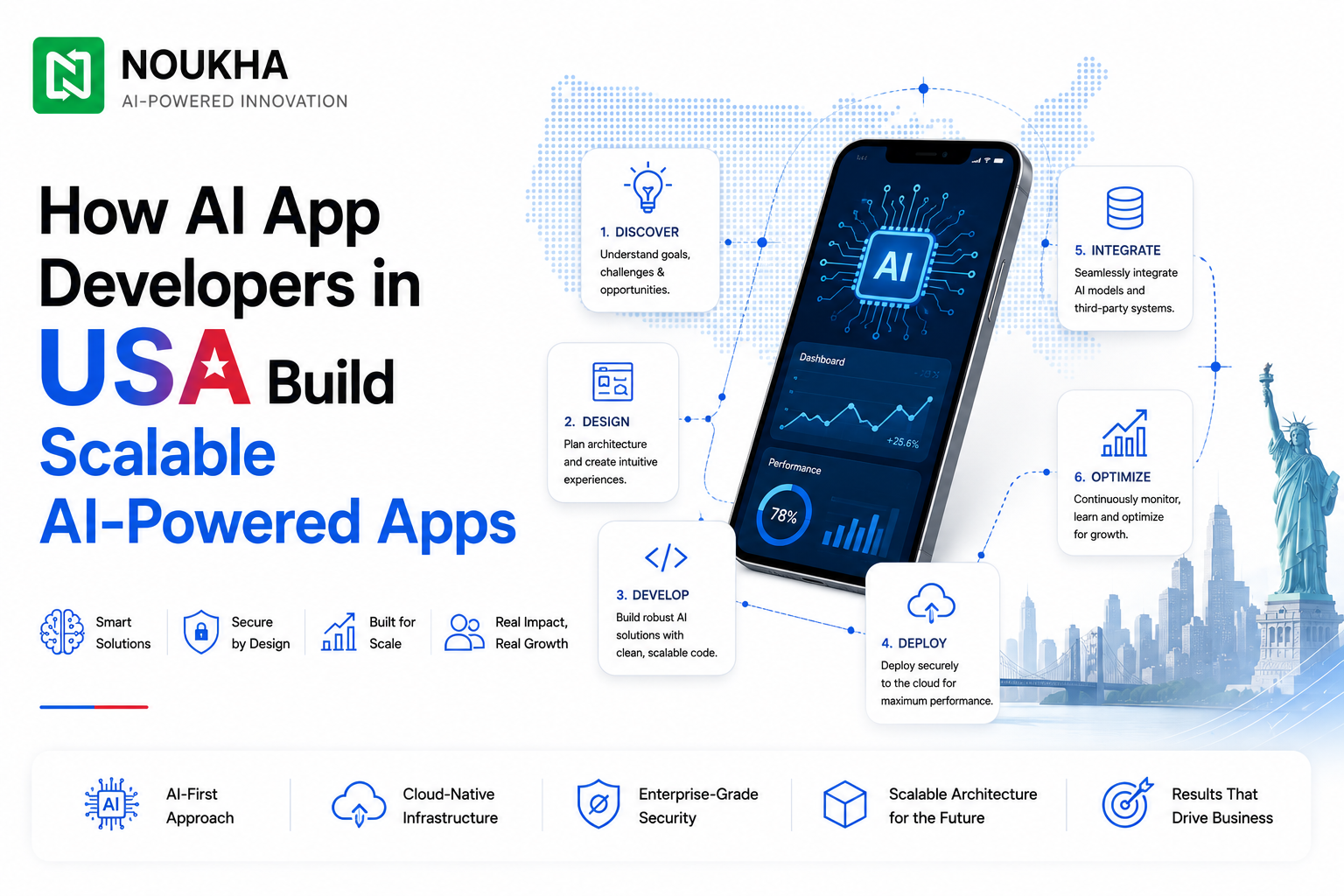
How AI App Developers in USA Approach the Development Process
Building an AI-powered app is not just a technical exercise. It requires a structured process that connects business goals with engineering decisions.
Discovery and Use Case Mapping
Before any code is written, teams typically spend time mapping out exactly where AI adds real value. This might mean automating customer support replies, predicting inventory needs, or personalizing product recommendations. Skipping this step often leads to AI features that look impressive in a demo but do not solve an actual business problem.
Choosing and Integrating the Right AI Models
Not every app needs a custom-built model. In many cases, integrating an existing large language model or a specialized machine learning service is faster and more cost-effective. The decision usually depends on the complexity of the task, the sensitivity of the data involved, and how much control the business needs over the model’s behavior. This is one of the areas where experience matters most, since choosing the wrong approach can quietly increase long-term costs.
Testing, Security, and Compliance Checks
AI systems behave differently from traditional software because their output can vary based on input and context. Thorough testing, bias checks, and monitoring for unexpected responses are essential before launch. For apps handling sensitive information such as healthcare or financial data, compliance requirements like HIPAA or SOC 2 also shape how the system is designed from the beginning.
Key AI App Development Trends Shaping the USA Market in 2026
A few clear patterns are influencing how new applications are being planned this year.
- Agentic AI features that can complete multi-step tasks on their own, rather than simply answering a single question.
- Growing use of low-code and no-code platforms to speed up early prototyping before a full custom build begins.
- On-device and edge AI processing, which reduces latency and keeps sensitive data closer to the user.
- Industry-specific applications in healthcare, legal services, and retail, where AI is tailored to very specific workflows rather than generic use cases.
- A shift from AI as an added feature to AI as the core architecture of the entire product.
These trends are not just talking points. They reflect what companies are actually requesting when they reach out to build or upgrade an application, and they influence how a modern development roadmap is structured.
What to Look for in an AI Application Development Company in USA
Choosing the right partner can be the difference between a product that scales smoothly and one that needs to be rebuilt within a year. A capable AI application development company in the USA should bring more than technical skill. Look for a team that asks detailed questions about your business goals before recommending a technology stack, has experience with the specific type of AI feature you need, and can explain their approach to data privacy and security in plain language.
It also helps to review past projects in a similar industry, ask how they handle post-launch support, and understand how pricing works as the application grows. A transparent development partner will walk you through trade-offs instead of simply agreeing to every request, since some ideas that sound appealing in a meeting are not practical once real users start interacting with the product.
Common Challenges When Scaling AI-Powered Apps
Even well-planned projects run into obstacles as usage grows. Being aware of these challenges ahead of time makes them easier to manage.
- Rising model usage costs as the number of active users and requests increases.
- Latency issues when AI responses need to happen in real time at a larger scale.
- Data quality problems that only become visible once the app is handling real, messy, real-world data.
- Security and compliance gaps that were manageable during a pilot phase but become risky at full scale.
- Technical debt from early prototypes that were never intended to support a large user base.
None of these challenges are reasons to avoid AI features. They are simply factors that need to be planned for early, with monitoring and cost tracking built into the system rather than added as an afterthought.
Frequently Asked Questions
What does an AI app developer actually do?
An AI app developer designs, builds, and maintains applications that use machine learning, natural language processing, or automation to perform tasks that would otherwise require manual effort. This includes selecting the right models, integrating them into the app, and making sure the system performs reliably as usage grows.
How long does it take to build a scalable AI app?
Timelines vary based on complexity, but a typical project ranges from a few months for a focused feature to well over six months for a full platform with multiple AI-driven workflows. Discovery, integration, testing, and compliance checks all add time but reduce costly rework later.
How much does AI app development cost in the USA?
Cost depends on scope, the type of AI models used, data readiness, and ongoing operational needs such as model monitoring. A simple AI feature added to an existing app costs far less than a fully custom AI-native platform built from scratch.
Can an existing app be upgraded with AI features?
Yes. Many businesses choose to add AI capabilities to an app that already has an established user base rather than starting over. This usually involves auditing the current architecture, identifying where AI can add measurable value, and integrating new services without disrupting the existing experience.
Build Your Scalable AI App With the Right Team
AI is no longer an experimental add-on. It is becoming a standard expectation for modern applications across nearly every industry. Whether you are launching a new product or upgrading an existing one, working with an experienced team can help you avoid common pitfalls and build something that holds up as your user base grows.
If you are ready to explore what a scalable, AI-powered application could look like for your business, contact us to discuss your goals and develop a clear, practical plan forward.