Table of Contents
- Why Payment Gateway Cost Estimation Matters in 2026
- Payment Gateway Development Cost by Gateway Type
- Development Phase Cost Allocation
- Compliance and Security Cost Impact
- Infrastructure and AI Fraud Costs
- Regional Development Rates and Team Economics
- 10 Key Drivers of Payment Gateway Build Cost
- Total Cost of Ownership and Cost Optimization
- Development Timelines and Budget Estimation Formulas
- Payment Gateway Development Cost FAQ and Final Takeaway
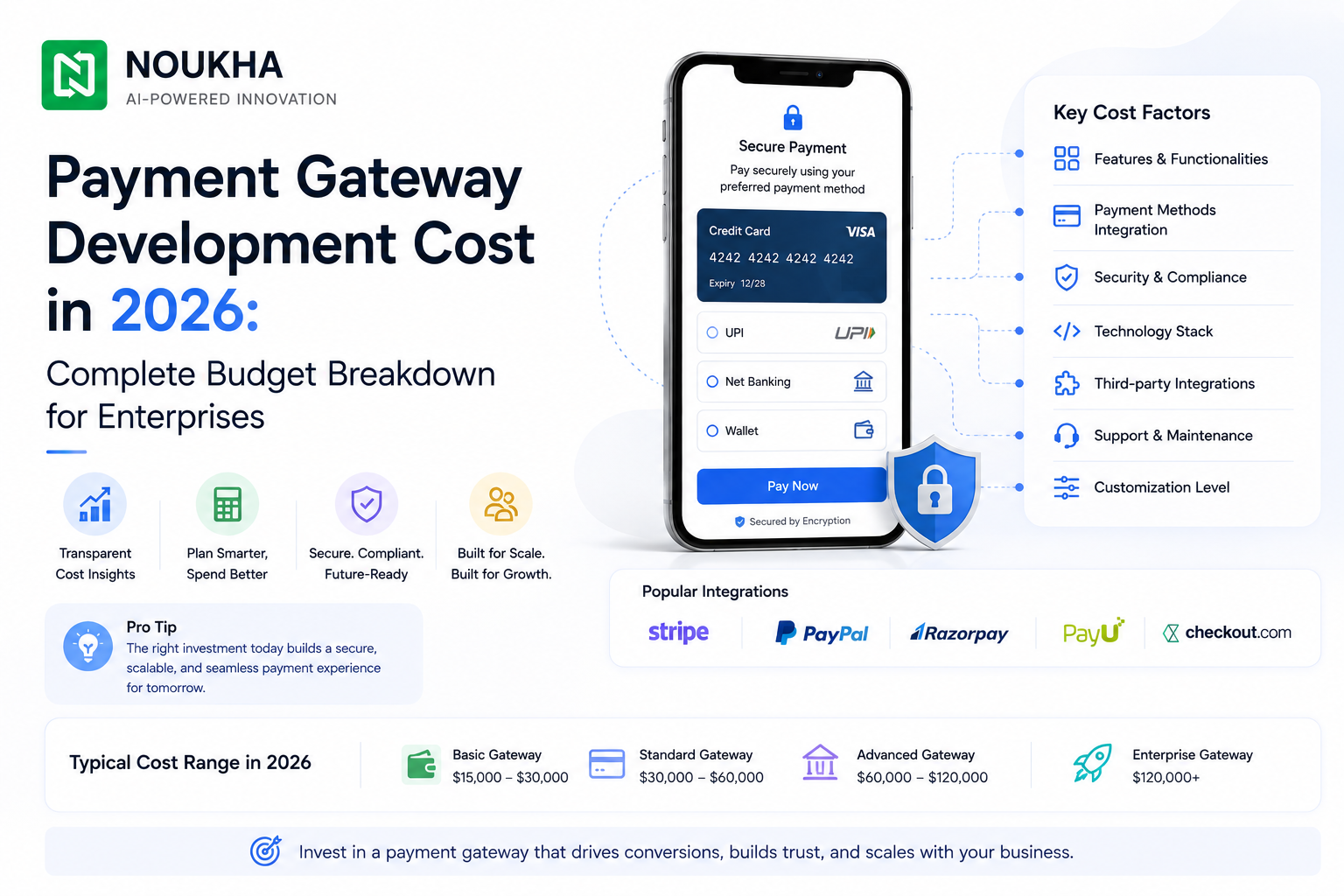
Payment Gateway Development Cost in 2026 is an important consideration for enterprises planning to build or own payment infrastructure. The total budget depends on the gateway type, transaction complexity, security requirements, PCI compliance, infrastructure, fraud prevention, integrations, and long-term operational needs.
The global payment gateway market is exploding-valued at $48.17 billion in 2025 and surging to $58.77 billion in 2026 alone, representing roughly 22% year-over-year growth. Grand View Research attributes the expansion to digital commerce, smartphone penetration, cashless transactions, and growing demand for secure online payment infrastructure. For enterprises, that growth changes the economics of payment architecture: a gateway is no longer just a checkout connector. It can become a strategic control layer for routing, authorization, fraud, tokenization, settlement, merchant operations, and cross-border expansion. Grand View Research
The practical question for a CTO or fintech founder is not simply, “What is the cost to build a payment gateway?” It is, “What level of ownership justifies the cost, and what will this platform cost to operate for three to five years?” A third-party integration may cost $5,000-$30,000. A production-grade custom gateway can require $150,000-$500,000, while an enterprise PayFac or orchestration platform can move beyond $500,000 before licensing, compliance renewals, processor fees, and internal operations. Transaction growth magnifies both good and bad architecture. Underbuild today and a rebuild may arrive precisely when transaction volumes, partner commitments, and regulatory scrutiny are highest.
Also Read: Custom Software Development Company in USA
Why Payment Gateway Cost Estimation Matters in 2026
Budget accuracy matters because the market is scaling faster than most enterprise procurement cycles. Grand View Research estimates the market rising from $48.17 billion in 2025 to about $58.77 billion in 2026. Other research firms publish lower baselines but still show strong expansion: TechSci Research forecasts $26.79 billion in 2025 to $57.85 billion by 2031 at 13.69% CAGR, while Global Market Insights estimates $32.7 billion in 2025 and $116.7 billion by 2035 at 14.1% CAGR. A much more aggressive forecast from Global Growth Insights reaches $521.37 billion by 2035 at 34.5% CAGR. These numbers should not be stitched together as one series; they use different definitions. The consistent message is that payment infrastructure is expanding rapidly. TechSci Research Global Market Insights
The financial risk of underestimating scope
A gateway that only authorizes cards is materially cheaper than a platform that manages retries, network tokens, smart routing, alternative payment methods, multiple acquirers, sub-merchants, reserves, reconciliation, chargebacks, and cross-border settlement. The initial payment gateway build cost can increase 25%-60% when processor redundancy, complex settlement, or regulated merchant onboarding enters scope. Underestimation typically appears later as redesign: the ledger cannot support split settlement, the data model cannot represent processor-specific states, or the system stores too much card data and expands PCI scope.
Why enterprises are building earlier
Enterprises considering ownership now are usually responding to one of four triggers: processor concentration risk, rising transaction volumes, unacceptable payment failure rates, the need to monetize payments, or regulatory/data-control requirements. In a market where retail and e-commerce are among the largest growth drivers, a two-point improvement in payment success can have more financial impact than saving $50,000 on initial engineering. The budget therefore needs to connect architecture to revenue, not just count developer hours.
Payment Gateway Development Cost by Gateway Type
The fastest way to frame custom payment gateway pricing is to decide how much of the payment lifecycle you intend to own. The ranges below are planning estimates for 2026 enterprise budgeting, excluding card-network fees, processor pricing, legal licensing, capital requirements, and transaction-based charges.
| Gateway approach | Typical 2026 build budget | Typical timeline | What the budget usually covers |
| Third-party integration | $5K-$30K | 2-8 weeks | Hosted checkout, API/SDK integration, webhooks, basic retries, limited reporting |
| White-label gateway | $20K-$80K | 1-4 months | Vendor core plus branded UX, merchant settings, reporting, limited workflow customization |
| Custom MVP | $50K-$150K | 3-6 months | Core authorization flow, tokenization approach, 1-2 processors, admin, basic ledger/reconciliation |
| Production-grade gateway | $150K-$500K | 6-12 months | HA services, multiple processors, fraud controls, settlement, observability, compliance hardening |
| Enterprise PayFac / orchestration platform | $500K+ | 12-18+ months | Sub-merchant onboarding, KYB/KYC, routing, reserves, split settlement, multi-region operations |
Third-party integration: $5,000-$30,000
This is appropriate when the enterprise does not need to own sensitive payment logic. Using hosted fields, checkout sessions, network tokenization, and processor-managed vaulting reduces both engineering and compliance scope. The trade-off is limited routing control, processor dependence, and less freedom to design a proprietary merchant or payment experience. For many commerce products, this is the financially correct answer.
White-label gateway: $20,000-$80,000
A white-label gateway sits between buy and build. The vendor supplies transaction processing while your team controls branding, merchant configuration, and selected workflows. It can shorten time to market by 40%-70% versus a full build, but customization limits and per-transaction economics can become expensive at scale.
Custom MVP: $50,000-$150,000
A focused MVP should prove transaction-state handling, processor integration, token strategy, basic risk rules, webhook reliability, and reconciliation. Keep the first release to one geography and one or two processors. Adding multi-currency settlement, complex refunds, recurring billing, or merchant sub-accounts can push the MVP into $120,000-$200,000 territory quickly.
Production-grade gateway: $150,000-$500,000
Production-grade systems budget for failure. They include idempotency, replay safety, high availability, audit trails, incident tooling, data partitioning, processor failover, reconciliation controls, test harnesses, and compliance evidence. At this tier, the architecture matters more than UI volume. Noukha’s custom software development services are relevant when the gateway is part of a broader business-critical platform rather than a standalone checkout component.
Enterprise PayFac platform: $500,000+
PayFac and payment-orchestration platforms add merchant onboarding, underwriting logic, KYC/KYB, reserve policies, fee calculation, split settlement, disputes, negative-balance handling, sponsor/acquirer integrations, and reporting at merchant and platform levels. A serious enterprise build can reach $750,000-$1.5 million+ as countries, payment methods, and compliance obligations expand.
Development Phase Cost Allocation
Once the product tier is clear, allocate budget by risk rather than by screen count. A $300,000 production-grade build, for example, may devote more than $100,000 to the core transaction engine and another $30,000-$45,000 to security and compliance engineering.
| Development phase | Typical share | Illustrative share of a $300K build | Primary deliverables |
| Planning & architecture | 8-12% | $24K-$36K | Payment flows, data boundaries, ledger model, failure modes, processor strategy |
| Core engine development | 35-45% | $105K-$135K | Authorization, capture, refund, void, state machine, idempotency, ledger |
| Security & compliance | 10-15% | $30K-$45K | Tokenization, encryption, key controls, audit logging, PCI evidence |
| Integrations | 10-20% | $30K-$60K | Processors, acquirers, wallets, KYC, notifications, ERP/finance systems |
| Testing & QA | 10-15% | $30K-$45K | Automation, negative tests, load, security, reconciliation validation |
| Deployment | 3-5% | $9K-$15K | IaC, observability, runbooks, rollout and rollback procedures |
Architecture first, coding second
The cheapest place to correct payment-state design is before code. Spending 8%-12% on architecture can prevent a 20%-40% rewrite later. Define payment intents, authorization lifecycles, partial capture, reversal, asynchronous processor events, duplicate requests, settlement timing, and ledger invariants before implementation.
Testing must model processor failure
Payment QA cannot stop at successful transactions. A credible testing budget of 10%-15% should cover timeouts after authorization, duplicate callbacks, webhook reordering, delayed settlement files, processor partial outages, chargeback events, currency precision, and reconciliation mismatches. These scenarios determine operational cost after launch.
Compliance and Security Cost Impact
Compliance costs rise primarily with data scope and business model. A merchant that redirects card entry to a PCI-compliant processor has a very different burden from a gateway that receives, decrypts, stores, or transmits primary account numbers. The numbers below are planning ranges for implementation, assessment preparation, controls, and supporting engineering; actual assessor, legal, licensing, and audit fees vary by organization and jurisdiction.
| Compliance / security workstream | Typical incremental budget | What drives the upper range |
| PCI DSS implementation | $20K-$100K+ | Card-data scope, segmentation, key management, evidence, service-provider requirements |
| 3-D Secure / SCA | $15K-$50K+ | Multiple processors, exemptions, fallback, challenge UX, regional rules |
| GDPR / CCPA controls | $15K-$60K+ | Consent, deletion, access requests, data mapping, retention, cross-border flows |
| KYC/KYB & AML | $30K-$120K+ | Merchant onboarding, risk tiers, sanctions screening, manual review, auditability |
| Security audits / penetration testing | $15K-$50K+ | System size, remediation cycles, cloud and application scope |
Card-data scope is the biggest controllable variable
Externalizing card entry and vaulting can cut security and compliance engineering by 20%-50% for many products. Hosted fields and tokenization allow the application to operate on tokens rather than raw card numbers. If business requirements demand direct card-data handling, plan for segmented infrastructure, stronger key management, restricted administrative access, detailed logging, evidence collection, and recurring assessments.
Authentication and regional privacy add workflow cost
3-D Secure and strong customer authentication are not simply API calls. They affect checkout state, exemptions, retries, challenge flows, and analytics. Privacy programs similarly require data inventories, retention controls, deletion paths, and vendor agreements. Enterprises with US and European customers can easily add $30,000-$100,000 across privacy and authentication workstreams.
Compliance is recurring, not a launch milestone
The enterprise payment platform cost must include annual assessment preparation, policy refresh, vulnerability management, access reviews, penetration tests, evidence automation, and remediation. Treat compliance as product infrastructure. Adding it after launch is usually more expensive than allocating 10%-15% during the initial build.
Infrastructure and AI Fraud Costs
Transaction volume changes infrastructure economics nonlinearly. A gateway processing a few thousand daily transactions can run on a modest cloud footprint; a platform responsible for millions of authorizations needs multi-AZ design, queue isolation, database scaling, observability, disaster recovery, and strict change control. Initial platform engineering can range from $30,000 to $400,000+ before monthly cloud consumption.
| Infrastructure pattern | Typical engineering budget | When it becomes necessary |
| Cloud-native baseline | $30K-$120K+ | API services, managed databases, queues, secrets, logs, IaC |
| High-availability architecture | $75K-$250K+ | Revenue-critical payments, strict uptime targets, processor redundancy |
| Multi-region deployment | $150K-$400K+ | Global traffic, regional resilience, data residency, low-latency routing |
| PCI-scoped infrastructure | $50K-$200K+ | Direct card-data environments, segmentation, hardened access and logging |
Fraud capability can become a second product
Rule-based screening may start under $20,000, but sophisticated fraud systems require feature pipelines, real-time scoring, case management, feedback labels, and model monitoring. If fraud losses materially affect economics, AI investment becomes easier to justify. Noukha’s AI app development capabilities are relevant when fraud, risk scoring, or intelligent operations need to be built directly into a payment platform.
| Fraud / risk capability | Typical initial build budget | Typical ongoing burden |
| AI fraud detection | $30K-$100K+ | Model/API spend, feature updates, analyst feedback |
| ML risk scoring | $60K-$200K+ | Training data, evaluation, drift monitoring, retraining |
| Chargeback prediction | $40K-$120K+ | Historical dispute labels, feature quality, retraining |
| Behavioral analytics | $50K-$150K+ | Event collection, device/session signals, real-time pipelines |
Initial model cost is not the main cost
Operational fraud cost often exceeds the prototype. Model inference, third-party risk signals, analyst review, false-positive tuning, labeling, retraining, and incident investigation can add $50,000-$250,000+ annually at enterprise scale. The budget should track fraud loss avoided and approval-rate improvement, not model accuracy alone.
Regional Development Rates and Team Economics
Hourly rate is a visible variable, but it is not the same as project cost. Payments engineering requires backend design, security, cloud architecture, QA automation, DevOps, product analysis, and often compliance specialists. A cheaper team that takes 1.8x the hours can cost more than a higher-rate team with payment-domain experience.
| Region | Indicative 2026 hourly rate | Illustrative production-grade project cost* |
| North America | $120-$250/hr | $300K-$900K+ |
| Western Europe | $90-$180/hr | $240K-$700K+ |
| Eastern Europe | $40-$90/hr | $150K-$420K+ |
| Asia | $25-$60/hr | $100K-$300K+ |
| Latin America | $35-$80/hr | $130K-$380K+ |
*Illustrative project costs assume a multidisciplinary team and should not be read as quotes. Scope, seniority, compliance, and architecture can move totals substantially. For enterprises seeking offshore economics with US-market delivery requirements, Noukha’s mobile app development services in the USA describe its approach to payment integrations, fintech requirements, and cross-time-zone delivery.
10 Key Drivers of Payment Gateway Build Cost
The following factors explain most variance in payment gateway development cost. Percentages are directional uplifts versus a simpler single-market, single-processor baseline and can overlap; do not add them mechanically.
- Transaction lifecycle complexity: Adding partial captures, incremental authorizations, reversals, recurring billing, split payments, disputes, and asynchronous recovery can increase engineering 15%-35%.
- Card-data scope and tokenization: Keeping raw card data out of your systems can reduce compliance/security effort 20%-50%. Direct card handling increases controls, testing, and assessment burden.
- Processor and acquirer integrations: Each additional processor can add 5%-15% to build cost, especially when APIs, settlement files, error taxonomies, or certification processes differ.
- Compliance requirements: PCI, SCA, privacy, money-transmission, KYC/KYB, AML, and local payment rules can raise initial scope 15%-40% for regulated platform models.
- Infrastructure architecture: Moving from single-region cloud to HA multi-region infrastructure can add 20%-60% to platform engineering before ongoing cloud spend.
- Fraud and AI implementation: Basic rules are inexpensive; real-time ML, feature stores, behavioral data, and case management can increase project cost 10%-35%.
- Payment methods and geographies: Wallets, bank payments, BNPL, local methods, multi-currency, FX, and regional authentication can add 10%-30% per major expansion wave.
- Settlement and reconciliation: Simple gross settlement is cheaper. Multi-party fees, reserves, netting, adjustments, and ERP posting can increase backend effort 15%-40%.
- Tech stack and team location: Rate differences can change labor cost 30%-70%, but inexperienced payment teams often consume the savings through rework and longer certification cycles.
- Scalability and SLOs: Designing for 99.99% availability, high TPS, disaster recovery, and zero-loss event processing can add 20%-50% compared with a standard SaaS baseline.
Also Read: Noukha SaaS Product Development
Total Cost of Ownership and Cost Optimization
Board approvals often focus on the initial cost to build payment gateway infrastructure, but the larger financial question is TCO. In a fast-growing market, transaction volume increases cloud consumption, support load, fraud exposure, compliance activity, and integration demand. A $300,000 build can reasonably require $70,000-$150,000+ per year in maintenance and operations before transaction fees and internal payment-operations headcount.
| Ongoing cost category | Typical annual / incremental cost | Budget implication |
| Infrastructure scaling | $10K-$60K+ annually | Traffic, logs, databases, queues, DR, observability |
| Compliance renewals | $20K-$100K+ annually | Assessments, evidence, scans, audits, remediation |
| Processor / network fees | Variable | Often dominates TCO at scale; model separately from software cost |
| Fraud operations | $15K-$60K+ annually | Analyst review, tooling, model maintenance, external signals |
| Maintenance | 15%-25% of build annually | Security patches, framework upgrades, reliability, support |
| New integrations | $10K-$40K+ each | Processors, wallets, bank rails, KYC, finance systems |
TCO can exceed initial build within three years
For a $400,000 gateway, annual maintenance at 20% is $80,000. Add $40,000 compliance, $40,000 infrastructure, $30,000 fraud operations, and two new integrations at $20,000 each, and software-related three-year TCO can approach $970,000 before payment-network and processor charges. This is why the buying decision should compare three-year economics, not only launch cost.
Seven ways to reduce cost without creating technical debt
- Start with a focused MVP. Limit the first release to the transaction flows that prove revenue and operational feasibility; savings can reach 20%-35%.
- Externalize card data. Hosted fields and processor tokenization can lower compliance and security scope 20%-50%.
- Limit initial processors. Start with one primary and one fallback only when redundancy has a clear business case; save 10%-20%
- Prioritize by revenue impact. Defer rarely used payment methods and reporting features; save 10%-25%.
- Embed compliance during architecture. Avoid redesigning data flows after assessment; potential rework avoided can equal 15%-30% of build cost.
- Use managed infrastructure strategically. Managed databases, queues, KMS, WAF, and observability reduce platform-engineering hours by 10%-20%.
- Build modular transaction services. Clear adapters for processors, risk, ledger, and settlement reduce the cost of future integrations by 20%-40%.
Development Timelines and Budget Estimation Formulas
Timeline is a cost driver because payment projects have external dependencies: processor certification, security testing, compliance assessment, legal review, and partner onboarding. Compressing an enterprise program aggressively may require parallel teams and can raise cost 20%-40% without shortening certification windows.
| Delivery target | Typical timeline | Typical budget band | Primary constraint |
| Custom MVP | 3-6 months | $50K-$150K | Focused processor/payment scope |
| Production-grade gateway | 6-12 months | $150K-$500K | Reliability, security, multiple integrations |
| Enterprise platform | 12-18+ months | $500K-$1.5M+ | PayFac operations, geographies, compliance, settlement |
Bottom-up estimation
Use (Engineering Hours × Blended Rate) + Integrations + Compliance + Infrastructure + Testing + Contingency. For example, 4,500 hours × $55/hour = $247,500; add $40,000 compliance, $30,000 integrations, $25,000 infrastructure, and 15% contingency, producing a planning budget of roughly $394,000.
PERT and parametric estimation
For uncertain modules, use PERT: (Optimistic + 4 × Most Likely + Pessimistic) ÷ 6. If processor certification is estimated at 3, 6, and 12 weeks, PERT yields 6.5 weeks. For operating economics, use a parametric model: Fixed Platform Cost + (Transactions × Variable Cost). This makes it easier to compare a custom gateway with a third-party provider as volume changes.
Payment Gateway Development Cost FAQ and Final Takeaway
How much does it cost to build a payment gateway?
A third-party integration can cost $5,000-$30,000, a custom MVP $50,000-$150,000, a production-grade gateway $150,000-$500,000, and an enterprise PayFac/orchestration platform $500,000-$1.5 million+ depending on compliance, settlement, geographies, and integrations.
How long does payment gateway development take?
Plan 3-6 months for a focused MVP, 6-12 months for production-grade infrastructure, and 12-18+ months for enterprise payment platforms. Certifications and audits can sit on the critical path.
What adds the most to payment gateway development cost?
Core transaction complexity, card-data scope, processor count, settlement/reconciliation, high availability, KYC/KYB, and compliance are usually the largest drivers. Multi-region and PayFac requirements can increase scope by 30%-100%+.
How much does PCI compliance add?
A planning range of $20,000-$100,000+ is reasonable for implementation and supporting engineering, but actual cost depends on PCI scope, merchant/service-provider status, assessment type, architecture, and existing controls.
What are typical ongoing costs?
Maintenance commonly runs 15%-25% of build cost annually, with separate budgets for infrastructure, compliance renewals, fraud operations, support, new integrations, and processor/network fees.
How can an enterprise reduce development cost?
Externalize card data, begin with fewer processors and payment methods, use managed cloud services, automate testing, define ledger/transaction states early, and roll out by geography. These choices can reduce first-release scope 20%-40%.
Should we build or buy a payment gateway?
Buy or integrate when payments are a supporting feature and provider economics are acceptable. Build when routing control, payment monetization, data ownership, processor redundancy, merchant operations, or proprietary workflows create strategic value greater than the three-year TCO.
What technology stack is commonly used?
Typical stacks use Java, Kotlin, Go, Node.js, or .NET for services; PostgreSQL or distributed SQL for durable records; Redis for controlled caching; Kafka or managed queues for events; Kubernetes or managed containers; cloud KMS/HSM services; and strong observability. Stack choice should follow reliability and team competence, not trend value.
Final takeaway. With the payment gateway market estimated by Grand View Research at roughly $58.77 billion in 2026, accurate budgeting is a competitive capability. The initial payment gateway development cost matters, but architecture determines what happens next: approval rates, failure recovery, compliance burden, processor flexibility, operational headcount, and the cost of every future integration. Enterprises should approve the build only after modeling transaction states, card-data scope, settlement, compliance, scale targets, and three-year TCO. If those decisions are made before engineering begins, a custom gateway can become strategic infrastructure instead of an expensive rewrite waiting to happen.
Planning a payment platform? Talk to Noukha about architecture and a scoped project estimate.
Author Bio
Noukha Technologies Editorial Team — Noukha builds custom software, AI platforms, integrations, and AI agents for enterprises. Its engineering approach prioritizes scalability, reliability, security, code ownership, and maintainability. Learn more: About Noukha Technologies