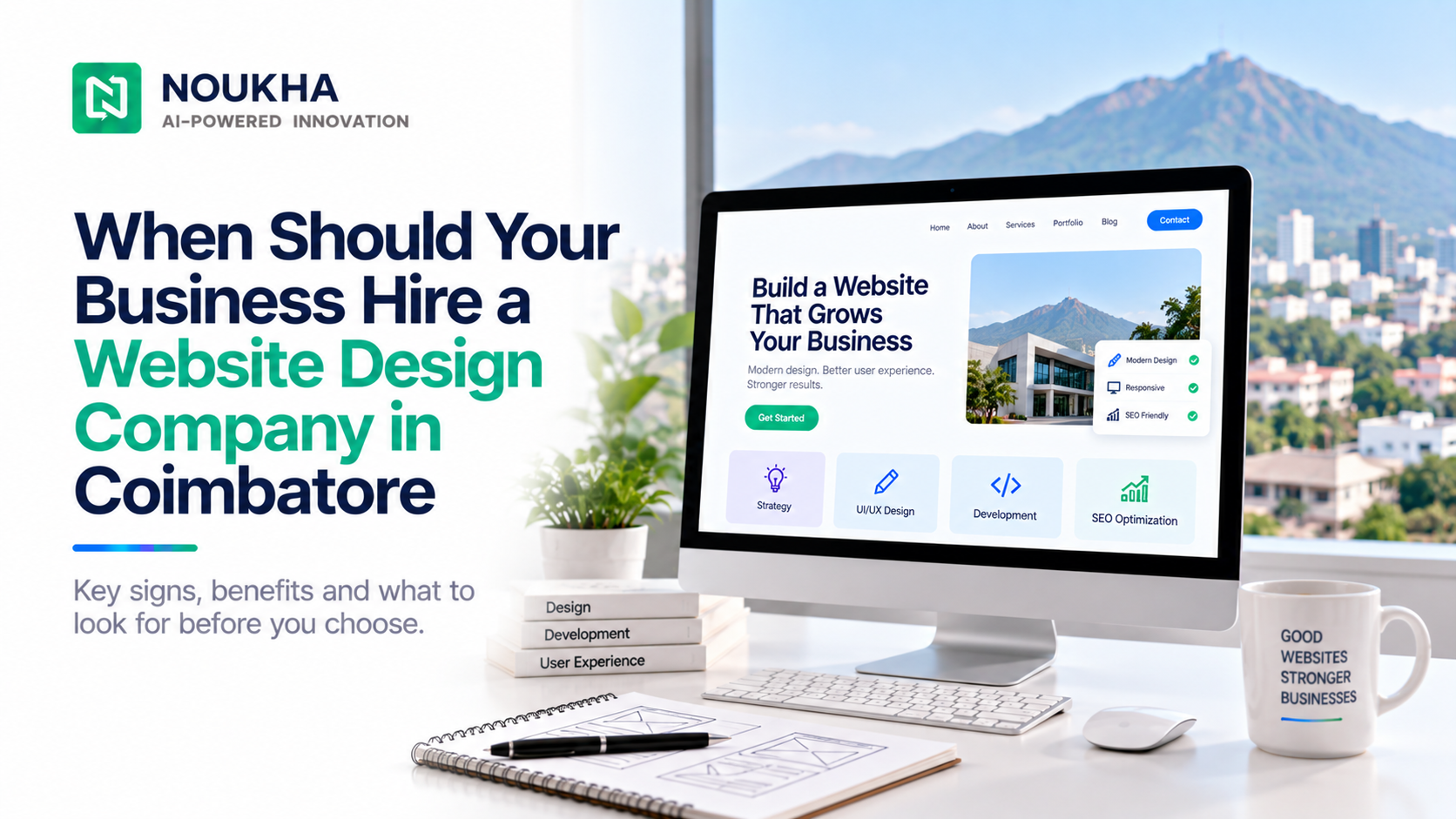
Few Coimbatore business owners decide to hire a designer on a Monday morning. The decision creeps up. A relative builds a quick site, a template gets patched every few months, and one day a customer mentions that they could not find your phone number on their mobile. That moment is a useful signal. This guide explains when a professional website design company in Coimbatore earns its fee, when a simple template is enough, and how to prepare so the project runs smoothly from the first meeting.
Signs Your Website Is Holding the Business Back
Customers Struggle on Mobile
Mobile usability is particularly important for businesses serving Indian customers. If your pages need pinching and zooming, buttons sit too close together or forms fail on a small screen, visitors may leave quietly and you never learn why. Test your own site on a mid-range Android phone over an ordinary mobile connection. If it frustrates you, it may also create friction for potential customers.
The Site Loads Slowly or Feels Unstable
Google’s Core Web Vitals use three key metrics: Largest Contentful Paint (LCP), which should be 2.5 seconds or less; Interaction to Next Paint (INP), which should be 200 milliseconds or less; and Cumulative Layout Shift (CLS), which should be 0.1 or less. Google generally evaluates these at the 75th percentile of real-world page loads, with mobile and desktop assessed separately. Repeated failures can result from issues with hosting, images, scripts, plugins, page structure or the underlying technology. In some cases, targeted optimisation is enough; in others, a rebuild may be more efficient.
The Site No Longer Reflects the Business
Companies grow into new products, export markets and customers while the website still describes what they did five years ago. If your sales team apologises for the site in meetings or sends PDFs instead of links, the website is working against them.
You Cannot Tell Where Enquiries Come From
Enquiries arrive, but nobody knows which page or campaign produced them. A site that measures nothing cannot be improved with evidence, and guesswork gets expensive.
Why Local Context Matters in Coimbatore
A Varied Local Economy
The Coimbatore District Administration describes a diverse local economy that includes textile mills, engineering companies and a major pump and motor manufacturing sector. Its economy page says that sector supplies over 40 percent of India’s requirements. A pump exporter needs catalogues and enquiry forms that overseas buyers trust. A clinic needs easy booking. A retailer needs a fast checkout. A team that understands these sectors asks better questions in the first meeting.
Practical Benefits of a Nearby Team
Shared working hours and easier access to in-person meetings can simplify communication and feedback. Distance is not necessarily a dealbreaker, but for a first project, sitting across a table from your designer can reduce misunderstandings.
Good Design Is More Than Looks
Clarity Beats Decoration
Visitors often make quick judgments about whether a page answers their question. Clear headings, a visible phone number, an obvious enquiry button and plain language about what you sell often serve them better than animations. Good designers should also consider accessibility, including readable text, sufficient colour contrast, keyboard accessibility and appropriately labelled forms.
Design and Search Work Together
Ask any agency who writes the content, who handles page titles and how the structure will help people find you.
Website, Web App or Mobile App: What Do You Actually Need?
Owners often ask for an app when a better website would do, or the reverse. The right answer depends on what your customers must do.
When a Well-Built Website Is Enough
If your goal is to be found on Google, explain your services, collect enquiries and build credibility, a fast, well-structured website is the right first step. It can work across modern phones, tablets and computers without requiring a traditional app download, and your own team can update it through a content management system.
When a Custom Web Application Fits
If staff keep repeating tasks in spreadsheets, such as quotations, order tracking or dealer approvals, a web application can replace them with one shared system.
When to Talk to Mobile App Development Companies in Coimbatore
Consider an app when customers or staff need something a browser handles poorly, such as repeat ordering, push reminders, offline access, or use of the camera, GPS or a barcode scanner. A sales team logging outlet visits and a delivery crew capturing proof of delivery are classic examples. A mobile app can require more development and maintenance effort than a simple business website, particularly when native device features, separate platforms and app-store requirements are involved, so test the idea with a simple prototype before committing.
Working With Android App Developers in Coimbatore
Why Android May Come First in India
StatCounter reported Android at 92.79 percent and iOS at 7.15 percent of India’s mobile operating-system market in August 2026. For businesses whose audience broadly reflects that market, Android may therefore be a practical platform to prioritise.
Check the Details That Matter
Ask how the app is tested on budget handsets, phones with little storage and slow networks. A polished app that crashes on an older device does not serve your real audience.
Preparing Before You Contact Any Agency
Define One Clear Goal
Write a single sentence, such as “We want more qualified enquiries from export buyers” or “We want patients to book online.” A concrete goal makes proposals comparable and gives you a way to judge results later.
Gather Content and References
Collect logos, product photos, certificates and customer stories, along with three websites you admire and the reasons why. Missing content is a common source of project delays, so preparing it early can keep the work moving.
Set a Realistic Budget Range
Prices vary widely with the number of pages, features and integrations, so treat every quote as an estimate tied to a written scope. Compare what each one includes, such as content support, testing, training and post-launch fixes, instead of only the headline price.
What to Expect During the Project
Discovery and Structure
Expect questions about your customers, competitors and goals, followed by a sitemap and wireframes. Approve the structure carefully before visual design begins, since structural changes late in a project are expensive.
Design, Build and Testing
You should see design mockups first, then a working staging site you can click through on your own phone. Testing should cover different browsers and devices, form submissions and page speed.
Launch and Handover
Ask for a launch checklist that covers redirects from old pages, analytics, backups and access to every account. Ask for administrator access to analytics, Search Console and other third-party services connected to the website. You should also own your domain, hosting logins and source files.
Training and Support After Launch
Your team should learn how to edit pages, add products and publish updates without waiting for a developer. Short training sessions, a simple guide and a clear route for support requests keep the site fresh.
Data Privacy Belongs in the Brief
Even a simple contact form collects personal data. India’s Digital Personal Data Protection Rules, 2025 were notified in November 2025 with a phased commencement schedule. Several substantive provisions are scheduled to take effect 18 months after publication, while others take effect earlier. Businesses should check which requirements apply to their website and data-processing activities, including clear notices explaining how and why personal data is processed, and any consent or other mechanisms the law requires. This is general information, not legal advice. Planning notices and secure storage early is easier than retrofitting them.
Red Flags When Comparing Proposals
- Guaranteed Google rankings, since no agency controls search results.
- No written scope or unclear limits on revisions.
- Reluctance to show live client sites or explain past work.
- Templates presented as custom design without saying so.
- Terms that leave your hosting or source code in the agency’s control.
- Proposals that skip testing on real mobile devices.
- No mention of who maintains the site after launch.
Conclusion
Hiring help makes sense when your website costs you customers, embarrasses your sales team or cannot support a new goal. Start with one clear objective, choose the simplest format that meets it, and expect ownership, testing and privacy to be part of the deal. Contact Us with a short description of your goal and timeline, and the Noukha team can suggest whether a website, a web application or an app fits best.
Frequently Asked Questions
How do I know whether I need a redesign or small fixes?
If problems are limited to content or a few pages, fixes may be enough. If the layout fails on mobile, speed scores stay poor or the site cannot support new features, a redesign usually makes more sense.
Is a template website ever the right choice?
Yes, for a small business testing an idea on a tight budget. Consider moving to a more customised design when the website becomes a significant source of enquiries, sales or customer interactions.
How long does a business website take to build?
It depends on scope and how quickly you supply content. A small brochure site may take a few weeks, while stores and portals take longer.
Should I build a website or an app first?
Businesses focused on search visibility, information and lead generation often benefit from a strong website first. An app becomes more relevant when a repeated customer or staff workflow depends on mobile-specific capabilities.
Who should own the website after launch?
You should. Confirm in writing that the domain, hosting accounts and source files are registered in your name or handed over at completion. Include analytics and other third-party accounts too.