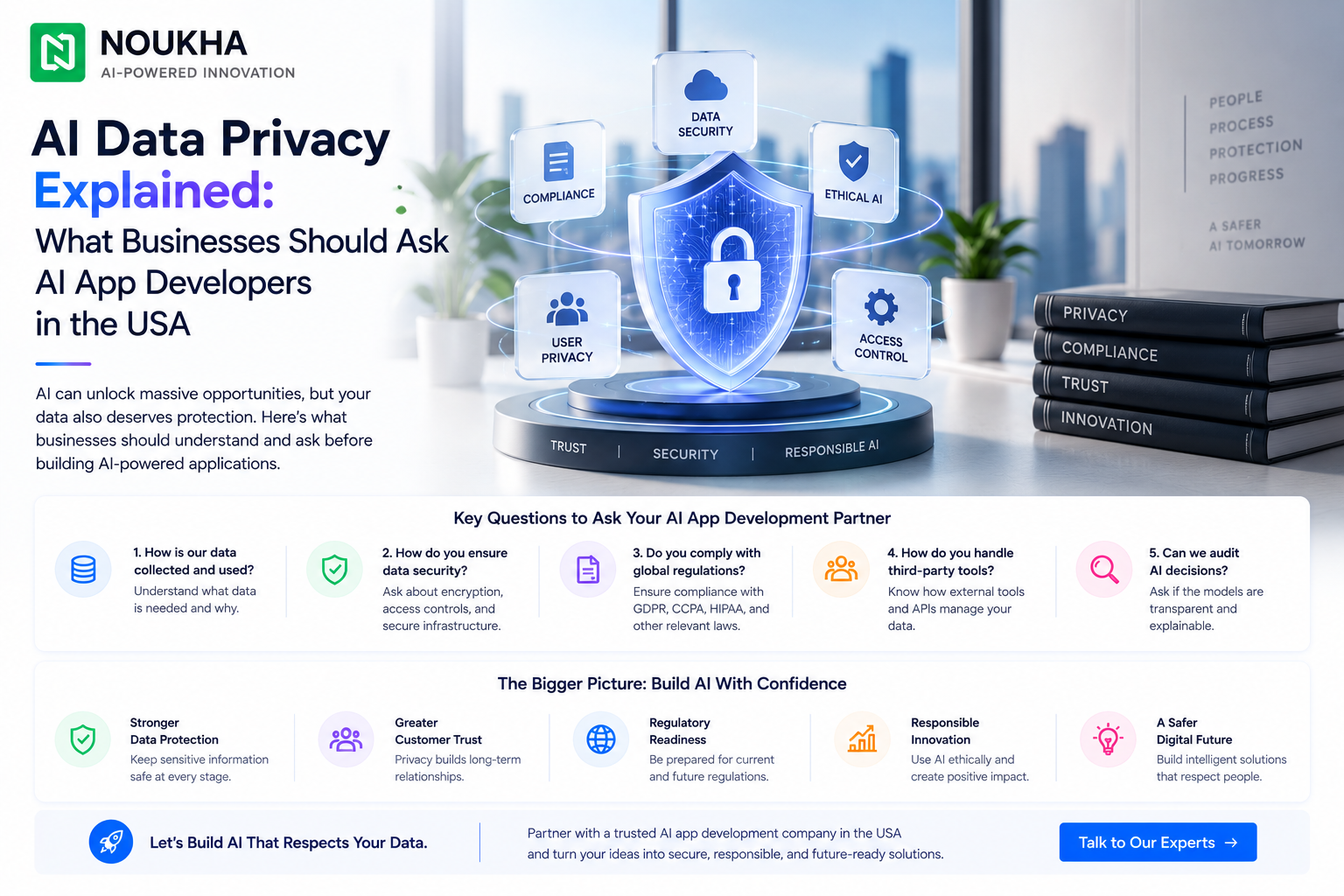
Artificial intelligence now touches customer records, employee files, and internal documents the moment it is switched on inside a business. That makes data privacy one of the first questions any company should settle before signing a contract, not something to review after launch. Whether you are building a customer-facing chatbot or an internal analytics tool, the AI app developers in the USA you choose will directly shape how your data is collected, stored, and reused. This guide breaks down what AI data privacy actually means, why it matters more in 2026 than it did even two years ago, and the exact questions worth asking before you commit to a development partner.
Why AI Data Privacy Has Become a Boardroom Issue
AI adoption has moved past the experimentation stage. Businesses are feeding real customer data, financial records, and proprietary documents into models to speed up decisions and personalize experiences. That shift changes the risk profile entirely. A poorly configured AI feature does not just slow down a workflow if something goes wrong; it can expose personal data, trigger regulatory penalties, and damage customer trust in ways that are hard to reverse.
Regulators have taken notice. The United States does not currently have a single comprehensive federal consumer privacy law, leaving businesses to navigate a growing patchwork of state requirements alongside sector-specific federal laws covering areas such as health, financial, and children’s data. As of 2026, 23 states have enacted comprehensive consumer privacy laws, according to the IAPP, though effective dates and requirements vary considerably. Vermont became the most recent addition in June 2026, with its law not taking effect until January 2028. Several states have also amended existing laws or added new requirements, keeping the compliance landscape in motion rather than settled, and some impose specific obligations around automated decision-making, sensitive or biometric data, and profiling. For a business operating across state lines, this means privacy compliance is not a single checklist item; it is an ongoing obligation that shifts depending on where customers live.
The Regulatory Patchwork Businesses Face
Instead of one national standard, companies must track overlapping state laws alongside sector-specific rules such as HIPAA for health information and various consumer protection statutes. Some states have gone further and added requirements that apply directly to AI systems used in hiring, lending, and other consequential decisions. This layered environment is exactly why the developer you hire needs to understand privacy law, not just software architecture.
What “AI Data Privacy” Actually Covers
AI data privacy is broader than encryption and passwords. It spans every stage of how information moves through an AI system, from the moment it is collected to the point where it might be used to retrain a model months later.
Data Collection and Consent
Before an AI feature processes personal data, a business should understand what information is collected, why it is needed, what notice is required, and whether consent or another applicable legal basis is required. Vague data collection practices are one of the fastest ways to fall out of step with state privacy laws, which may require specific notices, consumer rights, and opt-out mechanisms depending on the processing activity and the law that applies.
Data Storage and Retention
Where data lives, how long it stays there, and who can access it are practical questions that get overlooked during development. A privacy-conscious development team should establish appropriate retention periods, use encryption and access controls suited to the sensitivity of the data, and avoid retaining information longer than necessary for the defined purpose.
Model Training and Data Reuse
This is where many businesses get caught off guard. AI vendors have different policies governing whether customer prompts, files, or other inputs can be used for model improvement or training, and those policies are not standard across the industry. Businesses should verify the provider’s current terms and put any restrictions on data use directly into the contract rather than assuming a default.
This is not only a contractual concern. The Federal Trade Commission has warned that companies can face enforcement risk when their actual AI data practices conflict with privacy or confidentiality promises made to customers, particularly when a provider quietly changes how customer data is used for training after the fact.
If customer data is permitted to contribute to a shared model or service, businesses should evaluate the resulting privacy, confidentiality, and competitive risks before agreeing to those terms, since the outcome depends heavily on the provider’s architecture and data-use policy.
Key Questions to Ask AI App Developers in the USA
Once you understand what AI data privacy covers, the next step is asking pointed questions during vendor evaluation. A capable
team of AI app developers in the USA should be able to answer each of these without hesitation or vague reassurances.
Questions About Data Ownership
- Who owns the data once it is uploaded into the AI system, the business or the developer?
- Can the business export or permanently delete its data on request?
- What happens to data if the contract ends or the vendor relationship changes?
Questions About Compliance and Certifications
- Which state and federal privacy laws does the platform comply with today?
- Does the company hold current SOC 2, ISO 27001, or comparable independent security certifications, and what scope do they cover?
- How are updates to privacy law monitored and reflected in the product?
Questions About Model Training Practices
- Is client data ever used to train or fine-tune shared models?
- Is there an option to keep training strictly on isolated, private data?
- How is sensitive information such as health or financial data anonymized before processing?
Questions About Vendor and Subprocessor Access
- Which third parties, including cloud hosts and API providers, can access the data?
- Is there a documented list of subprocessors and their locations?
- What breach notification timeline is guaranteed in the contract?
Red Flags to Watch For When Evaluating an AI Application Development Company in the USA
Some warning signs show up early in vendor conversations. Be cautious if a company cannot clearly explain its data flow diagram, avoids putting privacy commitments into the contract, or treats compliance as a marketing line rather than a documented practice. A trustworthy
AI application development company in the USA should welcome detailed questions about data handling, not deflect them. If the vendor will process personal data on your behalf, ask whether a written data processing agreement is required and make sure the contract clearly defines each party’s responsibilities.
- Vague or shifting answers about where data is physically stored
- No named point of contact for privacy or security concerns
- Reluctance to address confidentiality and personal data processing responsibilities contractually
- Standard contract templates that make no mention of AI-specific data use
- No clear process for responding to a data breach or subject access request
None of these signs are automatically disqualifying on their own. But multiple unresolved warning signs should prompt deeper due diligence before the business shares sensitive information or commits to the engagement.
How Businesses Can Prepare Before Development Begins
Vendor selection is only half the equation. Businesses that get the best privacy outcomes also do some groundwork internally before a project kicks off, which makes it far easier to hold a development partner accountable later.
Map Your Own Data First
Before asking a developer how they will protect data, know what data you actually have. A short internal inventory of what personal information is collected, where it lives today, and who currently has access to it gives you a baseline to compare against whatever the AI system introduces.
Define What Success Looks Like Contractually
Privacy expectations that live only in a sales conversation tend to disappear once a project is underway. Put retention limits, training restrictions, breach notification requirements, and other privacy commitments into the appropriate contractual documents, such as a data processing agreement, a master services agreement, or a security addendum, rather than relying on verbal assurances.
Assign Internal Ownership
Someone on your side, whether a compliance officer, IT lead, or outside counsel, should own the privacy relationship with the developer. Without a clear owner, privacy reviews tend to slip once a project moves into active development and deadlines take priority.
Building a Privacy-First Partnership with Your AI Developer
Strong AI data privacy is not a one-time audit; it is an ongoing relationship. Businesses get the best outcomes when privacy expectations are written into the contract from day one, developers commit to regular security reviews, and both sides agree on how new regulations will be handled as they emerge. Involving legal or compliance staff early in technical discussions also helps, since privacy requirements are easier and cheaper to build into an AI system from the start than to retrofit after launch, especially once real customer data is already flowing through it.
AI Privacy and Risk Management Frameworks
Privacy should also be considered alongside broader AI risk management rather than treated as a stand-alone checklist. The National Institute of Standards and Technology maintains the AI Risk Management Framework, a voluntary structure organizations can use to identify, assess, and manage risks associated with AI systems, including risks to individuals, organizations, and society. NIST continues to develop additional profiles and guidance under this framework, and referencing it during vendor discussions gives businesses a shared vocabulary for governance, measurement, and risk controls, rather than relying on informal assurances alone.
Conclusion
AI data privacy is not a box to tick once and forget. It requires ongoing attention to how data is collected, stored, reused, and shared, along with a development partner who treats compliance as part of the build rather than an afterthought. Asking the right questions before development begins protects your business, your customers, and your reputation. If you are ready to evaluate a development team with privacy built into the process, contact us to discuss your project and the safeguards that should be part of it from day one.
Frequently Asked Questions
What is AI data privacy?
AI data privacy refers to how personal and business information is collected, stored, processed, and reused by AI systems, along with the safeguards in place to keep that data secure and compliant with applicable law.
Does the United States have a single AI privacy law?
No. The United States does not currently have a single comprehensive federal consumer privacy law. Instead, businesses must comply with a growing number of state privacy laws, 23 of which had been enacted as of 2026 according to the IAPP, alongside sector-specific federal regulations such as HIPAA. Requirements and effective dates vary by state.
Can AI developers use my business data to train their models?
It depends on the vendor. Policies on using customer prompts, files, or other inputs for model training vary across the industry, so businesses should verify the provider’s current terms and put any restrictions on data use directly into the contract rather than assuming a default.
What should be included in a contract with an AI developer?
Look for clear terms on data ownership, retention periods, subprocessor access, breach notification requirements, and whether client data can be used for training. If the vendor processes personal data on your behalf, confirm whether a data processing agreement is required and ensure it clearly defines each party’s responsibilities.
How often should AI privacy practices be reviewed?
Review frequency should depend on the sensitivity of the data involved, regulatory exposure, and how often the AI system, its vendors, or applicable laws change. At minimum, businesses should revisit privacy practices whenever there is a significant change to the AI system, its data flows, its vendors, or the regulations that apply to it.