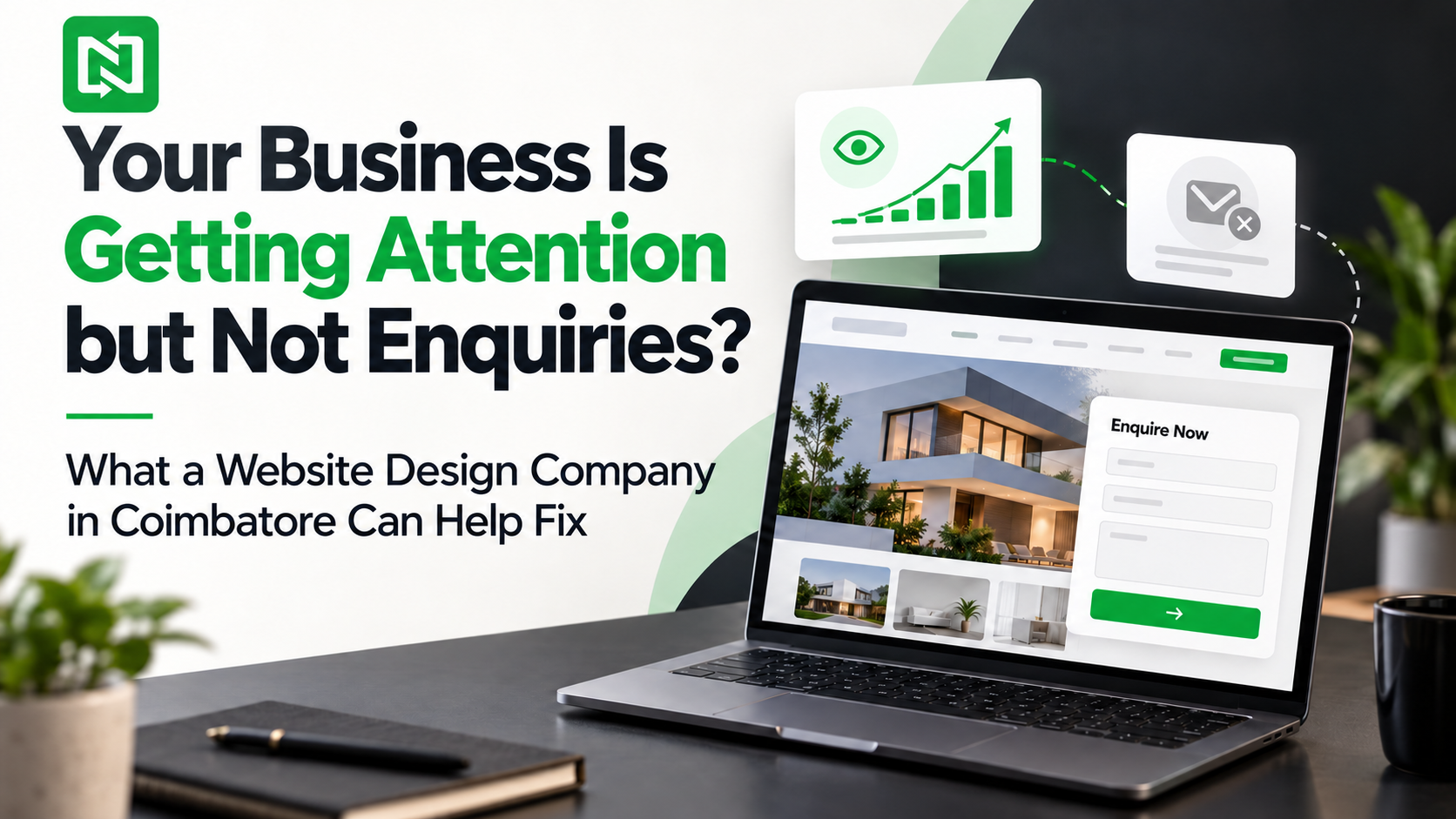
A Website Design Company in Coimbatore can help businesses turn website visitors into genuine enquiries. But if your website is already getting traffic without generating leads, the problem may not be visibility alone. Unclear messaging, slow loading pages, poor mobile experience and complicated enquiry forms can all prevent potential customers from contacting your business.
A site can look polished and still lose people at every step. Slow pages, vague messaging and awkward forms can quietly send interested buyers to a competitor. If you suspect your site is the bottleneck, a web design studio in Coimbatore can audit it properly. Before hiring anyone, however, this guide explains how to diagnose the problem yourself, what commonly causes it and which fixes deliver the greatest impact first.
Why Attention Does Not Automatically Become Enquiries, Why We Need a Website Design Company in Coimbatore
Attention indicates curiosity; an enquiry indicates confidence. Someone may click your ad, read an Instagram post or find you through Google, then leave within seconds because the landing page does not answer the question that brought them there.
Where visitors land matters as much as why they arrive. Statcounter’s September 2026 figures show mobile devices generating more than three quarters of web page views in India. Google primarily uses the mobile version of a page for indexing and ranking, so the smartphone experience should be treated as the primary version of your site. If your site was designed for desktop and then adapted for small screens, most visitors may be experiencing a weaker version of your business.
Speed and stability add another layer. Google’s Core Web Vitals define a good experience as the largest content element appearing within 2.5 seconds, interactions responding within 200 milliseconds and a cumulative layout-shift score below 0.1. The HTTP Archive’s 2025 Web Almanac found that only about 48 percent of mobile sites met all Core Web Vitals thresholds, so slow or unstable pages remain common. Being common does not make these issues harmless.
This is why traffic reports can feel encouraging even when the sales team receives few enquiries. Visits are an input; enquiries are the outcome. Your website sits between the two.
Signs Your Website Is Quietly Turning Visitors Away
These four issues commonly appear when a website receives traffic but generates few leads.
A First Screen That Does Not Say What You Do
Visitors scan pages before reading them in detail. If the top of your homepage opens with a slogan or stock photo rather than a clear statement of what you offer, whom you serve and where you operate, visitors may guess, and many may guess incorrectly. A strong opening answers three questions: What is this? Is it right for me? What should I do next?
Pages That Crawl on a Mid-Range Phone
Test the site on the type of phone your customers actually use, over a typical mobile connection rather than office Wi-Fi. Oversized banner images, auto-playing videos, chat widgets and multiple tracking scripts are common causes. When a button shifts just as a user tries to tap it, that is layout shift, and it can cost you clicks.
Contact Routes That Ask Too Much
A form with 10 required fields can feel like paperwork. Many buyers prefer to tap a call button or message you on WhatsApp. Offer more than one contact option, limit the form to name, phone number and a brief message, and display a clear confirmation so visitors know their enquiry was received.
Missing Proof of Trust
First-time visitors need reasons to trust your business. Real client names, photographs of finished work, a visible address, registration details and recent reviews all reduce hesitation. A website without proof leaves visitors to fill the gap with doubt.
Any one of these issues can reduce enquiries. Together, they explain why a website with healthy traffic may still generate few enquiries.
How to Find Out Where Visitors Drop Off
Start With the Data You Already Have
Open Google Analytics and Search Console. Compare pages by engagement and identify pages that attract visitors but rarely lead to calls or form submissions. In Search Console, queries with many impressions but few clicks may indicate that your page titles or meta descriptions do not match search intent. If you have not set up conversion tracking for form submissions and phone clicks, do that first; without it, you are relying on assumptions.
Split the Numbers by Device and Source
Average data can hide problems. Compare enquiry rates for mobile and desktop visitors, and for each source such as search, social and referrals. If desktop visitors enquire at a healthy rate while mobile visitors rarely do, the mobile experience is likely the problem. If one source sends substantial traffic but few leads, the promise in your ad or post may not match the landing page.
Watch Real Sessions and Ask Real People
Tools such as Microsoft Clarity can record anonymised session replays, so you can see where people hesitate, tap repeatedly or abandon a form. Pair this with one question to recent customers: What almost stopped you from contacting us? Two or three honest responses can often reveal more than analytics alone.
Fixes That Usually Move the Needle First
If you want to know how to get more leads from a website without rebuilding it, start with these changes, roughly in order of effort.
- Rewrite the headline. Say what you offer, whom you serve and where you operate in plain language.
- Give each page one primary action. Repeat the same button after each major section rather than offering several competing options.
- Reduce page weight. Compress images, lazy-load below-the-fold media and remove unused scripts. Then retest the page in PageSpeed Insights.
- Keep calling and WhatsApp messaging one tap away. A sticky call or WhatsApp button on mobile removes a step at the moment of highest interest.
- Place proof near every call to action. A short review, client logo or completed project photo beside the button can address a visitor’s final hesitation.
- Create a separate page for each service. A visitor searching for a specific service should land on a page focused on that service, not a general overview.
Notice that none of these require a new brand or a bigger budget. They require clarity and patience, and their impact can compound: a faster page earns more attention, while a clearer page converts it.
When a Website Alone Is Not Enough
Some businesses outgrow a brochure-style website. If customers rebook frequently, track orders, manage memberships or expect reminders, a mobile app can provide a more convenient experience than a browser tab. In that case, talk to a Coimbatore team that builds mobile apps about whether a cross-platform build fits your budget. If most of your customers use Android, which accounts for the large majority of smartphone usage in India, an Android-focused development team in Coimbatore can scope a leaner first version.
However, an app will not fix a confusing website. If visitors cannot understand what you offer on a web page, an app may inherit the same confusion. Clarify the message first, then extend it into an app.
A Practical 30-Day Plan
- Week 1: Set up conversion tracking, test the website on two real phones and identify your five highest-traffic pages.
- Week 2: Rewrite the first screen of key pages, shorten contact forms and add call and WhatsApp buttons.
- Week 3: Compress images, remove unused scripts and retest Core Web Vitals.
- Week 4: Add proof near each call to action, compare conversions with Week 1 and decide on the next improvement.
Where possible, change one element at a time so you can identify which fix improved results.
Common Questions About Low Enquiries
Why does my website get visitors but no enquiries?
It usually comes down to one of four issues: unclear messaging, slow mobile pages, weak trust signals or a difficult-to-find contact option. Review them in that order, as each can be tested relatively quickly.
How long before changes show results?
Clearer buttons and shorter forms may show an effect within a few weeks, provided the website receives consistent traffic. Websites with low traffic volume need more time before the data becomes statistically meaningful. No responsible agency can promise an exact date.
Do I need a full redesign?
Not always. If your platform is outdated, the layout breaks on mobile devices or every page requires rebuilding to solve a basic issue, a redesign may make sense. Otherwise, targeted improvements are usually faster and more cost-effective.
Will a faster website bring more enquiries?
Speed alone rarely solves the problem, but it removes a major barrier. A page that loads quickly and remains stable allows your message and offer to work effectively. Pair speed improvements with clearer messaging for the best chance of improving enquiries.
Turn Attention Into Conversations
Your visitors have already shown interest in your business. The job now is to make the next step obvious, quick and trustworthy. Whether you run a clinic, factory, shop or service business, people are more likely to contact businesses they find clear and credible.
If you would like a second opinion, share your website, highest-traffic pages and the action you want visitors to take, then get in touch with the Noukha team. We can help identify where visitors are likely dropping off and what to fix first.