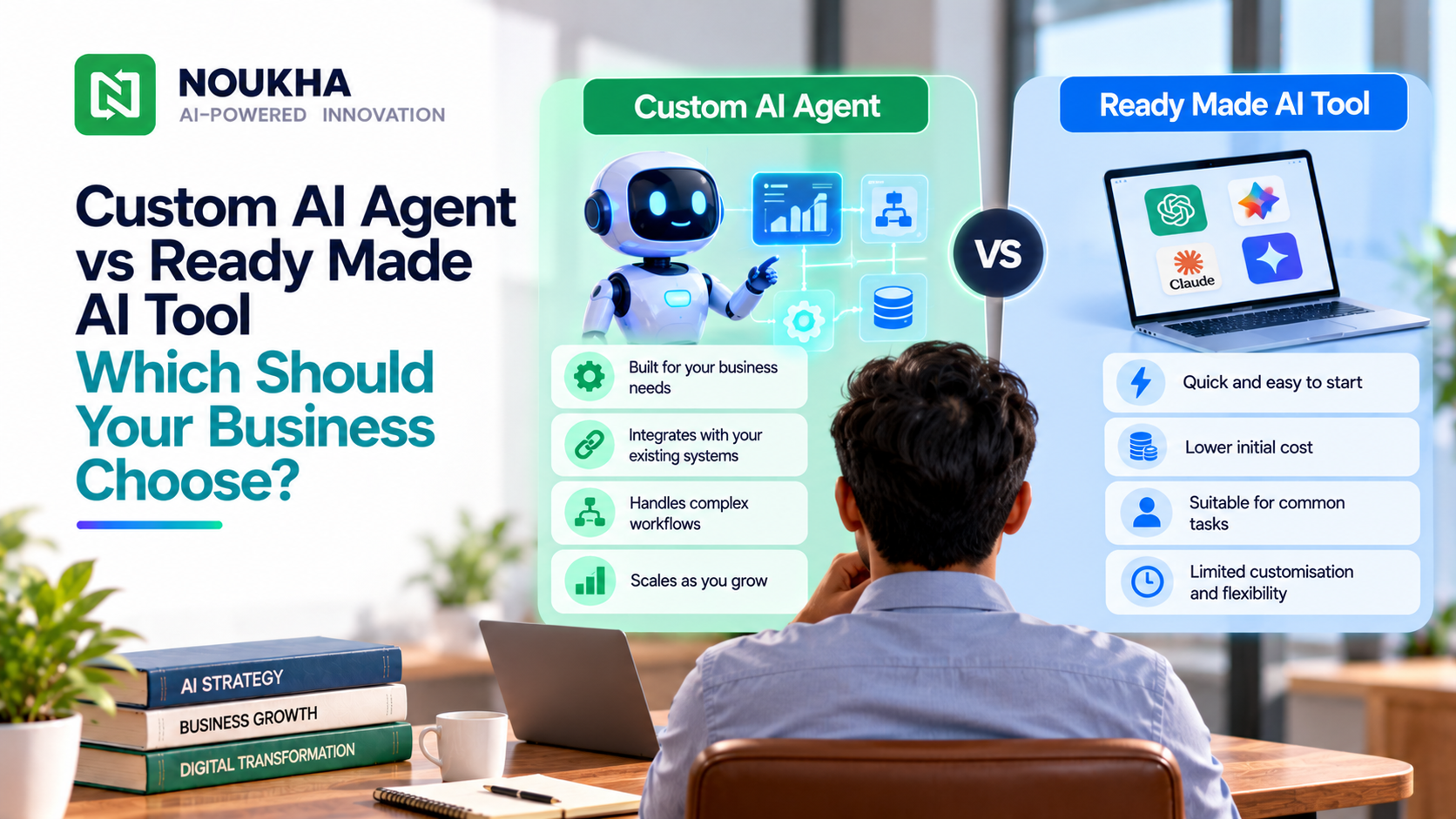
A ready-made AI tool may already do much of what your business needs. The question is whether it can complete the important parts of your workflow without creating more work for your staff. A custom AI agent becomes more relevant when the available tools cannot adequately handle your integrations, permissions or business rules.
There is also a middle option: use an existing AI platform and build a small integration around it. Before funding development, compare all three approaches against the work you need completed and the result your business expects.
Start with the workflow rather than the product category
Write down a real task from beginning to end. For example, a sales coordinator receives an inquiry, checks whether the company already exists in the CRM, collects missing details and prepares a follow-up for review.
Identify where judgment is needed and where a fixed rule is sufficient. Looking up a customer identifier is different from interpreting an unclear request. You may need an AI feature within a conventional workflow rather than a system that decides its own sequence of actions.
Anthropic’s engineering guidance distinguishes workflows with predefined paths from agents that choose their next steps dynamically. That is a useful design distinction, but it does not determine whether the software should be bought or built. Either purchasing route can involve several technical approaches.
For background on the wider architecture, read our guide to agentic AI workflows.
Custom AI agent vs ready-made AI tool : When a ready-made tool is a sensible starting point
A packaged tool deserves consideration when your requirements are common and its existing features support the important steps. It may let the team test usefulness without first commissioning a complete product.
Run the trial with representative work. Check whether the tool can use your data, preserve the necessary access restrictions and produce an output people can act on. A polished demonstration with the vendor’s examples is only an introduction.
Look at configuration effort and account limitations. You may need connectors, a particular plan or administrative setup before the tool supports the workflow shown in a sales presentation. Include that work in the comparison.
Also examine how the tool handles exceptions. If staff must manually repair most outputs or move information between systems, the subscription price alone will understate the cost of using it.
When custom development deserves consideration
Custom work is worth exploring when the unmet requirement affects the value of the whole process. Examples include a specialized approval flow, integration with an internal application or a customer-facing experience that must work inside your product.
The requirement should be specific. “We want more control” is difficult to estimate. “A supervisor must approve a proposed CRM change before it can be applied” gives the team a clear behavior to design and test.
Custom development also brings responsibilities. Someone must maintain the code, manage dependencies, monitor failures and evaluate changes. Using a commercial model inside your custom application still leaves a dependency on that provider and its terms.
Owning the surrounding software does not automatically mean owning the underlying model or eliminating all third-party services. Ask the proposal to distinguish those components.
Compare a configured tool and a custom system fairly
| Question | Ready-made tool | Custom implementation |
| Workflow fit | Test supported features and configuration | Define and build the required behavior |
| Integration | Confirm available connectors and limitations | Estimate each required connection |
| Control | Review settings, access rules and export options | Specify controls and verify their implementation |
| Maintenance | Understand vendor and customer responsibilities | Assign ongoing engineering and support |
| Cost | Include subscription, setup and manual work | Include build, usage, infrastructure and maintenance |
Neither column guarantees a better result. A packaged tool with a well-supported connector can be a better fit than a custom integration that your team struggles to maintain. A narrow custom component can also solve a gap that would otherwise require substantial manual effort.
Include a hybrid option in the comparison
Suppose an existing tool handles document extraction well, but your business needs a tailored review screen and a connection to an internal system. You may be able to buy extraction capability and build the missing workflow around it.
That approach still needs evaluation. Confirm what information passes between services, who can access it and what happens when one component fails. Check whether data and configuration can be exported if you later change providers.
The goal is to buy capabilities that already work and commission development where it adds necessary value. You do not have to choose between a completely generic product and building every component yourself.
Compare operating costs over a realistic period
Choose a planning period that fits the decision, then include setup, subscriptions or usage, integration support and staff effort. Use current vendor quotes and pilot measurements rather than assuming a custom build will eventually be cheaper.
For illustration, a tool costing USD 500 per month would cost USD 6,000 over twelve months before setup, extra usage or staff work. A custom system with an assumed USD 18,000 build and USD 300 in monthly operating charges would total USD 21,600 over the same period before maintenance or additional changes. These invented figures demonstrate the calculation; they are not product prices or Noukha rates.
The custom option would need a reason to justify the difference, such as an essential capability the tool cannot provide. That value must be assessed against the actual workflow. A feature list alone does not establish a return on investment.
Test both approaches against the same cases
Select a representative set of tasks and define what a successful result looks like. Include incomplete requests, unavailable systems and actions that the current user is not permitted to perform.
Measure completed work, correction effort, time taken and the cost of handling exceptions. If the system can change business records or contact customers, test the approval process as part of the task.
Separate a correct escalation from a failed answer. A system that stops because an account cannot be identified may be behaving appropriately. A system that guesses and updates the wrong record is not successful simply because it finishes quickly.
Make the decision with a clear owner
Ask who will manage the selected approach after launch. A ready-made tool still needs someone to maintain configuration and oversee access. A custom system needs an agreed support arrangement and a way to release updates.
Choose the option that meets the essential requirements with a support model your business can sustain. If neither approach is clear, commission a limited assessment or pilot before committing to a larger build.
The decision becomes much easier when you can point to a tested capability, a measured gap and a known operating cost.
Frequently asked questions
Is a custom AI agent always more capable
No. Its value depends on the design, implementation and fit with the workflow. A mature packaged product can perform a common task very well.
Can we begin with a ready-made tool and customize later
Sometimes. Review integration and export options before adopting it, and identify which future changes the vendor supports.
Does custom development remove vendor dependence
Not necessarily. Your application may still depend on a model provider, hosting service or external API. Make those dependencies explicit in the design.
What should we do before approving a custom build
Test available tools against the essential requirements, identify the remaining gap and estimate the value of solving it. Ask for a focused proposal addressing that gap.
Discuss the right approach with Noukha
Share the workflow, tools you have already tested and the requirements they could not meet. Discuss AI agent development with Noukha to assess where configuration, integration or custom work may be appropriate.