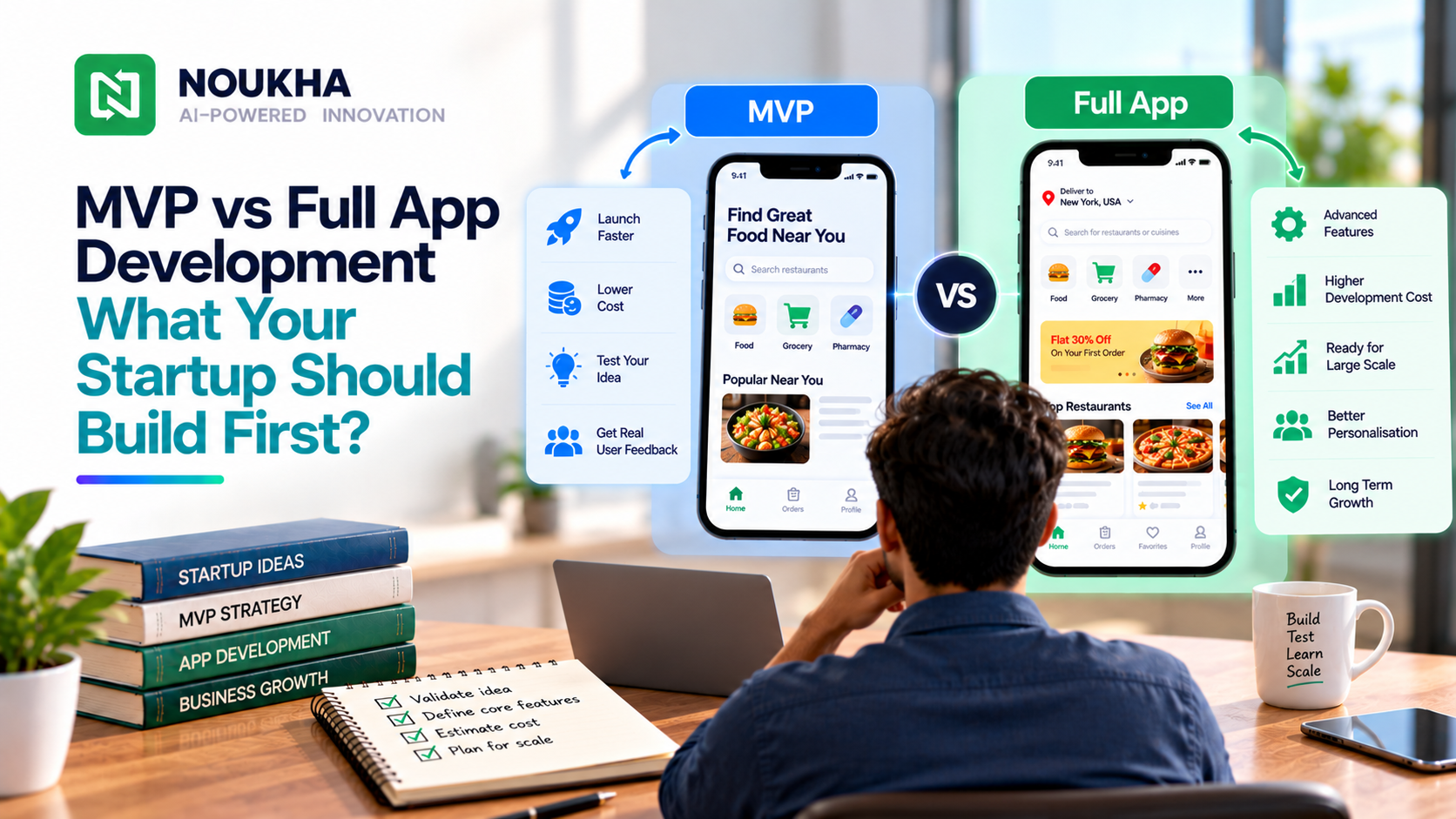
Should your startup begin with an MVP or invest in a more complete app? What is MVP vs full app development ? The answer depends on what you still need to learn and what customers need to use. If the core demand is uncertain, a focused minimum viable product can help you test it before funding a larger release. If customers already depend on an established workflow, the first version may need more functionality to be useful.
The right starting point is the smallest complete product that can serve its intended purpose. That might be an MVP, a prototype or a more substantial release. Your evidence should guide the choice.
What an MVP should accomplish
A minimum viable product gives real users enough functionality to experience the core value and gives the business useful evidence about demand. It needs a specific question to answer.
For a booking startup, that question might be whether a defined group of customers will request a service and return when they need it again. The MVP should support that journey reliably. It may not need loyalty points, advanced recommendations or several payment options.
A prototype serves a different purpose. It can help test a design or explain a concept before building the working system. If your immediate question is whether users understand a new interface, a clickable prototype may provide the answer at a lower commitment than a production build.
Our US MVP development guide covers the broader process. Here, the focus is choosing the right first investment.
What people mean by a full app
“Full app” is not a precise scope. It usually means a product supporting more user roles, business processes, integrations and operational requirements. The important question is which of those capabilities are necessary for the intended launch.
An established distributor replacing an order management system may need customer accounts, contract pricing, stock availability and integration with existing records. Removing those features could make the product impossible to adopt. Calling the first version an MVP would not change that requirement.
Write down what a customer or employee must be able to complete on day one. Then distinguish those needs from functionality that improves convenience, supports expansion or remains speculative.
Compare the two approaches against your situation
| Decision | A focused MVP may fit | A broader initial release may fit |
| Demand | The main customer assumption is untested | Existing customers already need the workflow |
| Audience | One narrow group can provide useful evidence | Several roles must participate from launch |
| Operations | Some work can be handled manually during a pilot | Manual work would disrupt essential operations |
| Integrations | A limited integration can test the core value | Existing systems are necessary to deliver the service |
These are prompts for a decision, not automatic rules. A new product can still have demanding operational requirements. An established business can still test one narrow improvement before replacing a larger system.
Compare costs using the same assumptions
An MVP usually reduces the amount of work being commissioned, but the saving depends on what is removed. Cutting a secondary dashboard differs from removing a difficult integration that the core product still requires.
Consider a hypothetical estimate at an assumed blended rate of USD 40 per hour. A focused release estimated at 500 hours would cost USD 20,000. An expanded version estimated at 1,000 hours would cost USD 40,000. These figures illustrate scope arithmetic; they are not market benchmarks, delivery promises or Noukha prices.
The second version may still be worth the investment if its additional capabilities are necessary for adoption. Equally, paying for unused features does not make an untested idea safer.
Ask the development team to show which features create the difference in effort. Separate build costs from hosting, third-party services and post-launch work. Use the same assumptions when comparing proposals.
Reduce scope without breaking the customer journey
Start with one target user and the outcome that matters to them. Map the steps needed to reach that outcome and identify dependencies. A feature belongs in the first release when removing it prevents the journey from working or prevents the business from testing its main assumption.
For a tutoring marketplace, a first release might let a parent submit a request, an operator arrange a suitable tutor and both parties confirm the session. Automated matching could come later if manual coordination still allows the team to test demand.
That approach does not justify leaving customers confused about the status of their requests. Confirmation, cancellation and a way to get help may be essential even in a small pilot. Minimal scope should still produce a coherent experience.
Keep reliability appropriate to the task
An MVP can have fewer features while still requiring careful testing, access controls and recovery from failures. The level of work depends on what the product does and what could happen when it fails.
If the app accepts payment, the team needs to handle failure and confirmation correctly. If it stores customer information, it needs suitable controls over who can access it. These requirements should be included in the first-release scope rather than deferred because the product is described as experimental.
Discuss the expected audience, usage and operating conditions. This helps the team choose a practical architecture without building for imagined scale that may never arrive.
Decide what the pilot must prove
Choose measures before launching. For a booking app, track qualified requests, confirmed bookings, completed services and repeat use at an appropriate interval. For an internal tool, compare task completion and the amount of manual correction required.
Signups are useful context, but they do not establish that people receive the intended value. Ask why users stop, which tasks require help and whether customers accept the proposed commercial terms.
Agree on the next decision. You might expand when a defined group repeatedly completes the core workflow, improve onboarding when setup blocks use, or reconsider the audience when users do not need the outcome. A pilot should make one of those decisions easier.
Plan the move beyond the first release
Ask how the proposed implementation supports likely next steps. That does not mean building every future feature now. It means understanding which choices are easy to extend and which may require replacement.
A deliberately temporary prototype can be the right tool for learning, provided everyone understands that it may not become the production application. A working MVP intended to grow needs a different discussion about maintainability, documentation and ownership.
The Agile Manifesto’s principles support early delivery of useful working software and simplicity. In practice, that means investing in the next valuable step and reviewing what the result teaches you.
Frequently asked questions
Should every startup begin with an MVP
No. Begin with the cheapest appropriate way to resolve the important uncertainty. That could be interviews, a prototype, a manual service or a working MVP. Some launches require a broader product to function.
Is an MVP the same as a low-quality app
No. It has a limited scope. The included workflow should still meet agreed usability, reliability and security requirements.
Will we have to rebuild the MVP
That depends on how it was designed and what the product becomes. Ask which parts are intended for continued use and which are temporary before approving development.
How do we stop the MVP from growing during development
Agree on the core hypothesis, first-release journey and acceptance criteria. Review new requests against those decisions and keep a separate backlog for later work.
Choose the first release with Noukha
Bring your target customer, core workflow and the question you need the product to answer. Discuss MVP development with Noukha to define a first release that fits the evidence and the available budget.