
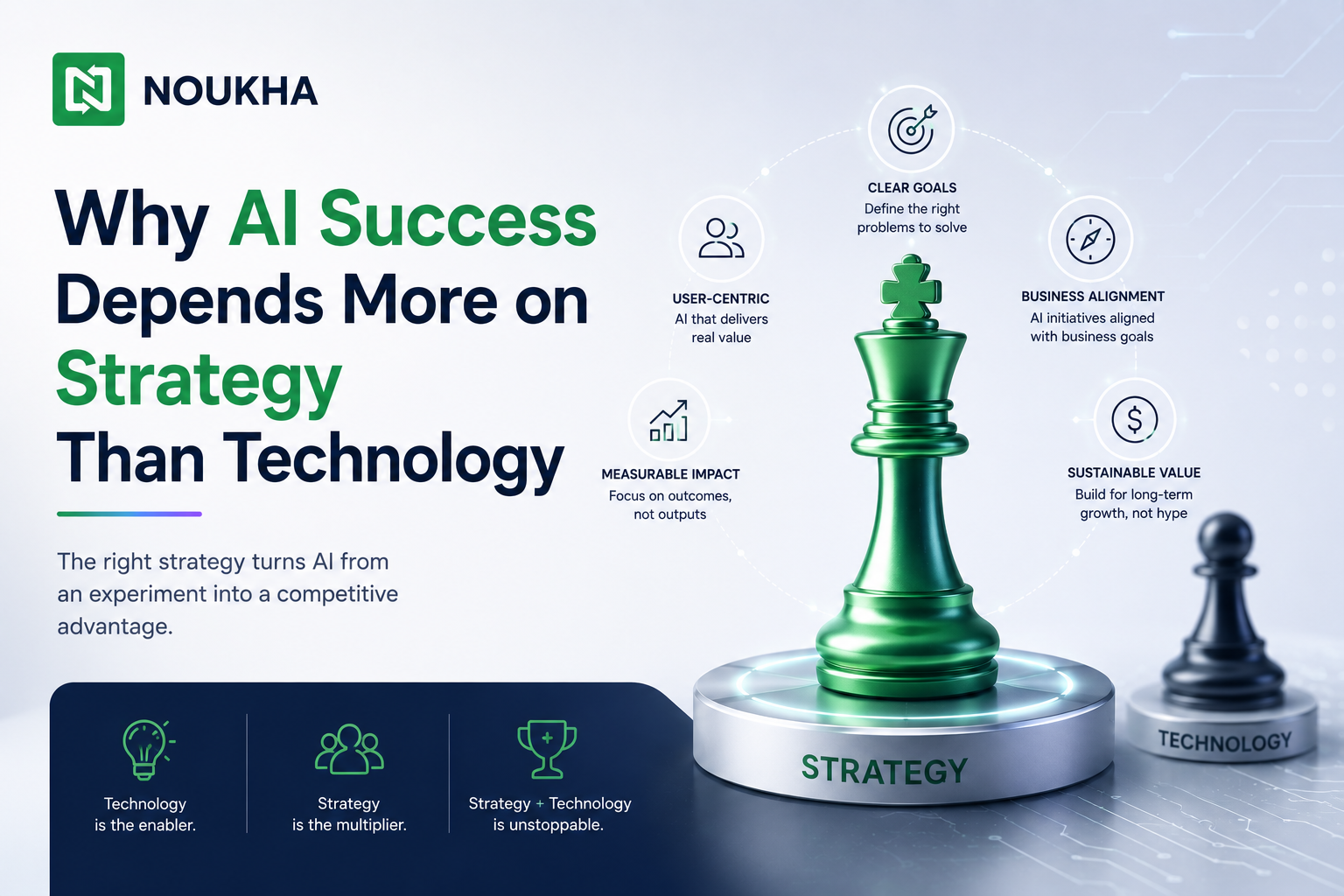
Most companies now have access to essentially the same AI models, the same cloud infrastructure, and the same off-the-shelf tools. Yet a large majority of enterprise AI initiatives still fail to deliver measurable business value. That gap is rarely about which model a company chose. It is almost always about whether the project was built around a clear business outcome in the first place. Businesses working with experienced AI app developers in the USA to ground projects in strategy before writing a single line of code tend to see very different results than those who start with the technology itself.
Why So Many Enterprise AI Projects Fail
The Numbers Are Worse Than Most Leaders Realize
Independent research points to a consistent and uncomfortable pattern. RAND Corporation estimates that as many as 80 percent of enterprise AI initiatives fail to deliver their intended business value, close to twice the failure rate of conventional software projects. MIT’s Project NANDA found that many generative AI pilots had yet to produce measurable financial returns, with only a small percentage demonstrating clear impact on profit and loss. Separate research from S&P Global found that a large share of companies abandoned most of their AI proof of concepts before they ever reached production, and only a relatively small share of AI initiatives progressed from proof of concept into production. These are not isolated or fringe findings. They come from some of the most established research organizations covering enterprise technology, and they consistently point in the same direction.
The Common Thread Behind Every Failure
When researchers dig into why these projects stall, the model itself is rarely the culprit. An analysis of more than a hundred enterprise AI implementations found that only about a quarter of failures traced back to model performance or integration complexity. The remaining majority came down to strategy, governance, and change management, all of which are parts of a project that have nothing to do with which large language model sits underneath it. In practice, most enterprise AI failure looks like an implementation problem rather than a science problem, which is exactly why simply upgrading the technology rarely solves it.
Why AI App Developers in the USA Start With Strategy, Not Technology
Businesses that work with experienced AI app development teams in the USA typically begin with a business strategy before selecting technologies, models, or development frameworks. That approach consistently leads to stronger adoption and measurable business outcomes.
What AI Strategy Actually Means
An AI strategy starts with a specific business problem, not a specific tool. It defines what success looks like in measurable terms before development begins. It identifies which workflow the AI is meant to change, and sets expectations for how that change will be adopted by the people actually doing the work. Without that foundation, a technically impressive pilot has nothing solid to be judged against once it leaves the demo environment.
Redesigning Workflows Before Selecting Tools
Research from McKinsey has found that organizations which redesign a workflow before selecting an AI tool are considerably more likely to report meaningful financial returns than those that select a tool first and adapt the workflow around it afterward. This ordering matters more than it sounds. Working with an established AI application development partner early in that redesign process tends to surface the real constraints of a workflow long before expensive development work begins.
Why Technology Alone Cannot Fix a Strategy Problem
Model Quality Is Rarely the Real Bottleneck
It is tempting to assume a failed AI project needs a better model, a bigger context window, or a newer version of whatever tool was used. In practice, swapping the underlying model rarely fixes a project that was scoped around a vague goal or built without input from the people who would actually use it every day. Technology can only execute a strategy that already exists. It cannot invent one. Teams that continually chase the newest model release instead of fixing an unclear business case tend to end up with a technically newer version of the same stalled project.
The Data Foundation Problem
AI systems depend on data that is clean, accessible, and current. Organizations with fragmented systems or inconsistent governance often spend far more time preparing and reconciling data than they spend generating any actual insight from it. Research comparing data investment strategies has found that organizations investing in proper data integration report dramatically higher returns than organizations working with poorly connected data, which makes data readiness a strategic decision rather than a purely technical one. A well designed AI strategy accounts for this upfront instead of discovering it midway through development.
Specialized Partners Outperform Generic Builds
MIT’s NANDA research also found a striking gap in outcomes based on how a company builds its AI capability. Companies that partnered with specialized AI engineering teams succeeded roughly twice as often as companies that attempted the same kind of build purely in-house using generic models with no outside expertise. Generic AI tools often work well for individual users precisely because they are flexible, but that same flexibility becomes a liability inside an enterprise workflow that needs the tool to behave consistently and predictably.
Building an AI Strategy That Actually Works
Define Success Metrics Before Development Begins
A recurring pattern among the minority of AI projects that do succeed is a clear, agreed-upon definition of success before any development work starts. Research has found that a majority of companies fail to define or monitor the financial metrics tied to their AI investments at all, which makes it nearly impossible to tell the difference between a project that is genuinely working and one that simply looks impressive in a demo.
Treat AI as Workflow Transformation, Not a Tool Rollout
AI does not simply change the software a team uses. It reshapes processes, responsibilities, and in some cases entire job functions. Without deliberate communication, training, and a phased rollout, teams tend to resist the change, and that resistance shows up later as an AI project that technically works but never actually gets adopted.
Executive Sponsorship and Change Management
Several of the studies on enterprise AI failure point to fading executive sponsorship as a recurring cause of stalled projects. When a project has no clear executive owner tying it to a business outcome, it tends to become the first initiative cut when budgets tighten, regardless of how promising the underlying technology actually was.
What This Means for U.S. Businesses
Hyperscalers are pouring enormous sums into AI infrastructure, and nearly every major U.S. business is now buying into AI in some form. Very few of them, however, can clearly demonstrate that the investment is working. For a growing number of U.S. businesses, the differentiator in 2026 is not access to a more advanced model. It is the discipline to define a business outcome first, build the right workflow around it, and measure whether it actually delivered before scaling it further.
Getting the Strategy Right From the Start
Most businesses do not need to abandon an AI initiative that has stalled. They need to step back and rebuild the strategy underneath it, starting with a clearly defined business problem and a realistic view of the data and workflow changes required to solve it. An experienced custom AI app development team brought in early tends to shorten that process considerably compared with rebuilding a strategy after a pilot has already failed.
Conclusion
AI models will keep improving, but better technology alone will not fix a project that was never built around a clear business outcome. The businesses seeing real returns from AI in 2026 are the ones treating it as a strategic transformation supported by technology, not a technology rollout that strategy gets added to later. If your organization wants to build an AI initiative around strategy from the start, contact us to discuss how we can help build that strategy from day one.
Frequently Asked Questions
Why do most enterprise AI projects fail?
Research from RAND, MIT, and other organizations consistently points to strategy, governance, and change management as the main causes of failure, not the underlying AI model. Vague success metrics, weak data foundations, and fading executive sponsorship show up far more often than technical limitations.
Does a better AI model fix a failing AI project?
In most cases, no. Studies analyzing enterprise AI failures have found that only a small share trace back to model performance or integration complexity. A stronger model cannot compensate for an unclear business goal or a workflow that was never redesigned around how the tool would actually be used.
What does it mean to redesign a workflow before selecting an AI tool?
It means mapping out how a task or process actually happens today, identifying where it breaks down or wastes time, and only then deciding which AI tool or model fits that redesigned process, rather than picking a tool first and forcing the workflow to adapt around it.
How important is data quality to AI success?
Very important. AI systems depend on data that is accurate, accessible, and current. Organizations with fragmented or poorly governed data often spend more time cleaning and reconciling that data than they spend generating useful insight from it, which delays or undermines returns.
Should a business build AI capability in-house or work with a specialized partner?
Research suggests that companies partnering with specialized AI engineering teams succeed considerably more often than companies attempting comparable projects purely in-house with generic models. The right choice depends on internal expertise and the complexity of the workflow being automated, but specialized experience tends to reduce the risk of a stalled project.
How can a business measure whether its AI investment is actually working?
Success should be defined in specific, measurable terms before development begins, tied to a real business outcome such as cost reduction, revenue growth, or time saved. Monitoring those metrics after launch, rather than assuming success from a positive pilot demo, is what separates AI investments that scale from those that quietly get abandoned.