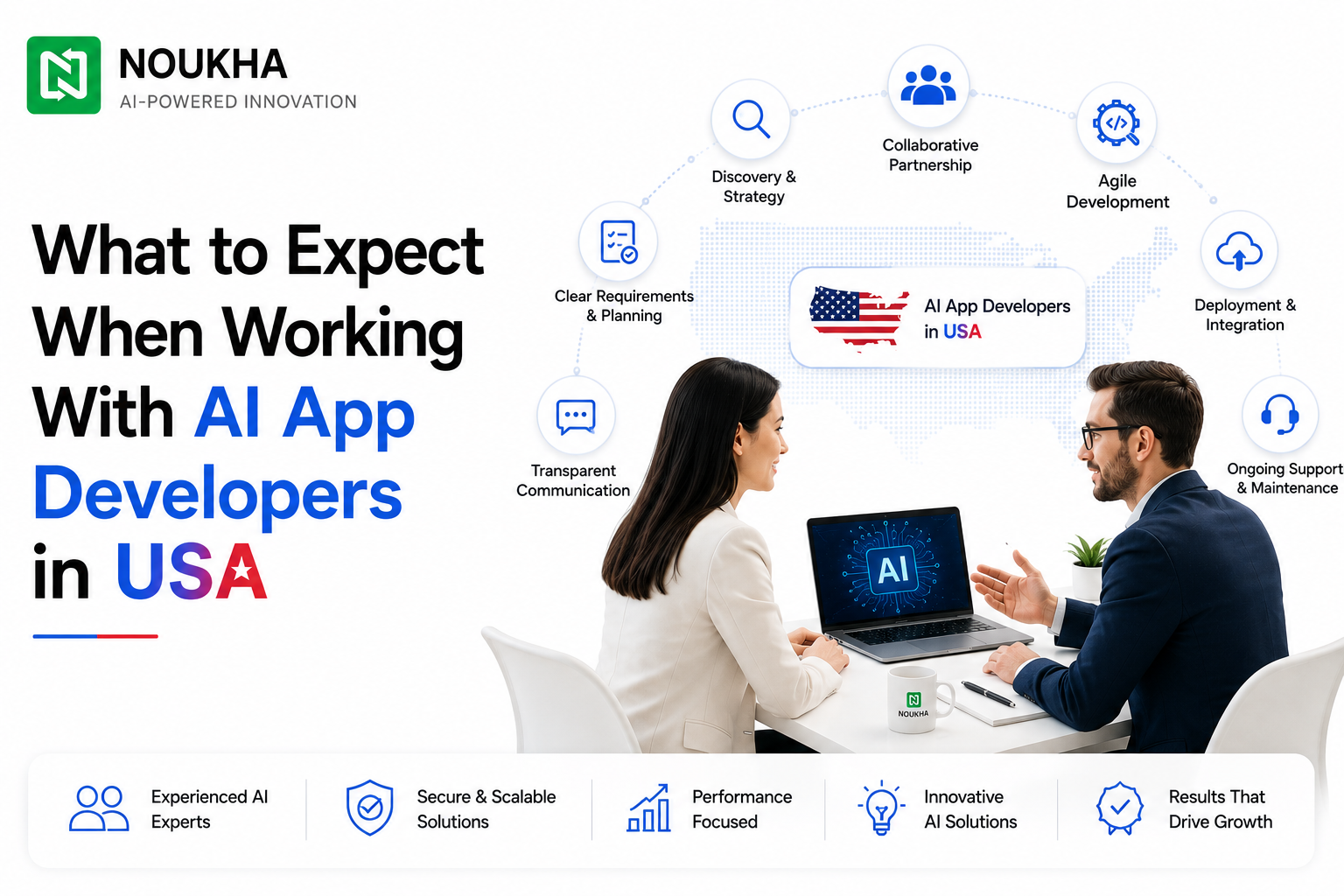
Bringing an AI feature into a product is not the same job as building a standard app. It involves data pipelines, model selection, accuracy testing, and tuning that continues well after launch. If you are getting ready to hire AI app developers in USA for the first time, knowing what the engagement actually looks like will help you set a realistic budget, pick the right partner, and avoid the confusion that derails many first-time AI projects. This guide walks through the planning phase, the build process, typical costs, and the working relationship a serious team should offer.
What AI App Development Actually Involves
A regular app follows fixed rules that a developer writes in advance. An AI-powered app can behave differently from traditional rule-based software, since its output may depend on models, training data, prompts, and probabilistic inference rather than a fixed set of instructions. Some applications also continue to improve over time as they are retrained or fine-tuned, though not every AI feature learns continuously from user interaction. This distinction changes the entire project structure.
Instead of moving straight from design to code, a competent team spends real time on data collection, model selection, and accuracy benchmarking before a single screen is built. Skipping this step is one of the most common reasons AI projects run over budget or fail to launch.
The Discovery and Planning Phase
Every serious engagement starts with discovery. This phase usually runs two to four weeks and produces a technical brief, not working software.
Defining the Business Problem
The team will ask what specific task the AI needs to handle. Product recommendations, document summarization, fraud detection, and customer support automation all require different models and different data. A vague goal like “add AI to our app” is a warning sign that the project has not been scoped properly yet.
Checking Data Readiness
Data preparation can consume a substantial share of project effort, particularly in data-heavy machine learning projects. Before any model work begins, the team reviews what data is available, how clean it is, and whether it needs to be labeled or restructured. Businesses that skip this check are usually the ones surprised by delays later in the project.
Choosing Between Pre-Trained and Custom Models
Not every project needs a model built from scratch. Many business problems, such as summarization or basic classification, can be addressed using existing pre-trained models, sometimes combined with retrieval, prompt engineering, or fine-tuning on business-specific data. Custom model training is usually reserved for cases where the problem is highly specific to your industry or where existing models consistently underperform on your data. A good team will tell you honestly which route fits your situation instead of defaulting to the more expensive option.
Assembling the Right Team With AI App Developers in USA
Complex production AI applications usually require multiple areas of expertise, even when a small team handles several roles at once. When you work with an experienced ai app developers usa team, the group involved will typically cover a wider range of skills than a single generalist developer could reasonably provide on a large build.
Roles You Should Expect to See
For more complex projects, expect the team to cover distinct areas of expertise, even if some team members handle multiple roles. A solution architect decides the overall infrastructure and whether the app relies on cloud APIs or on-device processing. A data scientist or machine learning engineer prepares the data and works on model selection or fine-tuning. A mobile or backend developer builds the interface and connects it to the AI layer. A QA specialist tests the system against edge cases the model was not trained on.
Why Team Structure Matters
Projects that assign all of this to one or two generalists on a large build tend to move faster at first and then stall once the model needs retraining or the data pipeline breaks. Clear coverage of these areas, whether by separate people or a small team wearing multiple hats, is one of the more reliable signs of a mature development process.
The Build Process Step by Step
Most engagements follow a similar sequence, even when the specific technology stack differs.
Prototype
A narrow version of the feature is often built first and tested against a defined evaluation set. This step can help validate the approach before the business commits to the full build, and it is not always required, particularly when the architecture and technology are already well established. Failure patterns are easier to document here than to discover in production.
Full Application Build
Once the approach is validated, the team builds the complete application, including integrations, error handling, and the user interface. Accuracy benchmarks are re-checked at each milestone rather than only at the end.
Testing and Handoff
The finished app is tested against real-world inputs and edge cases the model has not seen before. Documentation is written, the internal team is trained, and monitoring is set up so accuracy can be tracked after release.
Cost and Timeline Expectations
Timelines and budgets vary widely depending on complexity, but a few general ranges hold true across most engagements.
Typical MVP Timeline
A focused single-feature MVP can often be delivered in roughly eight to twelve weeks, assuming the data, integrations, and requirements are relatively straightforward. Projects involving custom model development, extensive data preparation, or multiple system integrations may require considerably longer timelines.
Typical Cost Range
Costs for a contained AI integration commonly start in the tens of thousands of dollars, while a full custom application with ongoing evaluation and support can run considerably higher. Price should always be discussed alongside scope, since a lower quote often means fewer testing cycles rather than better value.
What Affects Pricing
Several factors push costs up or down within these ranges. The number of integrations with existing systems, the need for custom model training versus fine-tuning an existing model, data labeling requirements, and the level of post-launch support all shape the final number. Two proposals for what looks like the same feature can differ significantly once these details are accounted for, so it helps to ask for an itemized quote rather than a single total.
Communication You Should Expect
Reliable partners communicate on a fixed schedule, not only when there is a problem. Weekly or biweekly progress updates, shared access to a project tracker, and a single point of contact are standard practice among established teams. For teams working across time zones, overlapping working hours can make feedback loops faster and reduce delays around technical decisions, which is one reason some businesses choose an ai application development company usa when close, real-time coordination matters for a project.
Common Mistakes That Slow AI Projects Down
Several patterns show up repeatedly in projects that run behind schedule. Businesses sometimes commit to a full build before validating the concept with a prototype. Others underestimate how much time data cleanup will take, or choose a vendor based on price alone without checking whether the team has handled AI-specific work before, not just general app development. A polished pitch is not the same as a proven delivery process, so asking to see a live AI feature the team has previously built is a reasonable and common request.
Industries Where This Approach Applies
The discovery-first, team-based approach described above holds regardless of industry, though the specific use cases differ. Retail businesses commonly use AI for product recommendations and demand forecasting. Healthcare organizations use AI for applications such as medical image analysis and clinical decision support, subject to applicable regulatory, safety, and oversight requirements. Financial services rely on it for fraud detection and risk scoring. Logistics companies use it for route optimization and inventory prediction. In every case, the underlying process of defining the problem, checking data readiness, and validating the approach before full development stays the same, even though the models and regulations involved vary.
What Happens After Launch
Launching the app is not the end of the relationship. AI systems can drift in performance over time as user behavior or input patterns change, so ongoing monitoring is necessary to catch accuracy drops early. A dependable partner will offer ongoing monitoring, security updates, performance reviews, and a clear process for model or system updates when performance changes, rather than treating the app as a finished, static product. Ask upfront how support is structured and what triggers a model update, since this is often left out of the initial proposal.
Frequently Asked Questions
How long does it take to build an AI app?
A focused MVP can often be delivered in roughly eight to twelve weeks. Larger builds involving custom model development or multiple integrations can take considerably longer, depending on data readiness and feature complexity.
Do I need technical knowledge to work with an AI development team?
No. A capable team will explain the process in plain terms and handle the technical execution. What matters most on your side is a clear definition of the business problem and measurable success criteria.
How much does AI app development cost?
Costs depend heavily on scope. A narrow integration into an existing app costs less than a fully custom application with proprietary model training, ongoing evaluation, and ongoing support. Always request a breakdown by phase rather than a single lump figure.
What is the biggest risk in an AI app project?
Poor data quality is a common cause of delays and disappointing results, particularly in data-dependent AI projects, though unclear objectives, integration complexity, and unrealistic expectations can also derail a build. Reviewing data readiness and project goals during discovery, before any model work starts, reduces this risk significantly.
Should I choose a local team or an offshore vendor?
Both can deliver good results. Overlapping working hours tend to speed up feedback cycles and reduce miscommunication, which is why some businesses lean toward a domestic partner for time-sensitive projects, while others successfully manage offshore teams with strong documentation and scheduled overlap.
Final Thoughts
Working with the right partner turns AI app development from a confusing experiment into a structured, predictable process. Understanding the discovery phase, the team roles involved, realistic timelines, and what support looks like after launch puts you in a far stronger position to evaluate proposals and avoid costly surprises. If you are ready to scope your project with an experienced team, contact us and we will walk you through the next steps.