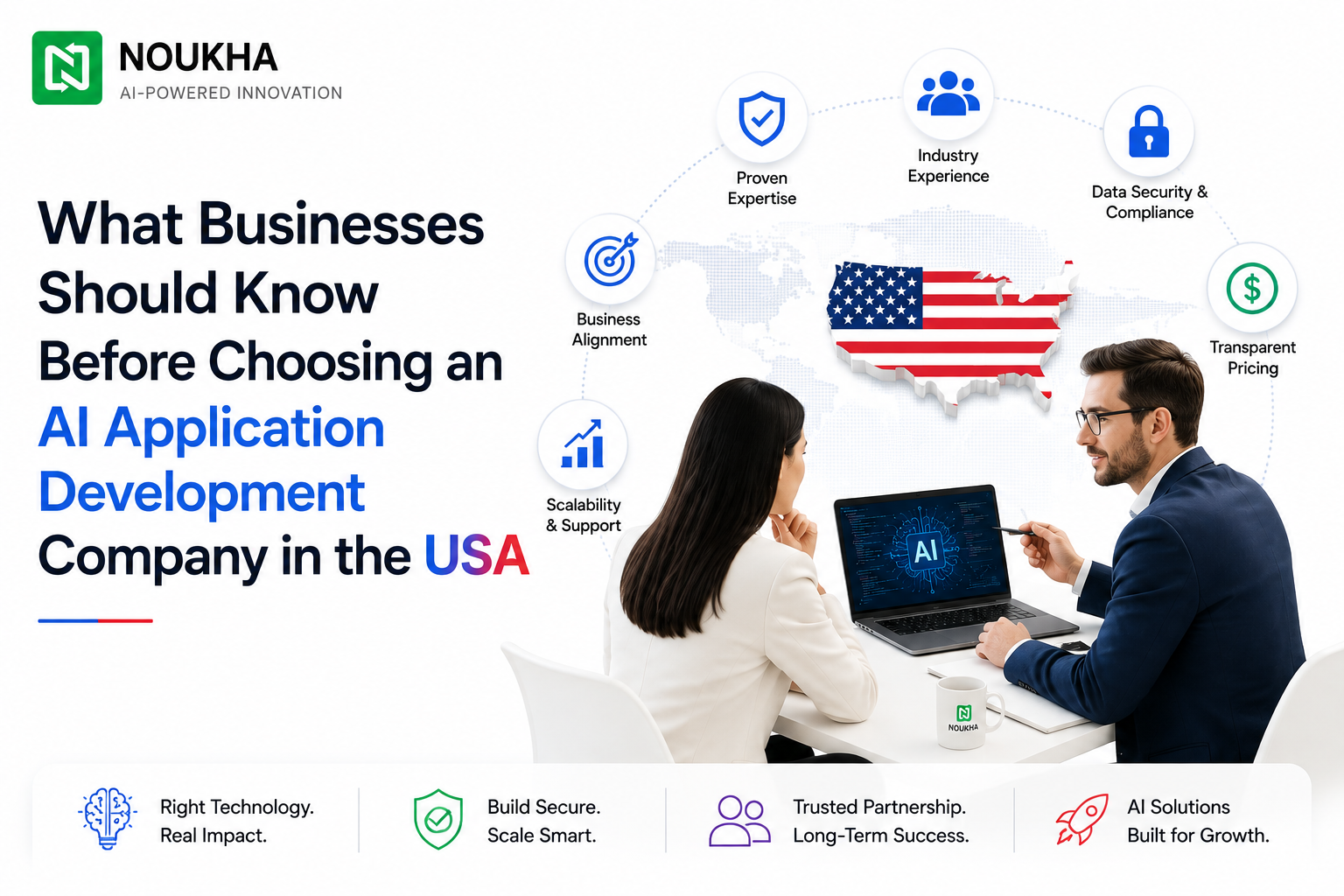
Artificial intelligence has moved from an experimental technology to an increasingly important business capability. Companies across healthcare, finance, retail, and logistics are now building custom AI applications to automate workflows, personalize customer experiences, and support faster decision making. Not every technology vendor can deliver these results with the same level of reliability. Businesses that want measurable outcomes need to work with experienced AI application development company in USA who understand both the technical and regulatory landscape. Choosing the wrong partner can lead to delayed timelines, security gaps, and wasted budgets, so understanding what separates a capable development team from an average one matters before any contract is signed.
Why the Right AI Development Partner Matters
Hiring an AI development partner is not the same as hiring a general software vendor. AI projects can involve data preparation, model selection or training, evaluation, integration, and ongoing refinement after launch, which means the relationship often extends well beyond the initial build. A team that only writes code without understanding data quality, evaluation, or model monitoring will struggle to deliver an application that performs reliably in a live environment. Businesses that invest time in vetting a partner upfront tend to avoid costly rework later.
The market for AI talent has also grown crowded. Many agencies now advertise AI services after adding a chatbot template or a basic recommendation widget to their portfolio, without the deeper machine learning background needed for more complex work. This makes due diligence more important than it was even a few years ago, since a polished website or a long list of past clients does not always reflect real technical capability.
Key Factors to Evaluate Before Hiring
Technical Expertise and Domain Experience
Technical depth is the first thing to verify. A development team should be able to explain, in plain language, how they approach model selection, data pipelines, and integration with existing business systems. Ask for examples of past projects that resemble your use case rather than general claims of expertise.
It is also worth asking how a vendor evaluates AI output before and after launch. A serious team should be able to discuss how it measures accuracy, relevance, and reliability, how it checks for hallucinations or bias where applicable, and how it tests for regressions after a model, prompt, or data source is changed. Ongoing evaluation is one of the clearer signs of a mature AI development process.
Machine Learning and Natural Language Processing Capabilities
Modern AI applications can combine machine learning, natural language processing, computer vision, generative AI, or other techniques depending on the use case. A partner should be able to describe which of these techniques applies to your project and why, along with realistic expectations about accuracy and development time.
Industry Specific Knowledge
A healthcare application has different requirements than a retail recommendation engine or a logistics optimization tool. Vendors familiar with your industry’s workflows and compliance requirements typically reduce the learning curve and produce more relevant solutions faster.
Data Privacy and Regulatory Compliance
AI systems are only as trustworthy as the data practices behind them. Businesses operating in the United States should determine which privacy and sector-specific requirements apply to their data and operations, including HIPAA for applicable healthcare information and the CCPA for businesses that meet its applicability criteria, such as revenue and data volume thresholds. Ask about encryption standards, access controls, and whether the company has undergone independent security audits such as SOC 2. These details are often overlooked during early conversations but become critical once an application handles real user data.
It also helps to ask where data is stored and processed, since some AI workloads run on third-party cloud infrastructure that may fall under different jurisdictions. A vendor that can clearly map out its data flow, from collection to model use to storage, is generally better prepared to handle an audit or a client’s own compliance review.
Businesses can also ask whether a vendor follows established AI risk management practices, such as those outlined in the NIST AI Risk Management Framework, to evaluate security, privacy, reliability, bias, and other risks throughout the AI lifecycle. This is not a legal requirement for most companies, but it signals a more disciplined and repeatable development process.
Engagement Models and Pricing Transparency
AI development costs vary based on project scope, the complexity of the models involved, and infrastructure needs. A transparent partner will break down pricing by phase, whether that is discovery, prototyping, development, or deployment, instead of offering a single vague quote. Fixed-price, time and materials, and dedicated team models each carry different risk levels, so it helps to understand which structure fits your budget and how flexible timelines are before committing.
Post Launch Support and Scalability
AI applications require ongoing monitoring after launch. Model or system performance can change as user behavior, data patterns, or underlying models change, so ongoing evaluation and monitoring help identify these shifts early. The appropriate response may involve retraining, fine-tuning, updating retrieval data, changing prompts, or adjusting the system architecture, depending on what is causing the change. Ask how a vendor handles updates, bug fixes, and scaling infrastructure as usage grows. A team that provides little post-launch support can leave a business without the expertise needed to monitor performance, address security issues, and scale the application as requirements change.
Scalability planning matters just as much as day-to-day maintenance. An application built for a few hundred users can behave very differently once it serves thousands, so ask how the architecture handles increased load, additional data volume, and new feature requests. Vendors who plan for growth from the start typically avoid costly redesigns later.
Questions Every Business Should Ask Before Signing a Contract
Before finalizing a vendor, ask for a technical discovery session, architecture proposal, or, where appropriate, a prototype or proof of concept, and speak directly with the engineers who will build the product rather than only account managers. A capable AI application development company in the USA will be transparent about model limitations, realistic timelines, and data requirements from the first conversation, instead of promising outcomes that sound too polished to be true.
Ownership of Code and Intellectual Property
Clarify who owns the source code, trained models, and any proprietary datasets created during the engagement. Also clarify ownership or licensing rights for prompts, fine-tuning artifacts, embeddings, evaluation datasets, and other project-specific assets where relevant, since determining who owns an AI system is often more complicated than simply owning the source code. This should be defined clearly in the contract, since disputes over intellectual property can be difficult and expensive to resolve after a project is already underway. It is also worth confirming whether any third-party libraries, pre-trained models, or open source components are used, since licensing terms for those components can affect how freely you are able to use or resell the final application.
Team Structure and Communication
Understand whether you will work with a dedicated team or a rotating pool of developers, and how often you can expect progress updates. Regular demos, sprint reviews, and a single point of contact generally lead to smoother collaboration and fewer misunderstandings about project direction.
Communication Across Time Zones and Teams
Even domestic teams often collaborate with distributed engineers, so it helps to confirm working hours, preferred communication tools, and how quickly the team responds to blockers. Clear expectations here prevent small delays from turning into missed milestones.
Common Mistakes Businesses Make When Choosing a Vendor
- Selecting a vendor based on the lowest quote without checking technical depth or past results.
- Skipping a technical interview or code review before signing a long-term contract.
- Overlooking data governance and compliance requirements until after development begins.
- Failing to clarify maintenance, monitoring, and support terms once the application goes live.
- Assuming every AI vendor has the same level of experience across industries and use cases.
How to Evaluate Portfolios and Case Studies
Reviewing completed projects from established AI app development companies in USA gives a clearer picture of practical experience than marketing claims alone. Look for measurable outcomes such as reduced processing time, improved accuracy, or cost savings, and ask for references you can speak with directly. A portfolio that spans multiple industries with consistent results is generally a stronger signal than a single flagship project.
Conclusion
Choosing an AI development partner is a decision that affects both the short-term success of a single application and the long-term technology direction of a business. Evaluating technical expertise, compliance practices, pricing transparency, and post-launch support before signing a contract helps avoid costly mistakes down the line. Businesses that take the time to ask the right questions and review real project outcomes are far more likely to end up with an application that performs as expected. If you are ready to discuss your project requirements in detail, contact us to speak with a team that can walk through timelines, pricing, and technical approach based on your specific goals.
Frequently Asked Questions
How long does it take to build a custom AI application?
Timelines vary considerably depending on scope, integrations, data readiness, model strategy, and testing requirements. A focused AI feature or minimum viable product may take a few weeks to a few months, while complex enterprise applications with custom model training or large-scale data integration can take considerably longer.
What is the average cost of AI app development in the USA?
Costs depend on project scope, the type of AI models used, and infrastructure requirements. A basic AI feature added to an existing application may cost less than building a full standalone AI platform from scratch. Requesting a detailed breakdown by project phase is the best way to get an accurate estimate.
Do I need a large dataset to start an AI project?
Not always. Some applications can start with relatively small business datasets by using existing foundation models, retrieval systems, or other pre-trained models. Traditional machine learning projects may require more project-specific training data, depending on the use case. A qualified vendor should be able to assess your existing data and recommend a realistic starting point.
How is data privacy handled during AI development?
A qualified vendor should be able to explain how it protects data using measures such as encryption, access controls, secure development environments, and appropriate data handling procedures. Depending on your industry, they should also address relevant regulations such as HIPAA or the CCPA, where applicable, and be willing to sign data processing agreements before development begins.
What ongoing support should I expect after launch?
After deployment, most AI applications need ongoing evaluation and monitoring, along with bug fixes and infrastructure scaling as user demand grows. Depending on what monitoring reveals, a team may need to retrain a model, adjust prompts, update retrieval data, or make other changes to maintain performance. Clarify support terms and response times in the contract before the project starts, so expectations are aligned from the outset.