
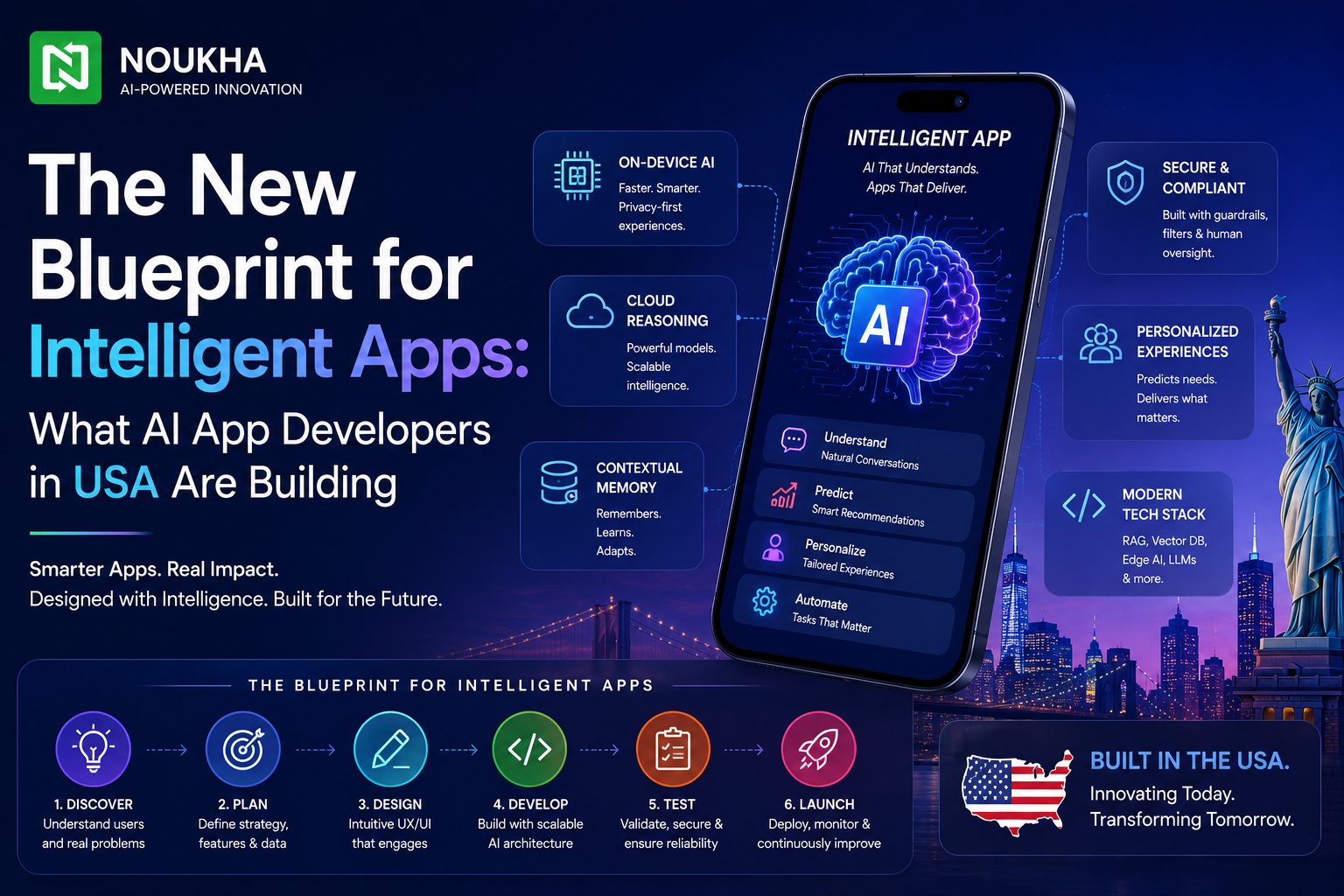
Mobile apps used to follow a fixed script – the same buttons, the same screens, the same responses, no matter who opened them. That model is fading fast. A new generation of AI App developers in USA is building apps that observe, learn, and respond in ways that feel closer to a conversation than a checklist. Instead of bolting a chatbot onto an existing product, teams are now designing intelligence into the app’s core from the very first architecture decision.
This shift isn’t hype. It’s a practical response to what users now expect: faster answers, fewer taps, and software that adapts to their habits instead of forcing them to adapt to it. Here’s what that blueprint actually looks like in 2026.
Why “Adding AI” Isn’t the Same as Building an Intelligent App
Plenty of apps advertise AI features that amount to a single search bar with a language model behind it. A genuinely intelligent app is different – the model influences navigation, content ordering, notifications, and even error handling, not just one isolated screen.
Builders who understand this distinction design intelligence as infrastructure, not decoration, which is why the planning phase now looks noticeably different from a traditional app build.
The Core Layers of an Intelligent App in 2026
Most modern AI-driven apps are structured around four working layers that sit on top of the usual frontend and backend.
On-Device Intelligence
Lightweight models now run directly on the phone for tasks like text prediction, image recognition, and voice commands. This reduces latency, cuts server costs, and keeps sensitive data on the device instead of sending it to the cloud for every request.
Cloud-Based Reasoning
Heavier reasoning tasks – summarising documents, generating recommendations, or handling multi-step requests – are routed to cloud-hosted large language models. The app decides in real time which tasks stay local and which go to the cloud, balancing speed against capability.
Contextual Memory
Rather than treating every session as brand new, intelligent apps retain relevant context – past orders, preferences, or previous questions – so responses feel continuous instead of repetitive.
Guardrails and Human Oversight
Confidence scoring, content filters, and clear escalation paths to a human are now standard, especially in finance, healthcare, and other regulated categories where an unchecked automated response carries real risk.
Getting these four layers to work together without draining the battery or the budget is where experience matters most. Experienced AI app development professionals in the USA typically start by mapping which features genuinely need intelligence and which are better served by simple, predictable logic – a decision that shapes both cost and long-term maintainability.
What AI-Driven Apps Are Actually Solving for Users
Behind the technical layers, the real value shows up in everyday use cases users have started to expect as standard.
Predictive Personalisation
Shopping, fitness, and content apps increasingly anticipate what a user wants next – surfacing a reorder, a workout adjustment, or a relevant article – based on patterns rather than a fixed menu of choices.
Agentic Task Completion
A growing category of apps can carry out multi-step actions on a user’s behalf, such as rebooking a cancelled appointment or comparing prices across saved items, instead of simply displaying information and leaving the user to act on it.
Natural-Language Interfaces
Search bars are being replaced by conversational input where users describe what they need in plain language, and the app interprets intent instead of matching exact keywords.
Real-Time Accessibility Support
Live captioning, voice navigation, and automatic image descriptions are increasingly built in from the start, widening who can comfortably use an app rather than treating accessibility as an afterthought.
The Technology Stack Behind These Apps
The tools powering intelligent apps have matured considerably over the past two years.
Model Selection and Fine-Tuning
Rather than training models from scratch, most teams fine-tune existing foundation models on domain-specific data, which is faster, cheaper, and produces more reliable results for a narrow use case.
Vector Databases and Retrieval
Retrieval-augmented generation (RAG) pipelines pull relevant information from a company’s own data before generating a response, which keeps answers grounded in facts instead of relying purely on a model’s training data.
Edge Computing Frameworks
Frameworks such as Core ML and TensorFlow Lite let compact models run efficiently on iOS and Android hardware, an approach that continues to gain ground as phone processors add dedicated AI chips.
Data Privacy and Security: A Non-Negotiable Foundation
Intelligent apps handle more personal data than traditional ones, which raises the stakes on privacy considerably.
Compliance With Evolving US Regulations
State-level privacy laws continue to expand across the US, and apps handling health, financial, or location data must build compliance into the architecture rather than treating it as a launch-week checklist item.
Transparent Data Usage
Users are increasingly asking what data trains a model and how it’s stored. Clear, accessible privacy disclosures inside the app itself are becoming a trust signal, not just a legal requirement.
Privacy missteps are one of the fastest ways to lose user trust in an AI-powered product, which is why teams built around reliable AI app developers in USA tend to treat data governance as a design requirement from day one rather than a compliance task handled after the build is finished.
Common Mistakes When Building AI-Powered Apps
Not every AI feature adds value, and several recurring mistakes show up across failed or underused products.
Adding Intelligence Without a Clear Problem
Features built because a model is available, rather than because users asked for the outcome, tend to be abandoned within weeks of launch.
Ignoring Latency and Cost at Scale
A cloud-based model that feels fast in testing can become slow and expensive once thousands of users hit it simultaneously, making early load testing essential rather than optional.
Skipping Human Review for High-Stakes Decisions
Fully automated responses in areas like medical guidance or financial advice, without a review step, remain one of the biggest sources of user complaints and regulatory risk.
Frequently Asked Questions
What makes an app “AI-powered” rather than just having a chatbot?
An AI-powered app uses machine learning models to influence core functionality – personalisation, task automation, or decision support – throughout the product, rather than isolating intelligence to a single chat window.
How long does it take to build an AI-integrated app?
A focused MVP with one or two AI features typically takes 10 to 16 weeks, while apps involving custom model fine-tuning and multiple intelligent workflows can take four to eight months.
Is on-device AI better than cloud-based AI?
Neither is universally better. On-device models are faster and more private for lightweight tasks, while cloud-based models handle complex reasoning that phone hardware still can’t process efficiently on its own.
Do AI features increase app development cost significantly?
Costs depend on whether the team uses existing foundation models through an API or builds custom fine-tuned models. API-based integration is considerably more affordable than training proprietary models from scratch.
How is user data protected in AI-powered apps?
Reputable development teams apply encryption, data minimisation, and clear consent flows, and route only the data genuinely needed for a given task to any external model or server.
Final Thoughts: Intelligence Should Serve the User, Not Impress Them
The apps setting the standard in 2026 aren’t the ones with the most AI features – they’re the ones where intelligence quietly removes friction the user didn’t even realise they were dealing with. That takes careful architecture, honest data practices, and a willingness to leave a feature out when it doesn’t genuinely help.
Have an idea for an intelligent app? Contact us today to talk through your project and map out a realistic path from concept to a working product.